Please ensure Javascript is enabled for purposes of website accessibility.
Search
Search
Search

GIA 4Cs Diamond Blog

GIA 4Cs Diamond Blog

Diamond Color: Seven Things You Need to Know

If you’re shopping for a diamond engagement ring, you need to know about what diamond color is if you want to understand quality and how diamonds are valued. If you are curious about what colors diamonds come in and how color grade impacts value, check out our seven essential things about diamond color you should know.

In this blog we cover:

  1. Diamond value is based (in part) on the absence of color.
  2. A diamond’s color grade should be determined by a grading laboratory.
  3. Colored diamonds are graded and valued differently from colorless diamonds.
  4. Treatments can improve diamond color.
  5. Diamond fluorescence has little to no impact on diamond color.
  6. Engagement ring settings can influence the perception of diamond color.
  7. To be sure of a diamond’s color, get a GIA grading report.

1. Diamond value is based (in part) on the absence of color

Diamond color is important: Most diamonds used in engagement rings are near-colorless with hints of yellow or brown. All things being equal, the more colorless a diamond is, the rarer it is, and this rarity will be reflected in its price.

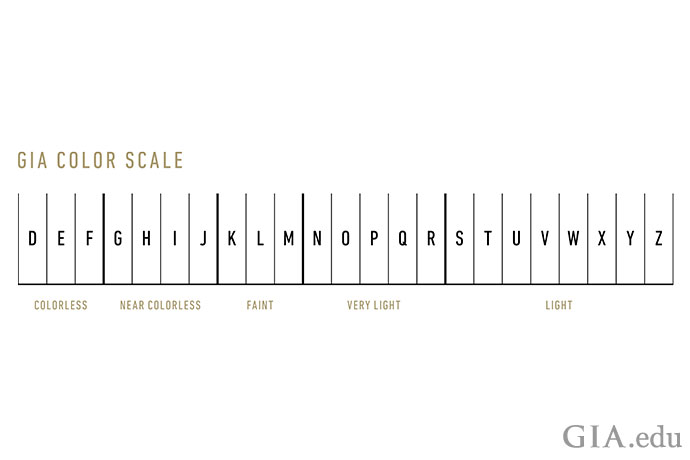
GIA D-to-Z diamond color scale.

The GIA D-to-Z Color Scale allows for precise measurement of diamond color. Illustration: GIA

GIA’s D-to-Z Color Scale is used to measure the degree of colorlessness of a diamond. The letter “D” represents a colorless diamond, with each following letter representing a diamond that has slightly more yellow or brown.

GIA organizes diamond color into five groups:

  • Colorless (D-F): The most rare, and therefore the most valuable
  • Near-colorless (G-J): Color is often unnoticeable except by trained graders
  • Faint (K-M): Color is still difficult to see by the untrained eye
  • Very Light (N-R): Subtle color can be seen in larger stones by an untrained eye
  • Light (S-Z): Color can be seen in stones of different sizes. The diamonds appear slightly yellow or brown but do not have sufficient color to be considered a “fancy” colored diamond
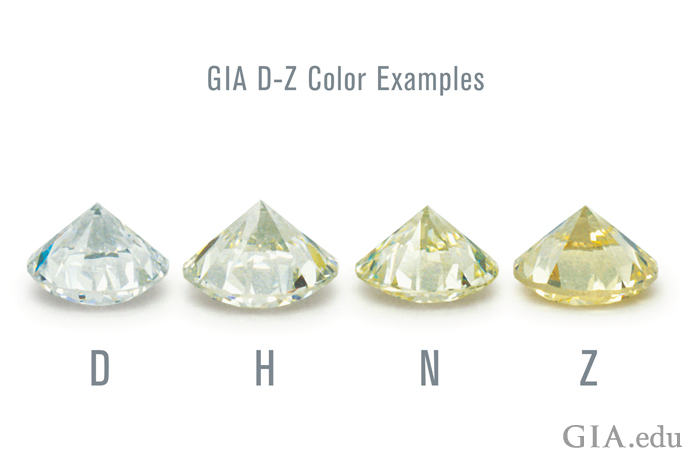
GIA D-to-Z diamond color scale showing diamonds at either end of the grading spectrum.

When diamonds at either end of the grading spectrum are placed side by side, it is easy to see the differences in diamond color. Photo: GIA

2. A diamond’s color grade should be determined by a grading laboratory

The distinctions between diamond color grades can be so subtle that they are undetectable to the untrained eye. But they do make a very big difference in diamond price. That’s why determining a diamond’s color grade is best left to a gemological laboratory, like GIA, that has the expertise and processes to ensure objective, unbiased color grading.

In working to evaluate what color a diamond is, GIA graders follow a strict protocol that dictates the type of lighting and neutral background used, as well as precisely how the diamond should be held and viewed during the assessment. A color grade is determined by comparing the diamond to masterstones – a set of color-comparison diamonds of known position on the GIA D-to-Z color grading scale – when all are placed table down in a grading tray. This viewing position reduces the complex appearance of a faceted colorless to near-colorless diamond when viewed face up.
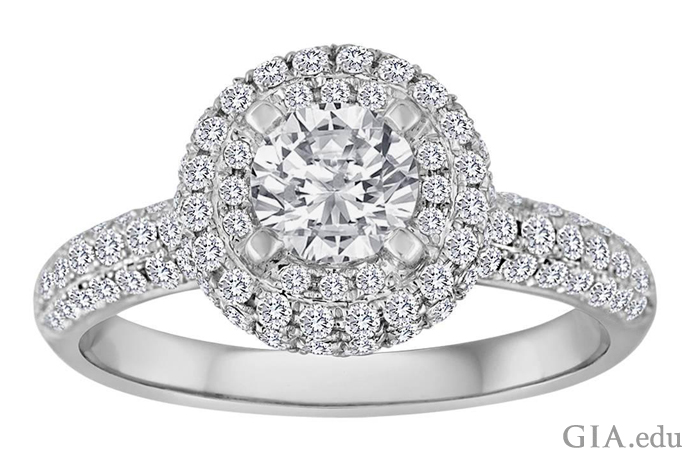
A 6.75 carat round brilliant cut diamond engagement ring featuring a diamond melee halo and band.

One look at this 6.75 carat (ct), F-color, SI-clarity round brilliant and you’ll know why diamonds are the universal symbol of love. Courtesy: 1stdibs.com

3. Colored diamonds are graded and valued differently from colorless diamonds

Diamond color is arguably the most important factor in colored diamonds. Some common colors that diamonds come in are yellow, brown, pink, red, blue, orange, purple, green, gray or black. This does not include diamonds in the normal color range that are slightly yellowish, slightly brownish or slightly grayish. When the color is natural, the diamonds are called fancy-color diamonds, fancy diamonds or fancies.
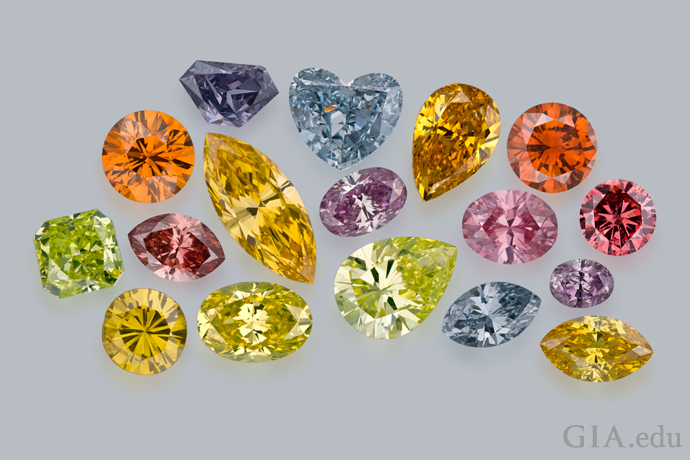
Colored diamonds come in a rainbow of hues.

Colored diamonds come in a rainbow of hues. Photo: Robert and Orasa Weldon/GIA

GIA grades colored diamonds differently from colorless diamonds. Unlike GIA’s D-to-Z grading system for colorless to light yellow diamonds, which is based on the absence of color when the diamond is viewed table down, the grading system for colored diamonds is based on the presence of color when the diamond is viewed face up. Terms used by GIA to describe colored diamonds include: Faint, Very Light, Light, Fancy Light, Fancy, Fancy Dark, Fancy Intense, Fancy Deep and Fancy Vivid.

What to look for in colored diamonds? In general, the more color a colored diamond has, the better. Fancy Deep and Fancy Vivid diamonds, for example, have more color than Fancy Light diamonds—and are usually more valuable. However, tone is also important: For example, a diamond that is extremely dark (Fancy Dark) may be less desirable than a lighter stone graded Fancy Intense.
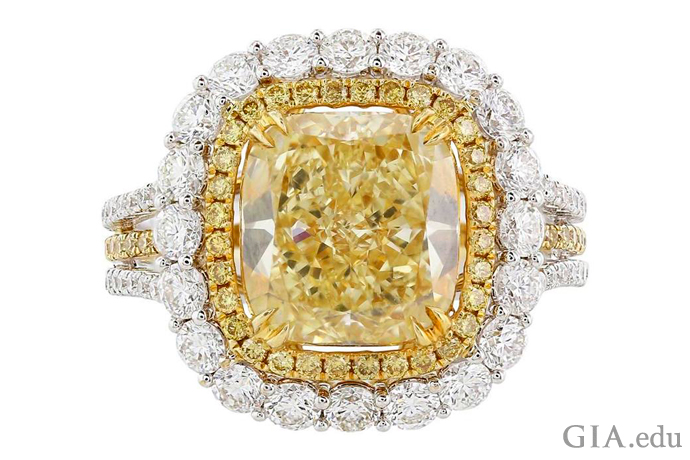
A 3.66 ct Fancy Yellow diamond engagement ring with two halos containing 0.37 carats of yellow diamonds and 1.50 carats of colorless diamonds.

Colored diamonds can be far more expensive than colorless diamonds. Here a 3.66 ct Fancy Yellow glows like a ray of sunshine. Two halos encircle it: the inner containing 0.37 carats of yellow diamonds; the outer, 1.50 carats of colorless diamonds. Courtesy: 1stdibs.com

Fancy-color diamonds are, for the most part, far rarer than diamonds in the D-to-Z color range. Some experts estimate that only two percent of total rough diamond production is fancy colored. Since rarity influences price, it’s not surprising that spectacular blue, pink, green, orange and other colored diamonds can sell for millions of dollars at auction.
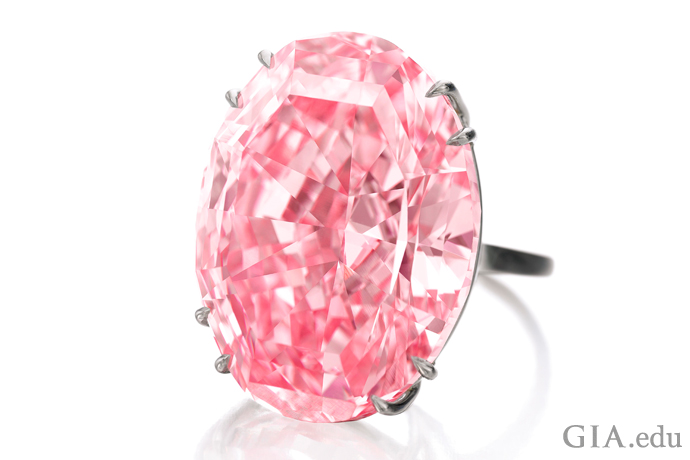
The Pink Star ring, which sold at a Sotheby’s auction for $71 million, contains a 59.60 ct Fancy Vivid pink diamond graded by GIA.

The GIA-graded Fancy Vivid pink 59.60 ct Pink Star diamond sold for $71 million at the April 4, 2017 Sotheby’s auction in Hong Kong. Courtesy: Sotheby’s

4. Treatments can improve diamond color

Diamond color can be altered by treatments. All else being equal, diamonds that have not been treated are more expensive than diamonds that have been treated. Legally, the seller must disclose any treatments. If you are aware what diamond color is, it’s easier to understand how they have been treated. 

High pressure, high temperature (HPHT) processing is perhaps the most common technique used to alter, enhance or remove color. HPHT treatment can change some brown diamonds into colorless ones or into other colors like yellow, greenish yellow or green. This process is also associated with treated pink, blue and orange-yellow diamonds. The resulting color is considered permanent, but HPHT treatment should always be disclosed.

Annealing is another process that uses controlled heating and cooling to change the color of a gem material, especially after irradiation. Irradiating a diamond or coating it are other methods used to enhance a diamond’s color.

.
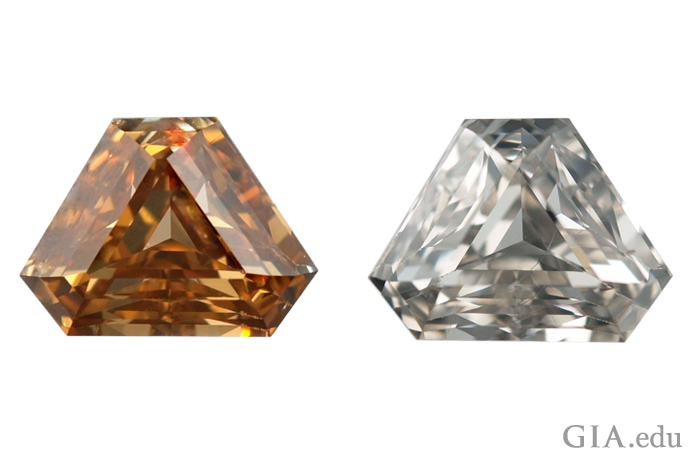
A 6.61 ct Fancy yellow brown diamond (left) before annealing and the same diamond (right), graded L (faint yellow) after annealing.

Before HPHT annealing to remove color, this 6.61 ct diamond was a Fancy yellow brown (left). After annealing (right), GIA graded the diamond an L (faint yellow). Photo: Robert Weldon/GIA

5. Diamond fluorescence has little to no impact on diamond color

Diamond fluorescence is visible light temporarily emitted by some diamonds when they are exposed to ultraviolet (UV) rays from the sun, fluorescent lamps or other sources. This emitted light can display various colors (often blue in diamonds), intensities (faint to very strong) and distribution patterns. When the light source is removed, the fluorescence is no longer visible.

Many in the diamond trade believe that strong blue fluorescence can make a light yellow diamond look closer to colorless when exposed to a UV source such as sunlight. Blue and yellow are color opposites and tend to cancel each other out, so blue fluorescence masks the yellow color. In rare cases, some diamonds with extremely strong fluorescence may appear slightly hazy or oily. Fewer than 0.2% of the fluorescent diamonds submitted to GIA exhibit this effect.

.
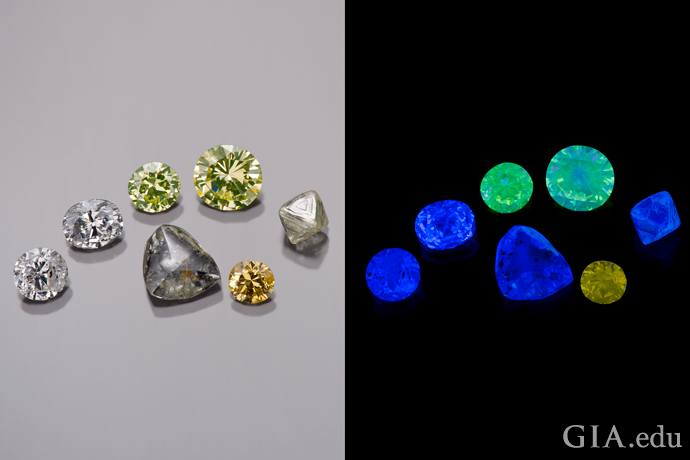
A group of seven diamonds shown under daylight-equivalent illumination (left) and exposed to long-wave UV irradiation (right).

The same group of seven diamonds is shown here under daylight-equivalent illumination (left) and when exposed to long-wave UV irradiation (right). Photos: Kevin Schumacher/GIA

To answer questions from consumers and the trade about the impact of fluorescence on diamond color in the D-to-Z range, GIA conducted extensive observer testing. Here’s what its researchers found: “For the average observer, meant to represent the jewelry buying public, no systematic effects of fluorescence were detected [on the face-up appearance of the groups of diamonds]. Even the experienced observers did not consistently agree on the effects of fluorescence from one stone to the next.” As a result, GIA considers diamond fluorescence to be an identifying characteristic, not a grading factor – meaning, it has little to no impact on what color the diamond is.

6. Engagement ring settings can influence the perception of diamond color

Diamonds are highly reflective – their facets are essentially an arrangement of tiny mirrors reflecting light and the surroundings. So it should come as no surprise that the color of a ring’s prongs and shank can influence the color you see in the diamond. A white metal like platinum or white gold can emphasize the absence of color in a diamond that is colorless or near-colorless, while a gold band might make a diamond lower on the D-to-Z scale appear more yellow.

Learn more about how metal affects a diamond’s color appearance.
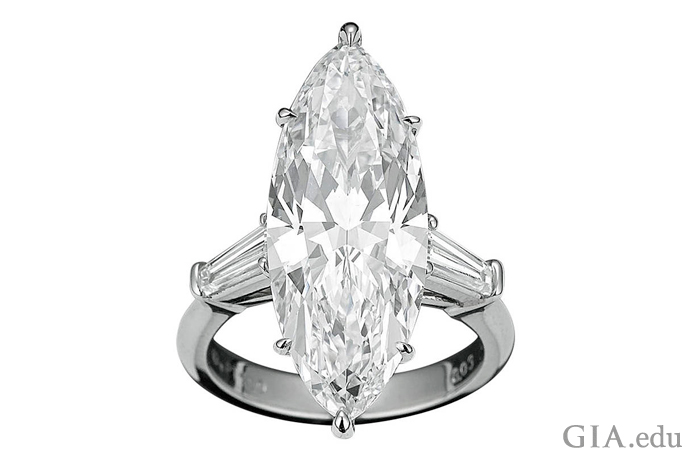
A 8.03 carat D color marquise cut diamond engagement ring set in platinum, flanked by two tapered baguettes weighing 0.72 carats.

The 8.03 ct marquise cut diamond in this engagement ring is D color. It is flanked by two tapered baguettes weighing a total of 0.72 carats. The platinum band and prongs highlight the beauty of the diamond. Courtesy: 1stdibs.com

7. To be sure of a diamond’s color, get a GIA grading report

A GIA Diamond Grading Report and GIA Diamond Origin Report provides an in-depth assessment of a diamond’s quality based on the 4Cs: diamond color, clarity, cut and carat weight. A report not only contains an objective color grade, but it also discloses other identifying characteristics like fluorescence, as well as any treatments detected. Learn what diamond color information is included in a GIA report.

An engagement ring is profoundly intimate and symbolic – it represents your love and commitment. A GIA Diamond Grading Report lets you make this most important purchase with peace of mind.

Now that you understand  what diamond color is and  its importance, here are 12 tips for buying an engagement ring.

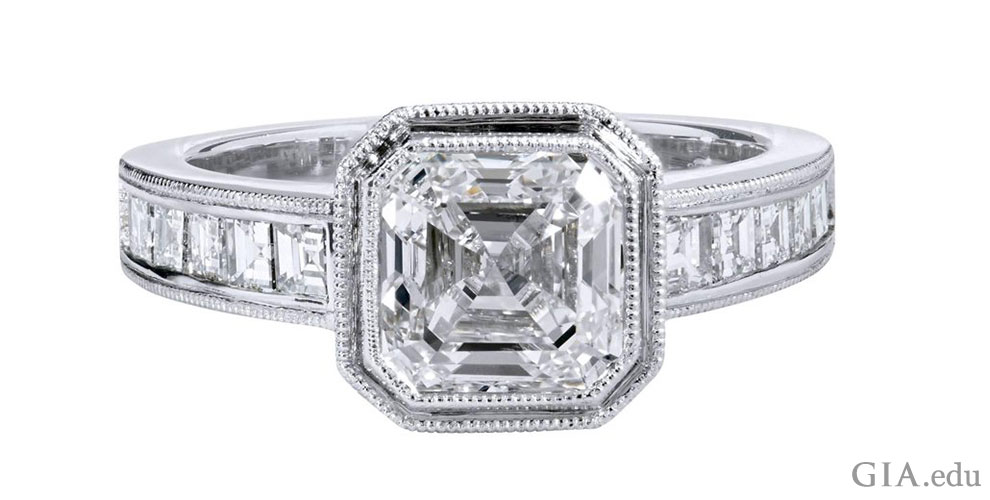
Lead image courtesy of 1stdibs.com
How to Determine Ring Size: Tips and Ring Size Chart

Getting the ring size right is a must for any engagement ring. After all, you’ve invested a lot in selecting the perfect ring and planning the proposal, so naturally you’ll want the ring to fit right out of the box.

In this blog, we’ll dispel some common myths floating around on the Internet and provide some reliable tips on how to determine her ring size, including an international ring size chart, so you can get it right. (more…)

December Birthstone: What You Need to Know About Tanzanite, Turquoise and Zircon

If you had to pick one December birthstone, which would it be: tanzanite, turquoise or zircon? From the blue to bluish purple of tanzanite, to the intense blue and green of turquoise, to the rainbow varieties of zircon, there’s a color for you. We help you pick one.

In this blog, we cover:

Tanzanite: The Newest December Birthstone
Gemological properties of tanzanite
Tanzanite history & lore
Where tanzanite comes from
Qualities to look for in tanzanite
Tanzanite treatments, care & cleaning

Turquoise: The Historic December Birthstone
Gemological properties of turquoise
Turquoise history and lore
Where turquoise comes from
Qualities to look for in turquoise
Turquoise treatments, care & cleaning

Zircon: The Colorful December Birthstone
Gemological properties of zircon
Zircon history & lore
Where zircon comes from
Qualities to look for in zircon
Zircon treatments, care & cleaning

TANZANITE: THE NEWEST DECEMBER BIRTHSTONE

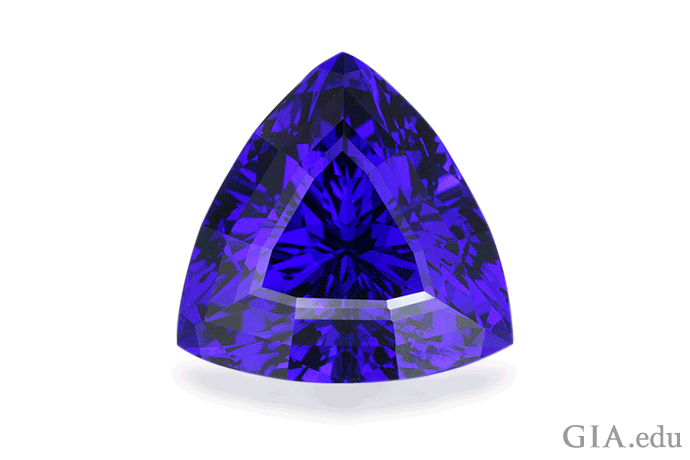
A trilliant cut tanzanite with an exceptional violetish blue color captivates as the December birthstone. Photo: Robert Weldon/GIA

A trilliant cut tanzanite with an exceptional violetish blue color captivates as the December birthstone. Photo: Robert Weldon/GIA

Gemological properties of tanzanite

Tanzanite is the blue to violet to bluish purple variety of the mineral zoisite. This December birthstone is mined commercially in only one area of the world — the Merelani Hills of Tanzania — from where it gets its name.

Tanzanite’s appearance is influenced greatly by its pleochroism – the different colors some gemstones show when viewed from different directions. Tanzanite can be violetish blue or deep blue – similar to a sapphire color – or much more purplish. Often, both the violetish blue and purple are readily visible in a fashioned stone when it is gently rocked and tilted. This December birthstone is rather fragile, ranking 6 to 7 on the Mohs scale of hardness; a diamond is a 10. The scale is exponential, meaning that a diamond is many times harder than tanzanite. Tanzanite’s toughness (the ability of a gem material to resist breaking, chipping or cracking) is fair to poor because it has one direction of cleavage (the tendency of a crystalline mineral to break along atomic planes) and is sensitive to sudden temperature changes.

Gemologists love tanzanite because it shows different colors when viewed from different directions.

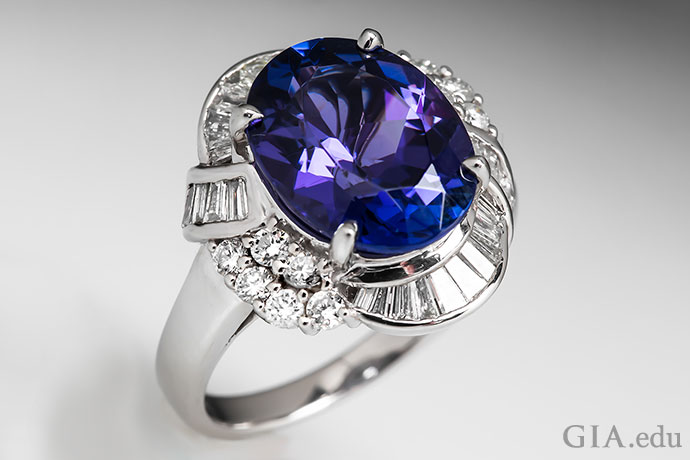
5.59 carat (ct) oval tanzanite contrasted with 28 channel set tapered baguettes and 12 round brilliant cut diamonds.

The vault of the evening sky and a field of stars is conjured by this 5.59 carat (ct) oval tanzanite contrasted with 28 channel set tapered baguettes and 12 round brilliant cut diamonds. Courtesy: EraGem.com

Tanzanite history & lore

Tanzanite may be a relative newcomer to the world of colored stones, but it was one of the most exciting gem discoveries of the 20th century. Blue stones emerging from Tanzania were identified as the mineral zoisite in 1962 by Polish expatriate George Kruchluk. Not until 1967, though, did prospector Manuel D’Souza — with the help of a Masai tribesman — locate the primary source: the Merelani Hills. D’Souza filed four mining claims. Word spread and 90 more claims were quickly registered – even though at the time there was some confusion as to the identity of the gem material.

Tiffany & Co. believed that tanzanite had international appeal and became its main distributor. In 1968, Tiffany launched a major advertising campaign to promote it. With its vivid colors, high clarity and potential for large cut stones, tanzanite quickly became a sensation. Today, it is not only a December birthstone, but it is also the gem for the 24th wedding anniversary.

Where tanzanite comes from

Grass-covered hillsides, scrub brush, rocky soil and an occasional tree form the landscape of the Merelani Hills. In the major mechanized operations there, thousands of workers recover tanzanite from mines dug over a hundred meters deep into the earth. North of the mines tower the snow-covered slopes of Mount Kilimanjaro.

Peeking out from the clouds is the domed summit of Mount Kilimanjaro. Tanzanite is mined in its shadow.

Peeking out from the clouds is the domed summit of Mount Kilimanjaro. Tanzanite is mined in its shadow. Photo: Eric Welch/GIA

Qualities to look for in tanzanite

Color: The most prized color in tanzanite is a pure blue similar to fine sapphire or an intense violet-blue. Tanzanite with a bluish purple body color is also popular, but less valuable. In any hue, pale colors are less prized than saturated ones.

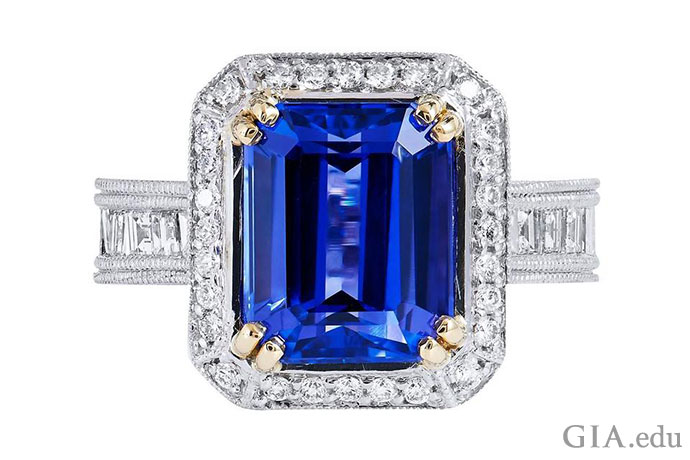
4.91 ct tanzanite, which mimics the deep blue of fine sapphire, and its regal frame of diamonds.

Be mesmerized by the rich color of this 4.91 ct tanzanite, which mimics the deep blue of fine sapphire, and its regal frame of diamonds. Courtesy: 1stdibs.com

Clarity: Tanzanite is usually free of eye-visible inclusions. If any inclusions are present – especially those that pose a durability problem, such as fractures – they typically lower the value.

Cut: Tanzanite is available in a wide range of shapes, but cushion and oval cuts are more common. Because of its pleochroism, cutting direction determines the gem’s overall face-up color. Cutting a tanzanite to emphasize the bluish purple color usually wastes less rough than cutting it to get a pure blue or violetish blue color. The cutter has to make a choice between a smaller top-color gem and a larger bluish purple one.

Carat Weight: Fine tanzanite with a strong, deep color can be found in pieces weighing 5.00 carats or more. Smaller sizes in less saturated colors are commonly seen in mass market jewelry.

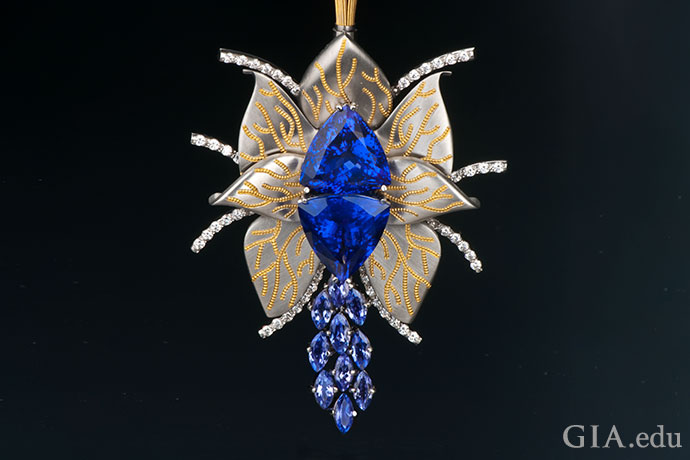
Some 17.67 carats of tanzanite blossom in Sir Zoltan David’s magical "Flowerfly" necklace.

Some 17.67 carats of tanzanite blossom in Sir Zoltan David’s magical “Flowerfly” necklace. The piece won the Tanzanite Foundation’s “Be Born to Tanzanite” Competition in 2007. Photo: Robert Weldon/GIA. Courtesy: Zoltan David

Tanzanite treatments, care & cleaning

Tanzanite is stable under normal wearing conditions, which means it’s resistant to the effects of normal heat, light and common chemicals. Still, the December birthstone may crack if exposed to very high temperatures or sudden temperature changes. It can be attacked by hydrochloric and hydrofluoric acids.

Warm, soapy water is always the best way to clean this December birthstone. Ultrasonic and steam cleaners are never recommended for tanzanite.

Untreated, tanzanite is typically brown. Tanzanite is routinely heat treated to modify its color to a predominantly blue to bluish purple. The treatment is stable with no additional durability concerns.

TURQUOISE: THE HISTORIC DECEMBER BIRTHSTONE

A shoreline of diamonds surround an ocean of turquoise in this captivating ring.

A shoreline of diamonds surround an ocean of turquoise in this captivating ring. Courtesy: Arya Esha

Gemological properties of turquoise

Turquoise is found in only a few places on Earth: dry and barren regions where acidic, copper-rich groundwater seeps downward through deeply altered or broken rocks where it reacts with minerals that contain phosphorus and aluminum. The result of this process is a porous, semitranslucent-to-opaque hydrous phosphate of copper and aluminum.

This December birthstone owes its texture to its structure and composition. Turquoise is an aggregate of microscopic crystals that form a solid mass. If the crystals are packed closely together, the material is less porous, so it has a finer texture. Fine-textured turquoise has an attractive, waxy luster when it’s polished. Turquoise with a less-dense crystal structure has higher porosity and a coarser texture, resulting in a duller luster when it’s polished.

Porosity and texture don’t just affect appearance: They also affect the durability of turquoise. This December birthstone is fairly soft—it ranks 5 to 6 on the Mohs scale of hardness. Turquoise with a coarse texture might have poor toughness, too, so it fractures easily. Samples with finer texture have fair to good toughness.

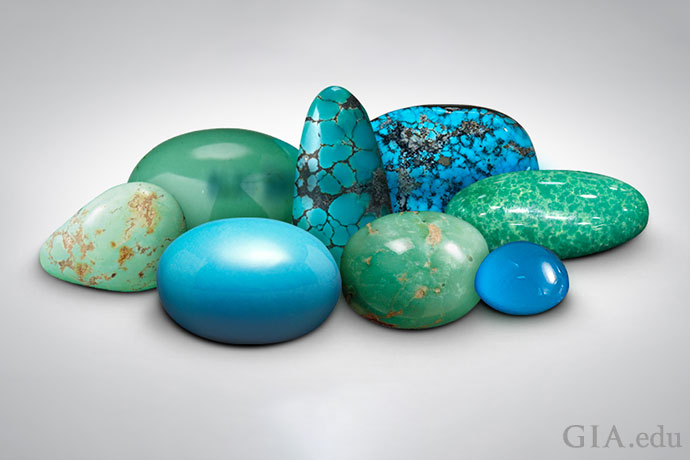
Gemologists love this December birthstone because turquoise often contains matrix: spiderweb-like veins that provide evidence of the rock in which it formed. They also like how turquoise is colored by copper, which creates some of the most vivid blues and greens in the gem kingdom.

Whether opaque, semitranslucent or checkered with spiderwebs, turquoise enchants

Whether opaque, semitranslucent or checkered with spiderweb-like veins, turquoise enchants. Composite photo: Eric Welch, Robert Weldon, Terri Weimer/GIA, Dr. Edward J. Gübelin collection. Courtesy (far right): Barlow’s

Turquoise history & lore

Turquoise has been cherished for millennia. The pharaohs and other rulers of ancient Egypt adorned themselves with it. Chinese artisans carved it more than 3,000 years ago.

This December birthstone was thought to possess many beneficial powers, like guaranteeing health and good fortune. From the 13th century on, it was believed to protect the wearer from falling (especially off horses), and would break into several pieces at the approach of disaster. Hindu mystics maintained that seeing a turquoise after beholding the new moon ensured fantastic wealth.

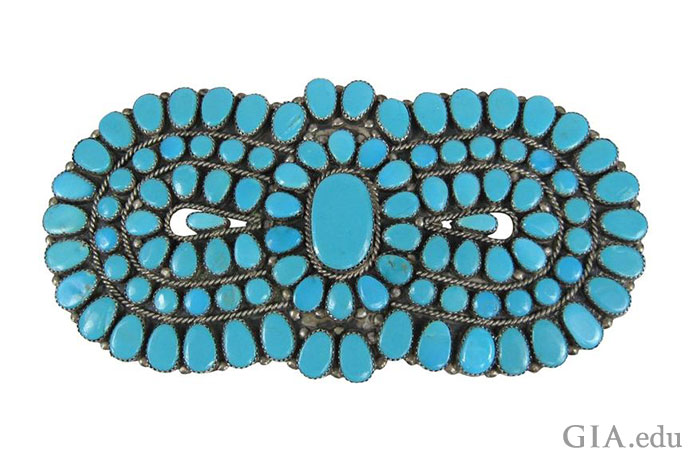
Turquoise played an important role in the lives of Native Americans. The Apache thought turquoise could be found by following a rainbow to its end. They also believed that attaching the December birthstone to a bow or firearm made one’s aim more accurate. The Pueblo maintained that turquoise got its color from the sky, while the Hopi thought the gem was produced by lizards scurrying over the earth.

An artisan from the Zuni tribe made this turquoise brooch.

An artisan from the Zuni tribe made this turquoise brooch. Courtesy: 1stdibs.com
Turquoise adorns the funerary mask of King Tut, who ruled Egypt more than 3,000 years ago. It also appears in jewelry belonging to more modern royalty, such as the Jordan turquoise demi-parure (turquoise, diamond and sapphire necklace and earrings) in the collection of Britain’s Queen Elizabeth II. Wallace Simpson (1896-1986), Duchess of Windsor, wore a famous amethyst and turquoise necklace made by Cartier. Turquoise is also the gem of the 11th wedding anniversary.

A dazzling display of color, Cartier’s bib necklace for the Duchess of Windsor features a sea of turquoise cabochons and faceted amethyst.

A dazzling display of color, Cartier’s bib necklace for the Duchess of Windsor features a sea of turquoise cabochons and faceted amethyst. Courtesy: N. Welsh, Cartier Collection © Cartier

Where turquoise comes from

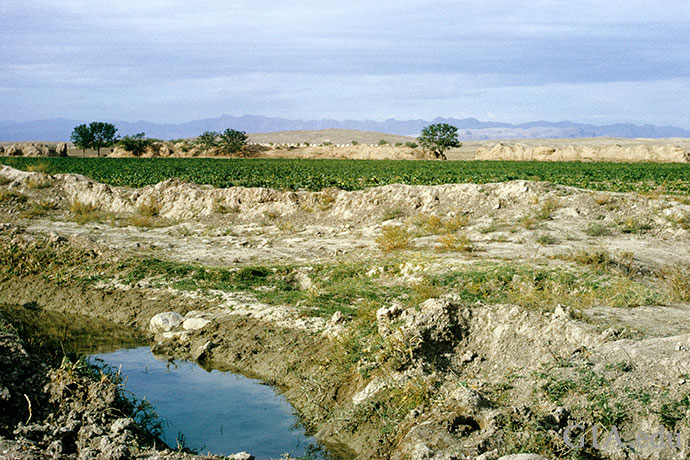
Turquoise has been mined in the Nishapur district of Iran for more than 1,000 years. The even-colored, intense blue turquoise from this region is dubbed “robin’s egg blue,” “sky blue” and “Persian blue.” Trade professionals now use these terms to describe turquoise of this color – regardless of the source.

This is the view on the way to Nishapur.

This is the view on the way to Nishapur. Courtesy: Dr. Edward J. Gübelin Collection

Although New Mexico was the largest producer of turquoise in the U.S. until the 1920s, today most of the U.S. production of this December birthstone comes from Arizona and Nevada. Mines have evocative names like Dry Creek, Easter Blue, Emerald Valley and Fox. The Kingman mine in Arizona is a historically important source that is known for producing intense blue turquoise. Now closed to turquoise mining, the Sleeping Beauty mine was a prolific producer for more than four decades.

The intense blue turquoise beads in this necklace came from Arizona’s Sleeping Beauty mine.

The intense blue turquoise beads in this necklace came from Arizona’s Sleeping Beauty mine. Photo: Robert Weldon/GIA. Courtesy: Somewhere In The Rainbow

China is now the world’s largest producer of fine turquoise. Hubei Province, in central China, is the source of most of the gem-quality turquoise currently being mined there.

Qualities to look for in turquoise

Color: The color of turquoise usually ranges from light to medium blue or greenish blue. It’s often mottled, and sometimes it has dark splotches. It might also have veins of matrix running through it.

The most-prized turquoise color is an even, intense, medium blue, with no matrix and the ability to take a good polish. But some consumers prefer a greenish blue, and some contemporary designers seek turquoise referred to as “avocado” and “lime green.”

Clarity: Turquoise can be semitranslucent to opaque. Semitranslucent stones are preferred.

Note the even color in the clusters of turquoise dangling from gold chains in this one-of-a-kind piece.

Note the even color in the clusters of turquoise dangling from gold chains in this one-of-a-kind piece. Courtesy: Denise James

Cut: Turquoise is most often fashioned as cabochons. The smoothly rounded dome shape sets off turquoise’s color, texture and any matrix beautifully. In addition, manufacturers and artisans fashion turquoise rough into round or oblong beads for necklaces, and into small, flat pieces that are popular as jewelry inlays. Other rough material might be tumbled into “nuggets” or polished as free-form shapes that reflect the shape of the original rough. There are also examples of top-color blue turquoise engraved with Persian or Arabic inscriptions that are then inlaid with gold.

Carat Weight: Turquoise is available in a wide range of sizes. All sizes, even very small ones, are used in Native American jewelry, and large pieces have been popular for carvings. For any size, the quality and evenness of the color is the overriding value factor.

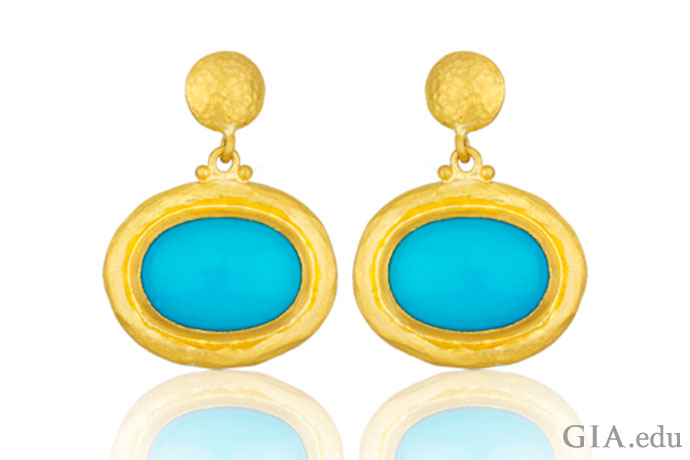
Rich blue turquoise surrounded by 24K gold makes these earrings a mesmerizing sight.

Rich blue turquoise surrounded by 24K gold makes these earrings a mesmerizing sight. Courtesy: Lika Behar

Turquoise treatments, care & cleaning

A colorless wax or polymer is often used to improve the color and luster of turquoise. Other treatments include applying epoxy to thin turquoise slices to strengthen them, applying coatings of lacquer or epoxy, and filling cavities with imitation pyrite inclusions made of metal-filled epoxy.

It’s safe to clean turquoise jewelry with warm, soapy water, but this December birthstone should never be cleaned with steam or ultrasonic cleaners. Heat or solvents can damage the treated surfaces on some turquoise.

Turquoise is generally stable to light, but high heat can cause discoloration and breakage. Turquoise can be damaged by acids, and it can be discolored by certain chemicals, cosmetics and even skin oils or perspiration.

ZIRCON: THE COLORFUL DECEMBER BIRTHSTONE

A 19.76 ct orangy brown zircon is ringed by 0.51 carats of diamonds.

A 19.76 ct orangy brown zircon is ringed by 0.51 carats of diamonds. Courtesy: 1stdibs.com

Gemological properties of zircon

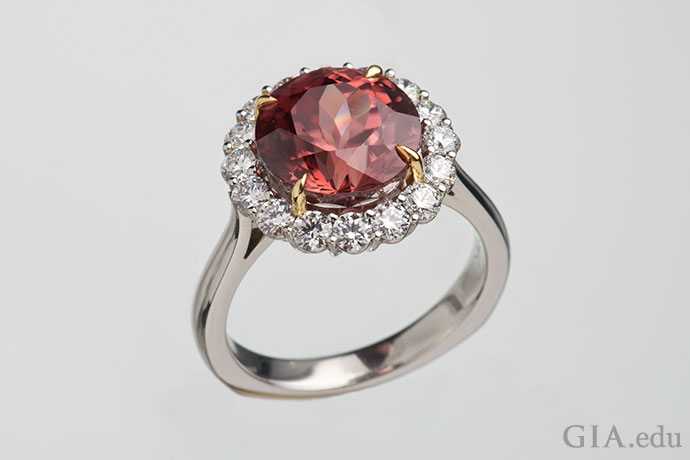
Zircon comes in a wide and varied palette of yellow, green, red, orange, brown and blue hues, making it a favorite among collectors and knowledgeable consumers. This December birthstone is 6 to 7.5 on the Mohs scale of hardness.

The zircons in this colorful array originate from Sri Lanka, Cambodia, Thailand, Tanzania and other locations.

Zircon comes in a wide array of attractive colors. Photo: Robert Weldon/GIA, Dr. Edward J. Gübelin Collection.

Colorless zircon is known for its brilliance and flashes of multicolored light, called fire. These two zircon properties are close enough to the properties of diamond to account for centuries of confusion between the two gems.

This 11.41 ct oval blue zircon with its diamond halo is like a lake that invites the viewer to peer into infinity. The tsavorite garnet side stones are leafy touches to the icy scene.

This 11.41 ct oval blue zircon with its diamond halo is like a lake that invites the viewer to peer into infinity. The tsavorite garnet side stones are leafy touches to the icy scene. Courtesy: Omi Privé

Gemologists love zircon because its radioactive trace elements are a geologic clock that tells us about the early Earth. This December birthstone also has very high luster, high refractive indices (the measure of the extent to which light is bent as it leaves a gemstone at an angle other than perpendicular to the surface) and strong dispersion, which is responsible for the brilliance and rainbow flashes of fire.

Zircon history & lore

The origins of the word zircon have elicited colorful debate. Some scholars believe it comes from the Arabic word zarkun, meaning “cinnabar” or “vermilion.” Others think the source is the Persian word zargun, or “gold colored.” Considering the color range for this December Birthstone, either derivation seems possible.

Zircon comes with pleasing lore. In the Middle Ages, it was thought to lull one into a deep sleep and scare off evil spirits. In the Hindu religion, zircon alternates with hessonite garnet as one of the nine gems of the navaratna. When worn together, the nine gems protect the wearer and bring good health, wealth and wisdom.

Victorians had a fondness for blue zircon. Fine specimens can be found in English estate jewelry from the 1880s.

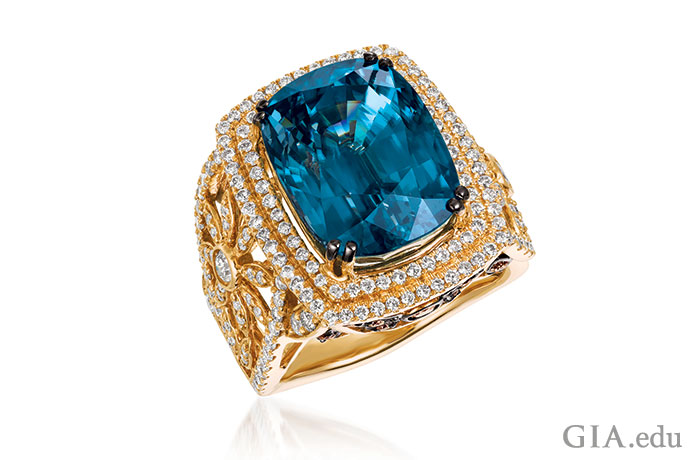
Regal rings like this show why blue zircon is a popular gem

Regal rings like this show why blue zircon is a popular gem. Courtesy: LeVian

Where zircon comes from

Sri Lanka’s wealth of gems is legendary: Sapphire in various colors, ruby, alexandrite, spinel, tourmaline, moonstone and quartz are some of the gem minerals unearthed there. So is zircon. Elahera, a region in central Sri Lanka, is one of the country’s most productive areas. Mountains, jungles and restless streams make for a dramatic landscape.

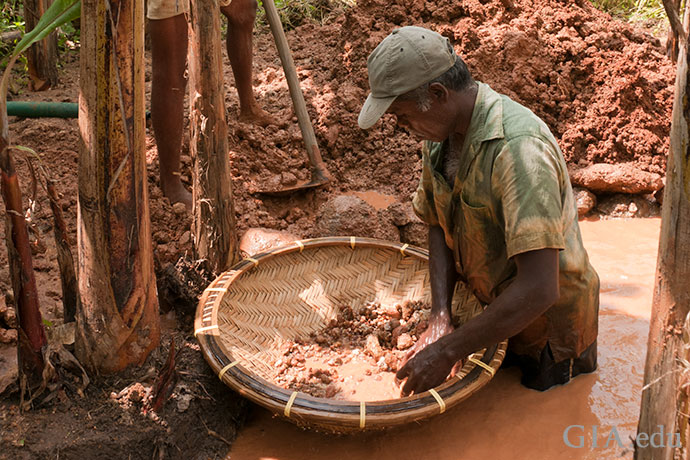
An artisanal miner searches for gems in the Elahera region of Sri Lanka.

An artisanal miner searches for gems in the Elahera region of Sri Lanka. Photo: Vincent Pardieu/GIA

Australia’s Harts Range is known for producing zircons in yellow-brown, orangy brown, pink and purple. Go there and you’ll see open savannahs, dry stream beds and low-lying hills that meet the horizon. Zircon Hill is where the gem is mined. The nearby city of Alice Springs is known for its outback culture, aboriginal art and quirky sporting events like a regatta race held in a dry river bed.

Zircon is often located near sapphire sources. Countries where the two overlap include Sri Lanka, Myanmar, Vietnam, Cambodia and Australia.

Qualities to look for in zircon

Color: Some zircons display warm autumnal earth tones such as yellowish and reddish brown. Red and green zircons have market value as collectors’ stones, and cat’s-eye zircons occasionally appear on the market. There are also colorless zircons.

A brisk autumn day, a fireplace and apple cider would be the perfect backdrop for this ring, which features a 7.96 ct zircon.

A brisk autumn day, a fireplace and apple cider would be the perfect backdrop for this ring, which features a 7.96 ct zircon. Photo: Robert Weldon/GIA. Courtesy: Richard Krementz Gemstones

Although collectors clearly love zircon’s variety of colors, consumers seem most enamored of just one hue: blue. Gem dealers report that at least 80 percent of the zircons they sell are blue. Because they’re in greater demand, blue zircons usually command higher prices than any of the other varieties.

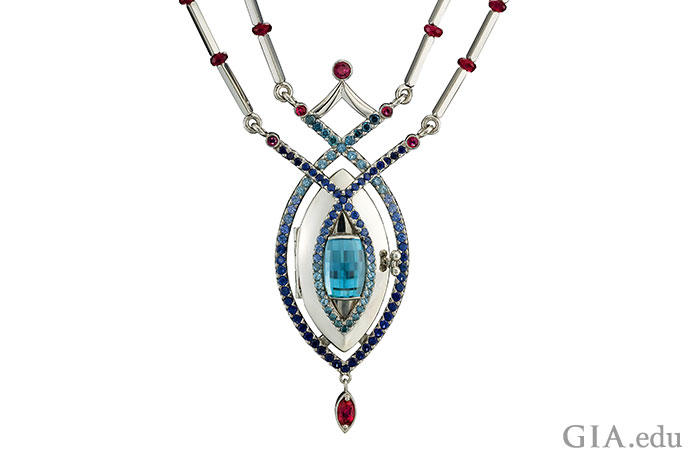
A blue zircon takes center stage in the “Reine de Glace” pendant designed by Lisa Krikawa.

A blue zircon takes center stage in the “Reine de Glace” pendant designed by Lisa Krikawa. Courtesy: Krikawa Jewelry Designs. Blue zircon by John Dyer & Co.

Clarity: Zircons are relatively free of inclusions. But many untreated zircons have a cloudy or smoky appearance that, if extreme, can be a negative factor with buyers. In Victorian times, this smokiness made zircon a popular gem for mourning jewelry. Today, most faceted zircon is free of inclusions that are visible to the unaided eye. Eye-visible inclusions cause a drop in zircon value. Rarely, zircon might contain long, parallel inclusions that create a cat’s-eye effect when the stone is cut as a cabochon.

Cut: It’s a challenge to cut zircon because the gem is brittle. Cutters usually fashion zircon in the brilliant style to take advantage of its brilliance and fire. Zircon can also be found in step cuts, which have rows of parallel facets, and mixed cuts, which are a combination of brilliant and step-cut facets.

A richly colored 7.23 ct zircon set in an ornate 18K gold ring looks like it belongs on the finger of European royalty.

A richly colored 7.23 ct zircon set in an ornate 18K gold ring looks like it belongs on the finger of European royalty. Courtesy: 1stdibs.com
Carat Weight: The supply of this December birthstone is generally limited, and typical zircon sizes depend on color. Blue or green stones normally range from one carat to 10 carats, with yellows and oranges up to around five carats. Reds and purples are usually smaller.

Zircon treatments, care & cleaning

Warm, soapy water is recommended for cleaning zircon. Ultrasonic and steam cleaners are not recommended for this December birthstone.

Zircon is commonly heat treated to produce blue and colorless varieties, as well as orange, yellow and red. The gem is generally stable when exposed to light, but some heat-treated stones might revert to their original colors (usually light brown) after prolonged exposure to bright light. Exposure to heat can alter the color of some zircon. Zircon is stable when exposed to chemicals.

Because zircon tends to abrade, it is best to avoid wearing it in rough conditions, such as while gardening, playing sports or doing dishes.

The color of the 14.48 ct zircon in this ring evokes a forest … fields … grassy expanses.

The color of the 14.48 ct zircon in this ring evokes a forest … fields … grassy expanses. Courtesy: 1stdibs.com

Ready to go shopping for the December birthstone?  Be sure to take our Tanzanite Buying Guide and Turquoise Buying Guide with you when you go!

November Birthstone: What You Need to Know About Topaz and Citrine

Those with a November birthstone have two beautiful options to choose from: topaz and citrine. Topaz comes in a rainbow of colors; citrine is known for its charming yellow and orange hues. The two gems give you countless options. Your challenge will be deciding which one to pick. We offer help.

In this post, we cover

Gemological properties of topaz
Topaz history & lore
Where topaz comes from
Qualities to look for in topaz
Topaz treatments, care & cleaning
Gemological properties of citrine
Citrine history & lore
Where citrine comes from
Qualities to look for in citrine
Citrine treatments, care & cleaning

November birthstone: Gemological properties of topaz

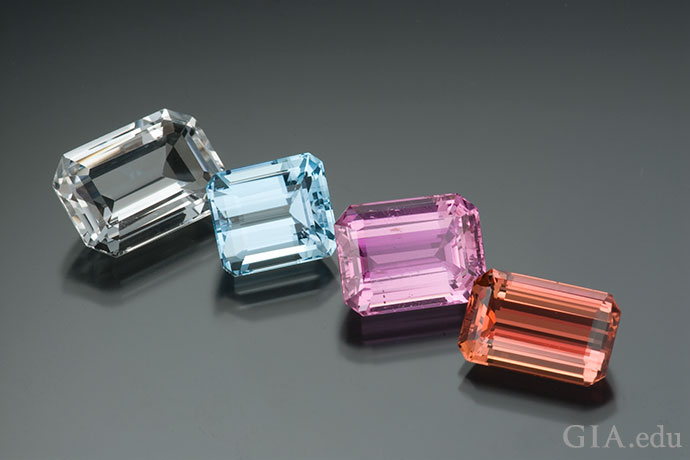
The November birthstone topaz has an exceptionally wide color range that, in addition to brown, includes various tones and saturations of blue, green, yellow, orange, red, pink and purple. Colorless topaz is plentiful, and is often treated to give it a blue color.

Pictured here are some of the many colors of topaz, the November Birthstone. From left to right: a 9.21 ct colorless emerald cut, a 15.01 ct light blue emerald cut, a 18.41 ct purplish pink emerald cut and a 12.54 ct orange-red emerald cut.

Pictured here are some of the many colors of topaz. From left to right: a 9.21 carat (ct) colorless emerald cut from Nigeria; a 15.01 ct light blue emerald cut from Brazil; an 18.41 ct purplish pink emerald cut from Pakistan; and a 12.54 ct orange-red emerald cut from Brazil. Photo: Robert Weldon/GIA

Color varieties of the November birthstone are often identified simply by hue name—blue topaz, pink topaz and so forth—but there are also a couple of special trade names. Imperial topaz is typically a medium reddish orange to orange-red though some dealers, especially those in Brazil, apply the term to yellow, pink and red topaz as well. The reddish pleochroic color (pleochroism is the display of different body colors from different viewing directions) of Imperial topaz often appears at the ends of fashioned gems–like pears and ovals–that have an otherwise yellow-to-orange body color. Red is one of the most sought-after (and least available) topaz colors.

Sherry topaz—named after sherry wine—is a yellowish brown or brownish yellow to orange. Stones in this color range are often called precious topaz to help distinguish them from the similarly colored but less expensive citrine and smoky quartz.

Topaz is an 8 on the Mohs Scale of Hardness. It’s not very tough, so a hard blow might split it, and extreme pressure or sharp temperature changes might cause it to break. The November birthstone is best set in a protective mounting like a bezel or used in pieces that aren’t subjected to heavy wear, like pendants and pins.

Pink topaz set in a diamond and platinum butterfly brooch.

A pink topaz set in a diamond and platinum butterfly brooch is a delightful sight. Photo: Robert Weldon/GIA. Courtesy: Richard Krementz Gemstones

Gemologists love topaz because it comes in some of the gem world’s largest crystals: The largest are measured in kilos, not carats. They also love the fact that faceted topaz takes such a high polish and is slightly slippery to the touch.

November birthstone: Topaz history & lore

Topaz was long thought to have many benefits. The ancient Greeks believed that topaz gave them strength. From the 1300s to the 1600s, Europeans thought it could thwart magic spells and dispel anger. The November birthstone was also believed to have curative powers. To treat “dimness of vision,” 12th century abbess St. Hildegard recommended placing topaz in wine for three days and then rubbing the moistened topaz on the patient’s eyes.

Imperial topaz has aristocratic cachet. It is commonly believed that the name originated with the Russian royal family’s insistence on keeping the finest colors of this gem, which was mined in Russia’s Ural Mountains, exclusively for their use. An alternate explanation, especially popular in Brazil, is that it dates from an 1881 visit by Brazilian Emperor Pedro II to Ouro Preto—the town closest to Brazil’s most productive topaz mines–and the gift of a reddish topaz to him. Regardless of the source of the designation, there is no question all believed this beautiful gem was fit for a king.

Oval cut Imperial topaz.

Want a gem with an aristocratic cachet? Imperial topaz might be the one for you. Photo: Robert Weldon/GIA

Blue topaz is the gem of the fourth wedding anniversary, and Imperial topaz is the gem of the 23rd wedding anniversary.

A 38.56 ct blue topaz

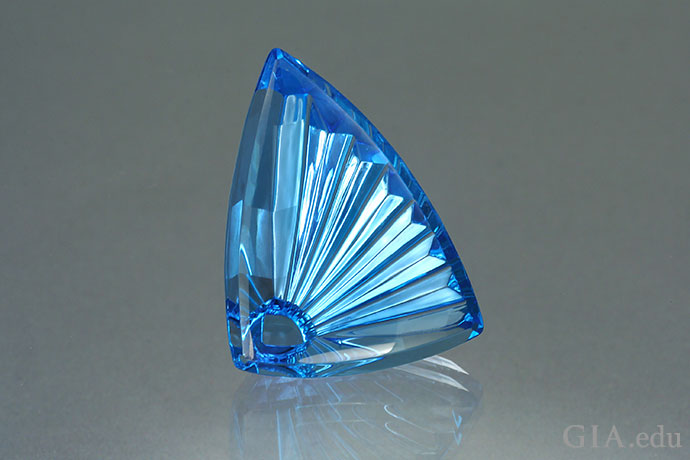
The artistic carving of this 38.56 ct blue topaz intensifies the color. Photo: Lydia Dyer. Courtesy: John Dyer & Co.

November birthstone: Where topaz comes from

Minas Gerais, a state in Brazil, is one of the most important sources for high-quality topaz. Yellow to orange, red, pink, violet and blends of red with orange or purple are some of the colors unearthed here. The nearby town of Ouro Preto is a fitting companion. In this UNESCO world heritage site, majestic colonial churches checker the skyline and quaint cobblestone streets crisscross the city.

Necklace set with a 24.13 ct fancy-cut topaz and the accompanying 44.11, 71.21 and 66.66 ct loose stones.

Topaz mined from the Ouro Preto region of Minas Gerais, Brazil comes in a lovely range of hues, as displayed in this necklace set with a 24.13 ct fancy-cut topaz and the accompanying 44.11, 71.21 and 66.66 ct loose stones. Photo: GIA and Harold & Erica Van Pelt. Courtesy: Amsterdam Sauer Co.

Northwestern Pakistan is known for producing pink topaz. Ghundao Hill, close to the small town of Katlang, has been mined since 1972. The most sought-after shade of pink topaz from Katlang has a tinge of violet, which some in the gem trade call cyclamen pink. But even at Ghundao Hill, only rarely is fine pink topaz found.

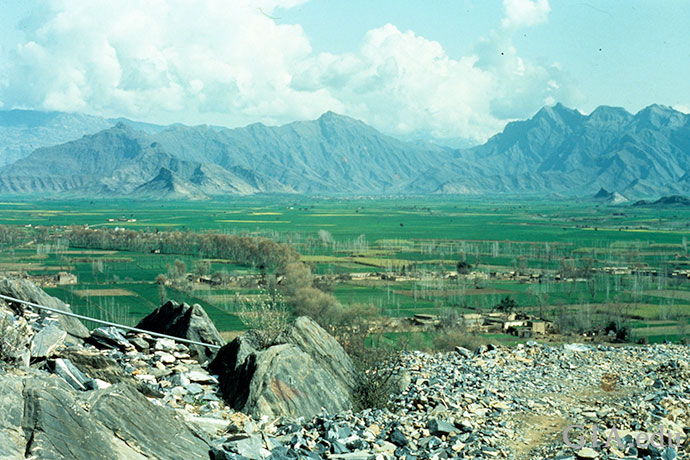
Ghundao Hill, a valley carpeted in green in Northwestern Pakistan, is known for producing topaz the November birthstone.

Ghundao Hill’s setting is quite picturesque: A valley carpeted in green starts at the base. The towering Hindu Kush Mountains rise in the distance. Photo: Dr. Edward J. Gübelin/GIA

Other topaz sources include Namibia, on the western coast of southern Africa, and the gem-rich island of Madagascar. Today, some topaz is also found in the historic Russian localities and elsewhere including, Africa, China, India, Myanmar, Sri Lanka and Vietnam, as well as the United States and Mexico.

November birthstone: Qualities to look for in topaz

Color: Blue topaz and colorless topaz are widely available and very affordable. Most of the blue topaz on the market today has been color treated, as described in the next section. Red and pink topaz varieties are rare, highly cherished and will carry a significantly higher price tag per carat. Imperial topaz is also highly prized.

An 11.11 ct Imperial topaz ring accented with 0.29 carats of rubies and 0.75 carats of diamonds, all set in rose gold.

A royal enchantment: This 11.11 ct Imperial topaz is accented with 0.29 carats of rubies and 0.75 carats of diamonds, all set in rose gold. Courtesy: Omi Privé

Clarity: Faceted blue topaz is almost always free of eye-visible inclusions. Topaz in colors that are not as plentiful may be included. Depending on the rarity of the color, inclusions may not have a significant effect on value.

Cut: Topaz is cut in a wide variety of shapes and styles, including emerald, cushion, oval, pear, round, triangular, marquise and fantasy cuts.

Carat weight: If the color of the topaz is considered rare, the per-carat price may rise dramatically as size increases.

A 1,002 ct fantasy cut topaz

This 1,002 ct fantasy cut topaz is a work of art. Photo: Orasa Weldon/GIA

November birthstone: Topaz treatments, care & cleaning

To clean this November birthstone, do not use steam cleaning or ultrasonic cleaners to clean topaz: Warm, soapy water works best.

Topaz is often treated. Since naturally colored blue topaz is extremely rare, colorless topaz is often processed with irradiation followed, in some cases, by heating to turn it various shades of blue. The three irradiation techniques used are exposure to gamma rays in a cobalt irradiator, bombardment with electrons in an accelerator and bombardment with neutrons in a nuclear reactor. Gems that are treated in an accelerator or nuclear reactor may become radioactive, but the U.S. National Regulatory Commission (NRC) does not allow release of such stones into the trade until radioactivity levels fall below certain limits. The NRC advises that “any dose from these gems would be extremely small” and would continue to go down. Dealers use terms like “London blue,” “Swiss blue,” “super blue” and “maxi blue” to describe darker blues, and “sky blue” for paler hues. In general, darker blues cost slightly more than lighter hues, but both are typically affordable.

A blue topaz that has undergone irradiation to achieve a color result often referred to as “Mystic Topaz” or “Caribbean Topaz”.

This blue topaz has undergone irradiation to achieve this color result often referred to as “Mystic Topaz” or “Caribbean Topaz” by the trade. Photo: Valerie Power/GIA

Also common, is the heating of yellow to reddish brown topaz to create pink gems. Both irradiation and heat treatment are permanent under normal conditions of wear and care. For the most part, they are undetectable.

High heat or sudden temperature changes can cause internal breaks in topaz. The gem’s color is generally stable to light, but prolonged exposure to heat or sunlight might cause fading in yellow-to-brown, reddish brown or dark brown gems. Topaz may be affected slightly by some chemicals.

In addition to irradiation and heat treatment, colorless topaz is sometimes coated with a thin metallic film to change the color or produce a fanciful iridescent effect. The coating can resist daily wear and tear, but abrasive cleaners or buffing wheels will remove it. Only a mild soap solution should be used to clean a topaz treated in this manner.

November birthstone: Gemological properties of citrine

Citrine is the transparent pale yellow to brownish orange variety of quartz. The finest citrine color is a saturated yellow to reddish orange free of brownish tints. Its color comes from traces of iron. However, this November birthstone is actually rare in nature: Most citrine on the market is the result of heat treating amethyst.

Citrine’s attractive color, plus the durability and affordability it shares with most other quartzes, makes it the top-selling yellow-to-orange gem. Gemologists love this November birthstone because it has a modest price tag, and the price per carat does not rise dramatically for larger sizes.

The Jolie Citrine Necklace features 64 graduated bezel-set cushion cut citrines, highlighted by a 177.11 ct pear shaped citrine drop.

The Jolie Citrine Necklace, once owned by American actress Angelina Jolie and now part of the National Gem Collection at the Smithsonian Institution, features 64 graduated bezel-set cushion cut citrines, highlighted by a 177.11 ct pear shaped citrine drop. Courtesy: RP Studio

November birthstone: Citrine history & lore

This November birthstone is a variety of quartz, which has been used in jewelry for thousands of years. The ancient Greeks carved rock crystal ornaments that glistened like permafrost. Roman pontiffs wore rings set with massive purple amethysts and citrine has been reported in Roman jewelry. It was particularly popular in colorful Scottish jewelry from the Victorian era. Citrine, believed to derive from the French word for lemon (citron), is given for the thirteenth wedding anniversary.

A 43.49 ct fantasy cut citrine.

A fantasy cut unleashes the fire within this 43.49 ct citrine. Photo: Priscilla Dyer. Courtesy: John Dyer & Co.

November birthstone: Where citrine comes from

The top sources for natural citrine are Bolivia, Spain, Madagascar, Mexico and Uruguay. Amethyst that’s typically heat treated to a citrine color is mined mostly in Brazil.

Citrine and diamond butterfly earrings

These citrine and diamond butterfly earrings remind us of the beauty surrounding the Anahí mine in Bolivia. Photo: C. D. Mengason/GIA. Gift of Denoir

Deep in the world’s largest freshwater wetland lies Bolivia’s Anahí mine, an important source for natural, unheated citrine. Fields of wild flowers, brightly plumed birds, kaleidoscopes of butterflies, Howler monkeys and jaguars are some of the actors on this vast stage. The story of the mine is worthy of the setting. Discovered by a Spanish conquistador in the 1600s, it was given to him as dowry when he married Anahí, a princess from the Ayoreos tribe of Paraguay. The mine was lost for three centuries, until it was rediscovered in the 1960s.

The Anahí mine in Bolivia, an important source for the November birthstone citrine.

Cradled between the two mountains lies the Anahí mine in Bolivia. Photo: Robert Weldon/GIA

The Anahí mine produces a unique combination of amethyst and citrine in the same crystal; when the two colors appear together in a fashioned gem, it is known as ametrine. The citrine produced at the Anahí mine typically ranges from orange-yellow to brownish/greenish yellow.

Citrine, amethyst and ametrine gems produced at the Anahí mine in Bolivia.

The Anahí mine produces citrine, amethyst and ametrine gems in a broad range of hues. Photo: GIA & Tino Hammid

November birthstone: Qualities to look for in citrine

  • Color: The finest citrine colors are saturated, with little to no brown component, and range from yellow to orange-yellow to reddish orange. Look for warm, sunny hues.
  • Clarity: Citrine is usually “eye clean,” meaning it lacks eye-visible inclusions. Visible inclusions in a pale-colored gem greatly reduce the citrine’s value.
  • Cut: Citrine is available in a wide variety of standard shapes and cutting styles. In addition, many high-end gem carvers have fashioned the warm yellow gem into unusual fantasy cuts for distinctive jewelry and objets d’art. Citrine rough with minor inclusions is often used to make beads or is used occasionally for cabochons or more conventional carvings.
  • Carat weight: Citrine crystals occur in a wide range of sizes, and faceted stones up to 20 carats are readily available in jewelry.
A citrine and diamond ring set in 18K gold.

Like an ember, citrine glows in this ring. Courtesy: Arya Esha

November birthstone: Citrine treatments, care & cleaning

Citrine can be safely cleaned with warm, soapy water. While it is usually okay to clean citrine in an ultrasonic machine, steam cleaning is risky since citrine should not be subjected to heat.

As noted above, most of the citrine on the market is the result of heat treatment, which causes some amethyst to change color from an undesirable pale violet to an attractive yellow. In some cases, a darker starting material is used, as the amethyst’s original hue can determine the richness of the resulting citrine’s yellow color.

A 15 ct citrine pendant encircled by 0.30 carats of diamonds.

Spring Bouquet, a pendant made for Rio Tinto’s “Diamonds with a Story” marketing campaign, glows with a 15 ct citrine encircled by 0.30 carats of diamonds. Courtesy: Matthew Campbell Laurenza

Love topaz? Craving citrine? You’ll find our Topaz Buying Guide and Citrine Buying Guide to be extremely helpful.

The History of the 4Cs of Diamond Quality

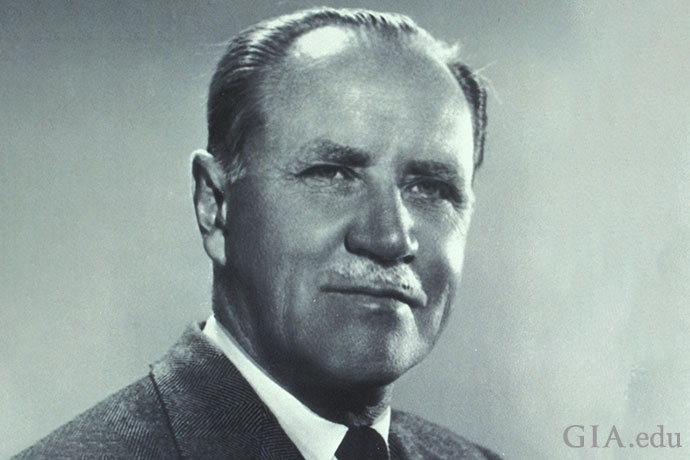
The term 4Cs we know today had its start in the early 1940s, as the brainchild of GIA founder Robert M. Shipley. A former retail jeweler, Shipley was fiercely committed to professionalizing the American jewelry industry. He established an institute (GIA) to provide jewelers with formal training and was a tireless advocate for greater knowledge, ethics and standards when it came to buying and selling gems.

Robert M. Shipley, GIA Founder.

Robert M. Shipley founded the Gemological Institute of America in 1931. Photo: GIA

Shipley developed the 4Cs as a mnemonic device to help his students remember the four factors that characterize a faceted diamond: color, clarity, cut and carat weight. The concept was simple, but revolutionary.

Throughout history, diamond merchants used a variety of different, usually broad, terms to talk about these four factors, rarely with any consistency. Terms such as river or water were used to describe diamonds that were the most colorless, with Cape assigned to pale yellow diamonds from South Africa’s Cape of Good Hope region. To describe clarity, they referred to diamonds as being “without flaws” or “with imperfections.” Cut was described as “made well” or “made poorly.” As a result, it was very difficult for jewelers to communicate those elements of value to their customers or for their customers to remember them. Only the term carat to describe weight has been used consistently from the 1500s to today.

Under Shipley’s direction, the term 4Cs became part of the American gem industry’s vernacular, popularized through advertising campaigns, lectures and GIA education courses. Within decades, they were integrated into the international nomenclature as well.

The 4Cs and the Diamond Grading Scales

Jewelers welcomed Shipley’s innovation, but GIA did not stop there. Shipley’s successor as president, Richard T. Liddicoat (affectionately known as “RTL” by later generations of GIA staff) – along with colleagues Lester Benson, Joseph Phillips, Robert Crowningshield and Bert Krashes – expanded on the 4Cs.

Richard T. Liddicoat, president of GIA from 1952 to 1983.

Richard T. Liddicoat, president of GIA from 1952 to 1983, integrated the 4Cs into GIA’s curriculum and laboratory reports. Courtesy: Norman B. Samuels Portrait Photographers, Los Angeles

Their work included not only development of the now famous GIA D-to-Z Color Scale and GIA Clarity Scale for diamonds, but also the scientific methods and procedures for objectively grading a diamond’s quality.

2.78 carat (ct) D-color round brilliant diamond that is internally flawless.

A 2.78 carat (ct) D-color round brilliant diamond that is internally flawless is a wonder of nature. GIA invented the color- and clarity-grading terminology that is now used internationally to describe diamond quality. Photo: Robert Weldon/GIA. Courtesy: Rogel & Co. Inc.

Color: The GIA D-to-Z Color Scale

Before the 4Cs and RTL’s contributions, a confusing alphabet soup was used to describe a diamond’s color. In communicating color quality to consumers, retailers used competing systems with descriptors like “A,” “AA” and “AAA.” There was virtually no agreement among firms as to what was considered an “A” grade. Most diamond wholesalers used terms like rarest white and top Wesselton, in addition to those mentioned above. In short, there were no standards that allowed for consistent evaluation and comparison.

Since the 1930s, GIA had been working on an accurate, objective color-grading system for colorless to light yellow diamonds. The goal was to develop a system based on absolutes, instead of relative terms and vague descriptions. In 1953, GIA, under RTL’s direction, introduced the GIA D-to-Z color scale, choosing the letter “D” for the top grade (colorless) precisely because the letter had negative associations and so was unlikely to be misinterpreted or misused.

GIA's D-to-Z Color Scale is the industry standard for grading the color of colorless to light yellow diamonds.

GIA’s D-to-Z Color Scale is the industry standard for grading the color of colorless to light yellow diamonds.

In addition to establishing a color scale, RTL and his colleagues defined the methods that would be used to grade a diamond’s color accurately and consistently. These included determining the type of lighting and neutral background with which a diamond should be evaluated, prescribing precisely how the diamond should be held and viewed, and developing master stones: sets of diamonds of predetermined color value against which the subject diamond is carefully compared.

The D-to-Z diamond color terminology RTL and his colleagues pioneered is now used around the world, and strict color-grading procedures are followed by the GIA laboratory.

This engagement ring has a 1 ct center stone surrounded by four diamond side stones. Melee diamonds in a halo setting frame the design and continue down the shoulders of the ring.

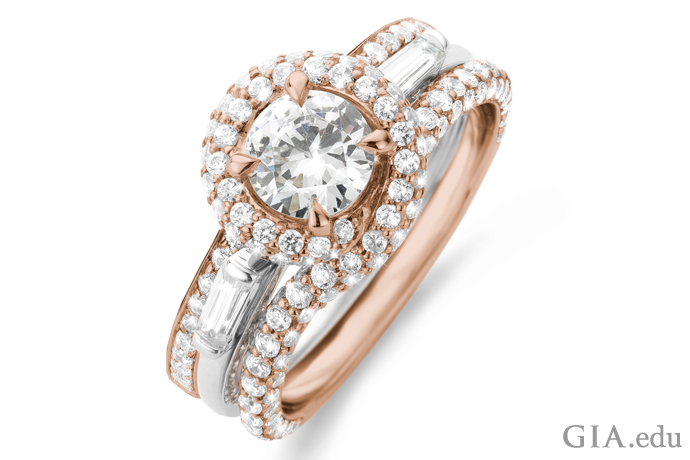
Understanding the 4Cs is essential if you’re shopping for a diamond engagement ring. This one has a 1 ct center stone surrounded by four diamond side stones. Melee diamonds in a halo setting frame the design and continue down the shoulders of the ring. Courtesy: Sylvie Collection

The GIA Clarity Scale contains 11 grades that range from Flawless (FL) to Included (I3).

The GIA Clarity Scale contains 11 grades that range from Flawless (FL) to Included (I3).

Clarity:  The GIA Diamond Clarity Scale – Flawless to I3

Diamond clarity grading was another area that was plagued by inconsistencies in terminology and methods. Some trade professionals used terms like perfect in addition to without flaws and with imperfections, which were vague and imprecise. Others used terms we recognize today, such as VS, VVS, and included, but without any agreed-upon definitions.  RTL and Benson used these terms in creating a clarity-grading scale, but defined precise categories and expanded the number of grades within each category to account for the array of diamonds in the market. Fine-tuned in subsequent years, the GIA Clarity Scale today consists of six categories ranging from Flawless to Included and contains 11 specific grades.

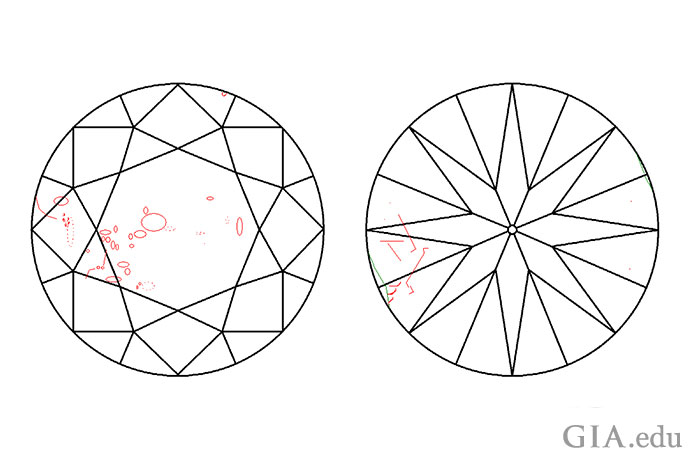
This precision in clarity grading was made possible by another GIA innovation: the introduction of the gemological microscope as a tool for clarity grading. Using the microscope, GIA graders plot the inclusions and blemishes in all diamonds for which a full GIA Diamond Grading Report has been requested.

A plotting diagram, a feature of all GIA Diamond Grading Reports, uses specific symbols to map a diamond’s various inclusions and blemishes.

A plotting diagram, a feature of all GIA Diamond Grading Reports, uses specific symbols to map a diamond’s various inclusions and blemishes.

Cut: Evaluating a Diamond’s Interaction with Light

The impact of Cut – how well a diamond interacts with light – was another attribute that RTL and his associates wanted to better explain and standardize. Originally, RTL turned to the work of Belgian mathematician and diamond cutter Marcel Tolkowsky to help determine “ideal” proportions for a round brilliant cut diamond. RTL’s contribution included a rating system with deductions for proportions that deviated from those.

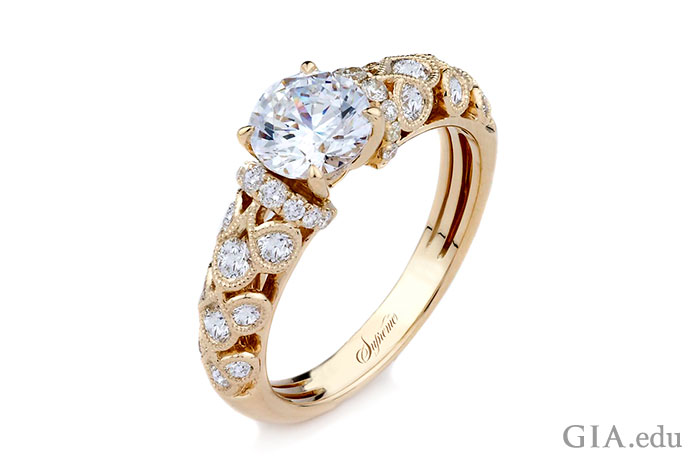
Because of GIA’s efforts to standardize the evaluation of diamond cut, round brilliants such as these can now be objectively graded.

Because of GIA’s efforts to standardize the evaluation of diamond cut, round brilliants such as these can now be objectively graded. Courtesy: Supreme Jewelry

GIA’s system for evaluating cut has been modified over the decades. In 2006, after years of extensive research that included advanced computer modeling and observational studies, GIA introduced the GIA cut grading system for round brilliant cut diamonds. Today, the GIA Cut Scale, ranging from Excellent to Poor, describes how successfully a diamond interacts with light to deliver the brightness, fire and scintillation we associate with a fine round brilliant.

The GIA Cut Scale assesses the overall cut quality of each diamond individually, taking into account such features as proportions, table size, polish and symmetry.

The GIA Cut Scale assesses the overall cut quality of each diamond individually, taking into account such features as proportions, table size, polish and symmetry.

Many factors contribute to the evaluation of a diamond’s cut, including the size of the facets, girdle thickness and total depth.

Many factors contribute to the evaluation of a diamond’s cut, including the size of the facets, girdle thickness and total depth.

More than the 4Cs: The World Standard

Using the latest scientific advances to establish grading standards that provide consistent, repeatable results, GIA has revolutionized the jewelry industry. With the framework provided by the 4Cs, it has transformed the way diamond quality is determined and communicated and, ultimately, how diamonds are bought and sold.

These standards are strictly followed by the GIA laboratory in its nine locations worldwide. They allow GIA to deliver objective, consistent diamond grading results anywhere in the world. It is important to note that although the terminology introduced by GIA has been adopted by other laboratories worldwide, only the GIA laboratory has the proprietary equipment and procedures to grade diamonds to these standards.

All this critical information becomes part of a GIA Diamond Grading Report. With it, you’ll know the essential facts about the diamond you’re considering.

1.37 ct H-color, VS1-clarity round brilliant in a platinum Tiffany & Co. setting.

The GIA Diamond Grading System provides a complete description of diamonds such as this 1.37 ct H-color, VS1-clarity round brilliant in a platinum Tiffany & Co. setting. Courtesy: 1stdibs.com

Why ask for a GIA Diamond Grading Report? Read more and decide for yourself.

October Birthstone: What You Need to Know About Opal

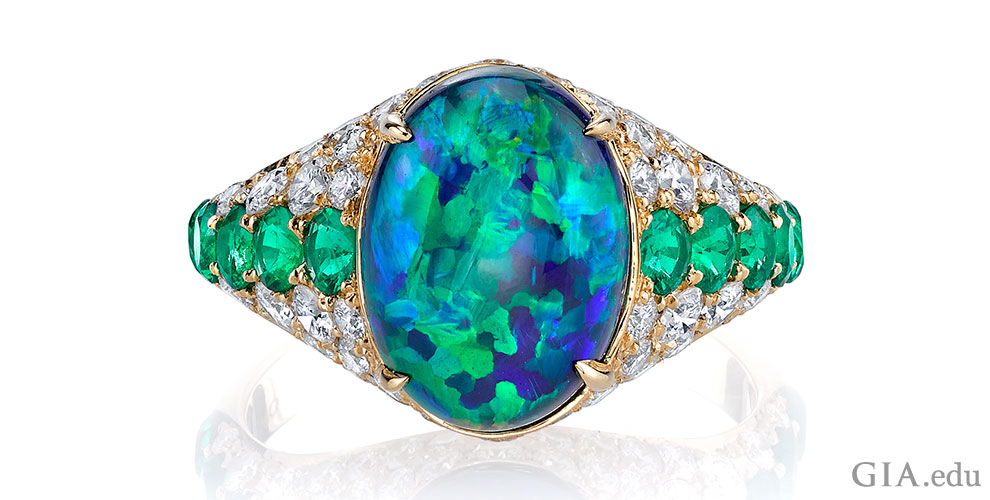
Opal is the October birthstone – and its play-of-color is so mesmerizing that it borders on magical. From coveted black opal, to serene water opal, to blazing fire opal, there’s one for every taste. We help you find your favorite. (more…)

July Birthstone: What You Need to Know About Rubies

Ruby is the July birthstone – and it’s one of the most coveted of gems. Called the “king of gems” in ancient India, today it can command the highest per-carat price of any colored stone. Here’s what you need to know about this beautiful gem.

In this post, we cover:
Gemological Properties of Ruby
Ruby History & Lore
Where Ruby Comes From
Qualities to Look for in Rubies
Ruby Treatments, Care & Cleaning


July Birthstone: Gemological Properties of Ruby

Ruby, the July birthstone, is a variety of the mineral corundum that contains trace amounts of the element chromium, which causes its color. The more chromium present, the stronger the color red. Chromium can also cause red fluorescence, which adds to the intensity of the color. Fluorescence is visible light temporarily emitted by some gem materials when they are exposed to high-energy sources such as ultraviolet light (as in sunlight), X-rays or lasers.

Some rubies form in marble, when heat and pressure act on minerals in limestone. These rubies tend to be highly prized, as they have a higher concentration of chromium and little iron, which is an ideal recipe for a bright red color. They also tend to be highly fluorescent.

Other rubies are found in basalt, which forms when molten lava cools and solidifies. Basalt-hosted rubies typically have significantly more iron than marble-hosted rubies and thus are darker. A higher iron content can also mask the fluorescence, eliminating that extra glow of red color.
Still other rubies form in an amphibole-bearing gneiss (a coarse-grained metamorphic rock). These rubies tend to have good color, though they have more iron than the marble-hosted stones and less than those from basalt.

Gemologists love the July birthstone because synthetic ruby was used to create the first laser in 1960. They also consider chromium to be the “rock star” of trace elements.
Consumers love ruby for its intense red color and because it’s a 9 on the Mohs scale of hardness, just below diamond. As such, it is a very durable stone that holds up well to daily wear in rings and other jewelry.

A look at these earrings featuring 8.16 carats of ruby, 1.78 carats of marquise diamonds, and 1.69 carats of round diamonds shows why we are enchanted by the gem. Courtesy: Omi Privé


July Birthstone: Ruby History & Lore

A prized gem like ruby naturally comes with many attributes. Because it resembles the color of blood, ancients believed it could stop hemorrhaging. The July birthstone was also thought to cure inflammatory diseases and soothe anger. Burmese warriors believed it made them invincible in battle. Medieval Europeans maintained that rubies bestowed health, wisdom, wealth and success in love.

In addition to being the July birthstone, ruby is traditionally given for the 15th and 40th wedding anniversaries.

The Harry Winston Ruby Slippers are a famous example of the July birthstone in a spectacular setting. To commemorate the 50th anniversary of the movie “The Wizard of Oz,” the House of Harry Winston fashioned a pair of red slippers featuring 4,600 rubies weighing an estimated 1,350 carats. When they were created in 1989, they were valued at $3 million.

4,600 rubies weighing an estimated 1,350 carats glitter in the slippers; another 50 carats of diamonds accent the unique creation.

Harry Winston’s famed ruby slippers were exhibited at GIA in December 1997. Some 4,600 rubies weighing an estimated 1,350 carats glitter in the slippers; another 50 carats of diamonds accent the unique creation. Courtesy: Harry Winston


July Birthstone: Where Ruby Comes From

Our search for the July birthstone starts in Myanmar (formerly known as Burma). For more than five centuries, the Mogok area in Myanmar has produced some of the finest rubies – vibrant red beauties softened by light-scattering inclusions and a glowing red fluorescence. The region is a place of weathered marble and ancient Buddhist temples.

Golden spires of a monastery near Mogok are flashes of color along the mountainside.

Golden spires of a monastery near Mogok are flashes of color along the mountainside. Photo: Robert C. Kammerling/GIA

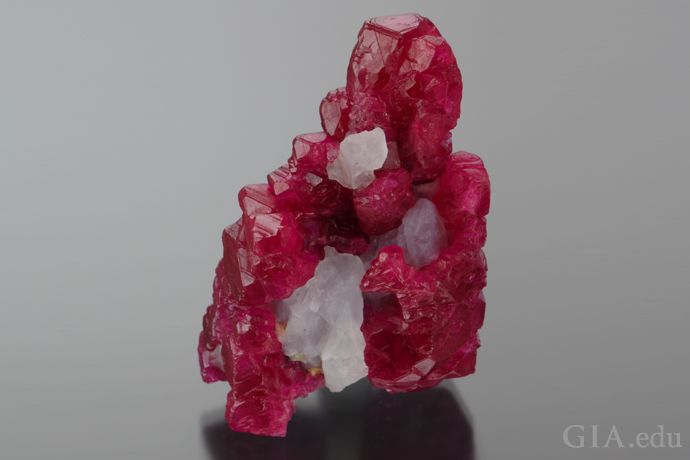
Ruby crystals intertwined with their matrix rival the beauty of finished gems from Mogok.

These ruby crystals intertwined with their matrix rival the beauty of finished gems from Mogok. Photo: Robert Weldon/GIA. Courtesy: Bill and Jeanne Larson

Vietnam is another important source for marble-hosted rubies. The Luc Yen region, where rainforest-clad mountains rise over broad paddy fields, produces rubies of red to purplish red color. Today, artisanal miners work the soil in hopes of finding a gem that will change their fortunes.

Small village sits at the base of the mountains in the ruby-bearing Luc Yen region.

A small village sits at the base of the mountains in the ruby-bearing Luc Yen region. Photo: Vincent Pardieu/GIA

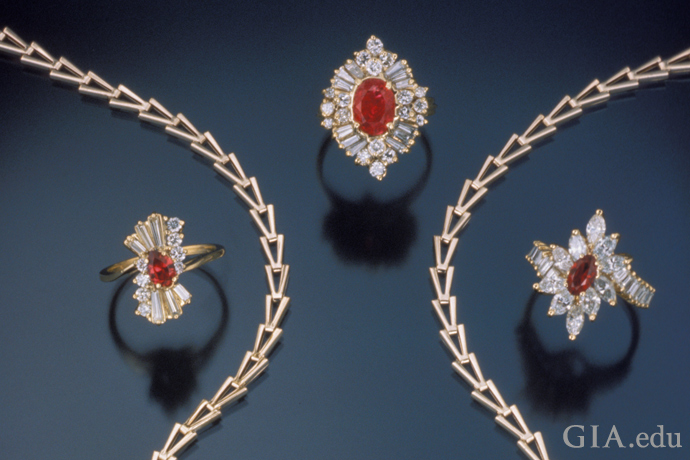
Rubies from Luc Yen and other locales in Vietnam star in these four rings and necklace.

Rubies from Luc Yen and other locales in Vietnam star in these four rings and necklace. Photo: Shane McClure/GIA

4.04 carat (ct) ruby came from Mozambique, the pre-eminent source of commercial and fine rubies.

This fine 4.04 carat (ct) ruby came from Mozambique, the pre-eminent source of commercial and fine rubies. Photo: Robert Weldon/GIA. Courtesy: Evan Caplan, GemFields

Mozambique is an important new, amphibole-related source for the July birthstone. This African nation is home to the prolific mines at Montepuez. Rubies found there have been compared to the famed gems of Mogok.

For many years in the late 1900s, the basalt-related ruby deposits along the border between Thailand and Cambodia were the major source of rubies in the marketplace. Other important producers include Sri Lanka, Tanzania and Madagascar.

Rubies from Madagascar are a bright, slightly orangy red.

Rubies from Madagascar are a bright, slightly orangy red. Photo: Robert Weldon/GIA. Courtesy: Allerton Cushman & Co., Sun Valley, Idaho


July Birthstone: Qualities to Look for in Rubies

  • Color: Color is the most important quality factor for the July birthstone. The finest rubies have a pure, vibrant red to slightly purplish red color. A color that’s too orangy or too purplish is considered less desirable. The highest-quality rubies have vivid color saturation that is not too dark.
  • Clarity: People in the trade expect rubies to have at least some inclusions, because inclusion-free rubies are rare. The impact of inclusions on the value of a stone depends on their visibility. Obvious inclusions or inclusions that reduce transparency or brightness can lower a ruby’s value.
  • Cut: A ruby’s crystal shape dictates its suitability for certain cuts. Ruby crystals often have a flat tabular hexagonal shape, but crystals from some sources may be elongate.
  • Carat weight: Rubies are available in a wide range of sizes, but fine-quality rubies over a carat are rare and, not surprisingly, very expensive.
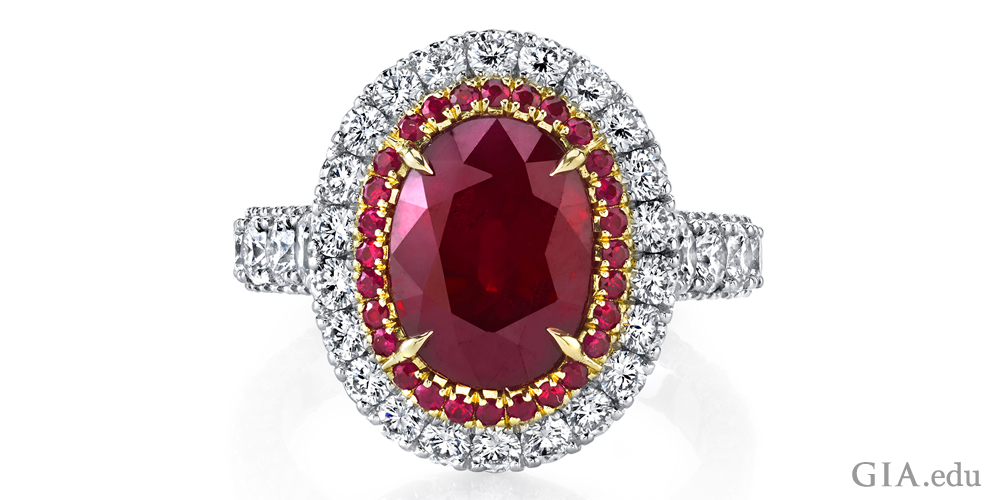
5.00 ct oval ruby is all the more radiant set in 18K rose gold and encircled by 2.53 carats of round diamonds in the halo and band.

This 5.00 ct oval ruby is all the more radiant set in 18K rose gold and encircled by 2.53 carats of round diamonds in the halo and band. Courtesy: Omi Privé


July Birthstone: Ruby Treatments, Care & Cleaning

Using warm soapy water is a safe option to clean ruby, the July birthstone. Ultrasonic and steam cleaners are usually safe for untreated, heat-treated and lattice diffusion–treated stones. Fracture-filled, cavity-filled or dyed stones should only be cleaned with a damp cloth.

Rubies are often heat treated to remove purplish coloration, leaving a purer red. The process can also remove “silk” (minute needle-like inclusions) that can cause a gem to appear lighter in tone and be more opaque. The trade typically accepts heat treatment to enhance color, as the treatment is stable to normal conditions of wear and care.

Lattice diffusion is a technique whereby heat and chemicals are used to diffuse a specific element into a gem to change its color. This treatment, too, is typically stable to normal wear and care.

Fracture filling is when a substance is introduced into surface-reaching fissures to make them less visible and thus improve the gem’s appearance. Common fillers include glass and glass-like substances, polymers and resins, and oils.

A high-lead-content glass is often used to fill fractures in rubies and thus improve their apparent clarity. There are many of these glass-filled rubies in the market, and in some cases the glass literally holds together a highly fractured gem. The glass can be damaged through contact with a variety of chemicals. Even relatively mild substances like concentrated lemon juice can etch the filler.

Dyeing with colored oils and filling small surface fissures with epoxies are other treatments. However, they are not permanent. These treatments need special care.

Always ask if your ruby has been treated before you buy. The Federal Trade Commission requires disclosure of treatments that affect a gemstone’s perceived value. A GIA Identification Report is important in identifying if a stone is natural or synthetic and whether it has been treated in any fashion.

Diamond and ruby bracelet shimmers with 20.56 carats of cabochon-cut rubies from Tanzania.

Reminiscent of the geometric shapes used in Art Deco–era jewelry, this diamond and ruby bracelet shimmers with 20.56 carats of cabochon-cut rubies from Tanzania. Photo: Kevin Schumacher/GIA

Whether or not you have a July birthstone, owning a beautiful ruby is a rare and precious thing. And if you love red gems in general, check out our Red Gemstone Buying Guide – Part 1 and Red Gemstone Buying Guide – Part 2 for some striking alternatives to ruby.

June Birthstone: What You Need to Know About Pearls

Coveted for millennia, the June birthstone still reigns supreme as the queen of modern fashion. Elegant, stylish and organic, pearls come in a rainbow of colors and a range of shapes. Our pearl primer will help you choose beautiful ones.

In this post, we cover:
What Is a Pearl?
Akoya, Tahitian, South Sea and Freshwater Cultured Pearls
Pearl History and Lore
Where Pearls Come From
Pearl Qualities to Look For
Pearl Care and Cleaning

"Black Star" faceted Tahitian pearl

Faceted pearls are not your traditional cultured pearls. These avant-garde beauties can have 200+ facets on their surface. Photo: Robert Weldon/GIA. Courtesy: Victor Tuzlukov


June Birthstone: What Is a Pearl?

A pearl is an organic gem that grows inside saltwater and freshwater mollusks. These soft-bodied animals possess one (univalve) or two (bivalve) shells. Mollusks are invertebrates, meaning they lack a spine or vertebrae.

Gemologists divide the June birthstone into two categories:

  • Natural Pearls: Pearls form without human intervention. When an irritant enters a mollusk, the mollusk secretes a mixture of calcium carbonate and conchiolin (called nacre). Like a protective shell, the nacre covers the irritant. Although used for adornment for thousands of years, today natural pearls are extremely rare and make up only a small fraction of total pearl sales.
Edwardian natural pearl necklace with alternating light and dark pearls

Natural pearls are the focal point in this necklace from the Edwardian era. Photo: Robert Weldon/GIA

  • Cultured Pearls: These are a product of human intervention. Technicians implant a piece of mantle tissue alone (common for freshwater cultured pearls) or with a mother-of-pearl shell bead (all saltwater) into a host mollusk. The mollusk covers the irritant with nacre, just like a natural pearl. Cultured pearls are raised in pearl farms – saltwater or freshwater operations where the mollusks are cleaned, protected from predators and eventually harvested. Cultured pearls account for the vast majority of pearl sales.


Cultured Pearls: Akoya, Tahitian, South Sea and Freshwater

Scientists estimate there are more than 100,000 different species of mollusks in the world’s waters. However, only a few dozen of these species produce the June birthstone and only about half of them are used to produce cultured pearls. Cultured pearls are classified by the species of mollusks that produce them.

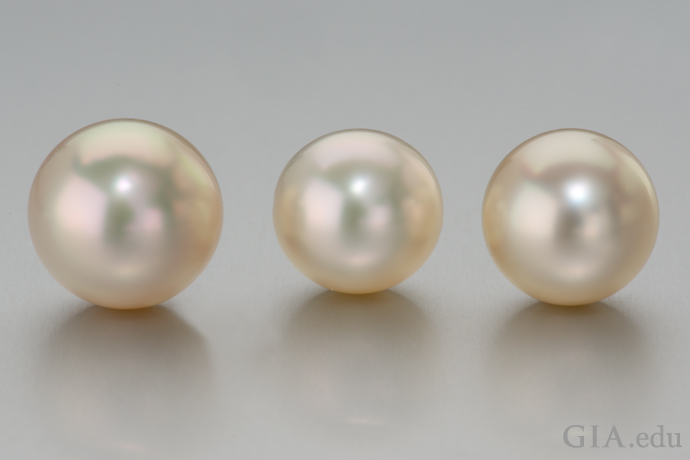
Three akoya cultured pearls

Akoya cultured pearls have an undeniable elegance. Photo: Robert Weldon/GIA

Akoya Cultured Pearls: The saltwater Pinctada fucata oyster produces white and cream-colored cultured pearls, generally between 2 and 11 mm in diameter, with the average being 6 to 8 mm. Akoya cultured pearls are often perfectly round and have a high luster (the light reflected from or near the pearl’s surface). Most akoya cultured pearls are commercially produced in Japan and China.

A necklace showing the many colors of Tahitian cultured pearls

The many different colors of Tahitian cultured pearls are on display in this exceptional necklace, which features 27 cultured pearls that range from 13 to 19 mm. Photo: Robert Weldon/GIA. Courtesy: A Private Collector and Mona Lee Nesseth, Custom Estate Jewels

Tahitian Cultured Pearls: Famous for their exotic, almost luminescent colors, these are the product of the saltwater Pinctada margaritifera oyster, which is native to the islands of French Polynesia. The mollusk produces pearls in bodycolors sometimes described in the trade with names like aubergine (dark grayish purple), pistachio (yellowish green to greenish yellow), or peacock (dark green-gray to blue-gray, with pink to purple overtones). Tahitian cultured pearls generally range from 9 to 14 mm in diameter, most commonly 9 to 11 mm.

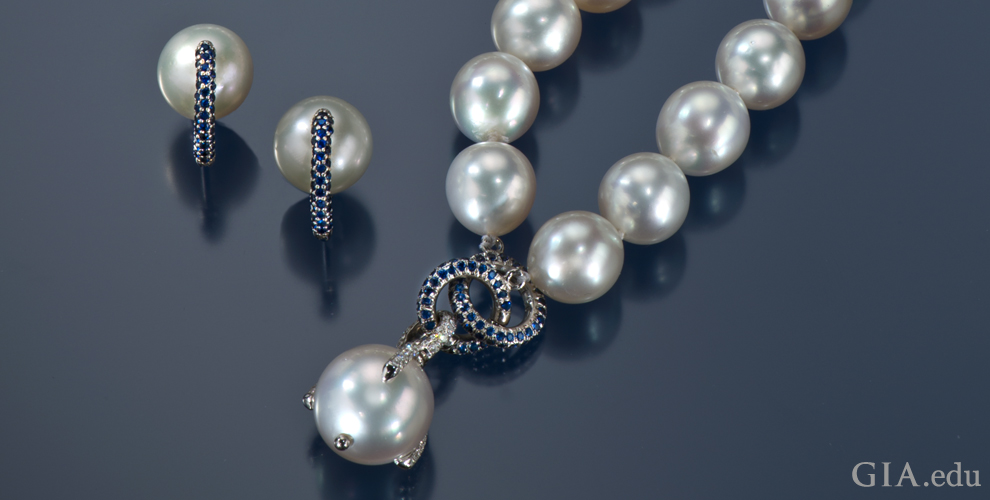
Semi-round South Sea cultured pearl necklace with blue sapphire accents

This necklace of semi-round South Sea cultured pearls with blue sapphire accents makes a breathtaking statement. Photo: Robert Weldon/GIA. Courtesy: Atelier Marisa

South Sea Cultured Pearls: The Pinctada maxima oyster is the largest of all saltwater cultured pearl oysters, and it can produce pearls from 8 to 20 mm in diameter; the average is 13 mm. There are two types of Pinctada maxima oysters: silver-lipped and gold-lipped. The silver-lipped oyster produces pearls that are mostly white to silver, sometimes with pink, blue or green overtones. The gold-lipped oyster produces mostly yellow to orangy yellow pearls, called “gold” or “golden” in the trade.

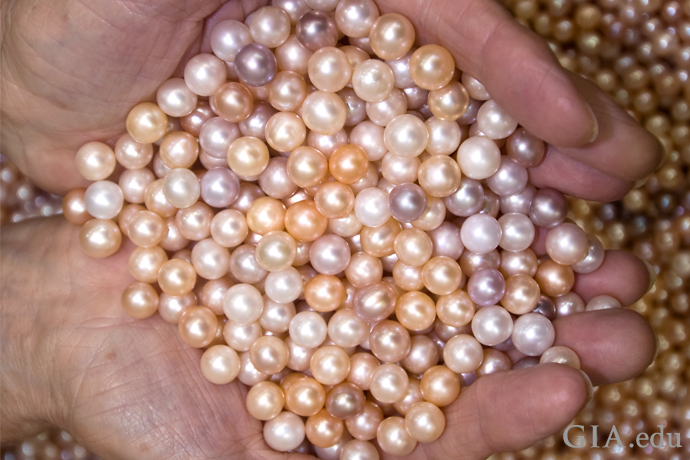
A handful of freshwater cultured pearls in many colors

Pearls come in many colors, like these freshwater cultured pearls from China. Photo: Robert Weldon/GIA

Freshwater Cultured Pearls: From the mussel Hyriopsis cumingii or a hybrid, these pearls are produced primarily in the lakes, ponds and rivers of China. They come in many shapes, sizes (up to about 20 mm) and natural colors, including white, orange, lavender and purple. They are also dyed in a wide array of colors.

Gemologists love the June birthstone because of its luster – the reflection of light off its surface, and from concentric layers of nacre, like light bouncing off a convex mirror. Pearl’s texture also fascinates: Natural and cultured pearls have a slightly rough feeling when rubbed against your teeth, while imitation pearls are smooth. However, gemologists use X-rays to examine a pearl’s inner structure, which allows them to conclusively separate natural from cultured pearls.


June Birthstone: Pearl History and Lore

The origin of pearls fascinated our forebearers. Ancients from the Middle East believed that pearls were teardrops fallen from heaven. The Chinese fancied that the June birthstone came from the brain of a dragon. Christopher Columbus and his contemporaries thought that mollusks formed pearls from dew drops.

Pearls have long been associated with purity, humility and innocence. So it may be said that the June birthstone meaning is “sweet simplicity.” As such, pearls were traditionally given as a wedding gift.

The June birthstone was also thought to have beneficial properties. In the ancient Sanskrit text, the Atharvaveda, pearls were said to bestow long life and prosperity. In Asia, pearls were believed to help alleviate indigestion and hemorrhages. Arab physicians in the 1820s maintained that pearl powder improved eyesight, quieted nervous tremors and eased depression.

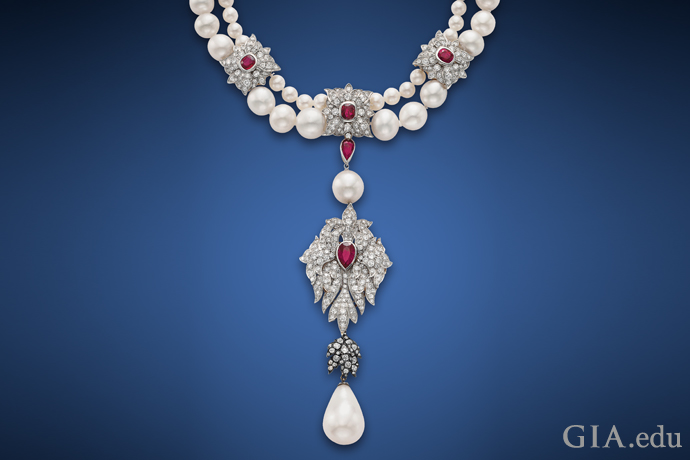
One of the most famous natural pearls is the 50.56 carat (ct) La Peregrina. About the size of a pigeon’s egg, the pearl was discovered in the 1500s in the Gulf of Panama. It became a prized possession of European royalty. Richard Burton eventually gifted it to Elizabeth Taylor in 1969; Christie’s New York auctioned it in 2011 for $11.8 million.

A two-strand necklace with 50.56 ct natural pearl pendant, accented with 56 saltwater natural pearls, four cultured pearls, rubies and diamonds

Literally a royal gem, Elizabeth Taylor’s 50.56 ct La Peregrina pearl was owned by eight Spanish kings, from Philip II (1582-1598) to Carlos IV (1778-1808). Cartier set the pearl as part of the pendant in this two-strand necklace that has 56 saltwater natural pearls, four cultured pearls, rubies and diamonds. Courtesy: Christie’s


June Birthstone: Where Pearls Come From

You’ll have to set sail for pristine waters if you want to find the June birthstone. Pearl-bearing mollusks fail to thrive in polluted waters, so pearl farms are usually located far from civilization – and often in breathtaking settings.

Saltwater pearls are grown in many areas around the world. Akoya cultured pearl farms are primarily found in Japan and China, especially along the southern coasts of Guangdong and Guangxi provinces. South Sea cultured pearls are farmed from the northern coast of Australia through Indonesia to the southern coast of Southeast Asia, with large operations in the Philippines as well. The Gambier Islands and the Tuamotu Archipelago, both part of French Polynesia, are two locales where the rich black Tahitian pearls are cultured.

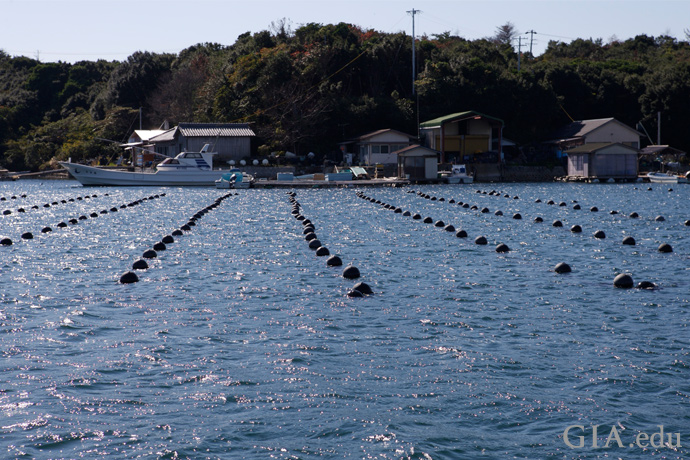
An akoya cultured pearl farm in Ago Bay, Japan

Ago Bay, Japan is one of the most important sites for akoya cultured pearl farms. Photo: Valerie Power/GIA

Freshwater cultured pearls are primarily grown in China, within a 400 mile (644 km) radius of Shanghai.

A cultured pearl farm in French Polynesia

The breeding waters of a cultured pearl farm in French Polynesia look like a piece of paradise. Photo: Amanda Luke/GIA

Natural pearls have been found in the Arabian Gulf (Persian Gulf) for at least 5,000 years, while divers have been recovering the June birthstone from the Red Sea since 300 BCE. The Strait of Mannar has been providing pearls since 2000 BCE. Starting in the 16th century, during Spanish colonial rule, large quantities of pearls were recovered from the waters off Mexico, Central America and what is now Venezuela. Only small quantities of pearls are found in any of these areas today.


June Birthstone: Pearl Qualities to Look For

As you’re shopping for pearls and comparing quality and prices, keep in mind the seven factors gemologists use to evaluate and describe the quality of the June birthstone. Known as the GIA 7 Pearl Value FactorsTM, they are:

  1. Size: Pearl measurements are stated in millimeters, rounded to the nearest 0.5 mm. All things being equal, the larger the pearl, the greater its value.
  2. Shape: GIA categorizes pearls as one of seven shapes:
    • Round
    • Near-round (almost round, with minor variations)
    • Oval
    • Button (symmetrical, circular and flattened)
    • Drop (symmetrical, rounded or pear shaped)
    • Semi-baroque (not quite symmetrical; an off-round)
    • Baroque (has no apparent symmetry and is noticeably irregular)
  3. Color: Pearl color has three components:
    • Bodycolor – The dominant, overall color of the pearl
    • Overtone – A translucent color that appears to layer over a large area of the pearl’s surface
    • Orient – More than one translucent color over the bodycolor, or surface iridescence
  4. Luster: The intensity and sharpness of the light reflected from a pearl’s surface. There are five categories of luster: excellent, very good, good, fair and poor.
  5. Surface: The nature and number of blemishes or irregularities on the pearl. As products of nature, few pearls are completely blemish free. Pearl surface is described as clean, lightly spotted, moderately spotted, or heavily spotted.
  6. Nacre Quality: The thickness and regularity of the nacre. For nacre quality to be acceptable on a bead-nucleated cultured pearl, no evidence of the bead should be visible and there should be no chalkiness.
  7. Matching: This factor applies when evaluating a strand of pearls or a jewelry item with two or more pearls. Excellent matching requires a uniform appearance across all the pearls, with the drill hole on center.

You should also know that cultured pearls routinely undergo treatment to improve their appearance. Some may be color enhanced by heating, dyeing, irradiation and coating. Other treatments include:

  • Bleaching – To whiten them and create a uniform appearance
  • Tinting – The use of a red dye to turn akoya cultured pearls pink (also called pinking)
  • Buffing – Tumbling pearls in a canister (or similar device) to remove surface imperfections
Diamond and Tahitian cultured pearl cluster earrings

Take special care when cleaning pearl jewelry like these diamond and Tahitian cultured pearl earrings. Photo: Robert Weldon/GIA. Courtesy: Mastoloni, New York


June Birthstone: Pearl Care and Cleaning

Pearls are 2.5 to 3.0 on the Mohs Scale of hardness, so they are a comparatively soft gem and require special care. Store them separately from other gemstones and metal jewelry to prevent scratching. Never store pearls in a plastic bag — plastic can emit a chemical that will damage their surface. Always apply perfume, hair products and cosmetics before putting on your pearl jewelry. The best way to clean your June birthstone: Use a soft, damp cloth, ideally after each time they are worn.

Read more tips on how to care for pearl jewelry to keep your watery treasures beautiful.

June is a month for celebrations, be it weddings, anniversaries, graduations or birthdays. And what better way to celebrate than with the June birthstone. From a classic strand of akoya cultured pearls to a single faceted Tahitian cultured pearl, there’s a look for every taste and budget.

Pearls are trending. Five Easy Pieces shows how to wear them with style.

GIA Diamond Grading Reports: Understanding Carat Weight

If you’re shopping for a diamond, carat weight is probably one of the important things you’re considering. It seems like a straightforward measurement, but there is more to it than a simple number. Here’s essential information you need to know.

In this post, we cover:


What Is Carat Weight?

Diamond weight is stated in metric measurements called carats. One carat is equal to 200 milligrams, which is 1/5 of a gram or 0.20 gram. There are 142 carats in an ounce. Carat is also the standard unit of weight for most gemstones.

The modern carat system has its roots in the carob seed, which comes from the locust tree. Because the small seeds are fairly uniform in size and weight, they were a useful standard for determining the weight of a gem. Early gem merchants and jewelers used carob seeds as counterweights in hand-held balance scales.

Carat weight was standardized as 0.20 gram in the early twentieth century. This gave trade professionals a uniform and universally accepted weight standard for diamonds.

Carob seeds and carob pods

Notice that the seeds from the carob pods are nearly identical in size. Photo: Orasa Weldon/GIA

Carat is abbreviated as “ct” and weights are typically given to two decimal places: 1.00 ct, 0.76 ct, 1.57 ct.

Like the dollar, a carat is made up of 100 parts, called “points” and abbreviated as “pt.” An easy way to remember this is to think of carats as dollars and points as pennies. They’re even written the same way: $1.34 means one dollar and 34 cents, and 1.34 ct means one carat and 34 points.”

A necklace featuring a 25.04 ct pear shape diamond suspends from 64.24 carats of diamonds

If you like big diamonds, you’ll love this necklace. The large pear shape weighs 25.04 ct, and it is suspended from another 64.24 carats of glittering diamonds. Photo: Robert Weldon/GIA. Courtesy: Chatila


How Does GIA Measure Diamond Carat Weight?

When a diamond is submitted to GIA, one of the first steps in the grading process is to determine its weight. To ensure precision, accuracy and consistency, GIA uses an electronic micro-balance scale to weigh each diamond. GIA adheres to strict calibration and maintenance procedures for its devices. These procedures exceed the manufacturer’s recommendations. In addition, the laboratory monitors and controls environmental conditions that might affect the quality of the results, such as room temperature and humidity.

Diamonds being weighed on an electronic mirco-balance scale

Diamonds submitted to GIA are weighed on an extremely sensitive electronic micro-balance scale. Photo: Valerie Power/GIA

The diamond’s dimensions are also measured. An optical measuring device captures the diamond’s measurements (length and width), as well as its proportions and facet angles, which will eventually inform the diamond’s cut grade.


Diamond Carat Weight and Rounding Up (or Down)

While most trade professionals typically weigh diamonds to a thousandth of a carat (three decimal places), GIA weighs diamonds to the fifth decimal place – a hundred thousandths of a carat, to ensure maximum precision and provide an identifying characteristic.

The rounding rules GIA follows are also stricter than normal mathematical rounding rules. As mentioned above, a diamond’s carat weight is conventionally stated to two decimal places (0.71 ct, 1.34 ct). To arrive at this number, GIA rounds up to the next higher hundredth only if there’s a nine in the thousandth place. For example, a diamond that weighs 1.769 ct would be rounded up to 1.77 ct, but one that weighs 1.768 ct would be rounded down to 1.76 ct. Such differences in carat weight might seem small, but they can make a significant difference in price.

Five fancy color diamonds provide an example of relative diamond size

Get a sense of relative diamond size with this photo. From left to right: a yellow princess cut (0.86 ct), a pink round brilliant cut (0.68 ct), a gray-blue round brilliant (0.56 ct), a gray round brilliant (0.30 ct) and a blue-green round brilliant (0.15 ct). Photo: Robert Weldon/GIA

Once the diamond has been graded, its carat weight and dimensions — as well at its color, clarity and cut grade (if applicable) — are clearly documented on a GIA diamond grading report. Also included is full disclosure of any diamond treatments detected during the process.

A GIA Diamond Grading Report shows a diamond’s weight

The diamond’s weight is prominently stated on a GIA Diamond Grading Report. Photo: GIA


Why Is Carat Weight Important?

All other factors being equal, the price of a diamond increases as its carat weight increases. Since diamonds 1.00 ct or larger are comparatively rare, prices jump dramatically for these gems.

Carat weight also helps you compare prices between diamonds with different weights but the same color, clarity and cut grades, allowing you to compare the per carat price for each stone to see where you’re getting the best value.


Carat Weight and Shopping Considerations

Here are a few concepts related to carat weight that you should be aware of as you’re shopping:


Carat Weight and Gemstone Size – Two Different Things

It’s a common mistake to equate a gem’s carat weight with its physical dimensions. After all, it seems logical that a larger stone will weigh more. This is true if you’re comparing two stones of the same gem material – like a diamond to a diamond, or an aquamarine to an aquamarine.

However, size is a function of the gem material’s specific gravity – the ratio of the weight of a gem to that of an equal volume of water. Materials with different specific gravities (densities) will have different sizes for the same weight (think of an ounce of lead compared to an ounce of feathers). For example, the specific gravity of diamond (3.52; that is, 3.52 times the same volume of water) is lower than that of ruby (4.0), so a one-carat diamond will be larger than a one-carat ruby.

The bigger the diamond, the more bang for your buck?

Not always. When it comes to diamonds, greater carat weight does not guarantee that the diamond will look bigger. For example, a poorly cut diamond may be too deep and have weight hidden below the girdle. You won’t see this weight when the diamond is mounted, and it won’t make the diamond more appealing – but the diamond will weigh more.

An illustration of a diamond showing excessive bulge as seen by gray areas on either side of the outline

Excessive bulge, shown by the gray areas on either side of the outline, adds to a diamond’s weight without contributing to its beauty or perceived size when viewed face-up. Illustration: Peter Johnston/GIA


Magic Sizes

As mentioned earlier, for diamonds that are equal in every way, diamond value increases as weight increases. At certain weight boundaries, called “magic sizes,” the price per carat increases significantly. That’s because these boundaries or thresholds coincide with popular weights, and popularity means greater demand and therefore higher prices for these weights. This is especially true at the magic one-carat size.

A graph showing punctuated increases of diamond values as they reach certain weights

Diamonds increase in price at magic sizes like 0.25 ct, 0.50 ct, 0.75 ct and 1.00 ct. Illustration: Peter Johnston/GIA

A quick comparison of two diamonds shows how magic sizes can affect price. If one diamond weighs 0.96 ct and another weighs 1.02 ct, the 6 pt (0.06 ct) difference in size is almost imperceptible. But if both are D-color round brilliants with identical clarity and cut, the difference in cost is significant. The fact that the second diamond is slightly over the “magic” one-carat threshold may cause its price to be as much as 20 percent more.

A 1.07 ct diamond engagement ring

The 1.07 ct diamond in this Tiffany & Co. ring is a magic size. Courtesy: TrueFacet

Nevertheless, for some people carat weight is symbolic, so they will pay the higher price to reach the magic size.
There is another side to magic sizes – if you think they’re unimportant, you can look for a diamond that weighs slightly less than one of these boundaries and save money.

Carat weight isn’t everything

If you want the largest diamond you can afford, you’ll have to sacrifice clarity, color and/or cut, which may mean sacrificing beauty and sparkle. Choosing a diamond means prioritizing the 4Cs, and then making some compromises. Here is a thoughtful look at determining what’s the most important C for you.


Total Carat Weight

Understanding diamond terminology is essential if you’re going to make a smart purchase decision. “Total carat weight” (abbreviated tcw) is the combined weight of all the diamonds in a piece of jewelry that only contains diamonds.

An engagement ring set with many small melee diamonds weighing 2.15 tcw will cost significantly less than a solitaire engagement ring set with a single 2.15 ct diamond. Again, think size/rarity/price.

Cushion cut diamond and platinum engagement ring surrounded by a halo of melee and natural pink diamonds

This Tiffany & Co. engagement ring has a cushion cut diamond, weighing 0.84 ct, surrounded by 0.06 carats of natural pink diamonds and 0.34 carats of melee. The total carat weight is 1.24 tcw. Courtesy: TrueFacet.

If an engagement ring has gems other than diamonds in it, the combined weight of all the stones is called “total gem weight.”


The Difference between Carats, Karats and Carrots

Here’s a last bit of terminology that we need to explain. As you know by now, a carat is a metric unit of measure to describe the weight of a diamond and other gemstones. Karat (abbreviated as K) is the measure of the purity of gold. A karat has 24 parts, so 18K gold would mean that the metal is 18 parts gold and 6 parts of other metals (such as copper, silver and/or zinc). Carrots, well, that’s something rabbits are famous for eating.

A diamond engagement ring is a once-in-a-lifetime purchase that is a symbol of your love. Understanding carats and points can help you with this “weighty” decision.

In addition to carat weight, a GIA grading report contains a wealth of information about your diamond. If you’d like to dig deeper, you’ll be interested in the other articles in this series:

GIA Diamond Grading Reports: Understanding the Diamond Color Grade
GIA Diamond Grading Reports: Understanding the Diamond Clarity Plotting Diagram
GIA Diamond Grading Reports: Understanding Diamond Cut Grades

May Birthstone: What You Need to Know About Emerald

With spring in full bloom and summer just around the corner, emerald is the perfect choice for the May birthstone. Kings and queens have prized the sought-after green gem for centuries. Here’s how you can pick a breathtaking one.

In this post, we cover:
Gemological Qualities of Emerald
Emerald History & Lore
Where Emerald Comes From
Emerald Qualities to Look For
Emerald Care & Cleaning


May Birthstone: Gemological Qualities of Emerald

Emerald’s green has been the standard by which other green gemstones have been measured for thousands of years. It is the rich green to bluish green variety of beryl, a mineral species that also includes aquamarine and varieties in other colors.

Trace elements that cause emerald’s color include chromium, vanadium and iron. As a general rule, the higher the chromium or vanadium content, the more intense the green color. The more iron present, the greater the degree of blue. When iron content is relatively high, emerald is a bluer green. When iron content is relatively low, the May birthstone is a purer green.

The difference between an emerald and a less-expensive green beryl is a matter of debate among gem experts. Some in the trade describe the May birthstone as any green beryl colored by chromium. However, gemologists, gemological laboratories and most colored stone dealers, think it is incorrect to call a green beryl an emerald when its color is “too light.” There are differences of opinion even in this group about the definition of “too light.” GIA settles the debate by using lab-graded comparison stones to determine if the green color is sufficiently dark and saturated to be called emerald.

Gemologists love the May birthstone for its inclusions. Emeralds from Colombia can have fascinating characteristic inclusions – called three-phase inclusions – that consist of tiny crystals of rock salt, a liquid and a bubble of gas.

The best emerald crystals are also gorgeous flat-topped green hexagonal columns that can rival the beauty of faceted stones.

A 47 carat rough emerald crystal

Weighing in at 47 carats, this rough emerald crystal from the Muzo mine in Colombia is so beautiful that it may put to rest all debates about color. Photo: Robert Weldon/GIA. Courtesy: Jon Sigerman


May Birthstone: Emerald History & Lore

From Egyptian pharaohs to Inca emperors, emerald has enchanted royalty. Cleopatra was known to have a passion for emerald, and used it in her royal adornments. The legendary Crown of the Andes, fashioned in colonial South America, is one example of how the Spanish revered the May birthstone. According to lore, its largest stone—now called the Atahualpa emerald—was taken from the last Inca emperor, Atahualpa, by conquistador Francisco Pizarro. The modern recovery of the Spanish galleon Nuestra Señora de Atocha shows the length generations of treasure hunters would go to recover its sunken loot.

The word “emerald” comes from smaragdos, ancient Greek for a green gem. Roman author Pliny the Elder, who died in the 79 CE eruption of Mt. Vesuvius, wrote in his encyclopedic Natural History that “nothing greens greener.” He also stated that the May birthstone had therapeutic properties that helped gem cutters: “(they) have no better method of restoring their eyes than by looking at the emerald, its soft, green color comforting and removing their weariness and lassitude.” Science now proves this belief: The color green relieves stress and eye strain.

An emerald and diamond necklace totaling 41.97 carats

An emerald necklace sure to soothe the eye, this beauty has 52 emeralds, with a total weight of 32.86 carats, and 160 diamonds, with a total weight of 9.11 carats. Photo: Robert Weldon/GIA. Courtesy: Ismael Daoud

Emerald was also thought to have magical powers. By placing it under the tongue, one could see into the future. Some believed the May birthstone offered protection against evil spells, cholera and malaria. Others thought it made one an eloquent speaker and exposed lovers who made false promises.

Emerald is traditionally given for the 20th and 35th wedding anniversaries.

The Crown of the Andes is set with a 24 ct emerald center and 442 additional emeralds

The Crown of the Andes, now at the Metropolitan Museum of Art in New York City, boasts an impressive 24 ct emerald center stone and 442 additional emeralds set in the golden headpiece. Photo: Dr. E. J. Gübelin/GIA


May Birthstone: Where Emerald Comes From

Colombia has been the source of the finest emeralds for more than 500 years, and they have been the standard by which all others are measured. Three mining sites in Colombia are particularly noteworthy: Muzo, Chivor and Coscuez. Emeralds of slightly different hues are found at each of these sites. Each locality produces a range of colors, but generally speaking, darker tones of pure green emeralds come from Muzo. Emeralds that are lighter in tone and slightly bluish green are associated with Chivor. Slightly yellowish green emeralds are unearthed in Coscuez.

A 38 carat emerald crystal cluster

This 38 carat cluster of emerald crystals originated from Colombia’s Muzo Mine. Photo: Robert Weldon/GIA. Courtesy: Ismael Daoud

A 4.50 ct polished emerald

Chivor, Colombia is the source of this 4.50 ct emerald. Photo: Robert Weldon/GIA


An 88.4 gram emerald crystal cluster

This 88.4 gram emerald crystal cluster is from Coscuez, Colombia. Photo: Robert Weldon/GIA. Courtesy: Gene Meieran

Emeralds are also found in the state of Minas Gerais, Brazil. One of the most productive sites for the May birthstone is the sophisticated Belmont Mine. Capoeirana is another important locality, a rugged region worked largely by independent miners and small-scale operations.

An independent miner holds a rough emerald

An independent miner at the Capoeirana mining area holds a rough emerald. Photo: Eric Welch/GIA

The May birthstone can also be found in Africa. Zambia is a major source, and mines in the Ndola Rural Restricted Area are known for producing emeralds that are bluish green and darker in tone. Pakistan and Afghanistan are important producers as well.

A 240 carat emerald drop necklace

The 240 carats of emeralds in this drop necklace come from Zambia. Photo: Robert Weldon/GIA. Courtesy: Sanjay Chordia, BEACAB GEMS INC.


May Birthstone: Emerald Qualities to Look For

Color: The most important quality factor in the May birthstone is color. Emeralds that are bluish green to green, with strong to vivid saturation and medium to medium-dark tone, are the most coveted. Emeralds that are highly transparent are especially valuable.

Clarity: Emeralds typically contain inclusions that are visible to the unaided eye. Because of this, jewelry professionals and some consumers understand and accept the presence of inclusions in emeralds. Eye-clean emeralds are especially valuable because they’re so rare.

Emerald inclusions are often described as looking mossy or garden-like. They’re sometimes called jardin, which is French for “garden.”

In colored stones, transparency and clarity are closely linked. This is especially true for emeralds. Jewelry professionals generally accept some eye-visible inclusions in higher-quality emeralds. But when the quantity or nature of the inclusions has a negative effect on transparency and clarity, they also dramatically reduce value.

Cut: Emerald crystals are difficult to cut. Almost all rough emeralds have significant fractures (sometimes called fissures) and a gem cutter must work to minimize the effect of those fractures on the appearance of the finished stone.

These inherent fissures make emeralds more brittle than other gems. Consequently, they are vulnerable to damage during cutting, polishing and setting–or even from careless daily wear.
The famous rectangular “emerald cut,” with its beveled corners and two, three or four concentric rows of facets, maximizes the shape and weight of the original emerald crystal. It also helps protect against damage because the vulnerable corners are faceted and provide a comparatively safe place for prongs.

Carat Weight: Fashioned emeralds come in a wide range of sizes. There are emeralds in museums and private collections that weigh hundreds of carats. At the other extreme are tiny emeralds that weigh fractions of a carat.

A 3.69 ct emerald ring with six diamond side stones

Take extra caution when caring and cleaning for emerald jewelry like this 3.69 ct emerald ring flanked with six diamond side stones. Photo: Robert Weldon/GIA. Courtesy: Ismael Daoud


May Birthstone: Emerald Care & Cleaning

Emerald is a 7.5 to 8 on the Mohs scale of hardness, so it is more susceptible to scratching than a diamond, which ranks 10 on the scale. The May birthstone is often treated to improve its color and clarity. Common treatment methods include:

  1. Dyeing: Paler porous or fractured emeralds are dyed green to enhance their color.
  2. Fracture Filling: Oils, waxes and artificial resins are sometimes used to fill surface-reaching fractures in emeralds. The goal is to reduce the visibility of the fractures and improve the apparent clarity. The volume of filler material present can range from insignificant to major; these substances have varying degrees of stability.

Emerald requires some special care; avoid exposure to heat, changes in air pressure (such as in an airline cabin) and harsh chemicals. Never put an emerald in an ultrasonic cleaner. Filled emeralds can also be damaged by exposure to hot water used for washing dishes.

The May birthstone is perfectly suited to the celebration of life blooming everywhere. Now you can treat yourself – or a loved one – to an emerald that captures the exuberance of the season. Learn more about how to pick a beautiful emerald with our Emerald Buying Guide.

Melee Diamonds: Tiny Diamonds, Big Impact

Look at a beautiful engagement ring and you might see small diamonds, called melee diamonds (pronounced meh-lee), that accent the center diamond and make the ring pop. Melee diamonds are a popular way to add sparkle to diamond engagement rings.

So what do you need to know about melee diamonds to make an informed purchase?

In this post we’ll cover:
What Are Melee Diamonds
How Melee Diamonds Are Cut
Popular Ring Settings for Melee Diamonds
Melee Diamonds and Your Engagement Ring


What Are Melee Diamonds?

GIA defines melee as small diamonds, either single cut or full cut (see definitions below), weighing less than 1/5 carat (ct). However, the exact size range of melee varies from country to country and from one segment of the trade to another. Melee diamonds can be as small as 0.001 ct (1/1000 of a carat). They are often cut into tiny round diamonds and set around a center stone or on the band.

Hundreds of melee diamonds glitter on a table.

Hundreds of melee diamonds glitter on a table, waiting to be sorted. Photo: GIA


How Are Melee Diamonds Cut?

Melee diamonds are produced in large quantities in factories that use the latest diamond cutting equipment. High-tech machines have reduced the amount of labor required and improved the quality of the finished product, but cutting and sorting melee is still a labor intensive business. The city of Surat in India is an important manufacturing hub for diamonds, including melee which are faceted, sorted, and sold in parcels of 100 carats or more to jewelry manufacturers who then set them in a wide array of jewelry.

Typical faceting styles for melee include:

  • Single cut: A cutting style with a round girdle outline and 17 or 18 facets, depending on whether a culet is present, including a table, eight crown facets, eight pavilion facets and (very rarely) a culet
  • Full cut: A round brilliant-cut with 57 or 58 facets, depending on whether a culet is present, including 32 crown facets, 24 pavilion facets, a table and (usually) a culet
Sorting small rough diamonds by hand at Alrosa's Lomonosov mine,.

Sorting small rough diamonds by hand at Alrosa’s Lomonosov mine, Arkhangel, Russian Federation. Photo: Russ Shor/GIA


Popular Ring Settings for Melee Diamonds

The more diamonds in a ring, the more sparkle it has. Due to their small size, melee diamonds are inexpensive when compared to larger diamond center stones, so they are often generously used in engagement ring designs to add sparkle. You’ll also find them as dazzling accents in watch faces, earrings and pendants – really in any piece of jewelry that calls for added sparkle and brilliance.

  • Halo setting: Melee diamonds are the building blocks for this popular setting, where tiny diamonds encircle the center stone. This style can add sparkle to a ring and draw attention to the center stone and make it appear larger.
Engagement ring featuring a halo setting of melee diamonds.

A halo of melee diamonds makes this engagement ring all the more dazzling. Courtesy: Ziva

  • Pavé setting: Pronounced “pah-vey” from the French for “to pave,” is a style of bead setting in which many small gems, like melee diamonds, are set close together to create an interlocking honeycomb pattern. It makes for a dramatic, sparkling look and it’s a setting style often used to make complex designs in engagement rings and other jewelry.
Cluster ring featuring 3.35 carats of diamonds in a pavé setting.

Pavé is the central design element in this cluster ring, pavé set with 3.35 carats of diamonds. Photo: Robert Weldon/GIA

The pavé technique also allows for the creation of more affordable engagement rings, as small diamonds are generally less expensive than larger ones of comparable quality. So an engagement ring with pavé may be a good alternative for those on a budget.

Melee diamond and center stone engagement ring.

Melee diamonds transform a simple design into an intricate work of art. Courtesy: Laurence Bruyninckx – Antwerp


Melee Diamonds and Your Engagement Ring

While you’ll have to make decisions about the color, clarity, cut, and carat weight of your diamond center stone, it’s unlikely you’ll have to select the melee for your engagement ring. Melee diamonds are sorted by color and clarity prior to being packaged into parcels and sold to jewelry manufacturers, who will then match them to the diamond center stone.

An independent diamond grading report is a must-have for your diamond center stone given its cost and any reputable jeweler will provide one. A grading report is your assurance that your diamond is natural and discloses any known treatments that may have altered its color or clarity. However, don’t expect to receive grading reports for your melee diamonds. There are a number of reasons why, but the overriding one is economic: The cost of grading for melee is too high in relation to their value. Melee are sold in large parcels often containing hundreds of diamonds so it is not practical to have each one graded.

Carat Weight vs Total Carat Weight

When buying a diamond engagement ring with melee diamonds, it’s important to understand the difference between “carat weight” and “total carat weight,” because diamond weight is a driving factor in determining price. Total carat weight, often abbreviated “tcw” in the jewelry industry, is used to describe the combined weight of all the diamonds in a piece of jewelry that only contains diamonds. The description carat weight, abbreviated “ct,” only applies to an individual stone, like the center stone. A ring with many small diamonds with a combined total weight of 2.50 carats (or tcw) can cost significantly less than a solitaire engagement ring with a single diamond weighing 2.50 ct. That’s because larger diamonds are more rare than smaller ones of comparable quality, and therefore they cost more per carat.

Piaget Limelight ladies watch featuring 4.37 carats of melee diamonds.

Shining like stars in the night sky, some 4.37 carats of melee diamonds twinkle in this luxurious Piaget Limelight tonneau-shaped ladies watch. Courtesy: 1stdibs.com
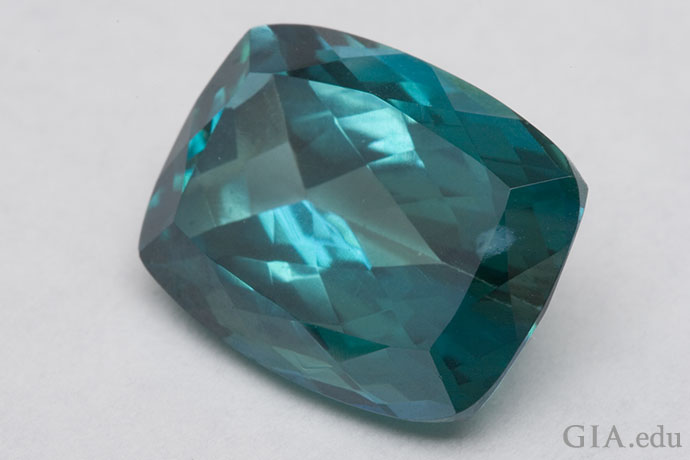
The sparkle in your engagement ring telegraphs your love to the world. Melee diamonds can make it glow a bit brighter. But if you’re looking to add even more sparkle to your engagement ring, you can go beyond melee diamonds with these additional engagement ring tips.

April Birthstone: What You Need to Know About Diamonds

Diamond does double-duty: it’s the April birthstone and a near-universal symbol of love. So if you were born in April, you have two reasons to adore the gem. Here’s a crash course on it – and tips for picking a beautiful one.

In this post, we’ll cover:
Gemological Information on Diamonds
Diamond History
Diamond Lore
Where Diamonds Come From
Qualities to Look for in a Diamond
Diamond Care & Cleaning


April Birthstone: Gemological Information on Diamonds

The hardest natural material on earth, diamond ranks 10 on the Mohs Scale of Hardness and is the only gem made of a single element: It is typically about 99.95 percent carbon. The other 0.05 percent can include one or more trace elements, which are atoms that aren’t part of a diamond’s essential chemistry. Some trace elements can influence its color or crystal shape. For example, the presence of nitrogen causes diamonds to appear yellow. Boron atoms are often responsible for the color of natural blue diamonds.

Heart-shaped yellow diamond.

Your pulse may quicken admiring this heart-shaped natural Fancy Intense yellow diamond. Photo: Robert Weldon/GIA

The Blue Empress, a 14 carat Fancy Vivid blue diamond.

Say goodbye to the blues when you admire the Blue Empress, a 14 carat (ct) Fancy Vivid blue diamond. Courtesy: Steinmetz Diamonds

Diamonds form under high temperature and pressure that exist only within a specific depth range (about 100 miles; 160 kilometers) beneath the earth’s surface. The conditions are extreme: Temperatures must be between 2102oF to 2192oF (1150 to 1200 0C); the pressure must be between 50 and 70 kilobars – 50,000 to 70,000 times greater than atmospheric air pressure at sea level. Carbon atoms in this environment in the mantle may form diamond.

A diamond’s hardness is due to the way the carbon atoms bond. Diamond’s crystal structure is isometric, which means the carbon atoms are bonded in essentially the same way in all directions. Graphite, a mineral used to make pencil lead, is also made of carbon, but because the molecules bond differently, this mineral is not nearly as hard.

Gemologists love diamonds because they are beautiful – and because many formed more than a billion years ago. Studying these ancient beauties tell us much about our planet.


April Birthstone: Diamond History

Our love for diamonds started in India, where they were gathered from the country’s rivers and streams. Traded as early as the fourth century BCE, diamonds were coveted by the wealthy. Caravans brought Indian diamonds, along with other exotic merchandise, to medieval markets in Venice. By the 1400s, diamonds were becoming fashionable accessories for Europe’s elite.
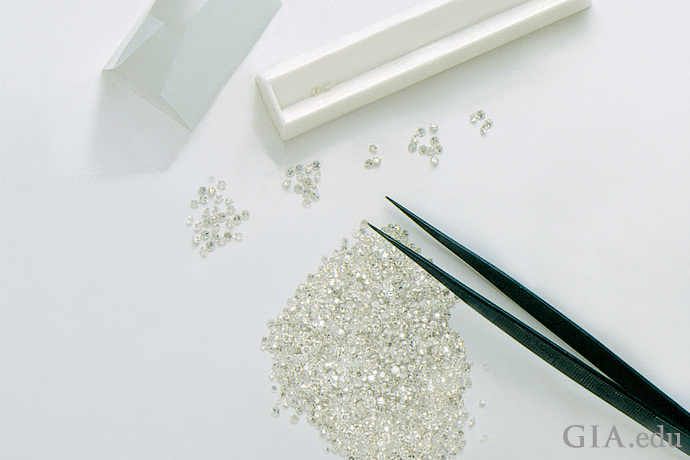
A 4 carat old mine cut diamond.

This 4 ct old mine cut diamond comes from India’s famed Golconda mines. Photo: Robert Weldon/GIA. Courtesy: Sudhir Jain (Fei)
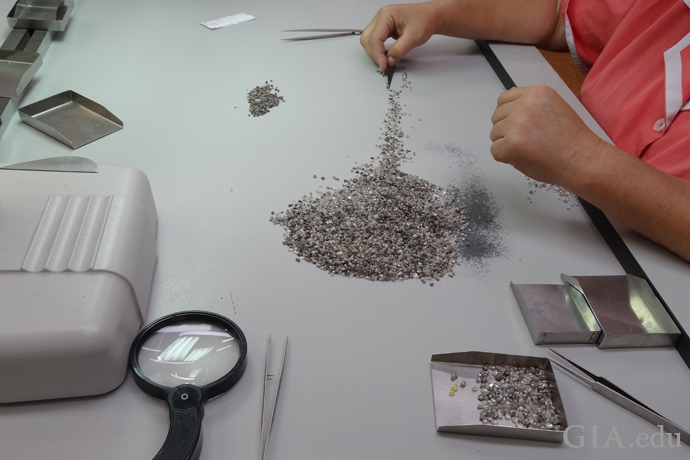
In the early 1700s, as India’s diamond supplies began to decline, Brazil emerged as an important source. Diamonds were discovered when gold miners sifted through the gravels of local rivers. The country dominated the diamond market for more than 150 years.

The first great South African diamond deposits were unearthed in the late 1800s. The 1866 discovery of diamonds in Kimberley, South Africa, marked the beginning of the modern diamond market. Entrepreneur Cecil Rhodes established De Beers Consolidated Mines Limited in 1888 and, by 1900, De Beers controlled an estimated 90 percent of the world’s production of rough diamonds.

At the end of the 1970s, South Africa, the Democratic Republic of the Congo (previously known as Zaire) and the former Soviet Union were the world’s most important rough diamond producers. In 1982, a highly productive new mine in Botswana added to world production, making the country third in the world in total diamond recovery and second in diamond value. Diamond mining expanded dramatically with the discovery of sources in Australia in 1985 and important new diamond deposits in northern Canada in 2000.

8.52 ct rough diamond crystal

A 8.52 ct rough diamond crystal from the Kao Mine, Lesotho, Africa waits to be transformed into a breathtaking faceted diamond. Photo: Eric Welch/GIA. Courtesy: Fusion Alternatives


April Birthstone: Diamond Lore

An anonymous second-century poet believed diamond warded off the evil eye – a malevolent look believed to cause sickness, poverty and even death. Diamond was even believed to have healing powers. Over the centuries, diamond was thought to be an antidote to poison; a protection against the plague; and a boon for longevity, strength, beauty and happiness.

Jason Down diamond Empress Ring

One look at Jason Dow’s spectacular diamond Empress ring will make you believe that the April birthstone is the cure for all ills. Courtesy: Jason Dow

In addition to being the April birthstone, diamond is the gift of choice for the 60th and 75th wedding anniversaries. And, of course, the diamond engagement ring has become a near-universal symbol of love and marriage.

There are many famous diamonds. The Taylor-Burton Diamond, the Cullinan II, the Portuguese, the Jubilee and the Koh-i-Noor are just a few breathtaking examples.

Taylor-Burton 69.42 carat, D color, Flawless pear-shaped diamond.

The Taylor-Burton diamond is a 69.42 ct, D color, Flawless, pear-shaped gem. This April birthstone sold for US$1.05 million in 1969. Courtesy: Mouawad


April Birthstone: Where Diamonds Come From

Diamonds are now mined around the world – from Angola to Zimbabwe. However, the five largest producers of diamonds account for the vast majority of global production.

Top Diamond Producing Countries – 2015

Country Rough Diamond Production
Russian Federation 41.9 million carats
Botswana 20.7 million carats
Democratic Republic of the Congo 16.0 million carats
Australia 13.5 million carats
Canada 11.6 million carats

Source:The Kimberly Process

Diamond mining in eastern Siberia reads like an adventure novel. The setting: tundra, frigid temperatures and short days. The props: jet engines and explosives used to heat and soften the ice covering kimberlite pipes – vertical, columnar masses of igneous rock that can be a primary source for diamonds. The story line: In 2013, Alrosa, a Russian diamond mining company, estimated that there were 970 million carats still waiting to be found in the frozen tundra.

Diamonds in Botswana lie below the eastern plains of the country. These prolific mines have been a boon to the economy, creating a growing middle class. The country is also a diamond hub, where approximately 40% of the world’s supply of rough diamonds are sorted and valued.

The Jwaneng open pit diamond mine.

The Jwaneng diamond mine is one of the most productive in the world. Photo: John Hummel/GIA.


April Birthstone: Qualities to Look for in a Diamond

Until the middle of the twentieth century, there was no agreed-upon standard by which diamonds could be judged. GIA created the 4Cs of Diamond Quality – the first, and now globally accepted standard for describing diamonds.

  • Color: In most diamonds, the term refers to the absence of color. The less color in the stone, the more desirable it is. Differences can be subtle and difficult for the untrained eye to see, but directly impact the overall quality and value of the stone.
  • Clarity: Is a measure of the amount, size and placement of internal characteristics, called inclusions, and external characteristics, called blemishes. Grades run from ‘Flawless,’ with virtually no inclusions visible under 10× magnification, to ‘Included,’ which contain obvious inclusions.
  • Cut: Cut does not refer to a diamond’s shape, but to its proportions and the arrangement of its facets and the quality of workmanship. The amount of brilliance, sparkle and fire in a diamond is determined by cut. Cut grades range from ‘Excellent’ to ‘Poor.’
  • Carat: This measurement describes a diamond’s weight. Generally speaking, the higher the carat weight, the more expensive the stone. Two diamonds of equal carat weight, however, can have very different qualities and values when the other three Cs are considered.M
Three stone diamond ring totaling 15 carats.

This impressive three-stone ring has 15 carats of diamonds, set in platinum. Courtesy: Rahaminov


April Birthstone: Diamond Care and Cleaning

Clean your diamond by wiping it with a lint-free cloth; or use warm water, mild soap and a soft toothbrush or a commercial jewelry cleaning solution. Also have your diamond jewelry periodically cleaned and its setting examined by a professional jeweler to maintain its beauty and integrity over time.

Yellow gold earrings set with rough diamonds.

Rough diamonds have been enjoying their moment in the spotlight. They capture another side of the gem’s beauty. Courtesy: Petra Class

Now that you’ve learned something about diamonds, you’ll be a smarter shopper. And maybe you’ll have a greater appreciation for the April birthstone.

Thinking about buying a diamond? Our diamond buying guide can help you pick a stunning one.