Please ensure Javascript is enabled for purposes of website accessibility.
Search
Search
Search

GIA 4Cs Diamond Blog

GIA 4Cs Diamond Blog

Is Diamond Fluorescence Good or Bad?

Courtesy: Chip Clark, Smithsonian Institution

Diamond fluorescence is a fascinating phenomenon where diamonds glow when exposed to long-wave UV rays. It can sometimes increase or decrease the value of a diamond. It can also affect diamond appearance—or not. How should you take fluorescence into account when choosing the perfect diamond? In this article, we’ll cover:


What is diamond fluorescence?

Fluorescence is the glow you sometimes see when an object emits visible light. Some diamonds fluoresce when they are exposed to long-wave ultraviolet (UV) rays from sources like the sun. This can cause them to emit a bluish light or more rarely, a yellow or green light. Once the UV light source is removed, the diamond stops fluorescing.

Do all diamonds fluoresce?

No. Only about 25% to 35% of diamonds exhibit some degree of fluorescence in reaction to long-wave UV light. More than 95% of these diamonds fluoresce blue. A rare few fluoresce other colors such as yellow or green.

Is there a diamond fluorescence grade?

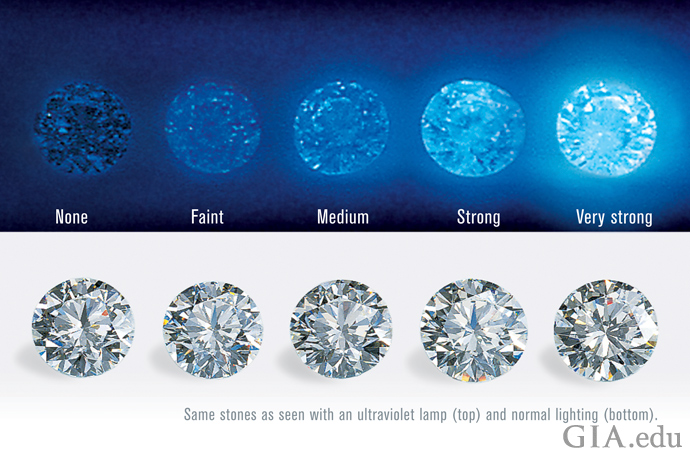
Fluorescence is not a grading factor like the GIA 4Cs (colorclaritycut, and carat weight), but it is an identifying characteristic. GIA Diamond Grading Reports and Diamond Dossiers describe a diamond’s fluorescence by its intensity under long-wave UV light (None, Faint, Medium, Strong and Very Strong). If the fluorescence is Medium, Strong, or Very Strong, the color of the fluorescence will be noted.
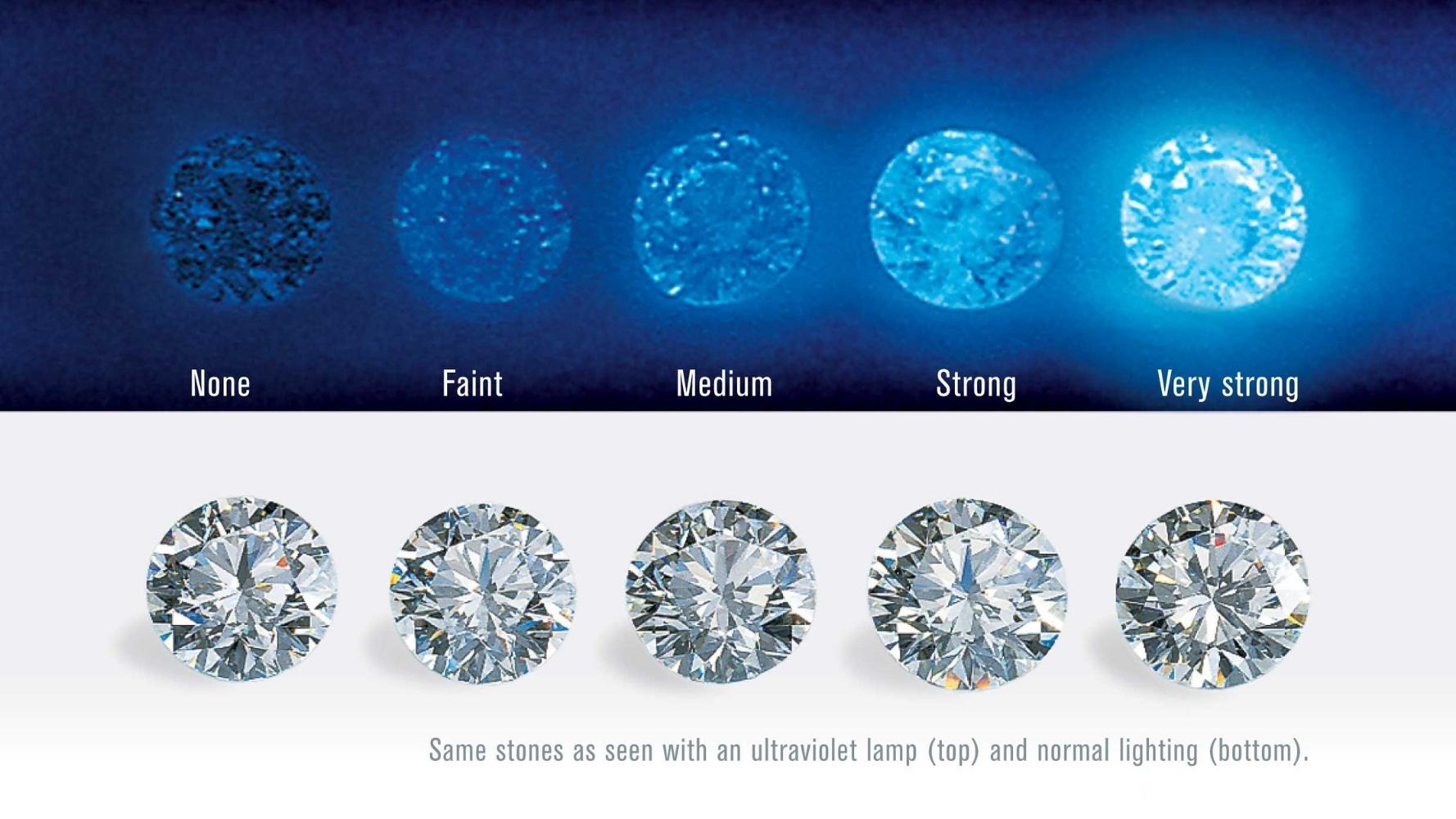
Photo: (Top) Maha Tannous/ GIA, (Bottom) Harold & Erica Van Pelt

Does diamond fluorescence make a yellow diamond look “whiter”?

Some trade professionals think blue fluorescence enhances a diamond’s appearance, especially in diamonds with I to M color grades. While bluish fluorescence can make a faint yellowish diamond appear more colorless in natural daylight, the color grade on a GIA report is not affected because the grading environment is engineered for consistency. 

The opposite is true for diamonds with higher color grades. In the trade, diamonds in the D to H color range with bluish fluorescence are often considered less desirable than similar grade diamonds without fluorescence, because some people believe that bluish fluorescence may cause diamonds to have a hazy or oily appearance. In a recent study, GIA observed that blue fluorescence has little to no impact on transparency except in extremely rare cases where a diamond (such as the Portuguese diamond) has a light-scattering defect. These defects cause haziness that can sometimes be intensified by strong fluorescence, thus reducing the contrast in the face-up pattern of the diamond. Fluorescence does not cause haziness by itself, however. Also, this hazy effect occurs in fewer than 0.2% of the fluorescent diamonds submitted to GIA.

Nonetheless, the association between fluorescence and haziness persists, and diamonds in the D to H range with very strong fluorescence often sell for less than diamonds that do not have fluorescence, even though their color and transparency are most likely unaffected by their fluorescence. These diamonds may prove to be a good deal. If you’re not familiar with the GIA Color Scale, learn more with the GIA Diamond Color Chart.

Does fluorescence cause haziness in diamonds?

No, fluorescence does not cause haziness in diamonds. Fluorescence can increase the pre-existing haziness of a diamond caused by light-scattering defects, thus reducing the contrast in its face-up pattern, but it does not cause haziness in and of itself. As light-scattering defects are incredibly rare, most consumers don’t need to worry about fluorescence impacting a diamond’s appearance in most lighting situations, even if the diamond has Strong to Very Strong fluorescence. But this does mean that consumers should look at a diamond in person. Any haziness intensified by fluorescence, if present, will be noticeable in (for example) daylight-equivalent lighting.

The center diamond is an H color diamond with Strong to Very Strong fluorescence. The two diamonds flanking it on either side are H color diamonds with no fluorescence. There is no visible difference in color or transparency. Courtesy: Jian Xin (Jae) Liao

Can the average person tell the difference between diamonds that do and don’t fluoresce?

In order to study the effect of blue fluorescence on diamond appearance, GIA scientists assembled sets of E, G, I, and K color-grade diamonds. The diamonds in each set were as similar as possible except for the intensity of their blue fluorescence. Diamond graders, trained professionals, and average observers viewed the diamonds in controlled conditions to make a judgment about their appearance. It seems that, for the average observer, meant to represent the jewelry-buying public, no systematic effects of fluorescence were detected. In general, viewers perceived that strongly blue fluorescent diamonds had a better color appearance when viewed table-up. Most observers saw no relationship between fluorescence and transparency.

Seen here are seven diamonds seen under daylight-equivalent illumination versus long-wave UV illumination. Photo: Kevin Schumacher/GIA

Is diamond fluorescence good or bad?

Diamond fluorescence is neither good nor bad. Some people find fluorescent diamonds beautiful and fascinating—others may not. Opinions range across the spectrum.

If you are considering a diamond with bluish fluorescence, look at it under different kinds of lighting, including natural daylight and compare it to other diamonds of the same color grade, and see if you notice any difference. If you do notice a difference, see if you like it!

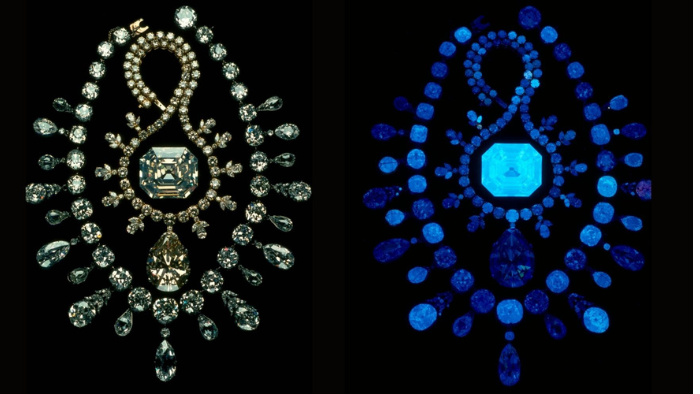
This beautiful brooch contains several diamonds that fluoresce under long-wave UV illumination.

Now that you know more about diamond fluorescence, read on to learn how light affects a diamond’s appearance.
 

How to Buy a Quality Diamond

Buying a quality diamond begins with 3Cs—not 4. Surprising? Cut, clarity and color all determine diamond quality, but carat doesn’t. After all, size doesn’t affect quality. Learn how to buy a stunning diamond based on 3Cs, fluorescence and shape.

(more…)
The Origin of Wedding Rings: Ancient Tradition or Marketing Invention?

The origin of wedding rings is a fascinating one. The tradition of exchanging rings dates back 3,000 years, while the first diamond wedding ring was recorded in the will of a widow who passed in 1417. Why are rings, especially diamond rings, the ultimate symbol of romance? (more…)

A Guide to Promise Ring Meaning: The Promise Behind Promise Rings

Promise rings symbolize love. Worn on any finger, a promise ring represents a couple’s commitment to their relationship. Learn more about promise ring meaning, its history and how to give one. (more…)

Are Diamonds Rare?

If you’re shopping for a diamond engagement ring and see the price tag, you may wonder, are diamonds rare? Why do they cost so much? Is demand only driven by advertising? Do they have intrinsic value? We look at these questions and more.
(more…)

The Marriage Proposal: Seven Tips to Help Get You There

“Will you marry me?” It’s the ultimate question. You want the marriage proposal to be perfect and the answer to be “yes!” There’s a lot that goes into popping the question. But have no fear. Follow these common tips for how to propose in a few simple steps. (more…)

Propose Now, Shop Later: The Placeholder Ring

Ready to propose but not ready to buy an engagement ring? A placeholder ring is a great stand-in while you work out the thousand-and-one details that go into buying your forever engagement ring. Here’s what to consider: (more…)

How to Choose Diamond Stud Earrings

Diamond stud earrings can dress up your look. They add a splash of style to any outfit. And turn heads. Just ask trendsetter Meghan Markle, now the Duchess of Sussex. Here’s how to choose a pair of diamond studs you’ll love. (more…)

GIA Diamond Cut Grade: Six Things You Need to Know

A GIA diamond cut grade is key to knowing how well your round brilliant diamond will sparkle. Cut is the most complex of a diamond’s 4Cs. Let’s cover some essentials so you can pick the perfect round brilliant diamond engagement ring.

In this blog, we cover:

  1. Diamond cut quality and why it’s important
  2. What goes into a GIA diamond cut grade
  3. Diamond sparkle and face-up appearance
  4. Why diamond proportions are important
  5. Design, craftsmanship and the GIA diamond cut grade
  6. How GIA assigns a diamond cut grade

1. Diamond cut quality and why it’s important

The most popular diamond in the marketplace is the round brilliant. Experts estimate that this cut alone accounts for more than 70% of all diamonds sold today. The quality of a round brilliant diamond’s cut determines how much the diamond sparkles. To pick a diamond whose flashes of light enchant the eye, you need to know the 4Cs of diamond quality, the universal standard for judging diamonds: color, cut, clarity and carat weight. All else being equal, the better the cut grade, the more valuable the diamond.

Some professionals consider cut the most important C of diamond quality. A well-cut round brilliant delivers that unmistakable, stop-in-your-tracks light show that telegraphs “diamond” across a crowded room. If the diamond is well cut, most compromises in clarity, color and even carat weight can be forgiven. A diamond’s cut grade is also an indication of how well it was designed and crafted. So, understanding the diamond cut grade is key to picking a round brilliant that’s not only beautiful, but also the best value.

2. What goes into a GIA diamond cut grade

In arriving at its cut grading system, GIA spent 15 years studying how light behaves within a round brilliant cut diamond. GIA’s aim was to understand the factors that contribute to a round brilliant’s appearance and to determine which of those factors – or combination of factors – produce diamonds that people consider attractive.

GIA’s research included the use of advanced computer modeling to analyze tens of thousands of possible proportion combinations. GIA then validated its research with human subjects, conducting more than 70,000 observations on actual diamonds, to determine which diamonds people found appealing and why.

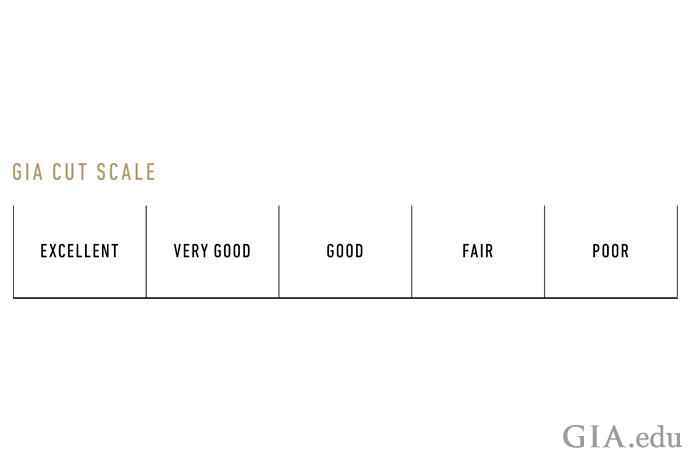
The result was the GIA Cut Grading System, which evaluates the cut quality of a round brilliant diamond along a five-point scale ranging from Excellent to Poor.

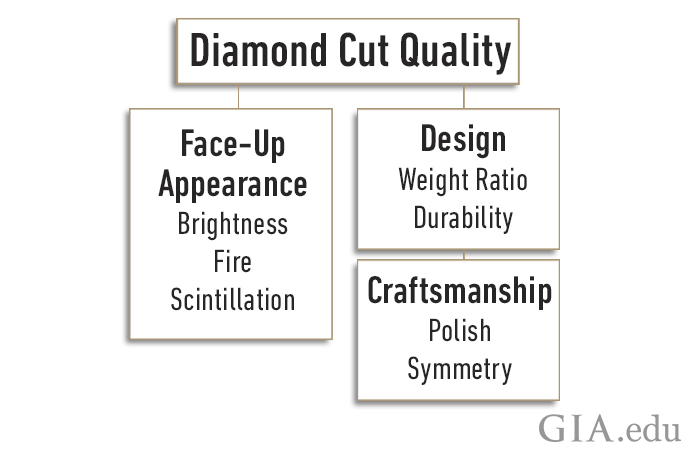
A GIA cut grade evaluates:

  1. How the diamond appears when viewed face-up based on the attributes of brightness, fire and scintillation
  2. How well the diamond was designed to ensure durability and optimal weight
  3. The quality of the workmanship or craftsmanship that went into aligning and polishing the diamond’s facets

The GIA diamond cut grade is based on seven factors: brightness, fire, scintillation, weight ratio, durability, polish and symmetry.

The GIA diamond cut grade is based on seven factors: brightness, fire, scintillation, weight ratio, durability, polish and symmetry.

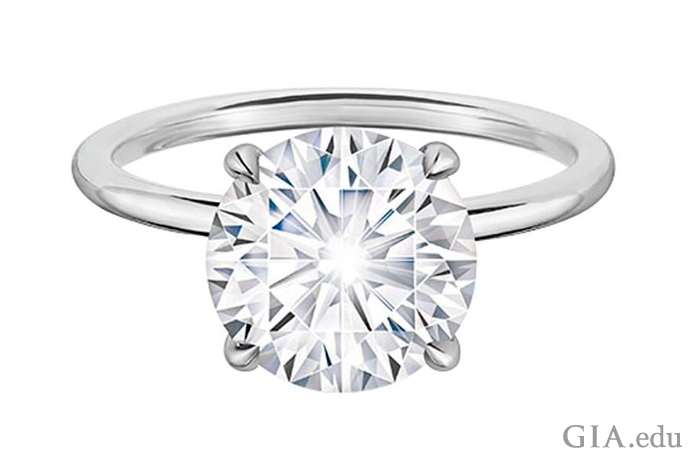
A 2.02 carat round brilliant cut diamond engagement ring with excellent cut, polish and symmetry.

This 2.02 carat (ct) round brilliant has excellent cut, polish and symmetry. Courtesy: 1stdibs.com

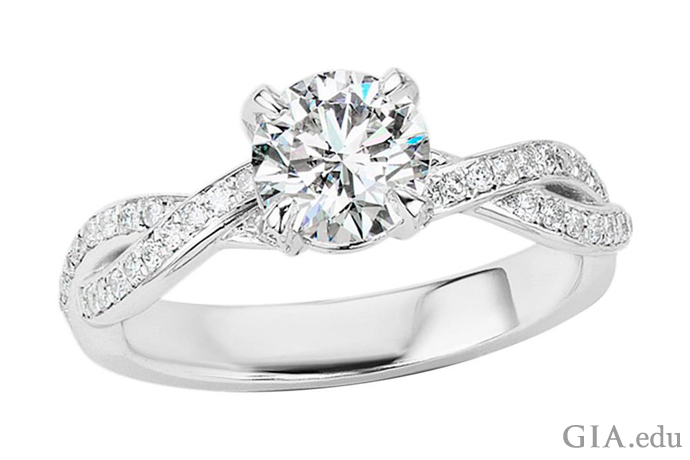
A 1.01 ct round brilliant cut diamond engagement ring that received an Excellent cut grade from GIA.

The reason behind the sparkle of this 1.01 ct round brilliant cut diamond engagement ring is the quality of the diamond’s cut. The diamond received an Excellent cut grade from GIA. Courtesy: 1stdibs.com

3. Diamond sparkle and face-up appearance

A key component of a GIA diamond cut grade is the diamond’s face-up appearance – or how the diamond looks when viewed from above, as if it was set in an engagement ring. People love diamonds for their dazzling interplay with light – which the layperson often translates as “sparkle.” But there’s a lot more going on here.

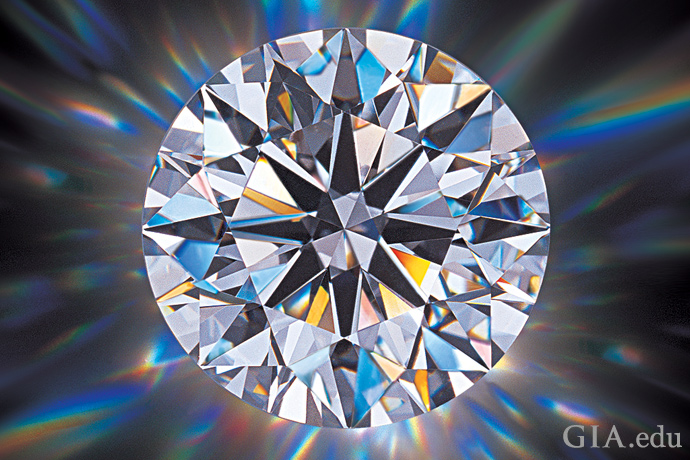
When you see internal and external white light reflected from a diamond, you’re noticing “brightness.” If you see the scattering of light into all the colors of the rainbow, you’re being treated to “fire.” Sparkle is actually “scintillation,” the pattern of bright and dark areas caused by reflections within the diamond as it or the light source moves. What you might consider “sparkle” is really the overall visual effect of these three factors. A GIA cut grade includes an assessment of how well a diamond delivers on each of these attributes.

Round brilliant cut diamond showing good brightness, fire and scintillation when the diamond is moved.

This round brilliant cut diamond shows good brightness and fire. Scintillation, the pattern of light and dark areas and the flashes of light, or sparkle, can only be seen when a diamond is moved. Copyright: GIA & Harold and Erica Van Pelt

4. Why diamond proportions are important

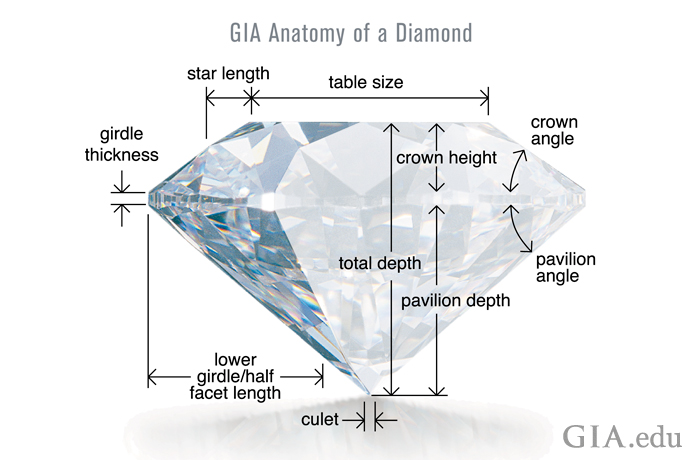
A diamond’s proportions – its crown and pavilion angles and the relative measurements of its facets – are key contributors to a diamond’s overall face-up appearance. Remember that facets are tiny mirrors. Their size and placement will influence how light behaves as it passes through the diamond and back to your eye.

A diamond’s proportions can help predict how well a diamond will deliver brightness, fire and scintillation. However, an important outcome of GIA’s cut research was the finding that there is no single set of proportions that defines a well-cut round brilliant diamond. In fact, diamonds with different proportions can receive the same cut grade. The diamonds may look and perform differently but they will still have a similar impact on the observer. So, as a diamond shopper, you need to look beyond the measurements on a grading report. Be sure to view a diamond in person to see if it’s the right choice for you.

An illustration demonstrating the proportions that affect a diamond’s cut grade.

This graphic illustrates the proportions that affect a diamond’s cut grade. The crown and pavilion angles and the relative measurements of its facets contribute to a diamond’s brightness, fire and scintillation.

5. Design, craftsmanship and the GIA diamond cut grade

While face-up appearance is all about how a diamond looks, design and craftsmanship evaluate the quality of the diamond’s manufacture. Poor design could add unnecessary weight to a diamond or cause durability issues that would prevent you from enjoying it for a lifetime. A diamond with poor craftsmanship won’t deliver much in the way of brightness, fire and scintillation. In evaluating these two components, the GIA Cut Grading System takes into account the diamond’s physical shape, its proportions, its weight ratio, and the care that went into fashioning and polishing its facets.

Design
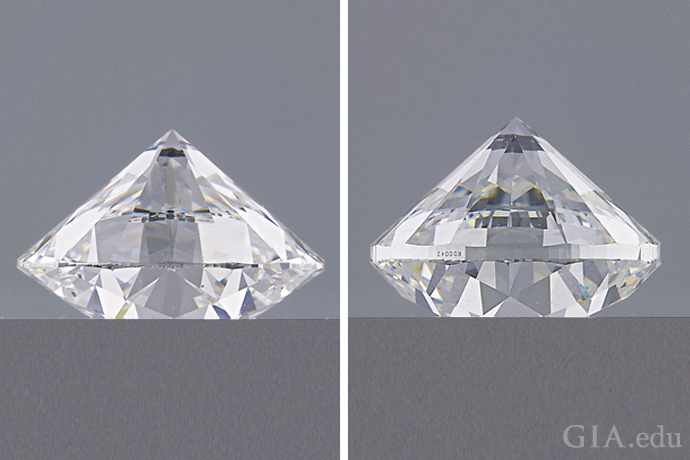
Design refers to decisions made during the fashioning process that determine the diamond’s physical shape, as seen in its proportions, weight ratio and durability. Weight ratio is the diamond’s weight in relation to its average girdle diameter (a fairly complex mathematical equation). A diamond with a smaller girdle diameter relative to its weight might appear smaller face-up than its well-designed counterpart, because much of the weight would be “hidden” in the overall depth of the diamond. For example, while a diamond with a thicker girdle could look great, the girdle is hiding unnecessary weight. As a result, you might end up paying more for a heavier diamond with no greater visual impact for the added cost. The bottom line: A diamond should not weigh more than its face-up size would indicate.

Image showing a diamond with a much thicker girdle (right) than the diamond on the left.

These pictures show the importance of weight ratio. Both of these diamonds have the same average girdle diameters, so face-up they appear to be the same size. But the diamond on the right has a much thicker girdle, so it weighs more (0.71 ct vs. 0.61 ct). The thicker girdle has no visual benefit, but the added weight will make the diamond more expensive. Photos: Maha Tannous/GIA

Durability in the case of a round brilliant diamond refers to the risk of damage that might result from an extremely thin girdle. Such a girdle can make a diamond highly vulnerable to damage during the jewelry setting procedure or even normal wear. Considering how much a diamond costs and its emotional significance, you want to avoid one that is susceptible to damage. A GIA Diamond Grading Report can eliminate this concern.

A 1.35 carat diamond with girdle areas very think to extremely thin.

Here is an example of why durability is important. This 1.35 ct diamond has girdle areas that are very thin to extremely thin, making it more susceptible to damage during everyday wear. Courtesy: Gary Roskin, G.G., F.G.A.

Craftsmanship

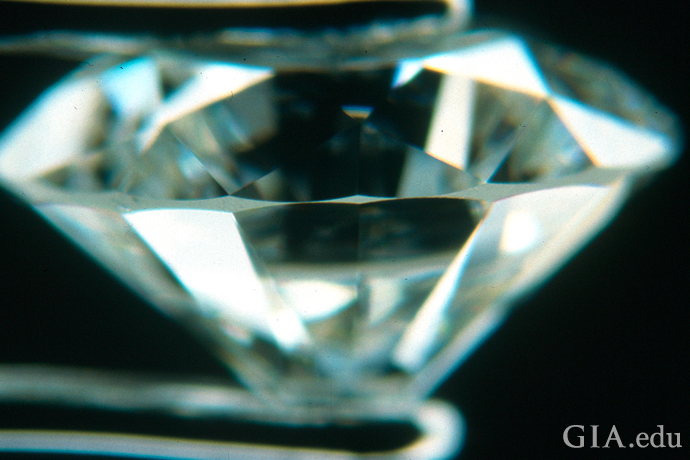
Craftsmanship describes the care that went into fashioning the diamond, as seen in its polish and symmetry. Polish refers to the overall quality and condition of the facet surfaces. It includes evaluation of any blemishes created by the polishing process or during wear. Polish is critical to the mirror-like performance of a diamond’s facets.

Diamond (left) showing lines created during polishing and diamond (right) with abraded facet junctions.

The diamond on the left shows lines created during the polishing process. The diamond on the right has abraded facet junctions caused by wear. Polish lines and abraded facet junctions can also affect a diamond’s clarity grade. Photos: Mitchell Moore/GIA

Symmetry is the exactness of a finished diamond’s shape and the arrangement and placement of its facets. A symmetrical diamond has an even display of brightness, fire and scintillation. A diamond with poor symmetry will have poor light performance, meaning that it’s likely to look flat.

An illustration showing all eight sections of a round brilliant identically. Illustration: GIA

All eight sections of a round brilliant cut diamond should be identical. This symmetry will help produce even brightness, fire and scintillation. Illustration: GIA

6. How GIA assigns a diamond cut grade

GIA evaluates a round brilliant diamond’s cut based on seven components – brightness, fire, scintillation, weight ratio, durability, polish and symmetry – to arrive at a GIA diamond cut grade, which ranges from Excellent to Poor. The grade is set by the lowest assessment the diamond receives for five of the seven components. In other words, if a diamond receives a Poor grade for brightness, then the highest its overall cut grade can be is Poor. The exceptions are polish and symmetry, which are assessed using standard GIA grading methodology: A diamond with Very Good polish and/or symmetry, for example, may receive an Excellent cut grade.

A GIA Diamond Grading Report contains the diamond’s full cut assessment, in addition to a diagram showing the diamond’s proportions and relative measurements. Consider the report an invaluable tool in helping you pick a dazzling diamond.

The official GIA Cut Scale for round brilliant cut diamonds.

The official GIA Cut Scale for round brilliant cut diamonds. Illustration: GIA

While knowing a diamond’s cut grade is essential, it shouldn’t be a substitute for seeing a diamond in person. As mentioned above, a diamond cut grade represents a range. For example, two diamonds with an Excellent Cut Grade may look – and perform – very differently. In addition, a diamond will look different under various lighting conditions, so you should take it for a test drive, so to speak. Last, you need to fall in love with the diamond – and no report can substitute for what stirs your heart.

A 2.03 carat round brilliant cut diamond engagement ring with Excellent cut.

An Excellent cut grade makes this 2.03 ct round brilliant diamond mesmerizing. Courtesy: 1stdibs.com

Diamond cut is extremely important. So is diamond color. Learn about it, too, so you can pick a spellbinding diamond.

Seven Things You Need to Know About Diamond Clarity

Diamond clarity is the relative absence of inclusions and blemishes. You should know about this 4Cs quality factor because it affects a diamond’s beauty and value. To understand what a diamond clarity is, use these tips to help you shop smartly:

  1. Inclusions and blemishes are not “flaws”
  2. When it comes to diamond clarity, less is more
  3. Learn the grades on the GIA Diamond Clarity Scale – the global standard
  4. Find out how GIA grades diamond clarity
  5. Treatments can improve diamond clarity – but it’s not all good
  6. Certain types of inclusions can make a diamond more vulnerable to damage
  7. To be sure of diamond clarity, get a GIA grading report

1. Inclusions and blemishes are not “flaws”

Diamond clarity is one of the 4Cs (the others being colorcut and carat weight). It plays an important role in determining a diamond’s overall beauty and ultimately its value. Diamond clarity refers to inclusions in the diamond and blemishes on its surface.

Inclusions and blemishes can result from a diamond’s formation, its crystal structure, the cutting-polishing-setting processes, or general wear. Inclusions can be totally enclosed within the diamond or they can extend into the diamond from its surface. Blemishes are confined to the diamond’s surface. Gemologists use 10× magnification to determine a clarity grade.

You may hear some people describe inclusions and blemishes as “flaws.” But most gemologists think of them instead as powerful identification tools. Inclusions can help in the separation of some natural diamonds and synthetic diamonds. And because most diamonds have a unique combination of inclusions and blemishes, these clarity characteristics act like fingerprints, giving each diamond its own identity.

If you’re wondering whether your diamond’s laser inscription is considered a blemish or inclusion – the answer is neither. A laser inscription is not considered a clarity characteristic.

To help you understand what diamond clarity is, here are pictures and descriptions of 16 types of inclusions and 11 types of blemishes commonly seen in diamonds.

2. When it comes to diamond clarity, less is more

When it comes to diamond clarity and value – like diamond color and value –  less is always more. Diamonds with few or no clarity characteristics are rare and because rarity drives price, they will cost more. In fact, diamonds without any visible clarity characteristics under a 10× jeweler’s loupe are called “flawless.” These diamonds are so rare that many jewelers may never see one in their career.

Less expensive diamonds often have inclusions that can be seen with the unaided eye. Most faceted diamonds fall between the two extremes – they have inclusions visible only with magnification.

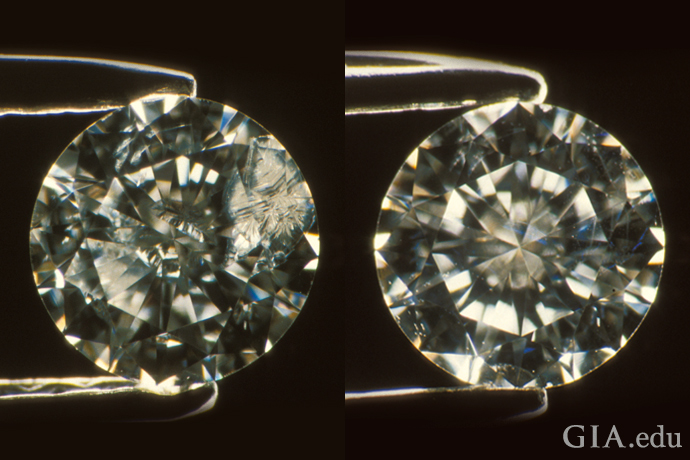
A diamond with a clarity grade of I3.

Diamond clarity affects a diamond’s appearance. A diamond with many inclusions and blemishes can look off-color, pitted and scratched. This diamond has a clarity grade of I3. Photo: GIA
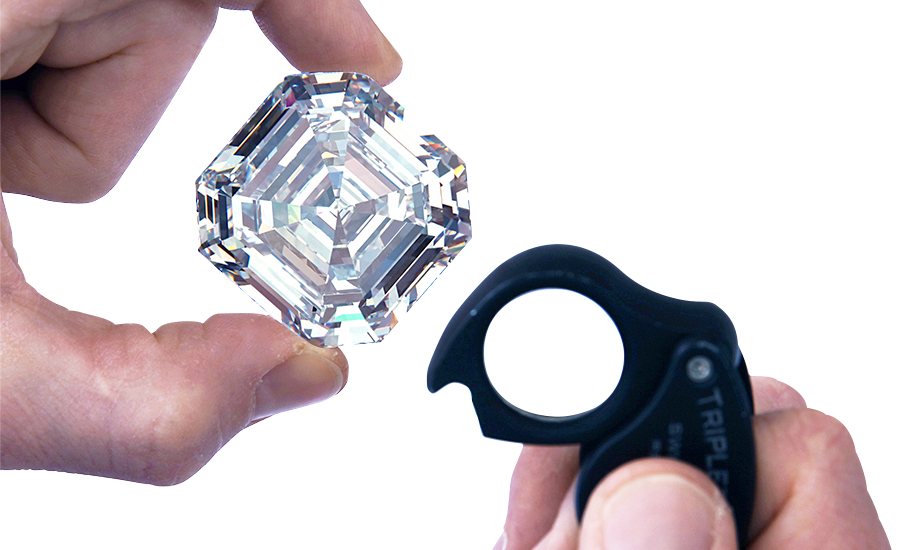
Clarity characteristics may be more visible in certain diamond cuts than others. For example, they will typically be easier to see in an emerald cut diamond compared to a round brilliant cut diamond. The long, rectangular facets that are characteristic of emerald cut diamonds make inclusions more readily visible than among the many smaller facets of a brilliant cut. However, if a diamond has many large clarity features, or if they are mirrored by the diamond’s many facets, they will be easy to see – no matter the shape or cutting style.

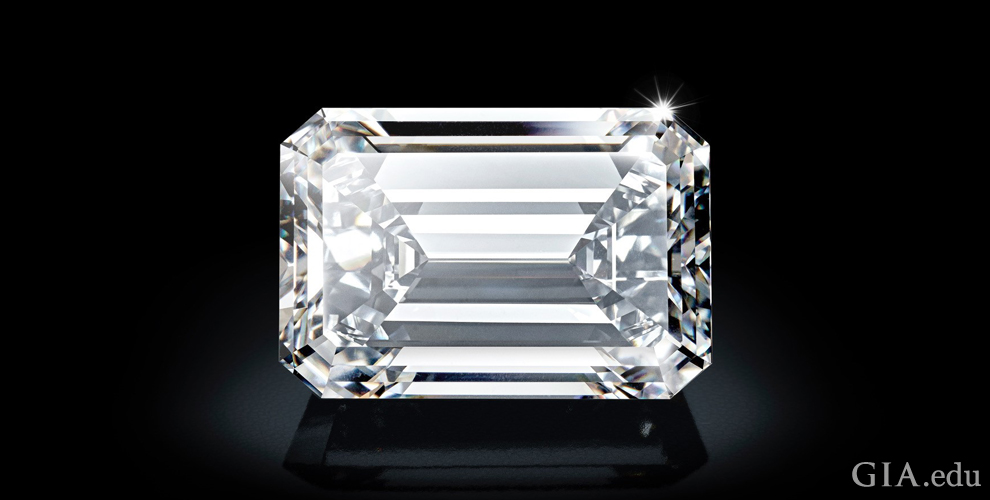
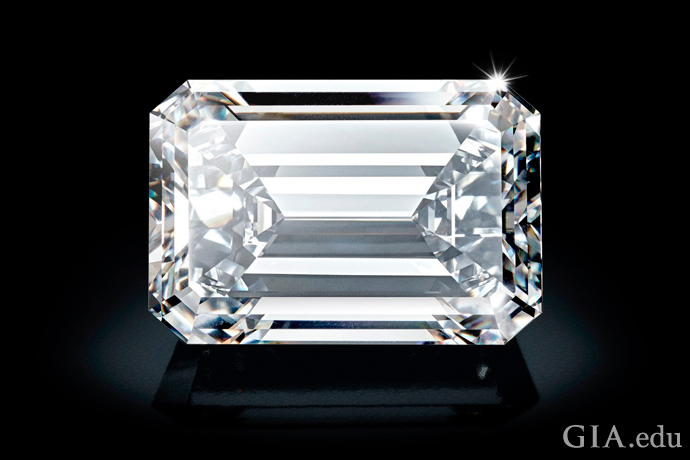
A 163.41 carat D-Flawless emerald cut diamond.

This 163.41 carat (ct) D-Flawless emerald cut diamond is a thing of uncommon beauty. Inclusions or blemishes visible with the unaided eye would mar its appearance. Courtesy: Christie’s

It’s worth noting that inclusions normally have more impact on a stone’s beauty and value than blemishes. This is because many blemishes are easy to remove. A fashioned diamond can sometimes be recut or repolished to eliminate blemishes and possibly improve its clarity grade.

 Diagram illustrating the effect of clarity on the value of diamonds

If all other factors are equal, as clarity increases so does diamond price per carat. Illustration: Peter Johnston/GIA

3. Learn the grades on the GIA Diamond Clarity Scale – the global standard

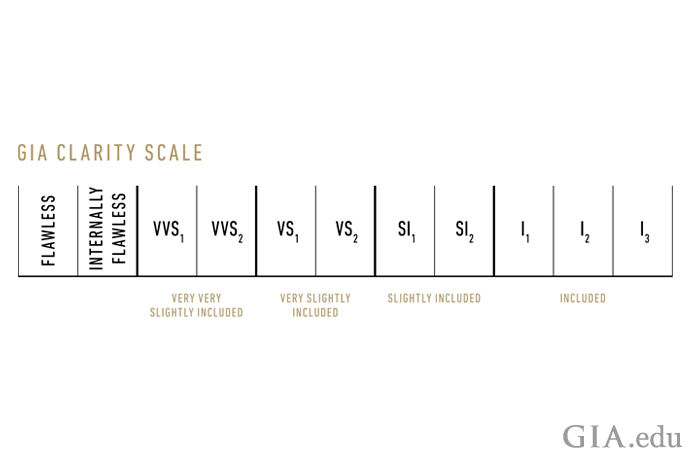
Diamond clarity is described using standard terminology developed by GIA in the 1950s. The grades are based, in part, on the visibility of inclusions and blemishes with 10× magnification by a trained grader. The GIA Diamond Clarity Scale is used to decide what diamond clarity is. It has six categories, some of which are subdivided, for a total of 11 specific grades for natural diamonds.

The GIA Diamond Clarity Scale has 11 grades, which range from Flawless to I3.

The GIA Diamond Clarity Scale has 11 grades, which range from Flawless to I3.

  • Flawless (FL): No inclusions and no blemishes visible under 10x magnification
  • Internally Flawless (IF): No inclusions and only insignificant blemishes visible under 10x magnification
  • Very, Very Slightly Included (VVS1 and VVS2): Minute inclusions that range from extremely difficult (VVS1) to very difficult (VVS2) to see under 10x magnification
  • Very Slightly Included (VS1 and VS2): Minor inclusions that range from difficult (VS1) to somewhat easy (VS2) to see at 10x magnification.
  • Slightly Included (SI1 and SI2): Noticeable inclusions that are easy (SI1) or very easy (SI2) to see at 10x magnification
  • Included (I1, I2 and I3): Inclusions that are obvious under 10x magnification – and often visible with the unaided eye – which may affect transparency and brilliance

An internally flawless 2.78 carat D-color round brilliant cut diamond.

This 2.78 ct D-color round brilliant cut diamond is Internally Flawless. Photo: Robert Weldon/GIA. Courtesy: Rogel & Co. Inc.

Here are two other terms you might come across.

  • Eye clean – This is an industry term for a diamond whose inclusions cannot be seen with the naked eye. Some shoppers may feel, “If I can’t see an inclusion or blemish, the diamond is beautiful enough for me.” An eye-clean diamond may fit the bill in these cases. GIA does not use this term.
  • SI3 – Some diamond grading labs issue a clarity grade of SI3. GIA does not. The Institute has studied the SI3 suggestion at various times over the years. GIA still concludes there is no reason to change its long-standing and universally accepted diamond grading system.

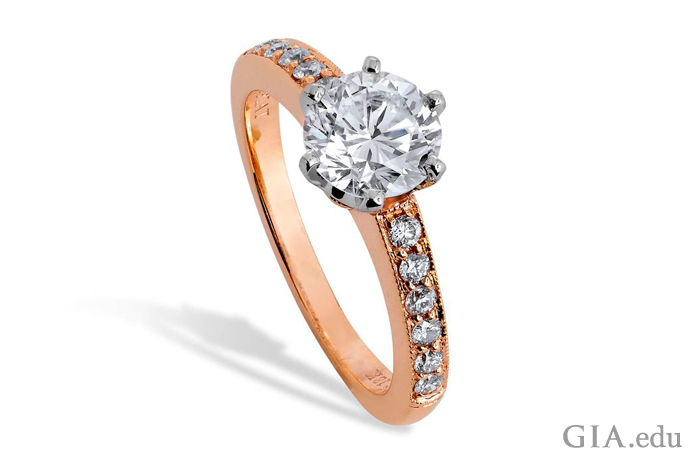
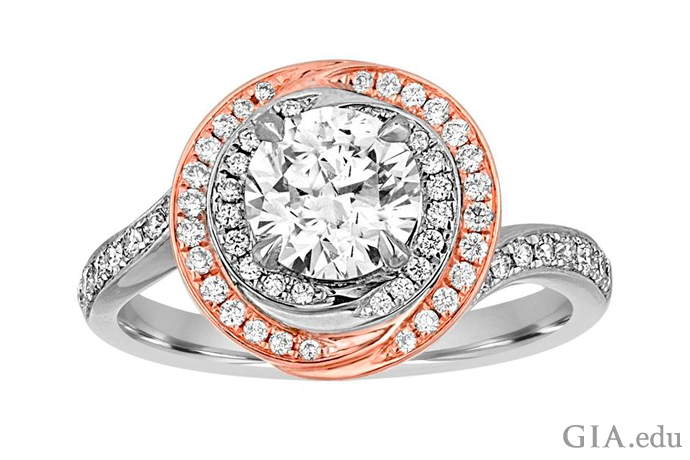
A 1.40 ct F color, SI1 clarity round brilliant cut diamond in a six-prong platinum engagement ring setting with 0.20 carats of diamond melee in an 18K rose gold shank.

The beauty of this 1.40 ct F color, SI1 clarity round brilliant cut diamond is undeniable. The six-prong platinum basket and 0.20 carats of diamond melee in an 18K rose gold shank add extra charm. Courtesy: 1stdibs.com

4. Find out how GIA grades diamond clarity

Just as GIA developed the globally recognized terms for grading diamond clarity, it also developed the processes for objective and unbiased diamond clarity grading . GIA procedures include viewing a diamond under controlled lighting conditions, using specific viewing angles and distances, and following precise steps that ensure every part of the diamond is examined to locate all the inclusions and blemishes that might affect its clarity.

A GIA diamond grader examines the diamond using her trained eye, a 10× jeweler’s loupe and sometimes a microscope at increased magnification. However, the final clarity grade is always determined by the diamond’s appearance under a 10× jeweler’s loupe.

In arriving at a clarity grade, the grader takes into account five factors:

  • Size – When all factors are equal, the larger the inclusion and the more visible it is, the lower the diamond’s clarity grade.
  • Number – When all other factors are equal, the more inclusions or reflections of inclusions that are visible face-up at 10× magnification, the greater their effect on the clarity grade.
  • Location – Refers to the position of an inclusion. The closer an inclusion is to the center of the table, the greater its effect on the clarity grade.
  • Relief – Refers to the contrast between the inclusion and the diamond. Generally, the more an inclusion differs in brightness, darkness or color from the diamond, the more visible it is and the greater its impact on clarity.
  • Nature – Refers to the type of characteristic and its inherent effect on the diamond. In other words, some inclusions or blemishes can have greater impact on clarity than others.

A diamond may have many tiny inclusions and still be high on the clarity scale. Ultimately, it’s the combination of these five factors that affects the overall clarity appearance. Blemishes, in contrast, can often be removed when a diamond is polished or repolished, so they rarely have an effect on grades lower than IF.
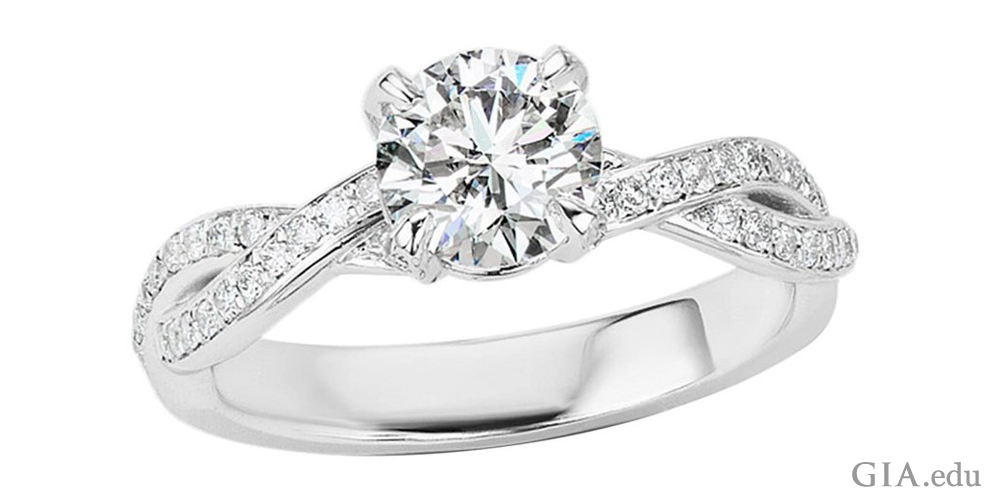
A 10.21 carat emerald cut diamond engagement ring with a clarity grade of VS2.

The 10.21 ct emerald cut diamond featured in this engagement ring received a diamond clarity grade of VS2. Courtesy: TrueFacet.com

5. Treatments can improve diamond clarity – but it’s not all good

Manufacturers sometimes try to improve diamond clarity to make stones more attractive and more valuable. Here are two common methods used to accomplish this.

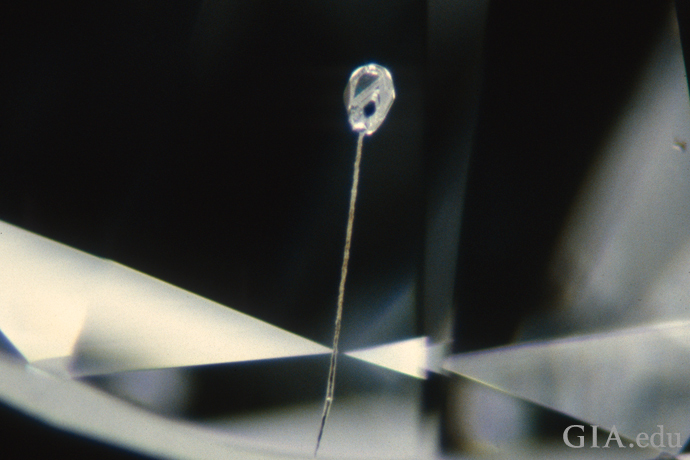
  • Laser drilling makes it possible to remove or lighten inclusions deep inside the stone. The laser creates a narrow channel from the surface to a dark inclusion in the diamond. If the included material is not vaporized by the laser, it is dissolved or “bleached” with a strong acid introduced via the channel. The resulting white appearance is generally considered more appealing than a dark spot that does not return light. Because the treatment is permanent (the inclusion will not come back or darken), GIA grades laser-drilled diamonds, but it records the resulting drill holes as inclusion features that may impact the clarity of the diamond.

A 30× magnification photo of a diamond showing a thin channel that been laser drilled from the surface to a large inclusion.

As seen here with 30× magnification, a thin channel has been laser drilled from the surface of the diamond to a large inclusion that was then vaporized or dissolved. Photo: Vincent Cracco/GIA

  • Fracture filling is the filling of surface-reaching fissures, fractures and laser drill holes with a glass-like material that has a refractive index close to that of diamond. Fracture filling doesn’t “heal” the fracture or improve the diamond’s actual clarity. The original fracture is still there, it’s just more difficult to see. However, this treatment is not permanent, and tales abound of fracture-filled diamonds that have been damaged when exposed to high heat during some jewelry repair, setting or cleaning procedures. As a result, many laboratories – including GIA – will not grade fracture-filled diamonds, and the fact the diamond has been fracture filled must be disclosed by the seller.

A before photo showing a 0.20 carat diamond with visible fractures and after filled with a glass-like substance.

A 0.20 ct diamond with large, highly visible reflective fractures is shown here before (left) and after (right) filling with a glass-like substance. Photos: Shane F. McClure/GIA

6. Certain types of inclusions can make a diamond more vulnerable to damage

Generally, if a diamond has significant durability problems, it doesn’t survive the friction and pressure of the cutting process. However, certain types of inclusions, especially if they’re near the girdle – the narrow section that separates the diamond’s upper (crown) and lower (pavilion) parts and functions as its setting edge – can make a cut diamond more vulnerable to damage. For example, if the stone is hit precisely on a feather or other surface-reaching inclusion, it might chip. Likewise, very deep feathers that extend from the crown to the pavilion, or that penetrate about one-third of the way or more into the diamond, could pose durability concerns.

The GIA Diamond Grading Report for diamonds on the D-to-Z color scale featuring a plotting diagram.

The GIA Diamond Grading Report for diamonds on the D-to-Z color scale features a plotting diagram (bottom center panel), which maps a diamond’s inclusions and blemishes as viewed from the crown (left) and pavilion (right).

7. To be sure of diamond clarity, get a GIA grading report

The GIA Diamond Grading Report, the GIA Diamond Origin Report and the GIA Diamond Dossier provide an objective, unbiased assessment of diamond clarity along with the other “Cs” of diamond quality.

GIA Diamond Grading Report and GIA Diamond Origin Report contain a plotting diagram that maps the diamond’s inclusions and blemishes. The diagram shows the diamond’s shape and facet arrangements as seen from two views: the crown and pavilion. Symbols are used to represent the type, location, relative size and sometimes the shape of the clarity characteristics being plotted. In addition to providing details about a diamond’s clarity features and describing the diamond’s clarity, the diagram can also assist in diamond identification. No two diamonds below Flawless and Internally Flawless have exactly the same combination or placement of clarity characteristics.

A 1.05 carat round brilliant cut diamond engagement ring surrounded by a double halo of diamond melee in an 18K white and rose gold setting.

In this engagement ring, a 1.05 ct round brilliant cut diamond is surrounded by a double halo of diamond melee in an 18K white and rose gold setting. The many facets of a brilliant cut diamond make inclusions less visible than they would be in some other cuts, such as the emerald cut. Courtesy: 1stdibs.com

Now that you’ve brushed up on some diamond clarity essentials and know what color and clarity grades are good for your diamond, you just might be wondering: What’s the most important C of diamond quality?

Fact Checking Diamond Fluorescence: 11 Myths Dispelled

If you’re shopping for a diamond engagement ring, you’ve probably heard about diamond fluorescence, along with varying opinions about its pros and cons. Let’s dig into a few common myths about fluorescence and D-to-Z color diamonds.

In this blog, we cover:
Myth #1: All diamonds fluoresce
Myth #2: You can see diamond fluorescence – no matter the lighting
Myth #3: Diamond fluorescence can always be detected
Myth #4: Diamond fluorescence influences a diamond’s color grade
Myth #5: Diamond fluorescence is given a grade, just like color, clarity and cut
Myth #6: Diamonds only show blue fluorescence
Myth #7: Strong blue diamond fluorescence is bad
Myth #8: Diamond fluorescence detracts from a diamond’s sparkle and beauty
Myth #9: Fluorescence means the diamond is a “real” natural diamond
Myth #10: Fluorescence can make a diamond less durable
Myth #11: Diamond fluorescence does/doesn’t affect value


Myth #1: All diamonds fluoresce
FACT: The majority of diamonds do not fluoresce. In a study of more than 26,000 diamonds submitted for grading to GIA, researchers found that only approximately 25% to 35% of them exhibited some degree of diamond fluorescence when examined with a standard long-wave UV lamp. So, it’s likely that the diamond you’re eyeing does not fluoresce.


Myth #2: You can see diamond fluorescence – no matter the lighting
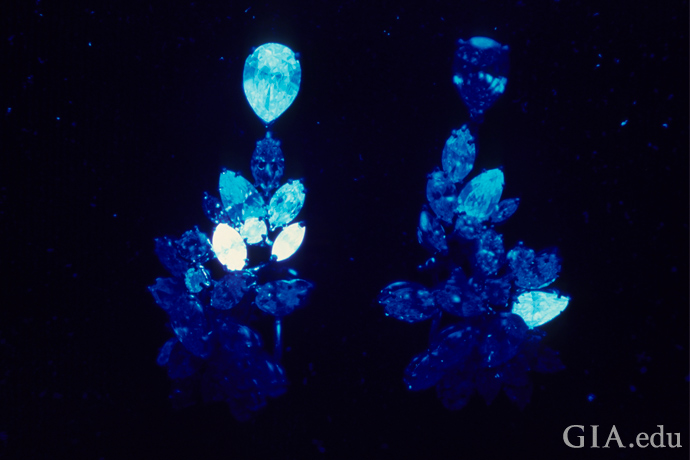
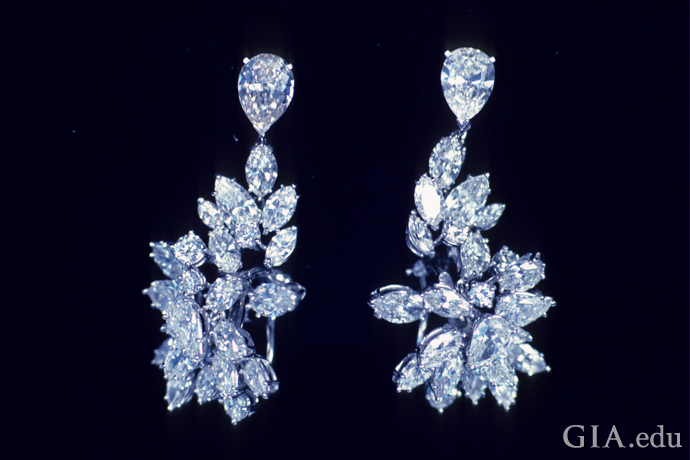
FACT: Diamonds that fluoresce only do so when they are exposed to invisible UV rays and other higher energy radiation sources such as X-rays and lasers. You might see your diamond fluoresce under a bright sun, in a tanning bed, at a dance club or in other places where strong fluorescent or black lights are used. But once the light source is removed, the diamond will stop fluorescing. Incandescent lighting will not cause a diamond to fluoresce.

Diamond earrings shown under incandescent light appear to be the same color.

When viewed with incandescent light, all the diamonds in these earrings appear to be the same color. Photo: GIA

Diamond earrings viewed under a UV lamp showing different degrees of diamond fluorescence.

When viewed with a UV lamp, the diamonds in the earrings show different degrees of diamond fluorescence. Photo: GIA


Myth #3: Diamond fluorescence can always be detected
FACT: Diamond fluorescence cannot always be detected. You need conditions where UV rays are present and the intensity of the fluorescence is strong enough to be observed. A reputable grading laboratory, like GIA, follows strict protocols to determine the presence of fluorescence. It also adheres to set standards in describing its intensity, to ensure objective and consistent reporting.

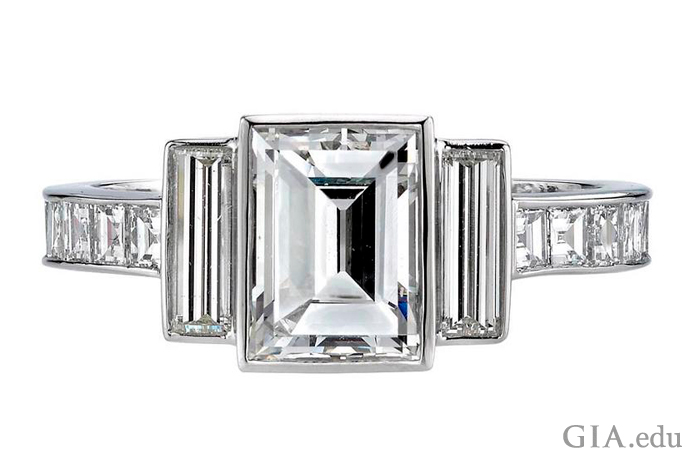
 A 1.42 carat step cut diamond engagement ring set in platinum.

Fluorescent or not, this 1.42 carat (ct) diamond engagement ring, with diamonds lining the band, captivates with its bold, clean lines. Courtesy: 1stdibs.com


Myth #4: Diamond fluorescence influences a diamond’s color grade
FACT: In assigning a diamond color grade, GIA examines the gem in a highly controlled viewing environment, designed to minimize the influence of fluorescence and to produce an accurate and objective assessment of the diamond’s color.

However, the way you perceive a diamond’s color grade may be affected by the extent to which it fluoresces – in a positive way. In a diamond lower on the GIA D-to-Z color scale (say, I to N) with a yellow tint, moderate-to-strong blue fluorescence may cancel out some of the yellow for a better color appearance than what its color grade would indicate. See Myth #7.


Myth #5: Diamond fluorescence is given a grade, just like color, clarity and cut
FACT: Diamond fluorescence is not one of the 4Cs – like color, clarity, cut and carat weight – which describe the quality of a diamond. GIA considers fluorescence an identifying characteristic – additional information that helps distinguish one diamond from another.

GIA diamond grading reports describe the intensity of fluorescence as None, Faint, Medium, Strong and Very Strong. If the fluorescence is Medium, Strong or Very Strong, the color of the fluorescence will be noted on the grading report.

Photo showing the intensity of diamond fluorescence described as: None, Faint, Medium, Strong and Very Strong under UV lighting (top) and under normal lighting (bottom).

A GIA Grading Report describes the intensity of a diamond’s fluorescence as: None, Faint, Medium, Strong and Very Strong. Composite photo in UV: Maha DeMaggio/GIA. Composite photo in normal light: Harold and Erica Van Pelt/GIA


Myth #6: Diamonds only show blue fluorescence
FACT: Diamonds can fluoresce in a variety of colors. These include orangy yellow, yellow, orange, red, white and green. Variations in the atomic structure, such as the number of nitrogen atoms present, cause the phenomenon. Blue, however, is by far the most common color of diamond fluorescence.

Rough diamonds displaying a range of colors when exposed to UV light.

These rough diamonds exhibit a range of colors when exposed to UV light. Photo: GIA


Myth #7: Strong blue diamond fluorescence is bad
FACT: GIA studied the influence of blue fluorescence on the appearance of a diamond under normal viewing conditions. The Institute found that average observers (meant to represent the jewelry buying public) could not consistently discriminate any fluorescence-related effects in the viewing environments most similar to those in which jewelry is purchased and worn.

However, GIA also found that strong blue diamond fluorescence could be beneficial. The results of its study revealed that, as noted for Myth #4, some strongly blue fluorescent diamonds were perceived to have a better color appearance than their color grade would suggest when viewed table-up, with no discernible trend table-down.

Composite photo of diamond necklace and one earring shown under normal lighting conditions (left) and a long-wave UV lamp (right).

Bejeweled fireworks: Half the diamonds in this necklace (132 carats total weight) and the one earring (3.20 ct center stone) in this composite photo are shown under normal lighting conditions (left), and the other half of the necklace and the same earring are shown as they appear under a long-wave UV lamp (right). Composite photo: Harold and Erica Van Pelt/GIA. Courtesy: Harry Winston Inc., New York


Myth #8: Diamond fluorescence detracts from a diamond’s sparkle and beauty
FACT: Diamond fluorescence has little to no effect on a diamond’s sparkle, and research shows that it doesn’t impact beauty either.

A diamond’s sparkle is determined primarily by its cut, not by whether the diamond fluoresces or not. A diamond’s cut – that is, the angles and relative measurements of its facets, as well as its other proportions, design and craftsmanship – determines how well light performs when it strikes the diamond and how well it will sparkle.

A 1.29 carat round brilliant cut diamond engagement ring with diamond melee in the shank.

Even strong blue fluorescence would not affect the beauty of this 1.29 ct E color diamond engagement ring in normal lighting. Courtesy: 1stdibs.com


MYTH #9: Fluorescence means the diamond is a “real” natural diamond
FACT: Absolutely not. The presence or absence of fluorescence should not be used as a DIY test to determine if your diamond is real. First, not all natural diamonds fluoresce under the standard UV lamp used by gemologists (see Myth #1). Second, some synthetic or lab grown diamonds do fluoresce to these wavelengths. Although differences have been noted in the intensity, color and pattern of fluorescence between natural and synthetic diamonds, there is overlap. Finally, some materials used to impersonate diamond – like cubic zirconia – can display fluorescence.

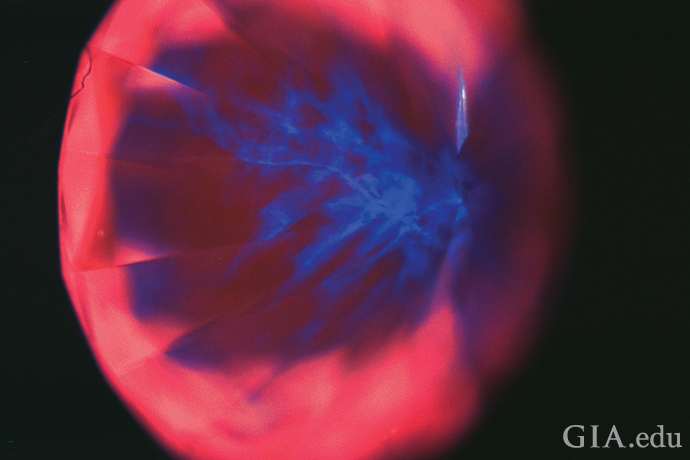
CVD diamond displaying strong pinkish orange fluorescence, with regions of strong blue or violet, when exposed to high-intensity ultra-short wavelengths.

Synthetic diamonds made by the chemical vapor deposition method may display strong pinkish orange fluorescence (among other colors), with regions of strong blue or violet, when exposed to high-intensity ultra-short wavelengths. Photo: Wuyi Wang/GIA


Myth #10: Fluorescence can make a diamond less durable
FACT: A diamond that fluoresces under a standard UV lamp has the same structural integrity as one with no reaction to it. Nothing in the submicroscopic structures that cause fluorescence inherently weakens the diamond.


Myth #11: Diamond fluorescence does/doesn’t affect value
FACT: Jewelry professionals disagree about whether fluorescence adds to or detracts from the value of a diamond. Some trade professionals believe those very rare diamonds at the high end of the D-to-Z color scale that have extremely strong blue fluorescence are worth less than their nonfluorescent counterparts because the fluorescence can affect their transparency by giving them a hazy or milky appearance. Conversely, some traders pay higher prices for blue-fluorescing diamonds of a lower color grade because, as noted above, they believe the fluorescence masks the faint to very light yellow color of these diamonds.
Diamond fluorescence and its effect on value is not a simple question, and there isn’t a simple answer. We recommend that you compare diamonds in a variety of lighting environments and choose the stone that you like best. Ultimately, GIA believes the beauty of a diamond is truly in the eye of the beholder.

A 1.67 ct diamond engagement ring set in platinum, surrounded by 0.56 carats of diamonds in the halo and shank.

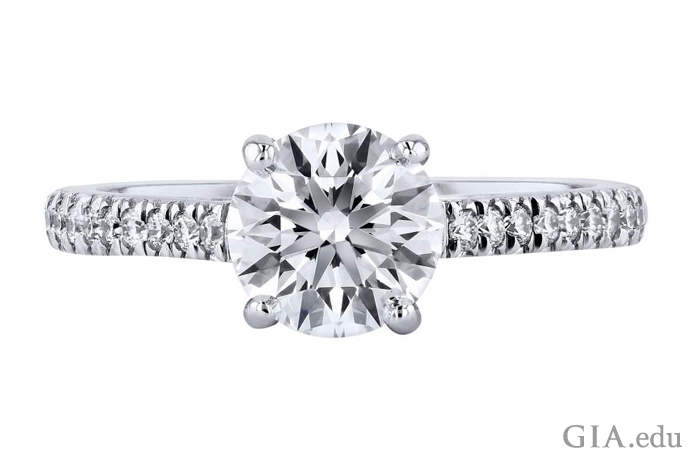
Wouldn’t it be awesome if this 1.67 ct center diamond fluoresced in a night club? Courtesy: 1stdibs.com

Is there a diamond fluorescence “fact” you’d like to verify? Leave us a comment below. In the meantime, if you enjoyed this post, you might like reading about common engagement ring myths.

Pear Shaped Diamond: Tips for Picking the Perfect One

With its graceful, tapered outline, a pear shaped diamond is an elegant and flattering choice for an engagement ring. Here are the essentials for selecting the perfect pear shape.

  1. Learn the anatomy of a pear shaped diamond
  2. Look for symmetry in a pear shaped diamond
  3. The ideal length-to-width ratio is the one you prefer
  4. Check culet placement and position of inclusions
  5. Make sure the table is centered on a pear shaped diamond
  6. Avoid the bow-tie on a pear shaped diamond
  7. Choose a setting that protects the point of a pear shaped diamond
  8. Point up or down? You decide how to wear a pear shaped diamond

1. Learn the anatomy of a pear shaped diamond

Jewelers consider the pear shaped diamond a “fancy shape,” meaning it’s a shape other than round. Reminiscent of a tear drop, a pear shaped diamond blends the best of the round and marquise diamond shapes.

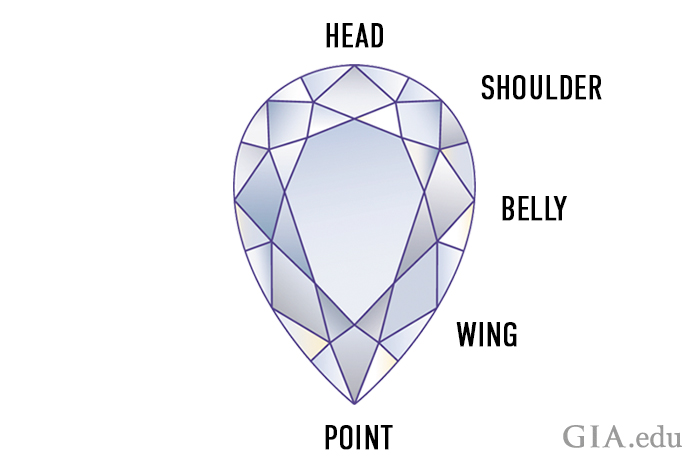
Since the parts of a pear shaped diamond contribute to its beauty, you should get to know them. Then you can shop for a pear shaped diamond engagement ring with a discerning eye.

Illustration showing the parts of a pear shaped diamond.

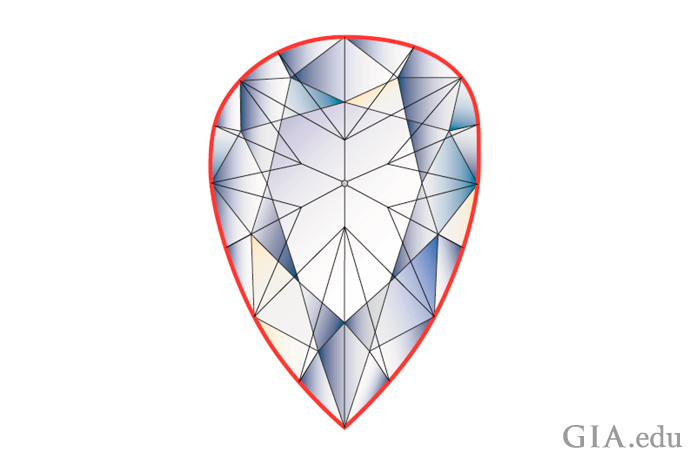
You’ll want to be able to name the parts of a pear shaped diamond when you’re looking at various stones. This shows the retailer you’re an informed buyer. Illustration: Peter Johnston/GIA

Look at the diamond face-up and pay attention to its outline. A pear shaped diamond should have gently rounded shoulders and wings. The wings should form attractive arches. If they’re too flat, they make the stone look too narrow. If they’re too rounded, they make it look short and stubby.

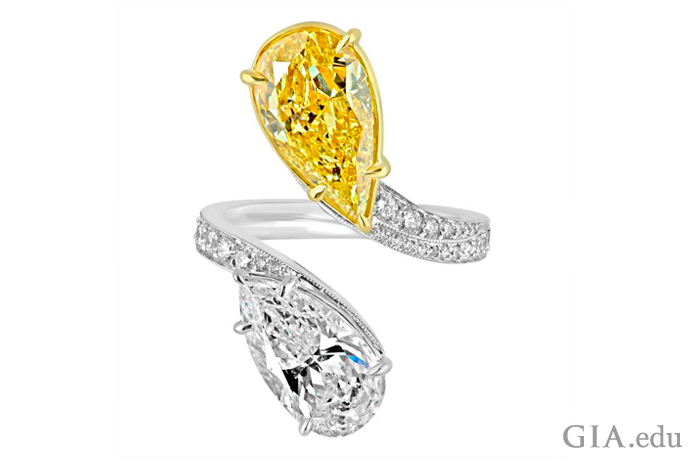
A 4.04 ct yellow pear shaped diamond and 3.02 ct colorless pear shaped diamond in a bypass engagement ring setting.

A bejeweled pair of pears: a 4.06 carat (ct) yellow pear shaped diamond is nestled against a 3.02 ct colorless diamond. The band, which flows from 18K white gold to yellow gold, echoes the colors of the stones. Courtesy: 1stdibs.com

The pear shaped diamond, like the round brilliant diamond, is faceted to deliver the most sparkle and brilliance. Here are the names of important parts of a faceted diamond, which you should know and are used in this blog:

  • Culet: The culet is a small facet at the bottom of the pavilion of a finished gem intended to prevent chipping and abrasion of the fragile tip. Some gems have no facet in this area, which is often called a closed culet.
  • Crown: The top part of a gem located above the girdle.
  • Girdle: A narrow band that circumscribes the edge of the plane separating the crown and pavilion.
  • Pavilion: The portion of a polished gem that is below the girdle. The purpose of pavilion facets is to reflect light toward the crown.
  • Table: A large facet in the center of the crown.

 A 3.83 ct pear shaped diamond.

On a black background, this 3.83 ct pear shaped diamond shines like a star in the night sky. Photo: Robert Weldon/GIA. Courtesy: Atelier Marisa

Like many other fancy shapes (such as the marquise or heart shape), a pear shaped diamond tends to hold more color than a round brilliant. Therefore, it is best to choose a diamond that is high on the GIA color scale or a fancy-color diamond.

A 1.21 ct Fancy purplish pink pear shaped diamond engagement ring set in 18K gold.

Because pear shaped diamonds tend to hold more color than round brilliant diamonds, it is best to choose a diamond that is high on the GIA color scale or a fancy-color diamond like this 1.21 ct Fancy purplish pink diamond engagement ring set in 18K gold. Courtesy: 1stdibs.com

2. Look for symmetry in a pear shaped diamond

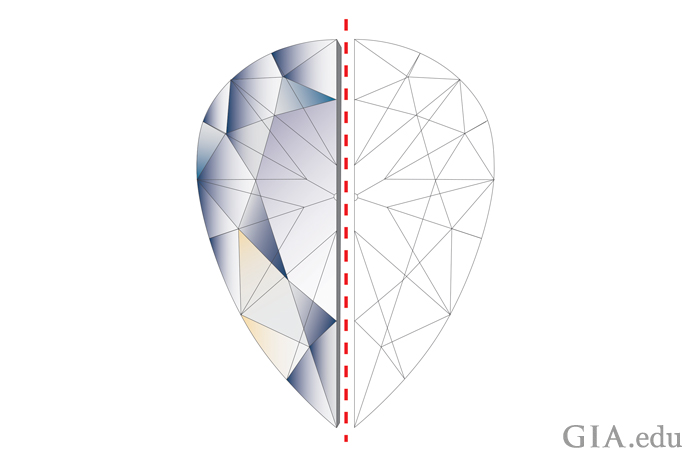
Symmetry is key to the overall beauty of gemstones, but it’s even more important in some fancy-shape diamonds like oval diamonds, heart shaped diamonds, marquise diamonds and pear shapes. To see if a pear shaped diamond is symmetrical, draw an imaginary line down the length of the gem and examine the two halves. The more closely they mirror each other, the better the symmetry is.

Notice how the shoulders, bellies and wings in the illustration below are identical on either side of the line, and how the shape, size and placement of the facets in each half of the stone mirror one another. This is an ideal pear shape. You can use the illustration as a guide when picking a pear shaped diamond.

Illustration demonstrating perfect symmetry in a pear shaped diamond.

Illustration: Peter Johnston/GIA

When GIA diamond graders evaluate the symmetry of fancy-shape diamonds, which includes pear shapes, they also look for things like a balanced and even outline. Certain types of asymmetry and uneven proportions are considered by most in the jewelry trade to have a negative effect on the appearance of a pear shaped diamond. These include:

  • High shoulders
  • Flat wings
  • Bulged wings
  • Undefined points

Uneven shoulders and uneven wings are other variations that will detract from the appearance of a pear shaped diamond. The illustration below has both.

Illustration showing an uneven outline of a pear shaped diamond with asymmetry in its shoulders, belly and wings.

The uneven outline of this pear shape reveals the asymmetry of its shoulders, belly and wings. You might want to avoid a diamond cut like this. Illustration: GIA

3. The ideal length-to-width ratio is the one you prefer

You might run into the phrase “length-to-width ratio” (comparison of the length and width of the outline of many fancy-shape diamonds, determined by dividing the diamond’s length by its width and stated as a ratio, like 1.75:1). Many experts prefer a length-to-width ratio that lies in the range of about 1.50–1.75:1. Others in the trade believe that a ratio isn’t enough to convey a diamond’s beauty. You may want to let your heart and eye guide you.

A 0.88 ct pear shaped diamond engagement ring accented with a halo of diamonds and melee in the shank.

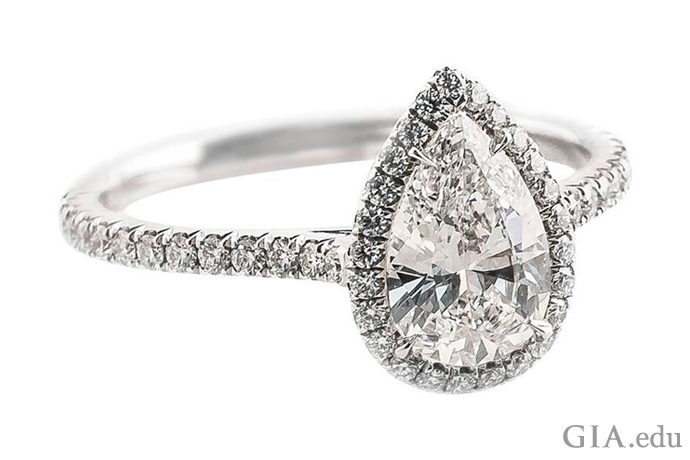
Falling in love with any diamond is more than finding the perfect symmetry and length-to-width ratio. Are you infatuated with this 0.88 ct pear shaped diamond? Courtesy: 1stdibs.com

4. Check culet placement and position of inclusions

The placement of the culet on a pear shaped diamond can affect its appearance. It should be the same distance from the two sides of the diamond. A culet that is off-center will affect the diamond’s symmetry and is likely to make it less attractive. In some pear shapes, the culet is included in a keel line that extends down the length of the diamond where the pavilion facets meet. Like the culet, the keel line should be equidistant from either side of the diamond.

An Illustration of a pear shaped diamond showing an off-center culet.

The culet on this pear shaped diamond is off-center. It should be symmetrically placed at the same distance from either side of the gem. Illustration: GIA

Note, too, whether the diamond has any inclusions, especially near its point, as this is the area of that is most sensitive to damage. In addition, if the pear shaped diamond has a larger table facet, inclusions could be more apparent, so good clarity is a consideration.

5. Make sure the table is centered on a pear shaped diamond

A poorly placed table facet can also make a pear shaped diamond look less attractive. For maximum brightness and fire, the table should be centered on the line of symmetry.

An illustration of a pear shaped diamond showing an off center table.

If the table is off-center, the crown facets on one side of the pear shaped diamond will appear larger than the facets on the opposite side. Illustration: GIA

6. Avoid the bow-tie on a pear shaped diamond

Many pear shaped diamonds show a dark pattern that resembles a bow-tie. This pattern typically runs across the width of the stone from the center of the table. The bow-tie on a well-cut pear shaped diamond should be minimal, but there will still be good contrast between light and dark areas in the stone.

A bow-tie can vary from light gray to black. The darker or larger it is, the more it detracts from the face-up appearance of a pear shaped diamond. A bow-tie gets darker as the difference between a diamond’s length and width increases and pavilion angle variations (the measured angle between the pavilion main facet plane and the table plane) become more extreme.

If you find the bow-tie effect distracting, be sure to examine a variety of pear shaped diamonds from different angles under the lighting conditions in which the engagement ring will be worn. You may not be able to avoid a bow-tie altogether, but you should be able to find a stone in which it is subtle.

These pear shaped diamonds display a bow-tie effect, the dark area that extends across the width of each stone.

These pear shaped diamonds display a bow-tie effect, the dark area that extends across the width of each stone. Photo: Nicholas DelRe/GIA

7. Choose a setting that protects the point of a pear shaped diamond

The most vulnerable part of a pear shaped diamond is the point. This area can be protected by placing a V-prong on the point or choosing a bezel setting around the entire stone.

An 8.25 ct pear shaped diamond engagement ring in a V-prong platinum setting.

A V-prong protects the point – an area susceptible to chipping – of this 8.25 ct pear shaped diamond. Four more prongs hold the diamond securely in place. Courtesy: 1stdibs.com

A bezel setting ensures that this 0.40 ct pear shaped diamond is well protected.

A bezel setting ensures that the 0.40 ct pear shaped diamond is well protected. Courtesy: Doyle & Doyle

8. Point up or down? You decide how to wear a pear shaped diamond

The traditional way to wear a pear shaped diamond engagement ring is to have the tip pointing away from you (down). According to many in the trade, this makes the finger look more slender. But tradition has its limits. Some brides choose to wear this shape with the point toward them (up). And some prefer a horizontal setting that gives this classic diamond shape a distinctive, contemporary look.

Like all matters of the heart, let yours decide which way the pear should point.

A 1.34 ct Art Deco style pear shaped diamond engagement ring with radiant cut diamonds and sapphires.

Whether the tip of the 1.34 ct pear shaped diamond points toward or away from you, an engagement ring like this will look spectacular on the finger. The center stone is surrounded by 43 radiant cut diamonds weighing 0.41 carats and 1.03 carats of sapphires. Courtesy: 1stdibs.com

Among the most elegant of the fancy shapes, a pear shaped diamond conveys both the delicacy of a single tear and the strength of the brightest star. While there are many factors to consider when searching for the perfect stone for your diamond engagement ring, it is a journey well worth taking. When deciding between different pear shaped diamonds, the overall appearance is more important than the specific proportion details. Often, what makes a pear shaped diamond attractive is a matter of personal taste. So enjoy looking at different pear shaped diamond engagement rings until you fall in love with the perfect one.
Before you go shopping, be sure to read our 12 tips for buying an engagement ring.