Please ensure Javascript is enabled for purposes of website accessibility.
Search
Search
Search

GIA 4Cs Diamond Blog

GIA 4Cs Diamond Blog

March Birthstone: What You Need to Know About Aquamarine

Winter is on the way out; aquamarine is on the way in. The placid hues of the March birthstone are a tranquil antidote to the season’s bluster. Read on to learn more about this gorgeous gem and how to pick a beautiful one.

In this post, we’ll cover:
Gemological Information on Aquamarine
Aquamarine History & Lore
Where Aquamarine Comes From
Qualities to Look for in an Aquamarine
Aquamarine Care & Cleaning


March Birthstone: Gemological Information on Aquamarine

Aquamarine is the green-blue to blue variety of the mineral beryl. (Emerald is the green to bluish green variety of the same mineral.) Most of the aquamarine in the marketplace is a light pastel slightly greenish blue. Traces of iron in beryl’s crystal structure cause aquamarine’s color. Like many beryls, aquamarine may form as large crystals suitable for exceptionally large fashioned gems and carvings.
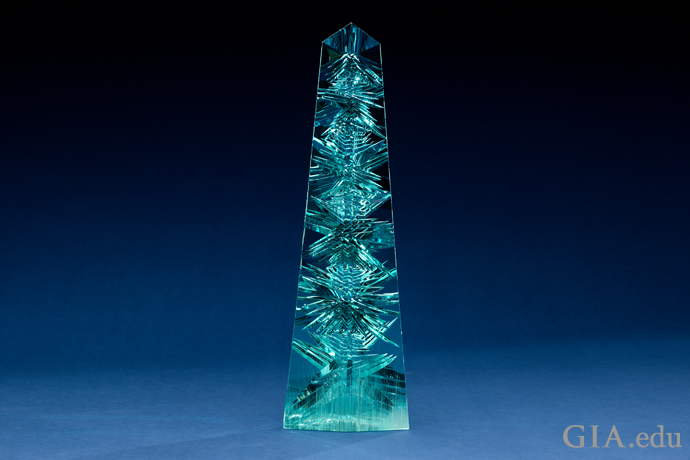
10,000+ carat Dom Pedro Aquamarine has been described as “the one gem that can rival the Hope Diamond.”

A celebrated attraction at the Smithsonian Institution, the 10,000+ carat Dom Pedro Aquamarine has been described as “the one gem that can rival the Hope Diamond.” Courtesy: Donald E. Hurlbert, Smithsonian Institution


March Birthstone: Aquamarine History & Lore

Aquamarine’s name comes from the Latin for seawater, and ancient mariners claimed the gem would calm waves and keep sailors safe at sea. March’s birthstone was also thought to bring happiness to marriages. Beryl was believed to give the wearer protection against foes in battle and litigation. It was also thought to make the wearer unconquerable and amiable, and to quicken the intellect.

Aquamarine is not only the birthstone for March, the gem is also given as a present on the 19th wedding anniversary. As for famous ones, in 1936 the government of Brazil gave First Lady Eleanor Roosevelt a dark blue rectangular step cut aquamarine that weighed 1,298 carats (ct). It was the larger of two stones faceted from a piece of aquamarine rough that itself weighed an impressive 2.9 pounds (1.3 kilograms). It is now housed at the Franklin D. Roosevelt Presidential Library and Museum in Hyde Park, New York. A celebrated attraction at the Smithsonian Institution is the 10,363 ct Dom Pedro Aquamarine – believed to be the largest faceted aquamarine in the world. The 14 inch (36 centimeter) high obelisk was fashioned by acclaimed German lapidary Berndt Munsteiner using the fantasy cut technique.

The government of Brazil gave this 1,298 ct rectangular step cut aquamarine to Eleanor Roosevelt

The government of Brazil gave this 1,298 ct rectangular step cut aquamarine to Eleanor Roosevelt when she and President Roosevelt visited Rio de Janeiro in 1936. Courtesy: The Franklin D. Roosevelt Presidential Library and Museum, Hyde Park, New York.


March Birthstone: Where Aquamarine Comes From

The Brazilian state of Minas Gerais has been an important source of aquamarine for the past two centuries. Travel there and you’ll find a changing panorama of landscapes: rocky hills, rivers and scrub brush dominate the central and eastern regions; savannahs, forests and streams checker the west; and lush green hills roll southward. Aquamarines are found in primary (hard rock) and secondary (weathered) pegmatite deposits in the eastern portion of the state, near the gem center of Teófilo Otoni.

Disguised as “love doves,” 14K white gold prongs hold a 32 ct cushion cut aquamarine from Brazil.

Disguised as “love doves,” 14K white gold prongs hold a 32 ct cushion cut aquamarine from Brazil. Courtesy: Loretta Castoro Signature Collection

Aquamarine is also found high in the Karakorum foothills of Pakistan. To reach the deposits, miners must climb steep paths to elevations of 9,800 to 13,000+ feet (3,000 to more than 4,000 meters) and work the sides of forbidding cliffs. Below this inhospitable rocky world lie fertile valleys, rushing rivers and small towns. Aquamarine from this area has been described as “water clear.”

Pakistan’s gem-rich Shigar Valley lies between foothills of the majestic Karakoram range.

A sliver of an opening (on the far left) is the entrance to an aquamarine mine. Pakistan’s gem-rich Shigar Valley lies between foothills of the majestic Karakoram range. Photo: Vincent Pardieu/GIA

Aquamarine is also mined in Kenya, Madagascar, Nigeria, Zambia and Mozambique, as well as elsewhere in Africa. U.S. sources include the Mount Antero area of Colorado (it’s the state gem) and California’s Riverside and San Bernardino counties. In addition, aquamarine has been found in China, Myanmar, Russia and Ukraine, among other countries.


March Birthstone: Qualities to Look for in an Aquamarine

Aquamarine is pastel blue, greenish blue or green-blue. The preferred color is a moderate slightly greenish blue to dark blue. Fine stones are an even blue with no bands of color (called “zoning”). Most faceted aquamarines are free of eye-visible inclusions. Aquamarine is readily available in large sizes – with many fine gems 25 ct or greater. Aquamarine can be cut into almost any shape, and is often fashioned as emerald cuts, pear shapes, or round or oval brilliants. It also lends itself well to fantasy cuts.

10.06 ct pear shaped aquamarine is surrounded by 72 round diamonds (0.35 carats) that are set in platinum.

A delightfully icy look: a 10.06 ct pear shaped aquamarine is surrounded by 72 round diamonds (0.35 carats) that are set in platinum. Courtesy: Omi Privé


March Birthstone: Aquamarine Care & Cleaning

With a hardness of 7.5 on the Mohs scale, aquamarine is durable enough for everyday wear. Caring for the gem is easy. Use warm water, mild dish soap and a toothbrush to scrub behind the stone where dirt can collect. Ultrasonic cleaners and steam cleaning are usually safe options as long as there are no feathers or liquid inclusions in the gem.

Nearly all the blue aquamarine in jewelry is produced by heat treatment of bluish green, green, greenish yellow and even brownish yellow beryl. The process removes the yellow color component and leaves a purer blue hue. The treatment is undetectable and appears to be permanent.
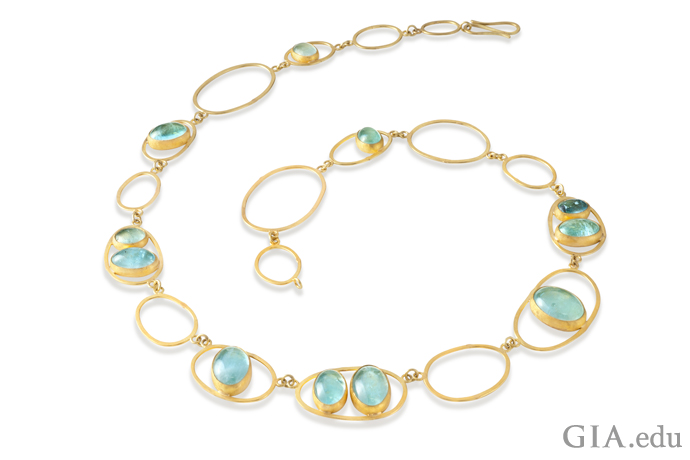
The aquamarine cabochons in this necklace look like drops of water from the Caribbean.

The aquamarine cabochons in this necklace look like drops of water from the Caribbean. Courtesy: Petra Class

The March birthstone aquamarine has it all: It’s beautiful, eye clean, rich in lore and exceptionably wearable. Now you know how to pick one that will become a cherished addition to your jewelry wardrobe.

Born in March? Pisces and Aries are your zodiac signs. Jewelry designers have fashioned some creative pieces, and we’ve found ones for you to enjoy.
February Birthstone: What You Need to Know about Amethyst

Amethyst, the February birthstone, has adorned the nobility for centuries. Now it’s in reach of most consumers. Here’s how to pick a stunning amethyst for the king or queen of your heart – or treat yourself to a royal present.

In this post, we’ll cover:
Gemological Characteristics of Amethyst
Amethyst History & Lore
Where Amethyst Comes From
Amethyst Qualities to Look For
Amethyst Care & Cleaning

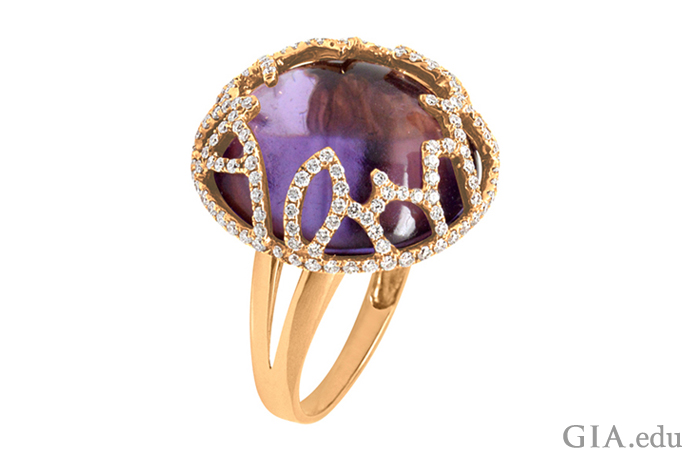
If this ring with an amethyst center stone seems a bit otherworldly, it’s because it comes from the Galaxy collection by Arya Esha.

If this ring with an amethyst center stone seems a bit otherworldly, it’s because it comes from the Galaxy collection by Arya Esha. Courtesy: Arya Esha


February Birthstone: Gemological Characteristics of Amethyst

Amethyst is the purple variety of the quartz mineral species. Its color ranges from a strongly saturated violetish purple to reddish purple in fine quality gems; to weak grayish violet in commercial quality stones. Natural irradiation acting on trace amounts of iron in its crystal structure causes amethyst’s characteristic color. Amethyst also commonly shows color zoning, which often occurs as angular bands of darker to lighter purple. The saturated purple color is typically limited to the tips of amethyst crystals, while the rest of the crystal fades to colorlessness. Cutting an amethyst crystal often produces a few high-quality, deep purple stones and many more low-quality, light-colored stones.

Gemologists and consumers alike love amethyst because it is a beautiful gem that is also affordable. Even fine amethyst can have a modest price tag. Here’s another reason: Amethyst rough comes in fascinating packages. In gem localities like Brazil, amethyst sometimes forms in hollow, crystal-lined geodes so big you can stand in them.

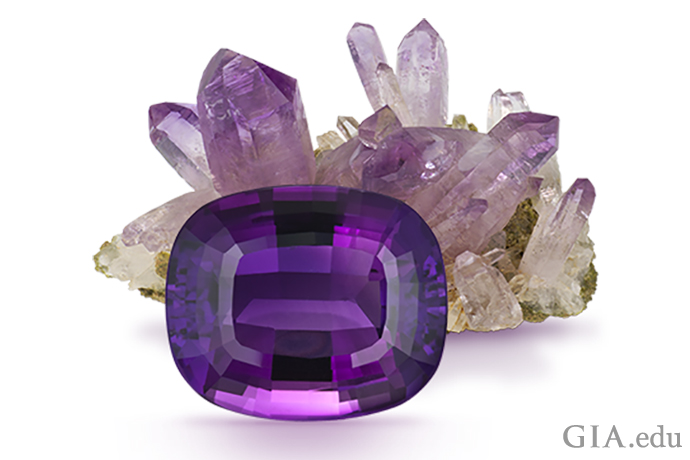
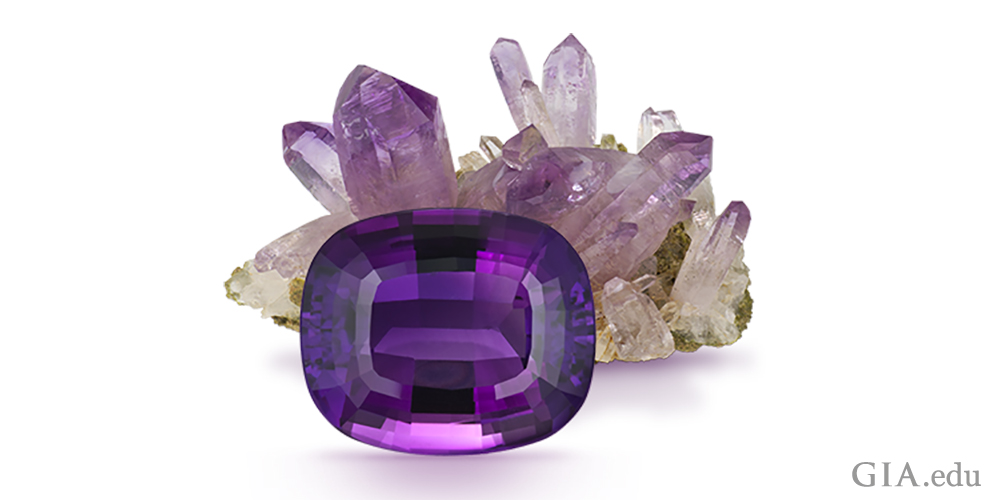
A 22.62 carat (ct) cushion cut amethyst is the dramatic foreground to the amethyst rough behind it.

A 22.62 carat (ct) cushion cut amethyst is the dramatic foreground to the amethyst rough behind it. Photo: Robert Weldon/GIA


February Birthstone: Amethyst History & Lore

The name amethyst derives from the Greek amethystos, which means “a remedy against drunkenness,” a benefit long ascribed to the purple gem. It’s no coincidence that methy is the word for wine, typically of a color very similar to that of this gem. Amethyst was also believed to keep the wearer clear headed and quick witted in battle and business affairs. Renaissance Europeans thought it calmed lovers overrun by passion.

Amethyst is the gem traditionally given for the sixth wedding anniversary. Wear it in celebration of your wedding nuptials or as your February birthstone and you’ll be in royal company: Catherine the Great (Empress Catherine II of Russia; 1729–1796) had a penchant for the gem, and decked herself in necklaces, earrings and other amethyst-adorned ornaments. The famous jewelry connoisseur Wallis, Duchess of Windsor (1896–1986) made a memorable statement when she wore a lavish Cartier-designed amethyst bib necklace to a gala in Versailles in 1953.

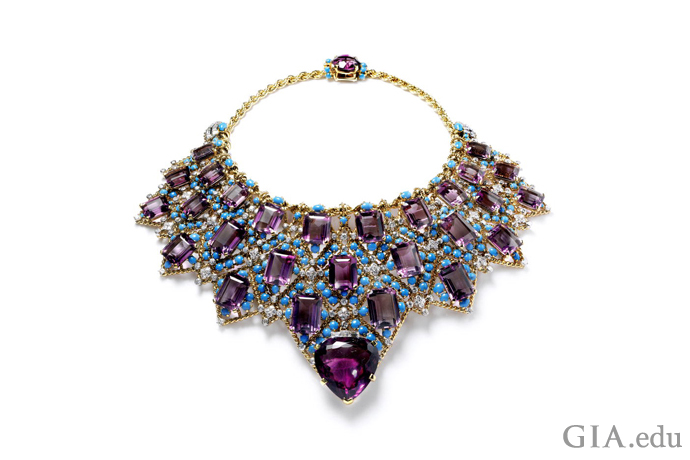
The Duchess of Windsor’s bib-style necklace boasts 27 step-cut amethysts, one oval faceted amethyst, and a large heart-shaped amethyst in the front, as well as turquoise cabochons and brilliant cut diamonds, all suspended from a rope-like gold chain.

A colorful medley of purple and blue, the Duchess of Windsor’s bib-style necklace boasts 27 step-cut amethysts, one oval faceted amethyst, and a large heart-shaped amethyst in the front, as well as turquoise cabochons and brilliant cut diamonds, all suspended from a rope-like gold chain. Courtesy: N. Welsh, Cartier Collection © Cartier


February Birthstone: Where Amethyst Comes From

Amethyst was as expensive as ruby and emerald until the 19th century, when large deposits were found in Brazil. The country is still an important source for amethyst, and its southernmost state, Rio Grande do Sul, is a particularly productive area. Along with its rich amethyst deposits, the region is also home to vast grassy plains, thick forests, waterfalls, panthers and jaguars.

The Anahí mine in Bolivia is another famous source for amethyst. Hidden in the Pantanál wetlands, the Anahí mine is shrouded in fascinating lore. It was discovered by a Spanish conquistador in the 1600s, given to him as dowry when he married Anahí (a princess from the Ayoreo tribe), forgotten for three centuries, and rediscovered in the 1960s.

A treasure trove of amethyst crystals lines the walls of the Anahí mine.

A treasure trove of amethyst crystals lines the walls of the Anahí mine. Photo: Robert Weldon/GIA.

The February birthstone is also found in Zambia. The country is a major producer, and the Kariba amethyst mine is an important source. Amethyst mined here tends to be of superb quality with richly saturated colors.

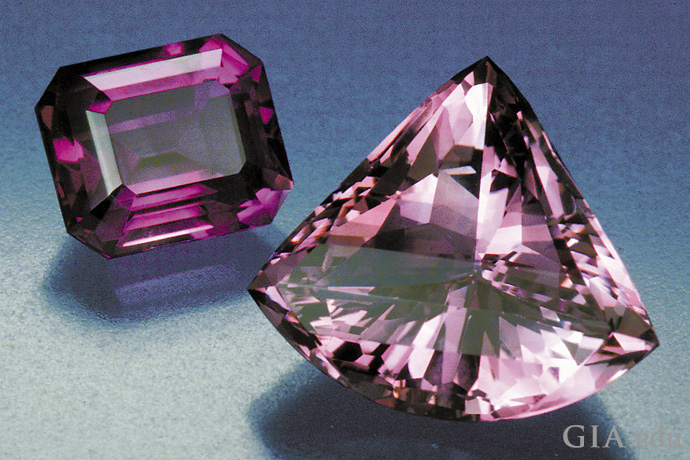
On the left is amethyst from Zambia. On the right is amethyst from Brazil.

On the left is amethyst from Zambia. On the right is amethyst from Brazil. Photo: Robert Weldon/GIA. Courtesy: Pala International


February Birthstone: Amethyst Qualities to Look For

To pick a stunning gem, consider these tips:

  • Color: The finest amethyst is a strong purple or reddish purple, with no visible color zoning. Any brownish or bronze-colored tints lower the value dramatically. Amethysts that are a little less saturated in color are usually more affordable than those with more color saturation. A light lilac amethyst is usually much less expensive than an intense purple.
  • Clarity: Almost all faceted amethyst is eye clean; that is, no inclusions can be seen with the naked eye. Material with eye-visible inclusions is usually cut into beads or cabochons.
  • Cut: It is not unusual to see faceted amethysts of 10 or 20 carats and even larger. Because the gem is so plentiful, matched sets of faceted amethyst are relatively easy to obtain for bracelets and necklaces. The gem can also be found in a variety of fancy cuts and nonstandard sizes.
A Striking fantasy cut amethyst pendant.

A series of grooves and concave facets breathe movement and life into this striking fantasy cut amethyst pendant. Courtesy: Sonja Kreis Unique Jewellery and Gems


February Birthstone: Amethyst Care & Cleaning

Amethyst is a 7 on the Mohs scale of hardness. This means that it is appropriate for daily use in rings and other jewelry, but over time may show wear and require repolishing. Because amethyst is more susceptible to damage than harder gems such as rubies, sapphires and diamonds, do not store your amethyst jewelry next to these, as they can scratch it.

Heat treatment is the most common technique for improving the color and marketability of natural amethyst. Heat treatment can’t make pale amethyst darker, but it can lighten the color of very dark amethyst and make it more attractive. It can also remove unwanted brownish inclusions in some amethysts. Some amethyst turns yellow–to citrine–with heat treatment.

Heat treating amethyst results in a durable and permanent change in color. However, submitting it to intense heat may render it slightly more brittle than usual, and care must be taken not to damage pointed faceted corners and edges. Note, too, that excessive heat can remove the color entirely, and some amethyst fades with prolonged exposure to strong light. Though the color is stable with normal use, this is not a gem to wear to the beach every day.

Amethyst jewelry can be cleaned with an ultrasonic cleaner or a steamer, but use caution to avoid thermal shock. A soft brush with mild soap is the safest option.

As you shop, you’ll also encounter lab-created amethyst. Having the same chemical properties as its natural counterpart, synthetic amethyst has been manufactured since the 1970s. As manufacturing processes became increasingly sophisticated, it became more difficult for gemological labs to distinguish natural from synthetic amethyst. GIA can tell the difference, but many in the jewelry industry do not request testing because of the expense and time required to determine the origin of what is a comparatively inexpensive gem. Still, merchants are required to tell you if a gem is natural or synthetic.

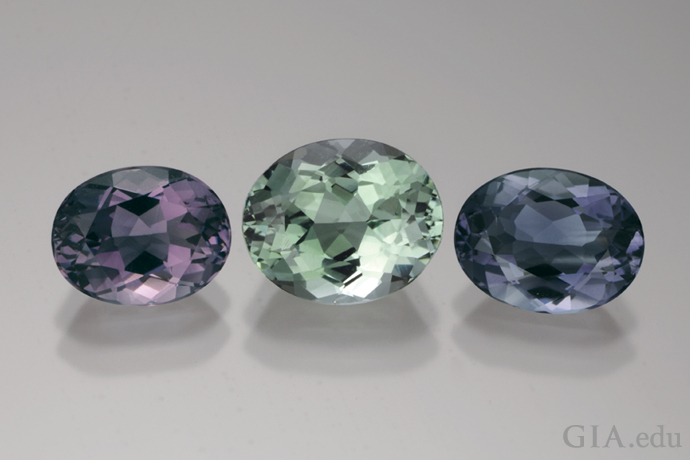
These gems from the Montezuma mine in Minas Gerais, Brazil show the varied coloration of quartz: untreated amethyst (left), heated green quartz (center) and heated and irradiated violet quartz (right).

These gems from the Montezuma mine in Minas Gerais, Brazil show the varied coloration of quartz: untreated amethyst (left), heated green quartz (center) and heated and irradiated violet quartz (right). Photo: Robert Weldon/GIA. Gift of Henrique Fernandes and Gabriel Freitas, Pinkstone International, Governador Valadares, Brazil.

Amethyst has enchanted kings and queens for many centuries. Now you know how to buy a royal gift for your love with a February birthday. And for some quick tips, take along our Amethyst Buying Guide the next time you go shopping.

How to Get the Most Diamond Sparkle

Diamond sparkle might be one of the most-desired requirements for an engagement ring. A diamond’s breathtaking light show is one of the reasons we love this gem. But finding a diamond that sparkles requires some knowledge. So let’s get to it!

In this post, we’ll cover:
What Makes a Diamond Sparkle
How to Choose a Diamond that Sparkles
Maximize Diamond Sparkle – What Works/What Doesn’t

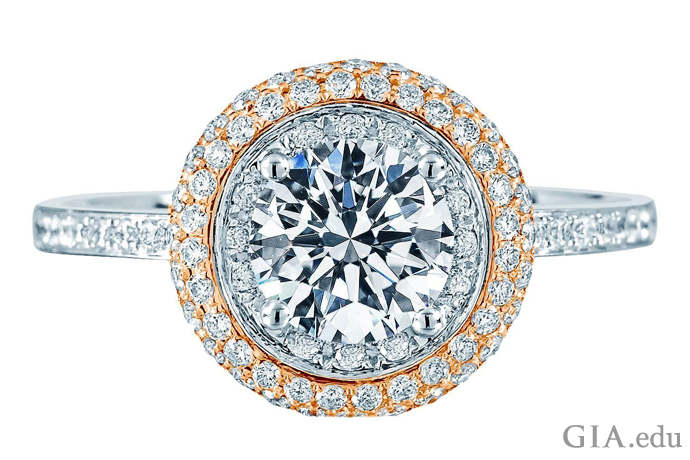
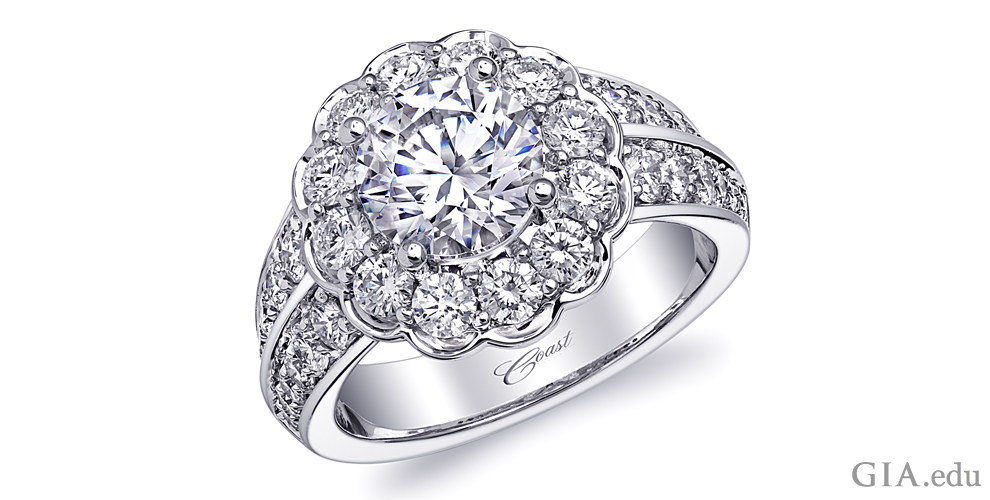
A pavé set diamond halo surrounds a center stone. The diamonds weigh a total of 1.46 carats.

A pavé set diamond halo surrounds a center stone, creating numerous opportunities for sparkle. The diamonds weigh a total of 1.46 carats. Courtesy: 1stdibs.com


What Makes a Diamond Sparkle?

The short answer: light’s interaction with a diamond’s cut. The type and quality of the cut govern how a diamond reacts to the light around it. The angles and relative measurements of a diamond’s facets, as well as its other proportions, have a dramatic effect on how light performs when it strikes a diamond.

The long answer: You probably use the word “sparkle” in a very general way to describe the overall visual effect of a diamond’s interaction with light. But gemologists who have closely studied diamond’s signature light show break it down this way:

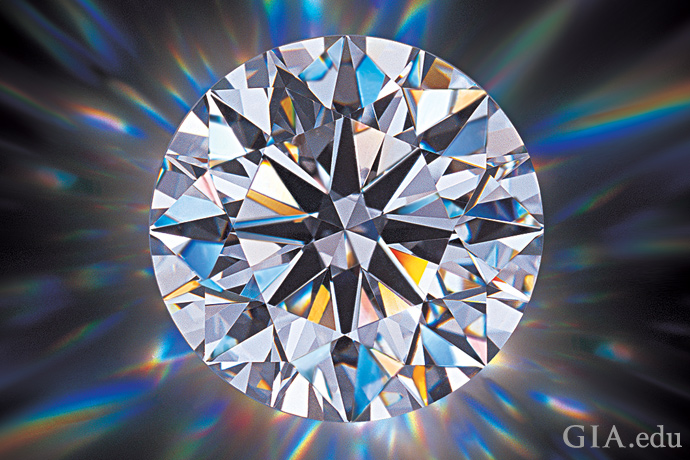
When light enters a diamond, it travels through it, reflecting off its interior surfaces, called facets. It then either leaves the diamond as white light, called brightness, or it divides into the spectral colors of the rainbow: red, orange, yellow, green, blue and violet, called fire.

Light leaving a diamond as spectral colors.

Light leaving a diamond as spectral colors can be quite breathtaking. Copyright: GIA and Harold & Erica Van Pelt.

As you or the diamond moves, an effect called scintillation occurs – visible as alternating flashes of white and spectral-colored light and the contrast of dark and light that moves around the diamond. This contrast is dynamic and causes, in layperson’s terms, sparkle.

How to Choose a Diamond that Sparkles

Since diamond sparkle is all about how well the stone interacts with light, the environment in which you view the diamond and the diamond’s cut quality are critical.

1. Be sure to examine the diamond under four different light sources. Spot lighting (or a lot of individual light sources) is the best way to see all the elements that produce sparkle. However, if there are too many spot lights and they are too bright, there will be so much glare that one diamond will look just as good as any other.

To avoid this, observe the diamond in an environment where the spot lighting is not overwhelming. Then look at the diamond in diffused lighting — fluorescent lights that bounce light off a white ceiling are best. Third, try to view it in a mixed lighting environment of spotlights and diffused lighting. And, finally, don’t forget to view the diamond in natural daylight.

Learn more about how light affects the appearance of a diamond.

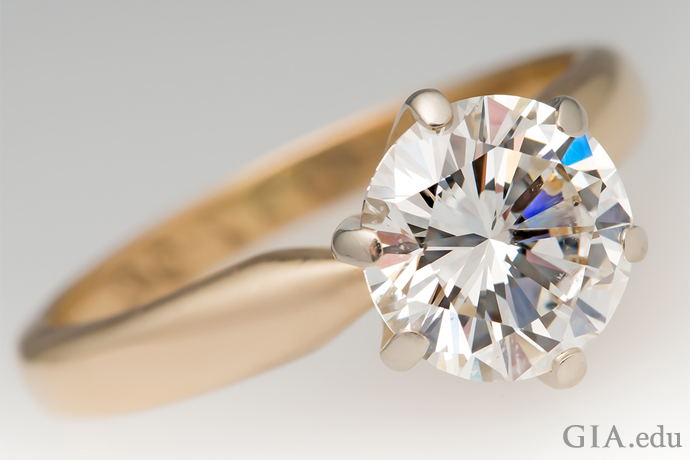
A 1.52 carat (ct) round brilliant diamond engagement ring.

A 1.52 carat (ct) round brilliant diamond is a visual delight in this engagement ring. Courtesy: EraGem

2. Pay attention to cutting style. The more facets a diamond has, the more reflective surfaces there are to bounce and scatter light. A round brilliant cut diamond with its 57 or 58 facets will appear to have more sparkle than a single-cut diamond with only 17 or 18 facets. Learn how to pick a round brilliant diamond engagement ring.

If you have your heart set on a shape other than round, you can still get the sparkle if you look for diamond shapes cut in the brilliant faceting style. These include princess, radiant, oval, pear, heart and marquise.

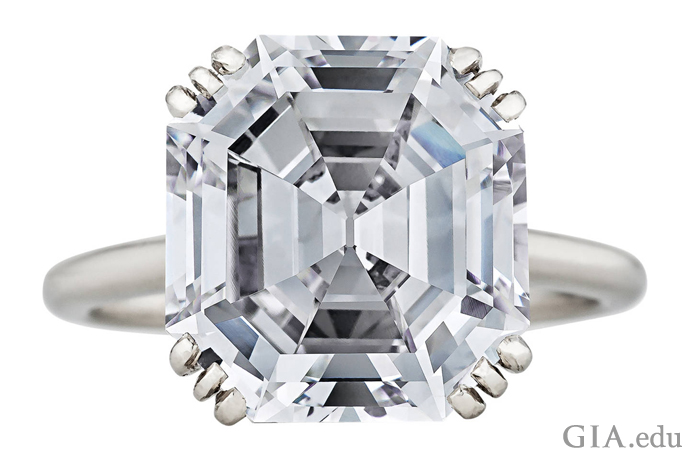
8.06 ct Asscher cut diamond from Cartier, circa 1935.

This 8.06 ct Asscher cut diamond from Cartier, circa 1935, is spectacular. Courtesy: 1stdibs.com

3. Pay attention to cut quality. There’s another solution for standard round brilliants, if you’re unsure about judging a diamond’s sparkle. A GIA Diamond Grading Report can be of great value in finding a diamond that sparkles. GIA issues one of five cut grades for a round brilliant diamond: Excellent, Very Good, Good, Fair and Poor.

A diamond with an Excellent cut grade is very bright. It shows an even pattern with good contrast between light and dark areas, so the reflections appear crisp and well balanced. This tells you that the cutter created the best possible stone from the rough.

A Very Good cut grade means the diamond has bright areas evenly distributed across the stone’s crown and few distracting areas.

A diamond with a Good cut grade isn’t quite as bright – reflections aren’t as sharp and there’s more darkness or dullness in the diamond.

A diamond with a Poor cut grade has much more prominent dark areas or dullness. Given the choice, most people would pick diamonds with either Very Good or Excellent grades.

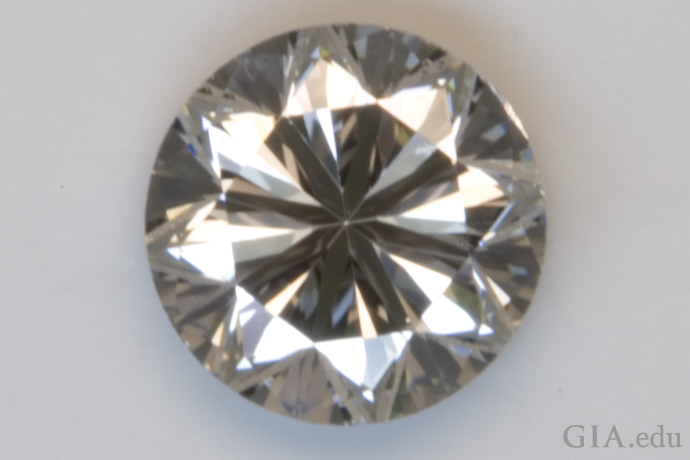
This diamond has an Excellent cut grade: It is very bright and shows an even pattern with good contrast between light and dark areas.

This diamond has an Excellent cut grade: It is very bright and shows an even pattern with good contrast between light and dark areas. Reflections appear crisp and well balanced. If all else is equal, an Excellent cut grade pretty much guarantees an extremely attractive diamond. Photo: Al Gilbertson and Barak Green/GIA.

This diamond has a Good cut grade. Its bright-reflections aren't as sharp and there's more darkening around the girdle.

This diamond has a Good cut grade. Its bright-reflections aren’t as sharp and there’s more darkening around the girdle. Photo: Al Gilbertson and Barak Green/GIA.

This diamond has a Poor cut grade. It has significantly more prominent dark areas; there's a much smaller bright area.

This diamond has a Poor cut grade. It has significantly more prominent dark areas; there’s a much smaller bright area. Photo: Al Gilbertson and Barak Green/GIA.

Learn more about how GIA grades diamond cut.

Maximizing Diamond Sparkle – What Works/What Doesn’t

Looking for more visual bang for your buck when purchasing a diamond engagement ring? Here are some tips for getting the most diamond sparkle.

1. Bigger is not necessarily better. You may think: the larger the diamond, the more sparkle. But in reality, diamonds with identical proportions, color and clarity have the same amount of sparkle regardless of size. Visually, you might perceive a difference when comparing two diamonds that are dramatically different in size. For example, a 0.25 ct diamond may appear to sparkle less than the 1.00 ct diamond next to it. But when it comes to choosing a diamond, typically you’re making a selection between diamonds that fall within a narrow size range, so slight differences in diamond size would have no effect on your perception of sparkle. Again, this assumes the cut quality of the diamonds being compared is the same.

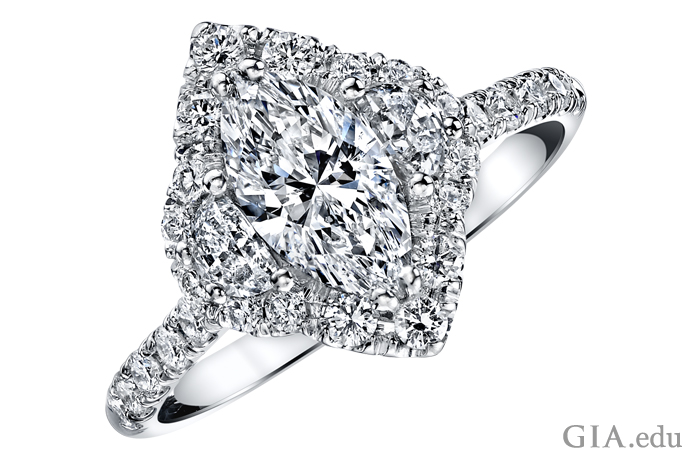
A marquise-shaped diamond in the center is flanked by two half–round brilliant cut diamonds, all of which are surrounded by more diamonds in a pavé setting that extends along the ring’s shank.

Talk about sparkle! This three-stone engagement ring seems to have it all. A marquise-shaped diamond in the center is flanked by two half–round brilliant cut diamonds, all of which are surrounded by more diamonds in a pavé setting that extends along the ring’s shank. Courtesy: ZIVA Jewels Inc.

2. Choose a diamond with good color and clarity. Researchers have found that brightness diminishes in diamonds that grade lower on the D-to-Z color range. Likewise, clarity issues in diamonds graded SI2 or I can diminish the appearance of fire. Both will reduce the sparkle in a diamond.

3. More diamonds, more sparkle. Definitely yes! More diamonds, whether big or small, will add more sparkle to your engagement ring. This is one reason why diamond side stones and pavé settings are so popular.

4. Pick the right setting. If you’re looking for a bigger visual display, a prong setting is better at allowing light to enter the diamond than bezel settings that cover more of the top surface of the diamond. Learn more about different setting styles.

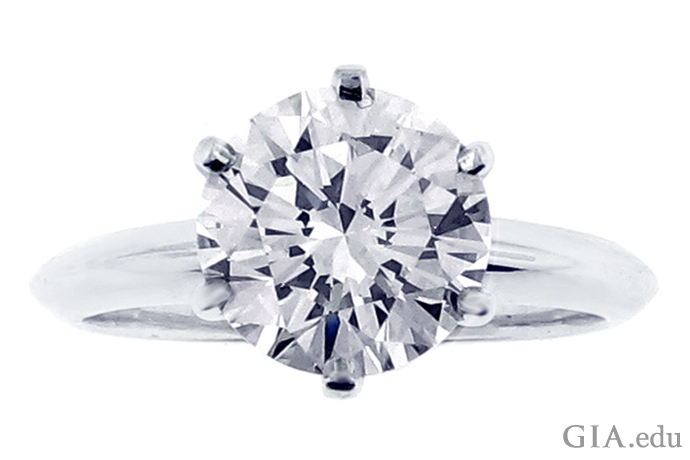
This solitaire engagement ring by Tiffany & Co. features a 2.28 ct round brilliant diamond.

You can have lots of sparkle and still have a simple ring design. This solitaire engagement ring by Tiffany & Co. features a 2.28 ct round brilliant diamond. Courtesy: Pampillonia Estate and Fine Jewelry

5. Keep the diamond clean. This is probably the most important (and affordable) tip. A diamond that’s dirty will not sparkle. Diamonds have an affinity for grease, so it’s important to clean them regularly. Find out how to keep your diamond clean.

In the end, nothing adds sparkle to an engagement ring like the love with which it’s given. So follow your heart and relish the moment — you really can’t go wrong.

If you need a little extra help as you shop, check out our glossary of common engagement ring terms. They’ll help you better communicate your needs and desires with a jeweler.

January Birthstone: What You Need to Know About Garnet

Lucky you if yours is the January birthstone. A favorite gem of the Victorian era, garnet comes in a palette of beautiful colors. Read on to gain a deeper appreciation for the gem and the knowledge to shop more wisely.

In this post, we’ll cover:
Types of Garnets
Garnet History & Lore
Where Garnets Come From
Qualities to Look for in a Garnet
Garnet Care & Cleaning


January Birthstone: Types of Garnets

Garnet is a group of minerals that have the same crystal structure but slight differences in chemical composition. Five members of this group are commercially important as gems:

  • Pyrope (purple to orangy red)
  • Almandine (purple to orangy red)
  • Spessartine (oranges and yellows)
  • Grossularite (colorless to yellow, to reddish orange and orangy red, to vibrant green)
  • Andradite (yellow and yellowish green)

There are also mixtures of these five species, creating even more colors. Variations in trace elements such as iron, manganese, chromium and vanadium produce the kaleidoscopic color range of garnets.

An array of the many colors of garnet, featuring yellow, orange , deep pink, reddish orange, green, and bluish green.

These are some of the many colors of garnet (top row, from left to right): 16.94 carat (ct) yellow garnet, 19.89 ct orange spessartine, 44.28 ct deep pink rhodolite, 16.99 ct reddish orange garnet, and 7.26 ct green tsavorite. Bottom row, left to right: 8.20 ct greenish yellow garnet, 12.36 ct golden yellow garnet, 9.22 ct pink garnet, 14.53 ct light green grossular, and 4.32 ct bluish green garnet. Photo: Robert Weldon/GIA

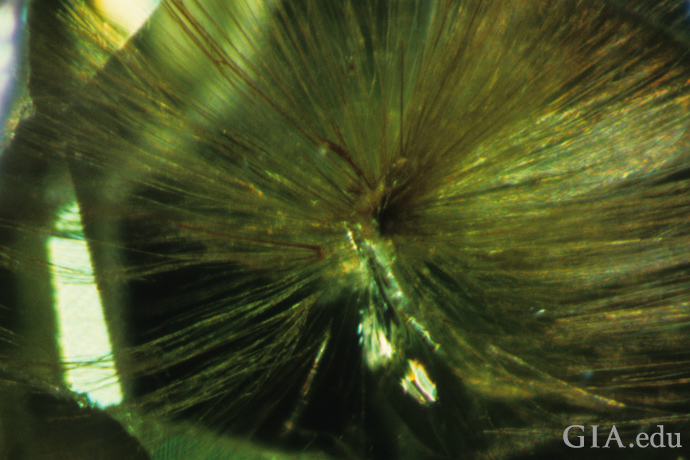
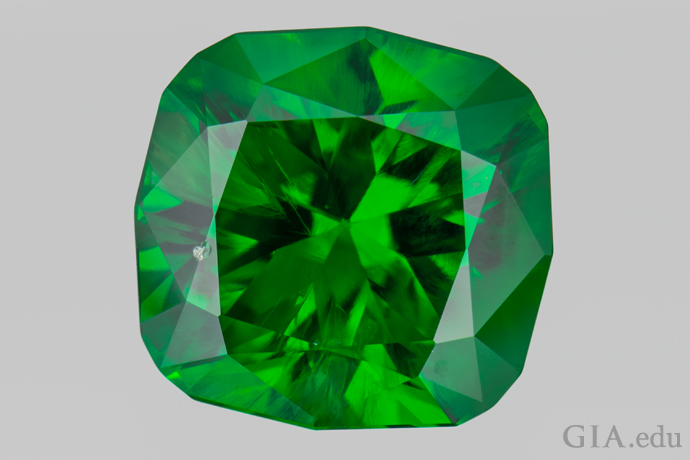
Gemologists love garnets for many reasons. For some, it’s the challenge of categorizing new garnet varieties. Others are fascinated by the characteristics of specific varieties. For example, demantoid garnets, the green variety of andradite, may display dramatic horsetail inclusions, which are one of the few internal clarity characteristics that can increase a gem’s value. Gemologists also love demantoid’s dispersion, which is so high that a well-cut gem displays an amazing amount of fire.

Image of horsetail inclusions in a green demantoid.

It’s obvious how horsetail inclusions got their name. Think of them as Mother Nature’s signature in this green demantoid. Photo: John I. Koivula/GIA

7.00 ct demantoid from Russia

This 7.00 ct demantoid from Russia shows why some garnets are so coveted. Photo: Robert Weldon/GIA. Courtesy: Pala International


January Birthstone: Garnet History & Lore

Red garnets have a rich history. Necklaces studded with them adorned the pharaohs of ancient Egypt. Signet rings in ancient Rome featured garnet intaglios that were used to stamp the wax that secured important documents. The clergy and nobility of the Middle Ages had a preference for them.

The Smithsonian’s antique pyrope hair comb is one of the most famous pieces of garnet jewelry (pyrope is from the Greek pyrōpos, which means “fiery-eyed”). A large rose-cut garnet sits at the crest, much like a queen serenely surveying her court. The pyrope garnets that decorate this tiara-like jewel came from the historic mines in Bohemia (now part of the Czech Republic), and these rich red beauties were extremely popular during the Victorian era (1837-1901), when this piece was fashioned.

Antique pyrope hair comb with a crescendo of red garnet.

A crescendo of red, this antique pyrope hair comb would have made a breathtaking statement when worn. Courtesy: Chip Clark, Smithsonian Institution.

Curious about garnet’s reputed health benefits? Red gems like garnet were thought to be remedies for inflammatory diseases, and to soothe the angry heart. Garnet also was thought to cure diseases of the liver.

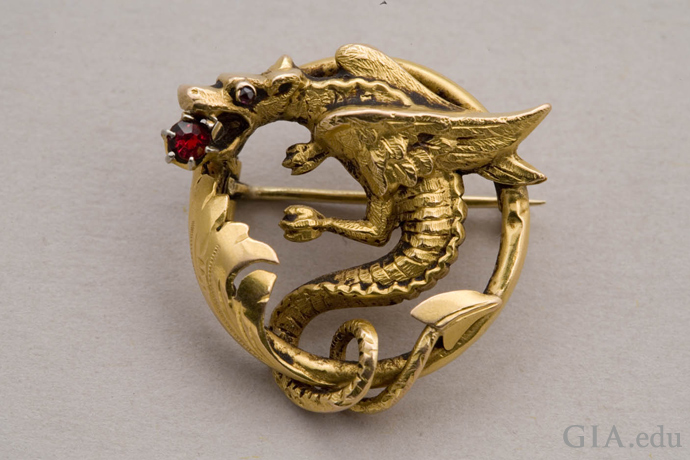
18K gold Art Nouveau era pin depicts a dragon or gryphon with a red garnet in its mouth.

This fanciful 18K gold pin depicts a dragon or gryphon with a red garnet in its mouth. It was made during the Art Nouveau era (1890-1914). Photo: Eric Welch/GIA. Courtesy: Jana Miyahira-Smith.


January Birthstone: Where Garnets Come From

Russia and Bohemia were important sources of garnet in the 19th century, when they were prized by the Russian royal family and used by the great jeweler Peter Carl Fabergé (1846 – 1920). Tanzania and Namibia are important present-day sources for garnet. The gem is also found in Myanmar, Brazil, Kenya, Iran, Afghanistan, Pakistan, India and Sri Lanka, among other countries.

The rolling hills of Green Dragon mine in Namibia.

Namibia’s rolling hills are the scenic backdrop to the Green Dragon mine – an important modern source for demantoid garnet. Courtesy: Green Dragon Mine


January Birthstone: Qualities to Look for in a Garnet

Here are some helpful tips on selecting a beautiful garnet:

  • Clarity: Garnet clarity depends on its type. The red garnets almandine, pyrope and rhodolite (a pyrope-almandine) typically do not have eye-visible inclusions. Some of the orange garnets, like spessartine and hessonite (a variety of grossularite), often have eye-visible inclusions. You can use this information to rule out particular gems. For example, you might not want to purchase red garnets that have eye-visible inclusions.
  • Cut: Many garnets are cut into standard shapes and sizes for easy setting into jewelry. This is especially true of many red garnets. Expensive garnets like fine-quality tsavorite (a variety of grossularite) are cut into shapes and cutting styles that allow more of the weight to be retained from the rough.
  • Demantoid is often cut to allow the best possible display of its fire. Garnets are also popular for designer cuts and carvings. Red garnets are classic materials for cutting into cabochons and beads. They are commonly found to have high clarity and to be very transparent.
  • Carat Weight: Garnets can be found in all sizes and weights. Some garnets, like demantoid and tsavorite, are more commonly found as small crystals, so their value goes up significantly with size. Other garnets, like almandine, occur as larger crystals, so there’s no dramatic rise in value as size increases.

Most garnets are more affordable than diamonds, rubies, sapphires and emeralds. This means you should be able to get a larger gem for the same price.

A 6.22 ct spessartine necklace is encircled with 0.40 ct of round diamonds set in platinum and 18K rose gold.

A 6.22 ct spessartine flaunts its beauty in this necklace. Encircling the fiery orange garnet are some 0.40 ct of round diamonds set in platinum and 18K rose gold. Courtesy: Omi Privé


January Birthstone: Garnet Care & Cleaning

The different types of garnet range between 6.5 and 7.5 on the Mohs scale of hardness. This means that garnets are more susceptible to damage than rubies, sapphires and diamonds. So while not all garnets are good candidates far daily wear in a ring, they are ideal for earrings, brooches and pendants.

Give thought to where you store garnet jewelry in your jewelry case. If you let it rub against harder gems–again, think diamonds, rubies and sapphires–it can be scratched.

Garnets might rarely be treated by fracture filling, which is a method of concealing surface-reaching breaks in the gem by filling them with a glass-like substance. Their comparative affordability may be a reason why garnets are infrequently treated. Regardless, warm soapy water is always safe for cleaning garnets. Ultrasonic cleaners are usually safe, except for stones that have fractures or have been fracture-filled. Steam cleaning is not recommended.

A 5.55 ct oval tsavorite garnet ring, with two fancy yellow diamonds weighing a total of 0.71 ct, and 136 round diamonds weighing 1.02 ct total weight, set in platinum.

This award-winning ring by Omi Privé may just take your breath away. It features a 5.55 ct oval tsavorite garnet, two fancy yellow diamonds weighing a total of 0.71 ct, and 136 round diamonds weighing 1.02 ct total weight, set in platinum. Courtesy: Omi Privé

Whether you’re shopping for the January birthstone, or a gem to celebrate your 2nd wedding anniversary, be sure to download our Garnet Buying Guide. It has the essential tips you need to find the perfect garnet. Take it with you, and shop with confidence.

What Are Simulated Diamonds?

Simulated diamonds — or diamond simulants — may look like diamonds, but they don’t have the same chemical, physical and optical properties. If you’re shopping for a diamond imitation, make sure you know the unique characteristics of the stone you are getting.
(more…)

December Birthstones: Where Do Turquoise, Tanzanite and Zircon Come From?

If you were born in December you have a lot to celebrate, including three December birthstones: turquoise, tanzanite and zircon. With a spectrum of colors to choose from, learning about where the sources of these gems will only add to their appeal. (more…)

How to Choose a Marquise Diamond

Are you an incurable romantic searching for an engagement ring with an aristocratic air? Consider the marquise diamond: It’s beautiful. It has a royal pedigree. And it looks fantastic on the finger. But before you shop, learn what to look for. (more…)

How to Buy Diamonds Online: Five Non-Negotiable Rules

When it comes to buying diamonds and diamond jewelry online, consumers face a dizzying array of choices in terms of quality, styles and price points. And they also face the uncertainties of buying something sight-unseen. So how can you protect yourself? How safe is it to buy diamonds online? (more…)

Moonstone: A Gem to Celebrate the Moon

According to Hindu mythology, moonstone is made of moonbeams! And it’s easy to see why so many cultures also associate the gem with moonlight. Read on to learn all about this remarkable gem, including what gives moonstone its other-worldly glow. (more…)

Black Diamonds: What You Need to Know

From cast-asides to starring roles, black diamonds have taken quite a journey. They’re even vying for position as center stones in engagement rings! But it pays to look beyond their unique appearance to learn more about this enigmatic gem. (more…)

October Birthstone: Where Does Opal Come From?

Opal’s kaleidoscopic hues have delighted us for centuries. Loved for its spellbinding play-of-color, this October birthstone seems to be a bit magical and mysterious. Get ready to find out where it comes from – and how it forms. (more…)

September Birthstone: Where Do Sapphires Come From?

Sapphire is a popular gemstone – and comes in a rainbow of colors. It’s also been long prized, from Ancient Greek rulers to the clergy of the Middle Ages. But where does the September birthstone come from? (more…)