Opal is the October birthstone – and its play-of-color is so mesmerizing that it borders on magical. From coveted black opal, to serene water opal, to blazing fire opal, there’s one for every taste. We help you find your favorite. (more…)

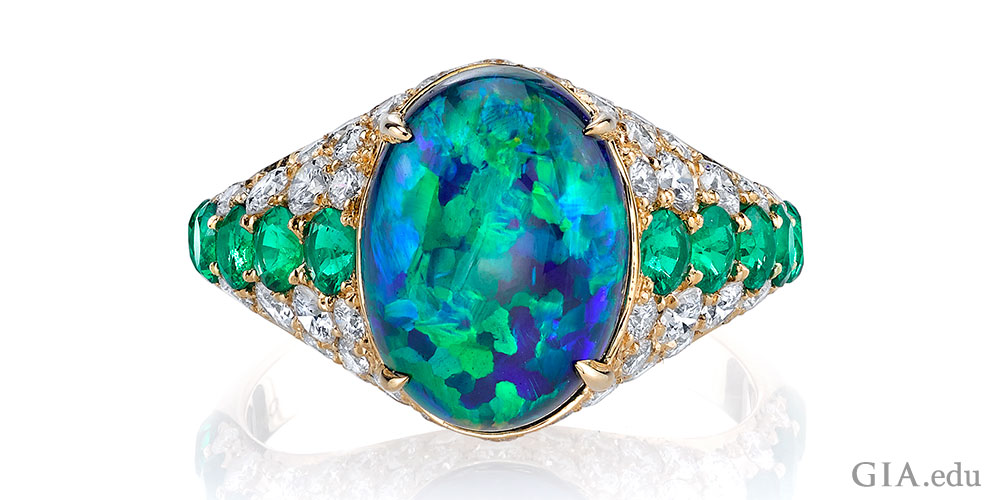
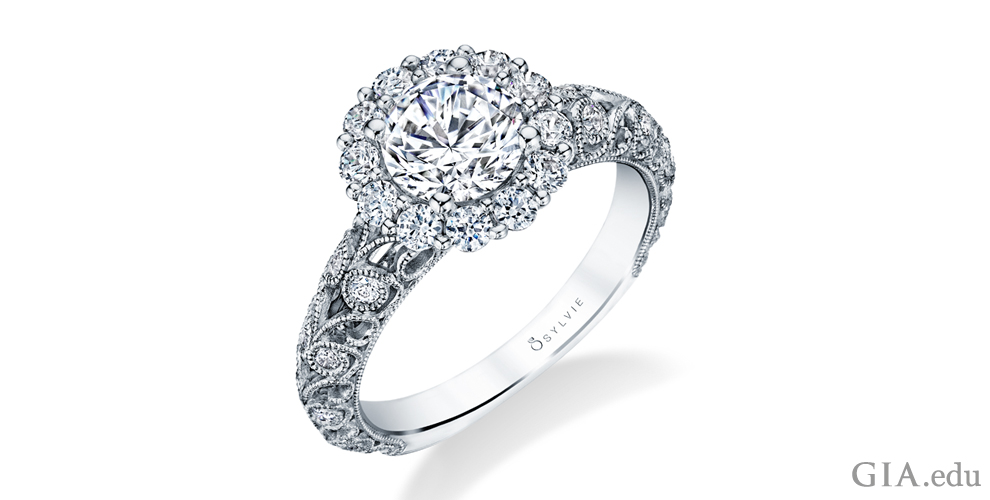
Protect your diamond engagement ring from damage or loss by making the right buying decision and then keeping it like new for the rest of your life. Here are some tips on how to safeguard your treasured possession.
Diamonds are the hardest gemstones on earth – they rank 10 on the Mohs scale of hardness – but they can still suffer damage. Diamonds have clarity characteristics called blemishes and inclusions. Blemishes are confined to the diamond’s surface. Inclusions are internal characteristics either totally enclosed within a diamond or extending into the diamond from its surface.
Generally, if a diamond has significant durability problems, it doesn’t survive the friction and pressure of the cutting process. However, certain types of inclusions, especially if they’re near the girdle, can make a cut diamond more vulnerable to damage. (A girdle is the middle portion of a diamond, a narrow section separating its upper (crown) and lower (pavilion) parts, and functioning as the diamond’s setting edge.) For example, if the stone is hit precisely on a feather or other surface-reaching inclusion, it might chip. Likewise, very deep feathers that extend from the crown to the pavilion, or that penetrate about one-third of the way or more into the diamond, could pose durability concerns. The size, number, location, relief and nature of the inclusions within a diamond are considered when its clarity grade is assigned. You should take into account the types of clarity characteristics before you purchase the stone.

A chip is a damaged area, usually near the girdle of a diamond. Photo: John I. Koivula/GIA
A GIA Diamond Grading Report contains essential clarity information about the diamond you’re considering. In addition to providing an objective assessment of the diamond’s color, cut and carat weight, the report also contains your diamond’s clarity grade along with a map of your diamond’s clarity characteristics. Called a plotting diagram, the color-coded map shows the types of inclusions and blemishes the diamond has and their precise locations. Learn more about the plotting diagram.

Since the corners on a princess cut diamond are vulnerable to chipping, select an engagement ring setting with V-shaped prongs to protect them. Courtesy: TrueFacet.com
Some diamond shapes and cuts are more vulnerable to chipping than others because they have points or sharp corners. The rectangular or square shaped princess cut is one example. The marquise, pear and heart shapes are others. This is not to say you shouldn’t buy one of these shapes; just make sure your diamond is in a setting that protects areas that are more susceptible to chipping. Very thin girdles, sometimes called knife-edge girdles, also pose a greater risk of damage, regardless of the diamond shape.
Diamonds have cleavage, which is the tendency of certain gems and minerals to break or split somewhat easily along crystallographic planes due to their atomic structure. Diamonds are tougher in the directions where the atoms are bonded tightly together, and less tough where they’re not so tightly bonded. This means that diamonds are more likely to be damaged on or near a cleavage plane.

The corners of a princess cut are more vulnerable to chipping since they lie close to a cleavage plane. Illustration: Al Gilbertson/GIA
A diamond in an engagement ring is often held in its mounting by prongs. A prong is a narrow metal support, typically used in groups of four to six. When it comes to protecting your diamond, a six-prong setting can offer more protection than a four-prong setting. In the event a prong breaks, a six-prong setting is more likely to hold the diamond in place. The two additional prongs might also provide a little extra protection for the girdle during daily wear. There are pros and cons to using four or six prongs.

Four prongs can provide an adequate degree of protection and hold your diamond securely. Courtesy: 1stdibs.com
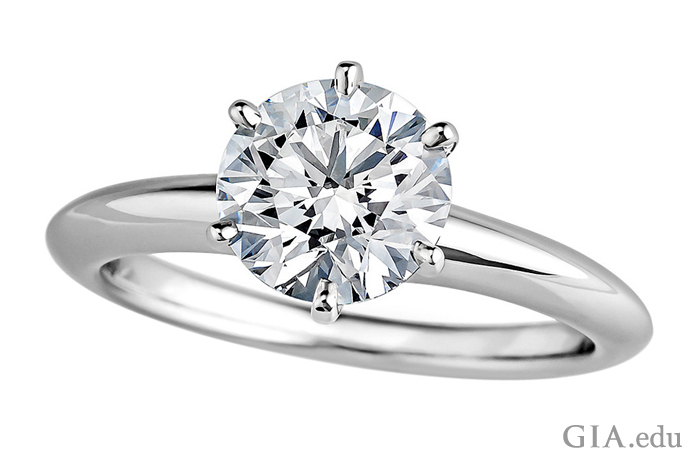
This 1.37 carat (ct) diamond is secure in a six-prong setting. If one prong breaks, the other five will probably hold the stone in its place. Courtesy: 1stdibs.com
Another choice that offers considerable protection is the bezel setting – a style in which a thin metal strip is pushed or hammered around a gem to hold it in place. A bezel setting helps prevent the center stone from falling out, and it protects the girdle against bumps, bangs and other accidents. Partial bezels and V-shaped prongs also protect vulnerable points and corners of diamonds.

The 0.53 ct diamond in this bezel setting is well protected. Courtesy: 1stdibs.com

Although striking and unusual, a tension setting may be a riskier choice for an engagement ring. The diamond, which appears to be suspended in air, is held in place by the inherent force in the two opposing sides of the metal setting. Photo: Robert Weldon/GIA. Gift of Steven Kretchmer and Eightstar Diamond Company
Diamonds graded by GIA often have their grading report numbers microscopically inscribed on their girdles. This laser inscription is automatically applied to all diamonds that come with either a GIA Diamond Dossier or Diamond FocusTM report. It’s an optional, low-cost additional service for diamonds with GIA Diamond Grading Reports.
A laser inscription serves as a secure identifying feature, which links the diamond to its specific report data. Viewable under 10× magnification with a simple jeweler’s loupe, the inscribed report number can be matched to the diamond’s physical report or entered into GIA Report Check, GIA’s online database containing the diamond’s grading details. Should your diamond be stolen and later recovered, a laser inscription may help the police identify it.
By the way, you’re not limited to inscribing a report number – you can also inscribe a short message, a special date or other meaningful symbol.

A diamond with a laser inscription can give you added peace of mind. Photo: Al Gilbertson/GIA
The emotional value of your engagement ring is priceless, but it does have a monetary value. That’s why insuring it is a smart thing to do. Most homeowner’s and renter’s insurance policies offer relatively inexpensive coverage for jewelry theft. Make sure your policy also covers damage and loss. Be sure to read it carefully.
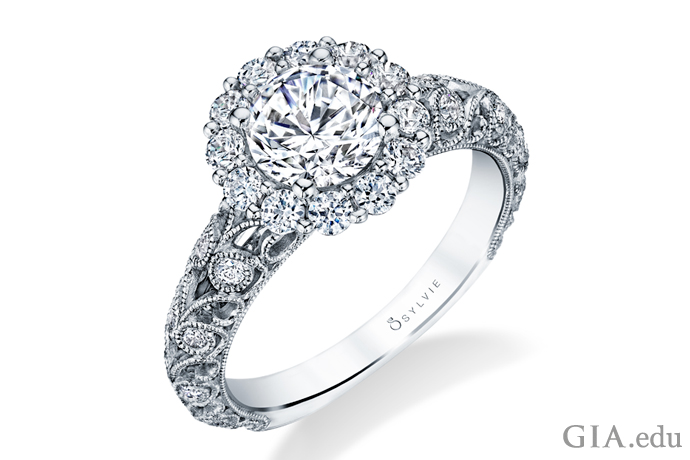
An engagement ring represents so much that you’ll want to make sure it’s a lifetime companion. Courtesy: Sylvie
Many insurance companies will require an appraisal in order to determine your diamond engagement ring’s replacement value. An appraisal is an evaluation of diamonds or other jewelry, usually for insurance or estate purposes. Appraisals normally provide a detailed description of the pieces being appraised, including the exact measurements of the important gemstones, together with (for diamonds) their color and clarity grades, plots showing the location of inclusions or blemishes, and information on the properties and make. They then state an estimated value.
You can find a local appraiser by consulting a list of professional appraisal associations. Many of these organizations require that their appraisers have a GIA Graduate Gemologist (GG) diploma in addition to supplemental appraisal training. They also expect members to uphold the highest ethical and professional standards.

You’ll want to insure this 1.03 ct heart-shaped diamond engagement ring. The V-shaped prong at the point helps protect the diamond from damage. Courtesy: Leo Ingwer
Diamond engagement rings are meant for a lifetime of daily wear, but they’re not indestructible. Prongs can shift and loosen over time. Exercise, gardening, catching on clothing and accidental bangs all may take their toll.
Even washing the dishes with an engagement ring on isn’t ideal (how many stories have you read about a ring going down a drain?). Wearing it in cold weather can be risky; fingers shrink and rings can slide around. A good way to protect your diamond is to remove your engagement ring before these kinds of activities.
You’ve heard that only a diamond can scratch a diamond? Well, storing or wearing diamond-set jewelry items next to each other can cause chips and other damage as well as scratches. One solution is to store your diamond ring or other jewels individually in padded boxes or soft pouches. Make sure you place only one piece of jewelry in each bag or box.

To protect the 1.01 ct pear shaped diamond and surrounding melee, be sure to take the ring off before gardening or performing other risky activities. To avoid inadvertently scratching or chipping the stones, store the ring individually in a box or soft bag. Courtesy: 1stdibs.com
It’s a good idea to get the prongs in your engagement ring checked every six months for potential damage. If this seems too frequent for you, use your yearly wedding anniversary as a convenient reminder to get the prongs checked. Many insurance companies also require that the ring receive regular check-ups. Contact your carrier to find its requirements.
Tightening prongs is a routine task for a bench jeweler. You can check if a prong is loose by seeing if the stone moves when you gently push it (if it moves, it’s loose). Gaps between the diamond and the setting are another warning sign. Look at the ring with a 10× loupe to help see such gaps and spot damaged prongs.

A breathtaking sight: An 11.17 ct marquise is held in place by six prongs. Tapered baguettes decorate the shank. Photo: Valerie Power/GIA
Dirt won’t break or chip your diamond, but it will dull its appearance. You can clean your diamond by using a lint-free cloth or washing it with warm water, mild soap and a soft toothbrush. Don’t use abrasive household cleaners, or steam cleaners. Ultrasonic cleaners are safe for untreated diamonds; however, treated diamonds can be damaged by ultrasonic cleaners. You can briefly dip your diamond in a commercial jewelry cleaning solution. It’s also a good idea to have your ring periodically cleaned by a professional jeweler. If you follow the check-up advice above, your diamond engagement ring will retain its sparkle for a lifetime.
Now that you know how to protect your diamond, it’s time to debunk eight common diamond engagement ring myths.

Victorian style engagement rings evoke a romantic past. Flowers, hearts and acrostic messages are just a few of the motifs you can use to create a symbol of your love. Learn more about this captivating engagement ring style.
The Victorian era is named after Queen Victoria (1819–1901), who ruled Great Britain for almost 64 years, from June 20, 1837 until her death on May 1, 1901. For decades, the beloved monarch’s tastes influenced art, style and customs. A wreath of fragrant orange blossoms that she wore on her wedding day became the fashion of the time for British brides. The jewelry that she wore, which was featured in newspapers, was widely copied.

A young Queen Victoria is adorned with jewels and her royal regalia in this portrait by Alexander Melville from 1845. Courtesy: www.bildindex.de, obj 13850883, via Wikimedia Commons
Queen Victoria’s marriage to Prince Albert lasted a brief 21 years. Their love was celebrated and idolized by an admiring public. After Albert’s untimely death from typhoid in 1861, Queen Victoria spent the rest of her life in mourning, but her love for Albert became the stuff of legend.
Queen Victoria’s jewelry collection included a serpent bracelet she wore to symbolize “the wisdom of the serpent” that she sought as the head of state, reset treasures from the Crown Jewels, a heart-shaped locket with strands of Prince Albert’s hair (worn after his passing), and a sapphire and diamond diadem. Particularly beloved were the jewels Albert gave her, often of his own design. His wedding gift was a sapphire and diamond brooch, which she wore proudly in her bridal portrait. Over the years that followed, in honor of the floral tiara she wore at her wedding, he gave her several pieces in the orange blossom theme.
Mourning jewelry, which she wore after Albert’s death, became the style across England. In addition to the black enamel, jet and onyx of mourning jewelry, diamonds continued to play an important part in Queen Victoria’s life. As a widow, she dressed herself in black silk and diamonds.
During Queen Victoria’s long reign, a number of revolutionary inventions reshaped society: anesthesia, the telegraph, the telephone, automobiles, bicycles, the electric bulb and railways. It was a time of comparative peace and prosperity for a growing middle class who could afford to purchase jewelry. In the late 1860s, the discovery of large quantities of diamonds in South Africa put a gem that was once reserved to the aristocracy and wealthy within the reach of many.
As Queen Victoria reigned for more than six decades, the period is rich in jewelry styles. Here are some motifs you can use in your one-of-a-kind Victorian style engagement ring.
Victorians loved acrostic jewelry – using the first letter of gemstones to spell a word. For example, the word “Regard” was spelled by using a ruby, emerald, garnet, amethyst, ruby and diamond. Regard, Adore, Dear and Dearest were popular acrostic terms, as were birthday wishes. Acrostic jewelry was meant to send private messages known only to one’s beloved. That makes it perfect for your personally-designed custom Victorian style engagement ring or wedding band.

Ruby, emerald, garnet, amethyst, ruby and diamond spell “Regard” in this Victorian-era (circa 1870) acrostic engagement ring. Courtesy: Doyle & Doyle, doyledoyle.com
The snake has been used as a symbol for millennia. Today the snake may have negative associations for many; however, during the Victorian era, the snake represented love, eternity and wisdom. Adding a snake motif to your custom Victorian style engagement ring and wedding band could be an edgy and eye-catching choice.

Two snakes are locked in an embrace in this Victorian-era (circa 1860) ring. An old European cut diamond and a ruby crown the heads of the snakes. Courtesy: 1stdibs.com

Edgy and Victorian-inspired, this platinum serpent style ring with heart shaped diamonds and melee borrows two signature design motifs from the period. Courtesy: Platinum Guild International, USA
Victorians loved horticulture, built greenhouses to grow exotic plants and devoured books on the subject. They felt specific flowers had specific meanings: Tulips meant passion, bluebells represented kindness, myrtle stood for good luck and love in marriage, red roses symbolized love, and purple violets conveyed “thoughts occupied with love.” As a result, the giving of flowers often conveyed emotions that could not be spoken out loud. Now that you know the meaning of these blooms, you can add the appropriate flower or even a bouquet of flowers to your Victorian style engagement ring.

A dramatic declaration of love is told in gems: Three flowers with ruby petals glow in this Victorian-era ring. Diamonds are the hearts of the blooms, and melee diamonds surround them in a play of light. Courtesy: LangAntiques.com

This modern engagement ring with its floral inspired design evokes the romantic Victorian period. Courtesy: Erika Winters Fine Jewelry, erikawinters.com
By the latter half of the 19th century, the discovery of diamonds in South Africa had put the dream of a diamond engagement ring within reach of the rising middle class. A gem that was once extremely rare was now being mined in sufficient quantity to fulfill the demands of a broad range of people.
The old mine cut, an early cushion-shaped brilliant cut with many proportion variations, was often used in jewelry during the early and mid-Victorian periods. It has 58 facets like most round brilliants, but it typically has a smaller table, larger culet and higher crown. Other characteristics include short lower half facets and a girdle that is very thin in places. As a result, an old mine cut diamond has a very distinctive look. Advances in diamond-cutting technology in the late 1800s allowed cutters to create round girdles. This led to the old European cut, precursor to today’s round brilliant cut, gaining popularity during the late Victorian period.

An old mine cut diamond has a distinctive look – especially compared to a round brilliant. Photo: Orasa Weldon/GIA
For centuries a plain gold band was a common choice for an engagement ring. By the Middle Ages, though, gem-set “betrothal rings” had become fashionable. In 1477, Archduke Maximilian of Austria gave Mary of Burgundy a diamond betrothal ring, one of the earliest on record. To bring more light (and, thus, brilliance and sparkle) to the faceted diamonds that were becoming increasingly popular, the Tiffany Setting (a six-prong setting) was introduced in 1886. A diamond solitaire is still an extremely popular choice for an engagement ring, and the use of an old mine (or similar) cut diamond will give your custom engagement ring the essence of Victorian style.

The diamond solitaire ring has become a universal symbol of love. It has a timeless quality, as evidenced by this Victorian-era engagement ring featuring a 0.88 carat (ct) old mine cut diamond. Courtesy: TheRealReal.com
The image of a heart has long represented love, and it especially appealed to Victorians, who had a soft spot for things sentimental. Then as now, the motif is a popular means of expressing affection. A heart-shaped diamond – or any gemstone – is an easy way to get the look in your Victorian style engagement ring. Two pear-shaped stones coming together in a single heart send the same message in a very clever fashion.

Two hearts beat as one in this Victorian-era ring, which features two stunning pear shapes, a 0.84 ct diamond and a 1.28 ct ruby. Courtesy: 1stdibs.com

Looking for design inspiration for your Victorian style engagement ring? Take heart! This modern heart-shaped yellow diamond ring features a signature motif of the Victorian era. Courtesy: 1stdibs.com
A crossover ring wraps around the finger, with the ends of the band passing each other. The style was popular in the 1890s, and still remains so. It is also called a toi et moi ring (“you and me” in French). The two stones are said to symbolize the intertwining of two lives. Such a romantic notion would be a lovely design choice for your Victorian style engagement ring.

This Victorian-era (circa 1885) crossover ring, set with a sapphire and an old European cut diamond, celebrates two lives joined together in marriage. Courtesy: Treasurly by Dima
There’s no shortage of delightful style motifs from the Victorian era that you can use to design a custom engagement ring. Before you start sketching, take a few minutes to learn the 4Cs of diamond quality: color, clarity, cut and carat weight. Knowing these will help you choose the perfect diamond for your beautiful Victorian style engagement ring.

The September birthstone is sapphire – a gem that’s been cherished for thousands of years. Sapphire is one of the most popular colored stones because of its beautiful blues. It also comes in a rainbow of other colors. Here’s how to pick a stunning one.
In this post, we cover:
Gemological Properties of Sapphire
Sapphire History & Lore
Where Sapphire Comes From
Qualities to Look for in Sapphire
Sapphire Care & Cleaning
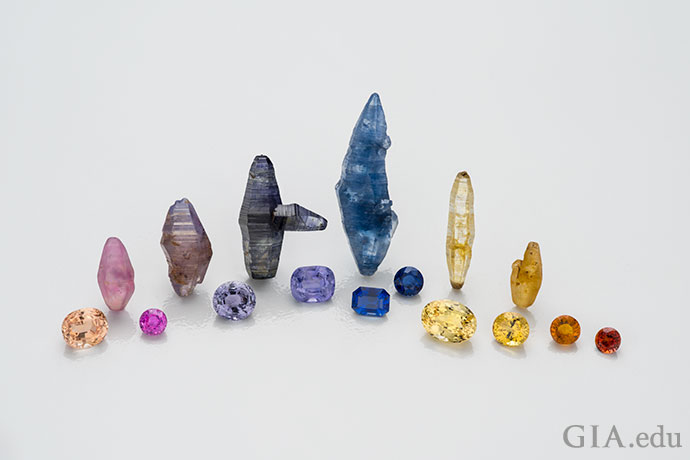
The colors of sapphire enchant. Faceted stones (from left to right): 6.36 carat (ct) pinkish orange “padparadscha,” 1.63 ct pink, 4.76 ct violet, 5.43 ct violet-purple, 3.03 ct blue, 2.12 ct blue, 8.06 ct yellow, 3.46 ct yellow, 2.00 ct orange and 1.01 ct deep orange. Photo: Robert Weldon/GIA. Courtesy: Dr. Edward J. Gübelin Collection and Bill Larson, Pala International
The September birthstone, sapphire, comes in a range of colors in addition to the familiar blue. Called “fancy sapphires,” these are violet, green, yellow, orange, pink, purple, black, brown and intermediate hues. Sapphire can be colorless, too. That’s because the gem belongs to the mineral species corundum, which is composed of aluminum and oxygen. In its purest state, corundum is colorless. However, colorless corundum is rare. Most corundum contains trace amounts of additional elements including iron, titanium, magnesium, vanadium, and chromium that replace aluminum in the corundum structure. The coloration of blue and fancy sapphires involves interactions between these impurity elements—sometimes in combination with imperfections in the gem’s crystal structure—that absorb light and impart color into this otherwise colorless mineral.
Blue in sapphire requires interaction between impurities of iron and titanium, whereas chromium is key to the pink in pink sapphires and the red color of ruby, which also belongs to the corundum mineral species. (Red corundum is the only color not called sapphire – it is called ruby.)
Any color of corundum can show a phenomenon called asterism, or the star effect. This phenomenon usually appears as a six-ray star pattern across a cabochon-cut stone’s curved surface when the gem is examined in direct sunlight or with a single intense light. Asterism is caused by the presence of numerous tiny, needle-like inclusions of rutile or hematite oriented in specific directions.

The star, or asterism, in this 5.43 ct blue sapphire is heavenly. Photo: Robert Weldon/GIA. Courtesy: Fu Gemstone Import, Seattle, WA.
Another interesting variety is color-change sapphire. These fascinating stones appear to be a different color under different lighting conditions, most often going from violetish blue in daylight or fluorescent lighting to deep reddish purple in incandescent light. Their presence adds a special dimension to the options available for the amazing September birthstone.
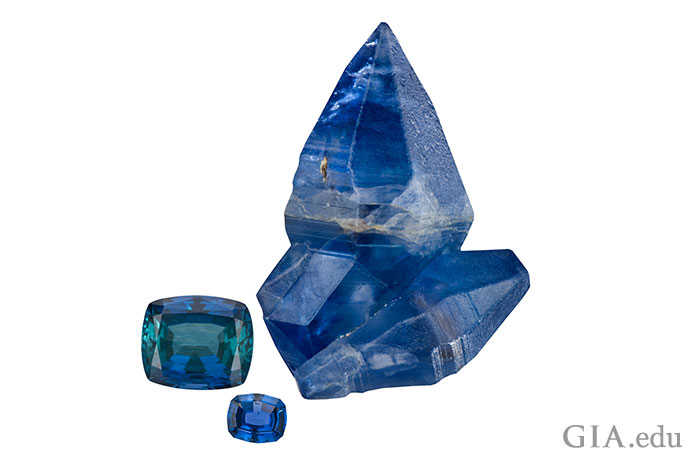
Pictured here are a cluster of sapphire crystals from Myanmar, a faceted blue-green sapphire from Kenya and a faceted blue sapphire from Montana. Photo: Robert Weldon/GIA. Courtesy: (Rough) Bill Larson, Pala International; (Left) Columbia Gem House; (Bottom) Dr. Edward J. Gübelin collection.
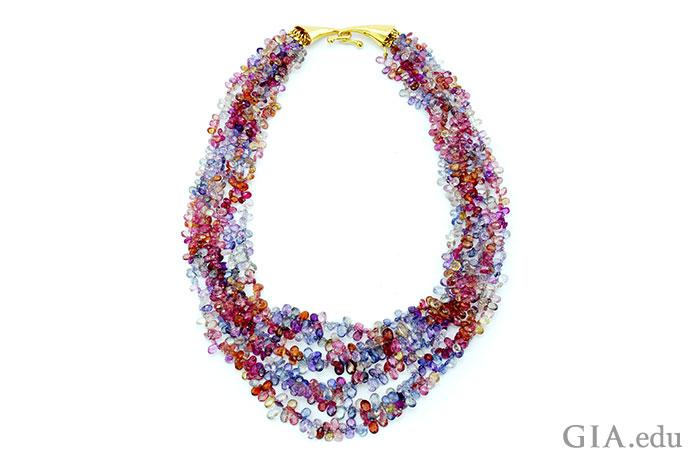
Some of the many colors of sapphire are on display in “Dawn” – a one-of-a-kind necklace that features 450 carats of sapphire beads. Courtesy: Denise James
The September birthstone has traditionally symbolized sincerity, truth, faithfulness and nobility. For countless centuries, sapphire has adorned royalty and the robes of the clergy. The elite of ancient Greece and Rome believed that blue sapphires protected their owners from harm and envy. The clergy of the Middle Ages wore sapphires because they symbolized Heaven.
The September birthstone was also reputed to have healing powers. Medieval Europeans believed that sapphire cured plague boils and diseases of the eye. It also was thought to be an antidote to poison.

A dragonfly brooch studded with a 38.82 carats of pink, green, blue and yellow fancy sapphires and 5.74 carats total weight of diamonds might make you believe in the magical powers of the gem. Photo: Robert Weldon/GIA. Courtesy: Pioneer Gems
Famous sapphires include the Rockefeller Sapphire, a 62.02 ct rectangular step cut stone that was unearthed in Myanmar (Burma). Acquired in 1934 by financier and philanthropist John D. Rockefeller, Jr. (1874–1960) from an Indian maharaja, the gem was recut and remounted over the years. The sapphire was first set as a brooch and later as a ring featuring two triangular brilliant cut diamond side stones.
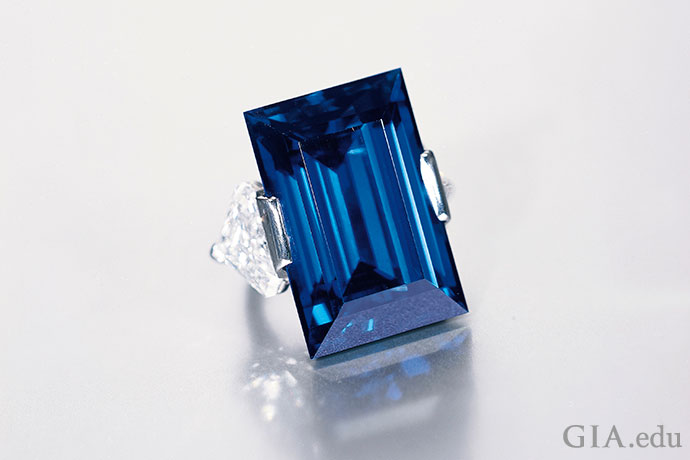
The Rockefeller Sapphire is a 62.02 ct rectangular step-cut sapphire weighing 62.02 ct. Here it is flanked by cut-cornered triangular cut diamonds, mounted in a platinum ring signed Tiffany & Co. Courtesy: Christie’s Images Ltd., 2015
The Starry Night Sapphire is another famous gem. Also originating from Myanmar, the Starry Night Sapphire is a 111.96 ct cabochon-cut gem whose magnificent six-rayed star is a fine example of asterism.
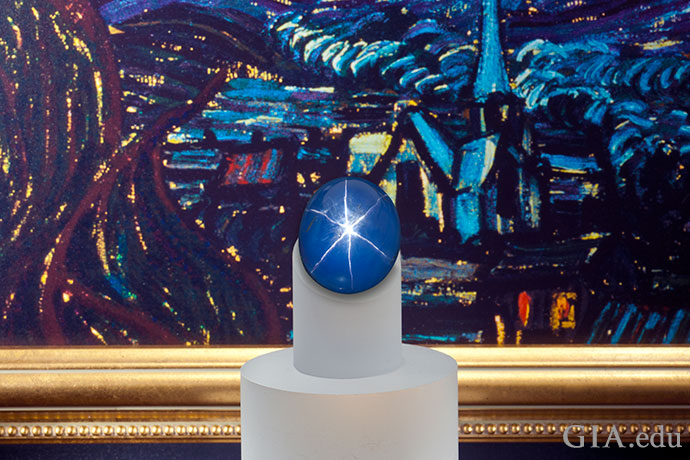
The Starry Night Sapphire comes from Myanmar, one of the most important sources of the gem. The gemological phenomenon asterism is responsible for creating the six-rayed star. Photo: Robert Weldon/GIA. Courtesy: Benjamin Zucker
In addition to being the September birthstone, sapphire is also the gem commemorating the 5th and 45th wedding anniversaries.
Kashmir, Myanmar and Sri Lanka are three historically important sources for sapphire. Significant quantities of the September birthstone have also been found in Australia, Thailand, Cambodia, Madagascar and the United States (Montana), among other countries in Asia and Africa.
Sapphires were discovered in Kashmir around 1881, when a landslide high in the Himalayas exposed a large pocket of velvety “cornflower” blue crystals. As the spectacular sapphires began to appear farther south, the Maharaja of Kashmir—and his army—took control of the new locality. From 1882 to 1887, thousands of large, beautiful crystals were recovered. In this short season of six years rests Kashmir sapphire’s reputation as one of the world’s most coveted gems. Production has been sporadic since then, but auction houses occasionally sell fine pieces of Kashmir sapphire.

A magical pool … a drop of the sky … a slice of eternity. This 3.08 ct cushion cut Kashmir sapphire conjures such visions. Photo: Robert Weldon/GIA. Courtesy: Edward Boehm, RareSource

The Himalaya Mountains are the source of Kashmir’s beautiful blue sapphires. Photo: Robert C. Kammerling/GIA
The Mogok area of Myanmar is another locale famed for producing the September birthstone. Jungle-clad hills hemmed by mountains make a dramatic landscape. Sapphire typically occurs alongside ruby deposits, but in much lower quantities than its red counterpart. ”Burmese” sapphire, as it is still called by many, can possess a rich, intense blue hue, which has made it particularly prized. Myanmar is also a noted source of jadeite jade, spinel, zircon, amethyst, peridot and other fine gem materials.

A scenic view near Mogok rivals the beauty of the sapphires hidden underground. Photo: James E. Shigley/GIA
For more than 2,000 years, Sri Lanka has been a source of fine sapphire. The blue stones mined from the alluvial gravels of this “jewel box of the Indian Ocean” can display remarkable brilliance and saturation. In addition, the island’s milky white “geuda” sapphires can be heat treated to a rich blue color.
Sri Lanka is one of the few sources for padparadscha (from the words for “lotus color” in Sinhalese) sapphires. Poetic descriptions for this light to medium pinkish orange to orange-pink sapphire include “salmon,” “sunset” and ”ripe guava.” Padparadschas are quite coveted and have a very high per-carat value.
This gem-rich island is also home to ruby, spinel, garnet, tourmaline, topaz and many more gems.
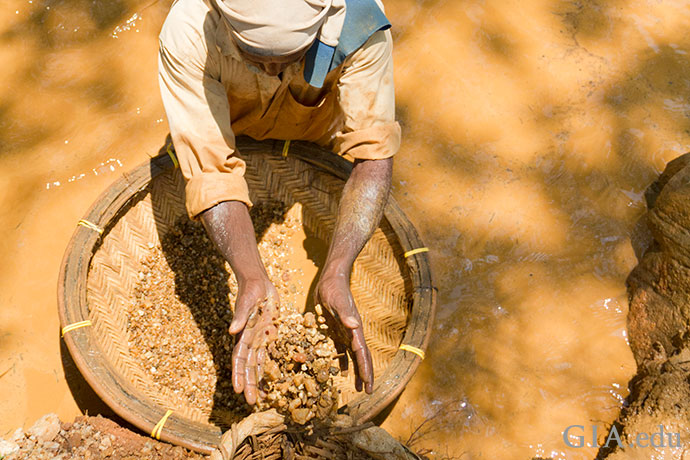
Using the same rudimentary washing techniques as generations before them in Sri Lanka, miners search for sapphire among the gravels in a local stream. Courtesy: Afsaneh Tazari
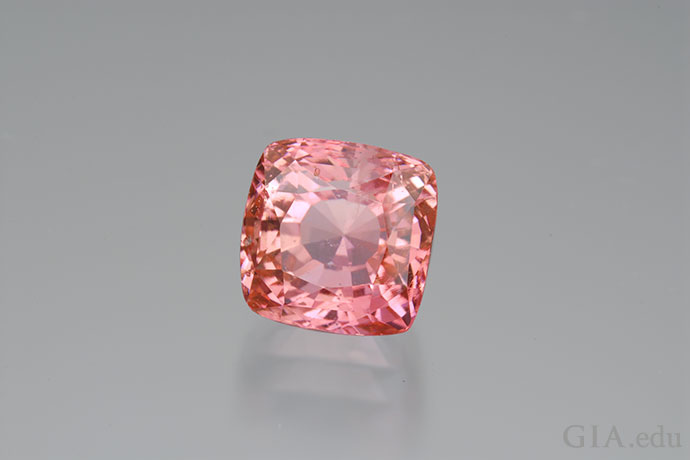
The spellbinding beauty of this 6.66 ct gem from Sri Lanka shows why padparadscha sapphires are so prized. Photo: Robert Weldon/GIA, Dr. Edward J. Gübelin Collection
Thailand is a source of sapphire and a major cutting and treatment center. In dense jungle crossed by dirt roads, miners dig for sapphire in Chanthaburi Province. Sapphires from Myanmar and Cambodia often end up in Chanthaburi for cutting and treatment, and are also sent to Bangkok, an important gem hub.

In the distance, a mining pit dots the tropical terrain of Chanthaburi, Thailand. Photo: Vincent Pardieu/GIA
Here are some tips for picking a stunning sapphire.
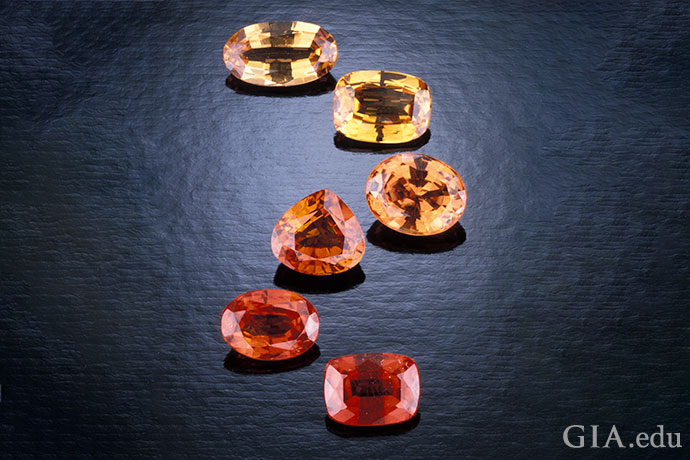
For those who prefer warm-colored gems, the September birthstone does not disappoint. These fancy sapphires range from yellow to highly saturated reddish orange. Photo: GIA & Tino Hammid. Courtesy: Varujan Arslanyan

The cushion cut is particularly popular for sapphires, like this 4.47 ct blue stone. Photo: Robert Weldon/GIA. Courtesy: Bear Essentials
Asterism in a sapphire will only be revealed if the stone is cut as a cabochon. A finished stone’s attractiveness depends on the star’s orientation and the cabochon’s symmetry, proportions and finish.
Look for a cabochon with a symmetrical outline and a star that’s centered when the gem rests on its base. The dome of the cabochon should be fairly high—about two-thirds of the stone’s width—to focus the star sharply. If it’s too high, the phenomenon loses its graceful motion when the stone is tilted. Excessive height also makes the stone difficult to mount.

Sapphires are the stars in these earrings. They were especially popular during the Art Deco era of the 1920s and ‘30s, a look that you can get in an engagement ring. Courtesy: Genevive
The September birthstone is relatively hard, ranking 9 on the Mohs scale. It has excellent toughness and no cleavage, which is a tendency to break when struck. This makes it a great choice for rings and other mountings subject to daily wear.
Corundum is stable under normal wearing conditions, which means it’s resistant to the effects of heat, light and common chemicals. Boric acid powder will etch the surface of even untreated stones. Fracture-filled, cavity-filled and dyed stones can be damaged by even mild acids like lemon juice.
Warm, soapy water is always a safe choice for cleaning the September birthstone. Ultrasonic and steam cleaners are usually safe for untreated, heat-treated and lattice-diffusion-treated stones. Fracture-filled, cavity-filled or dyed material should only be cleaned with a damp cloth.
Now that you know all about sapphire, you’re probably in the mood to buy a beautiful one. Our Sapphire Buying Guide can help you make a great choice.
There’s no shortage of engagement ring myths. Here are some of the more common ones: Bigger diamonds always look better than smaller ones. Round brilliants are the best. Diamonds are unbreakable. True? False? We investigate these myths and deliver the facts.
In this blog, we examine the following engagement ring myths:
A Bigger Diamond Is Always Better
Any Diamond Will Sparkle
I Need to Buy a Round Brilliant
Diamonds Can’t Break
Inclusions Will Cause a Diamond to Break
I Can Get a Better Deal on a Diamond by Not Buying Retail
Diamond Fluorescence Is Bad
A Diamond Engagement Ring Should Cost Three Months’ Salary
A common myth about engagement rings is that a bigger diamond has a better face-up appearance than a smaller one. But just because a diamond is big doesn’t mean it will have more brightness, fire and scintillation. A small diamond can have mesmerizing sparkle, while a large diamond can look dull. How a diamond performs under light is a function of its cut, not its carat weight. So, debunking one of the biggest myths about engagement rings, a bigger diamond is not necessarily a better one.
A common misconception about diamond engagement rings is that every diamond sparkles. A diamond’s cut – how its facets interact with light – creates its sparkle. Precise artistry and workmanship are required to fashion a stone so its proportions, symmetry and polish deliver the magnificent return of light. A diamond with a poor cut will have little to no sparkle.

A diamond’s cut greatly affects its appearance, as these three round brilliants illustrate. From left to right, they received cut grades of: Poor, Good and Excellent. Photo: Kevin Schumacher/GIA
You can turn to a GIA Diamond Grading Report, a GIA Diamond Origin Report or GIA Diamond Dossier for an objective evaluation of the cut of a round brilliant diamond. A GIA cut grade of Good or better will deliver the sparkle you’re expecting.
It’s worth mentioning that dirt is the enemy of sparkle. Just as a dirty mirror will reflect poorly, so will diamond facets that have skin oils, lotion and other substances on them. Keeping your diamond clean is key to keeping it sparkling.
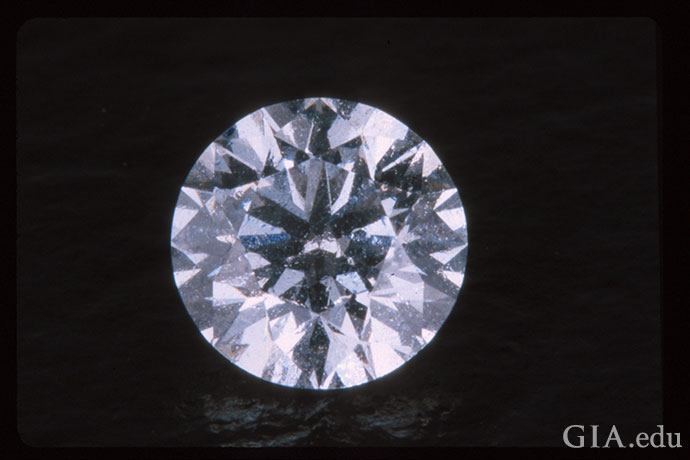
The sparkle of this E color 0.61 ct round brilliant is dulled by oil and dirt. Photo: Maha Tannous/GIA

What a difference a cleaning makes. Oils have been removed from the same diamond, and it now has a scintillating sparkle. Photo: Maha Tannous/GIA
The takeaway from all of this: If you want a diamond that sparkles, make sure it is cut well; if it is a round brilliant, look for one with a cut grade of Good or better on its GIA Diamond Grading Report. Once it is yours, keep it clean. This way, the engagement ring will be noticed and admired.
A round brilliant diamond is the most popular shape and cut for engagement rings. About half of all brides wear one. And for good reason: It’s beautiful, appealing and can have spectacular brightness, fire and scintillation.

Simply enchanting and enchantingly simple, this six-prong ring with a 1.37 ct H color diamond is sure to win the heart of a bride to be.
But do you need to buy a round brilliant? Consider that about half of all brides wear engagement rings set with diamond shapes other than round brilliants. These fancy shapes can be just as beautiful and deserve your consideration. And some might even cost less per carat than a round brilliant. Some of the more popular fancy shape diamonds include: the princess cut, marquise, cushion cut and emerald cut. Ovals are currently popular and can have bewitching sparkle. So, the myth that only a round brilliant diamond makes for a beautiful engagement ring is untrue! Other diamond shapes are just as popular, and just as beautiful.
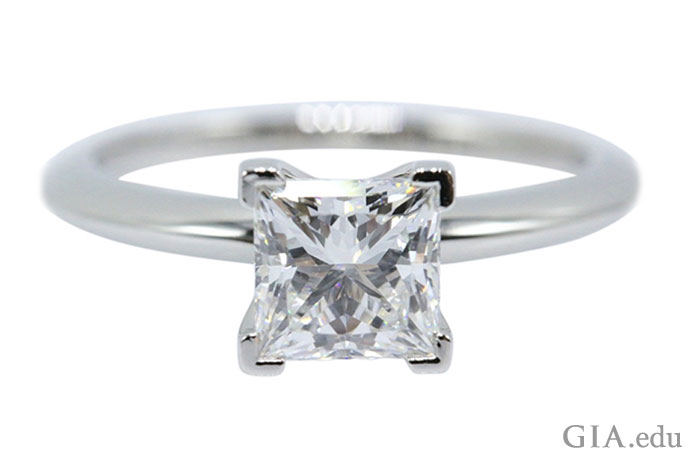
A princess cut diamond can rival the brightness of a round brilliant. Square or rectangular in shape, the princess cut also looks a bit different, like this 1.03 ct beauty in a four-prong setting. Courtesy: TrueFacet.com

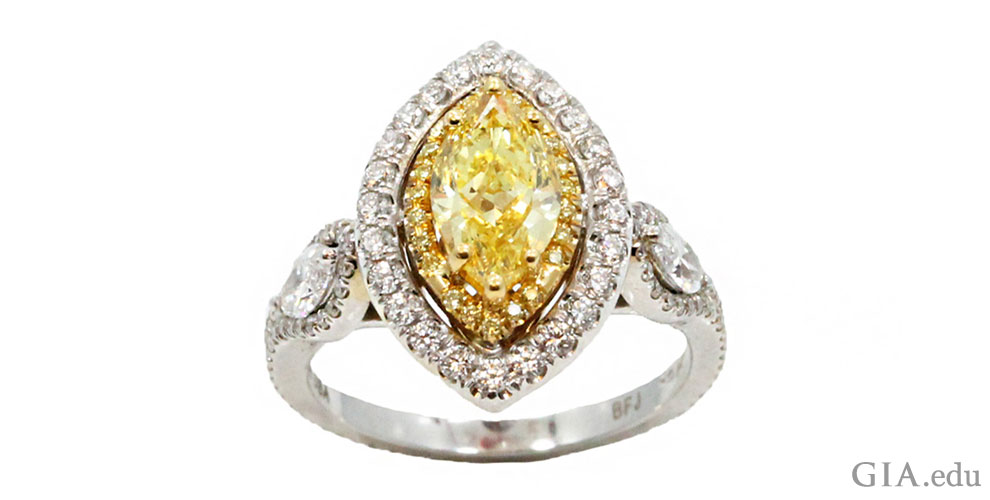
Supposedly named after the Marquise de Pompadour because its outline resembled the shape of her mouth, the marquise diamond is rich in beauty and lore. This sunny stunner of an engagement ring boasts a 1.10 ct marquise yellow diamond and two white marquise diamonds in the shank, with a halo of melee diamonds surrounding the center stone. Courtesy: TrueFacet.com
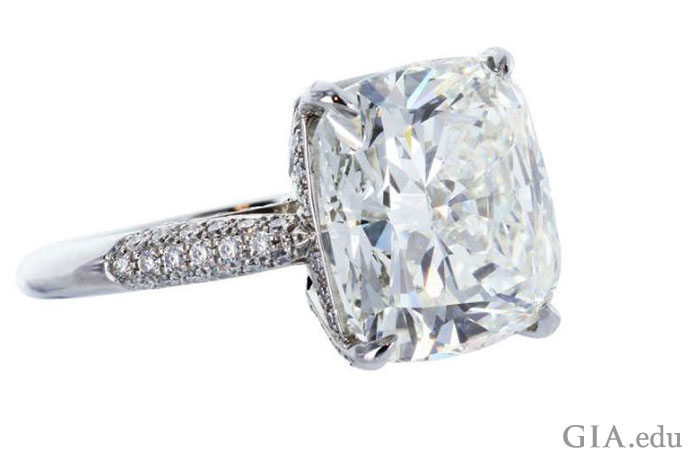
The cushion cut diamond traces its roots to the 1700s, and the passage of time hasn’t dimmed its beauty. Its appeal is easy to see in this engagement ring, which features a 7.82 ct cushion cut center stone. Courtesy: 1stdibs.com
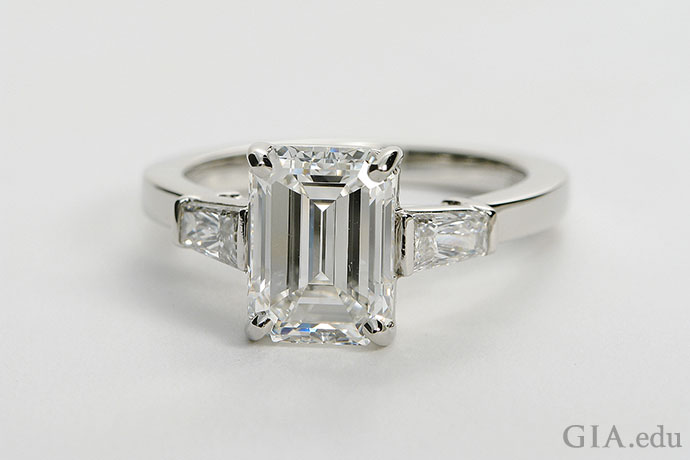
This 2.71 ct diamond showcases the stately beauty of an emerald cut, The center diamond is accentuated by two tapered baguettes. Courtesy: Blue Nile
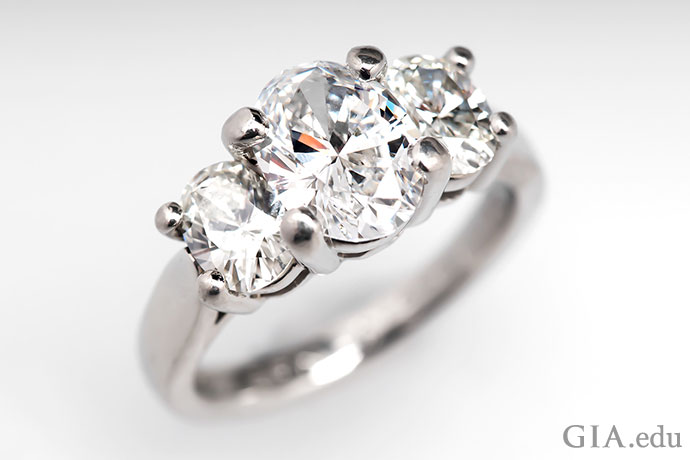
Romance and sparkle abound in this three stone platinum engagement ring featuring a 1.57 ct oval diamond center stone. Photo: GIA
Diamond is the hardest gem material on earth and is impervious to virtually all acids. It can also withstand higher temperatures than most gemstones. But if a diamond cutter can purposely cleave (split) a diamond by giving it a sharp blow in the right direction, you can achieve the same result if you accidentally hit it hard enough in the right place.
Cleavage planes in diamond occur because carbon atoms parallel to these planes are more tightly bonded (that is, tougher) than the atoms between the planes. A cleavage plane is the weakest direction in the molecular arrangement of a diamond crystal, and it always parallels one of the crystal’s triangular faces. If a diamond is hit hard along one of these planes, it can chip or fracture.
Chips typically occur when the girdle edge or an exposed point, like the tip of a pear shape or marquise, strikes something hard. Diamonds being unbreakable is simply a myth. Storing or wearing diamond-set jewelry items next to each other can also cause chips, scratches or other damage. Certain diamond cuts with pointed corners, like the princess cut, are particularly vulnerable and are often set with V-shaped prongs positioned over the corners to protect them from chipping.
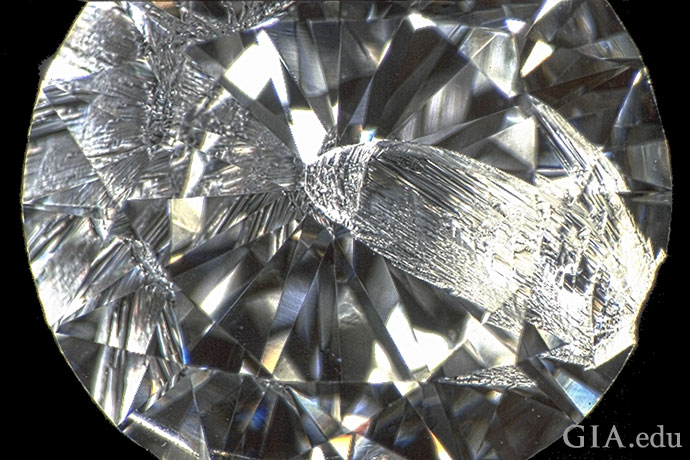
Diamonds are known for their hardness – their ability to resist scratches and abrasions. But contrary to some diamond engagement ring myths, diamonds are not impervious to damage, since their hardness varies depending on the crystal direction. This 1.05 ct diamond has a chip starting at its girdle that extends to the culet. Photo: GIA
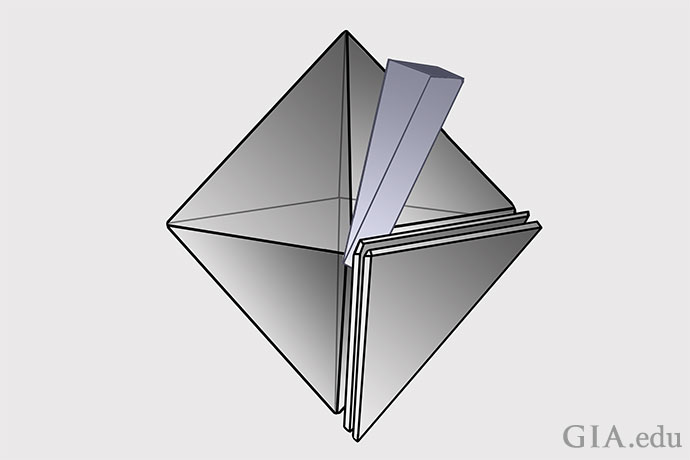
This illustration shows examples of cleavage planes parallel to the triangular octahedral face of a diamond. Illustration modified from V. C. Venkatesh and S. Izman, Precision Engineering, 2007, p. 54.
Of all the diamond engagement ring myths covered here, there is some truth to this one. Inclusions are clarity characteristics that lie within a diamond. Inclusions in themselves won’t necessarily cause a diamond to break. But if they’re located on or near a cleavage plane or another vulnerable area like a girdle or culet, they could make the diamond more prone to chipping.

This diamond is marred by a chip, which may have been caused by an inclusion located on or near a cleavage plane or the girdle. Photo: GIA
This is one of those engagement ring myths that really demands your due diligence and some research. It’s tempting to think that you’ll get a better price buying a diamond from “a friend of a friend,” through an online auction, or directly from a wholesaler or dealer. After all, you think, these sellers have lower overhead, so they should also have a lower markup — with these savings passed along to you. You may be right. However, it pays to comparison shop, taking into account all the costs associated with purchasing an engagement ring.
Whether you decide to buy your diamond from a traditional brick and mortar retailer or through another channel, be sure to look for some basic consumer protections: a minimum 30-day period for refunds or exchanges, quality guarantees, and diamonds accompanied by grading reports from a reputable lab. Any seller failing to provide these basic services may be offering a deal that’s too good to be true.
Buying from a traditional retailer may offer some additional advantages. A jeweler’s expertise is invaluable in helping you select both the diamond and the right setting for it. And many retailers offer discounted diamond-and-ring packages. Many also offer cleaning, repair and maintenance as long as you own the ring, as well as insurance and even trade-in programs should you want to up-grade your diamond in the future. In the end, you may find that the savings offered by other types of sellers are negated by the package discount and additional services offered by a retailer.
All this is to say that you have more options than ever when it comes to buying a diamond. Just be careful and smart, as you would with any important purchase.
This is one of the more common engagement ring myths – here are the facts: Diamond fluorescence is neither good nor bad. It is a naturally occurring characteristic that a diamond may possess. Some people like the blue (or rarely another color) glow that some diamonds emit when exposed to long-way ultraviolet (UV) light such as that from the sun and fluorescent lamps. Whether you choose a diamond with fluorescence is a matter of personal preference.
Fluorescence is common: Between 25% and 35% of the diamonds on the market exhibit some degree of fluorescence, which GIA grading reports describe as None, Faint, Medium, Strong or Very Strong. It’s worth noting that fluorescence is not considered a quality factor like the 4Cs (color, clarity, cut and carat weight). The extent of a diamond’s fluorescence is included in a grading report as additional information to help in identifying that particular diamond.
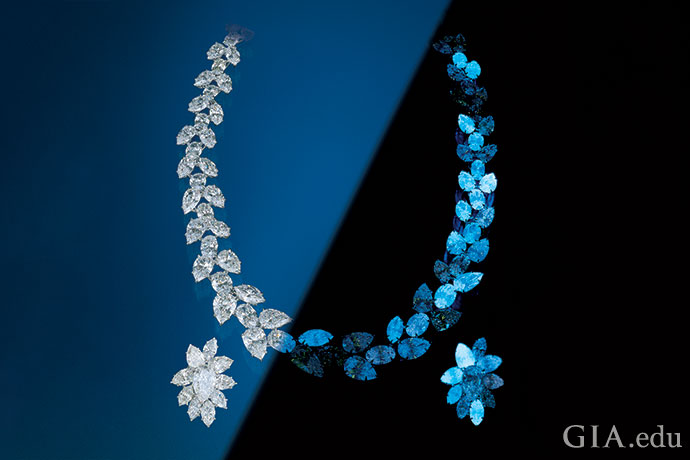
Blue is by far the most common fluorescence color in diamonds when they are exposed to long-wave UV rays. Half the necklace and one earring in this composite photo are shown under normal lighting conditions (left), and the other half of the necklace and the same earring are shown as they appear under a long-wave ultraviolet lamp (right). Copyright: GIA and Harold & Erica Van Pelt. Courtesy: Harry Winston, Inc., New York
You may have heard the myth about engagement rings that the fluorescence affects a diamond’s color grade. Not true. GIA color grades diamonds under tightly controlled lighting conditions designed to eliminate any effect from fluorescence. So it has no impact on the color grade assigned. However, the strength of a diamond’s fluorescence can influence your perception of the diamond’s color when viewed with certain types of lighting. For example, in bright sunshine some diamonds with a Medium to Strong blue fluorescence may appear more colorless. In rare cases, diamonds with Very Strong fluorescence may have a hazy or oily appearance; less than 0.2% of fluorescent diamonds exhibit this effect.
GIA’s research discovered that for the average observer, meant to represent the jewelry buying public, blue fluorescence had no systematic effect on a diamond’s face-up appearance. Even experienced observers did not consistently agree on the effects of fluorescence from one stone to the next.
One of the older engagement ring myths, this one dates back to the 1950s. It’s been debunked before, but it’s worth negating again. The fact is, there is no hard and fast rule on how much you should spend on a diamond engagement ring. You need to determine what you can afford, set a budget and stick to it. By learning a little bit about diamonds, including the 4Cs of diamond quality and doing some comparison shopping, you’ll be able to choose a diamond of the best quality for your budget. Remember, at the end of the day the ultimate value of a diamond isn’t what it costs, but the love that goes into giving it.

Retro style engagement rings and cocktail rings have a distinctive look. Gold mountings, diamond baguettes, colored gems and invisible settings are just some of its design elements. Here’s how you can re-create a striking classic.
The Retro era spanned approximately 1935 to the 1950s, a period that included the Great Depression and World War II. It had its roots firmly planted in the Art Deco era that came before. Jewelry designers took Art Deco’s bold lines and geometric shapes and softened them with curves, creating pieces that had a sculptural quality. Gold was usually the metal of choice, as platinum was reserved for wartime uses. Jewelry designers also used vivid color combinations of rubies, sapphires and emeralds; as the Retro era moved farther away from Art Deco, they incorporated more muted colors with stones like topaz, citrine, green beryl and aquamarine.
Finding authentic vintage engagement rings from the Retro era can be challenging. The ravages of war destroyed many jewelry businesses and their inventories. During the war years, jewelry designs became simpler and lighter weight to reduce the amount of metal used and to keep items affordable. Countless pieces around the world were broken up and the materials repurposed once hostilities ended.
Jewelers devised ingenious ways to adapt to these challenges. One innovation was to alloy a low karat gold with a higher percentage of copper. The result was gold with an attractive reddish tinge. Chains that were hollow (instead of solid) and the use of large, inexpensive stones were other techniques in this time of scarcity. This allowed jewelers to create a big look for less money.
Diamonds in engagement rings of the Retro era were small; in addition to the war sapping resources and interrupting gemstone supply lines, enlisted men had scant disposable income for jewelry. The illusion setting and white gold detailing were ways jewelers made smaller stones look larger.

This 0.75 carat (ct) diamond looks larger than it is because of the white gold illusion setting. Photo: Robert Weldon/GIA. Courtesy: Rose Tozer
If engagement rings of the period were modest, cocktail rings of the same era were exuberant and showy. Popularized during Prohibition (1920 to 1933), cocktail rings were a symbol that one was proudly flouting the law against drinking alcohol. The signature of the design – large and flashy – remained largely unchanged as styles evolved during the Retro period.
Cylinders, scrolls, fans, prisms and asymmetry were common stylistic motifs. Red and yellow gold were the metals of choice; again, because of the demands of the defense industry, platinum made an appearance only occasionally.

Considering the challenges Retro-era jewelers faced when making engagement rings, your search for vintage engagement rings just might lead you to create your own by using design motifs from the period and finding inspiration in cocktail rings.
Here are some of the signature design elements to help you get that Retro style.
Retro designers took the sharp angular lines of Art Deco jewelry and reimagined them with curved edges. Geometric shapes also went from having a two-dimensional look in Art Deco jewelry to a three-dimensional look in the Retro era. This gave the jewelry a chunky, sculptural quality. Current events and the spirit of the times also influenced jewelry designers. The machine age was at its height and WW II left its mark. Gears, cylinders, and all types of mechanical objects became the inspiration for bold new designs. Links resembled tank treads, and chain resembled gas pipe.

As noted above, bold color combinations were common in early Retro jewelry. Rubies, sapphires and emeralds were favorite choices as styles transitioned from Art Deco. Gems with more muted colors like topaz, citrine, green beryl and aquamarine eventually became popular. So adding colored gemstones can be one way to infuse your engagement ring with Retro style.


During World War II, platinum was in high demand by defense manufacturers because of its malleability, resistance to acids and high melting point. They used it to make tubes, fuses, sparkplugs and explosives for the war effort. So jewelers turned to gold, which became the predominant metal of vintage engagement rings of the Retro era.


Wartime restrictions on metals forced jewelers to be inventive. They had to use low-karat gold, and often alloyed it with greater amounts of copper, creating a metal with an appealing reddish hue. The warm and beautiful hues of rose gold are now popular in contemporary engagement rings. Other alloys created other colors of gold, which were often mixed in a single piece of jewelry.

The illusion setting mentioned above was popular with wartime brides and grooms because it made the center stone appear larger. These settings are still very popular and can be an easy way to get the Retro style.
The star setting – placing a gem in the center of an engraved star – was another recurring motif in Retro-era jewelry. Perhaps the imagery offered the wearer an escape to a kinder realm, far away from the travails of the time. It’s a motif that can be carried to wedding bands to complement a Retro-style look.

Also popular during the Retro era was the invisible, or “mystery,” setting. Patented by Van Cleef & Arpels in the 1930s, this technique results in no visible metal around the gemstones. Special grooves are cut into the gems below the girdle, and the gems are held in place using metal rails that fit into these grooves.

Rectangular step-cut diamonds (called baguettes) were often seen in Retro-era jewelry. Used as side stones and as design elements, baguettes created an elegant and sophisticated look.


The Retro era gave birth to a dazzling variety of ring designs, so there’s no shortage of inspiration waiting for you. Once you’ve settled on your own design, you’ll probably want to start shopping for a diamond. Before you begin, be sure you know your 4Cs of Diamond Quality: color, clarity, cut and carat weight.

A radiant cut engagement ring is an irresistible combination: It has the fire of a round brilliant diamond and the aristocratic elegance of an emerald cut. Created in 1977, the radiant cut has been charming brides-to-be for decades.

This dramatic 8 carat (ct) radiant cut yellow diamond is an alluring choice for a diamond engagement ring. Courtesy: McTeigue and McClelland
A relative newcomer to the ranks of fancy-shaped diamonds, the radiant cut can be square or rectangular; notably, it has cropped corners and brilliant-cut facets. Diamonds with less-than-exceptional clarity can be good candidates for radiant cut engagement rings: In addition to giving the stone plenty of sparkle, this brilliant-cut faceting pattern disguises inclusions that would be more readily apparent in an emerald cut.

A 3 ct radiant cut diamond is flanked by two trilliants weighing 0.70 ct. Courtesy: 1stdibs.com
Radiant cut diamonds have broad appeal. Elongated stones can create the effect of slenderizing fingers, while shorter styles can flatter even the most petite hands. To determine which proportions work best for you, we recommend trying on various options to find the perfect radiant cut engagement ring.

A beautiful 20.04 ct radiant cut diamond set in platinum showcases the excitement of this faceting style. Courtesy: Norman Silverman
Important characteristics to look for in any radiant cut diamond are a well-centered culet, parallel sides and corners cropped to identical size.

Looking for a simple yet elegant square shape for your engagement ring? This radiant cut center stone with round brilliant cut diamonds is an attractive option. Courtesy: Brilliant Earth
The enchanting sparkle and alluring appearance of radiant cut diamonds makes them especially attractive as solitaires. And they don’t require extra embellishment to stand out from the crowd: Taste-making celebrities like Megan Fox sport the cut.

The three yellow radiant cut diamonds in this ring set with round yellow melee diamonds make a breathtaking statement. Courtesy: Rahaminov Diamonds
The radiant cut diamond also pairs well with side stones. Shapes with straight edges—like trilliants, or baguettes and other rectangular stones—are popular in radiant cut engagement rings because their linear silhouettes are complementary. And while you’ll often see radiant cut diamonds oriented north-to-south in engagement rings, the east-to-west orientation is gaining in popularity.

You’re sure to stand out and be noticed with an engagement ring that has a radiant cut diamond pointing east to west. This magnificent ring has a 4.15 ct stone with trapezoid-cut side stones weighing another 1.25 ct. Courtesy: 1stdibs.com
If you are looking for the elegance of a rectangular or square shape with the fire of a round brilliant diamond, a radiant cut engagement ring may be perfect for you. Ready to start shopping? Read on to learn more about how to pick a radiant cut diamond.
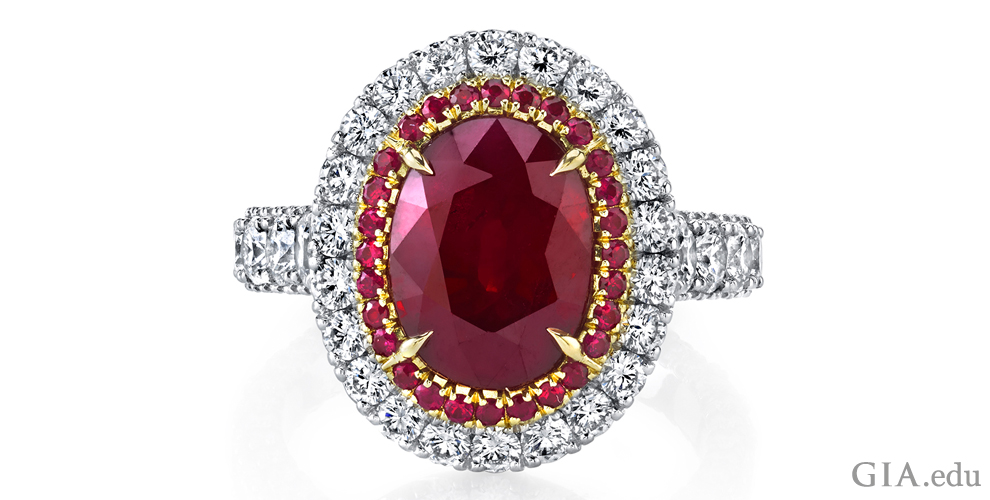
Ruby is the July birthstone – and it’s one of the most coveted of gems. Called the “king of gems” in ancient India, today it can command the highest per-carat price of any colored stone. Here’s what you need to know about this beautiful gem.
In this post, we cover:
Gemological Properties of Ruby
Ruby History & Lore
Where Ruby Comes From
Qualities to Look for in Rubies
Ruby Treatments, Care & Cleaning
Ruby, the July birthstone, is a variety of the mineral corundum that contains trace amounts of the element chromium, which causes its color. The more chromium present, the stronger the color red. Chromium can also cause red fluorescence, which adds to the intensity of the color. Fluorescence is visible light temporarily emitted by some gem materials when they are exposed to high-energy sources such as ultraviolet light (as in sunlight), X-rays or lasers.
Some rubies form in marble, when heat and pressure act on minerals in limestone. These rubies tend to be highly prized, as they have a higher concentration of chromium and little iron, which is an ideal recipe for a bright red color. They also tend to be highly fluorescent.
Other rubies are found in basalt, which forms when molten lava cools and solidifies. Basalt-hosted rubies typically have significantly more iron than marble-hosted rubies and thus are darker. A higher iron content can also mask the fluorescence, eliminating that extra glow of red color.
Still other rubies form in an amphibole-bearing gneiss (a coarse-grained metamorphic rock). These rubies tend to have good color, though they have more iron than the marble-hosted stones and less than those from basalt.
Gemologists love the July birthstone because synthetic ruby was used to create the first laser in 1960. They also consider chromium to be the “rock star” of trace elements.
Consumers love ruby for its intense red color and because it’s a 9 on the Mohs scale of hardness, just below diamond. As such, it is a very durable stone that holds up well to daily wear in rings and other jewelry.

A look at these earrings featuring 8.16 carats of ruby, 1.78 carats of marquise diamonds, and 1.69 carats of round diamonds shows why we are enchanted by the gem. Courtesy: Omi Privé
A prized gem like ruby naturally comes with many attributes. Because it resembles the color of blood, ancients believed it could stop hemorrhaging. The July birthstone was also thought to cure inflammatory diseases and soothe anger. Burmese warriors believed it made them invincible in battle. Medieval Europeans maintained that rubies bestowed health, wisdom, wealth and success in love.
In addition to being the July birthstone, ruby is traditionally given for the 15th and 40th wedding anniversaries.
The Harry Winston Ruby Slippers are a famous example of the July birthstone in a spectacular setting. To commemorate the 50th anniversary of the movie “The Wizard of Oz,” the House of Harry Winston fashioned a pair of red slippers featuring 4,600 rubies weighing an estimated 1,350 carats. When they were created in 1989, they were valued at $3 million.

Harry Winston’s famed ruby slippers were exhibited at GIA in December 1997. Some 4,600 rubies weighing an estimated 1,350 carats glitter in the slippers; another 50 carats of diamonds accent the unique creation. Courtesy: Harry Winston
Our search for the July birthstone starts in Myanmar (formerly known as Burma). For more than five centuries, the Mogok area in Myanmar has produced some of the finest rubies – vibrant red beauties softened by light-scattering inclusions and a glowing red fluorescence. The region is a place of weathered marble and ancient Buddhist temples.

Golden spires of a monastery near Mogok are flashes of color along the mountainside. Photo: Robert C. Kammerling/GIA
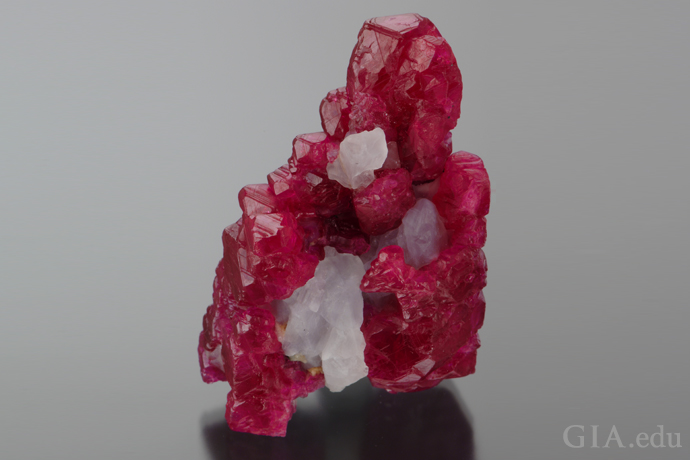
These ruby crystals intertwined with their matrix rival the beauty of finished gems from Mogok. Photo: Robert Weldon/GIA. Courtesy: Bill and Jeanne Larson
Vietnam is another important source for marble-hosted rubies. The Luc Yen region, where rainforest-clad mountains rise over broad paddy fields, produces rubies of red to purplish red color. Today, artisanal miners work the soil in hopes of finding a gem that will change their fortunes.

A small village sits at the base of the mountains in the ruby-bearing Luc Yen region. Photo: Vincent Pardieu/GIA
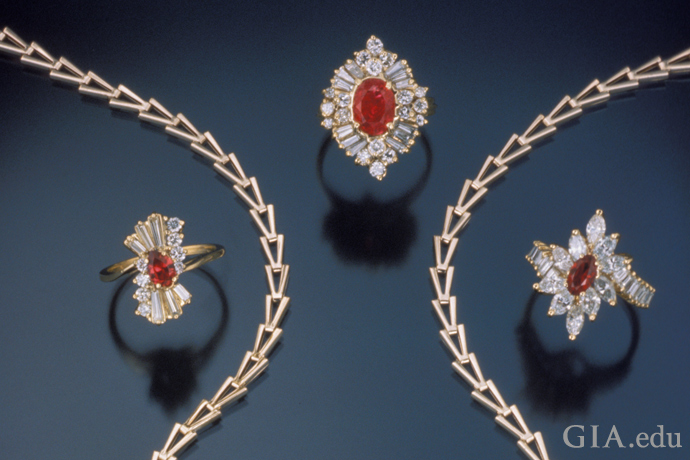
Rubies from Luc Yen and other locales in Vietnam star in these four rings and necklace. Photo: Shane McClure/GIA

This fine 4.04 carat (ct) ruby came from Mozambique, the pre-eminent source of commercial and fine rubies. Photo: Robert Weldon/GIA. Courtesy: Evan Caplan, GemFields
Mozambique is an important new, amphibole-related source for the July birthstone. This African nation is home to the prolific mines at Montepuez. Rubies found there have been compared to the famed gems of Mogok.
For many years in the late 1900s, the basalt-related ruby deposits along the border between Thailand and Cambodia were the major source of rubies in the marketplace. Other important producers include Sri Lanka, Tanzania and Madagascar.

Rubies from Madagascar are a bright, slightly orangy red. Photo: Robert Weldon/GIA. Courtesy: Allerton Cushman & Co., Sun Valley, Idaho

This 5.00 ct oval ruby is all the more radiant set in 18K rose gold and encircled by 2.53 carats of round diamonds in the halo and band. Courtesy: Omi Privé
Using warm soapy water is a safe option to clean ruby, the July birthstone. Ultrasonic and steam cleaners are usually safe for untreated, heat-treated and lattice diffusion–treated stones. Fracture-filled, cavity-filled or dyed stones should only be cleaned with a damp cloth.
Rubies are often heat treated to remove purplish coloration, leaving a purer red. The process can also remove “silk” (minute needle-like inclusions) that can cause a gem to appear lighter in tone and be more opaque. The trade typically accepts heat treatment to enhance color, as the treatment is stable to normal conditions of wear and care.
Lattice diffusion is a technique whereby heat and chemicals are used to diffuse a specific element into a gem to change its color. This treatment, too, is typically stable to normal wear and care.
Fracture filling is when a substance is introduced into surface-reaching fissures to make them less visible and thus improve the gem’s appearance. Common fillers include glass and glass-like substances, polymers and resins, and oils.
A high-lead-content glass is often used to fill fractures in rubies and thus improve their apparent clarity. There are many of these glass-filled rubies in the market, and in some cases the glass literally holds together a highly fractured gem. The glass can be damaged through contact with a variety of chemicals. Even relatively mild substances like concentrated lemon juice can etch the filler.
Dyeing with colored oils and filling small surface fissures with epoxies are other treatments. However, they are not permanent. These treatments need special care.
Always ask if your ruby has been treated before you buy. The Federal Trade Commission requires disclosure of treatments that affect a gemstone’s perceived value. A GIA Identification Report is important in identifying if a stone is natural or synthetic and whether it has been treated in any fashion.

Reminiscent of the geometric shapes used in Art Deco–era jewelry, this diamond and ruby bracelet shimmers with 20.56 carats of cabochon-cut rubies from Tanzania. Photo: Kevin Schumacher/GIA
Whether or not you have a July birthstone, owning a beautiful ruby is a rare and precious thing. And if you love red gems in general, check out our Red Gemstone Buying Guide – Part 1 and Red Gemstone Buying Guide – Part 2 for some striking alternatives to ruby.

A baguette diamond, usually set in multiples, adds a dash of style to an engagement ring – or any jewelry piece. Popular since the Art Deco era, this dazzling diamond cut should be part of your shopping vocabulary. Here’s what you need to know.
In this blog, we cover:
Baguette Diamond: A Definition
Baguette Diamond: A Brief History
Baguette Diamond: What to Look For
Baguettes are small, usually rectangular, step-cut diamonds with straight or tapered edges. Some baguettes are almost square, while others have a length-to-width ratio of 5:1 or even longer. A tapered baguette diamond has long sides that angle inwards. Baguettes are popular side stones in engagement rings.
 All the edges are parallel to each other in this baguette. Illustration: Peter Johnston/GIA |
 The long sides of a tapered baguette angle inwards. Illustration: Peter Johnston/GIA |

Channel-set tapered baguettes make these earrings visually arresting. Photo: Robert Weldon/GIA
Emerald cut diamonds are also rectangular or square step cuts. Unlike baguettes, though, they have diagonally cut—not square—corners.

An emerald cut diamond has diagonal corners. A baguette does not. Illustration: Peter Johnston/GIA
In a style called the ballerina setting, baguettes surround the center stone to form a skirt that resembles a ballerina’s tutu. While the tutu effect is best shown with tapered baguettes, so the skirt appears to flow out from the girdle of the center stone, other diamond shapes have also been used. For a ballerina setting, baguettes are typically channel set, though they are occasionally prong set.

Tapered baguettes in a prong setting are used to make this “ballerina setting,” which encircles the ruby. Courtesy: The RealReal
An attractive novelty cut is the brilliant baguette. This is primarily a mixed cut, with brilliant-style facets (triangular and kite shaped) on the pavilion and step-cut facets on the crown. A benefit of this style is that it can add more sparkle to your diamond engagement ring.

The top image is a tapered baguette diamond with brilliant-style facets on the pavilion and step-cut facets on the crown. The bottom image shows where the crown and pavilion facets are typically placed. Photo and Illustration: Al Gilbertson/GIA

Baguettes with a brilliant facet arrangement on the pavilion add even more visual fireworks to the 2.30 carat (ct) round brilliant center stone. Courtesy: Blue Nile
Dimensions are more important than weight when purchasing baguette diamonds, since they are usually sold in multiples. For example, if you were purchasing two of them–to sit on either side of a center stone–you or your jeweler would ask for two stones of equal dimensions – and not of equal carat weight.
The origin of the term “baguette” for these small step-cut diamonds is up for debate. The traditional translation of the French word is “rod” or “stick,” but one meaning given in Randle Cotgrave’s 1673 French and English Dictionary is “a little jewel.” It is the diminutive of the French “bague,” which at the time meant “jewel” or, its current meaning, “ring.”
The rectangular step-cut diamond now called the baguette diamond is believed to have evolved from the hogback, an elongated table cut that was known since at least the mid-16th century. At that time, it was often used to make monograms and jeweled letters (like the owner’s initials). Cartier reintroduced the baguette cutting style in 1912, and in the following decades jewelry designers of the Art Deco period favored its clean lines and geometric shape. It was in the 20th century that the term “baguette” was first used in English to refer to this popular side stone as we know it today. Some think that the diamond cut was named after the long, thin loaf of French bread that it often resembles.

Six baguettes and 18 round brilliants border a 1.37 ct emerald cut diamond in this Art Deco ring (circa 1930s). The use of geometric shapes is a defining characteristic of the period. Courtesy: 1stdibs.com

Another Art Deco treasure, this engagement ring features a 2.40 ct emerald cut center stone, 0.85 carats of baguettes and triangular diamonds, and 0.96 carats of trilliant cut synthetic rubies. Courtesy: The RealReal
The baguette diamond is frequently used in contemporary jewelry and engagement rings. So if you want a modern version of an Art Deco engagement ring, consider one with baguettes.

A bonanza of baguette diamonds with a total weight of approximately 0.70 carats, these slender beauties bring a majestic look to the 1.79 ct center stone. The ring, a contemporary creation, shows that the Art Deco look is alive and well. Courtesy: 1stdibs.com
Here are some tips for picking beautiful baguette diamond:

An 8.03 ct D-color marquise diamond is the unquestioned star in this ring. Two flanking baguette diamonds play a supporting role: Their colors blend seamlessly and do not detract from the diamond’s beauty. Courtesy: 1stdibs.com

A 2.01 ct E-color SI1 emerald cut diamond is flanked by two tapered baguettes weighing approximately 0.35 carats in total. Baguettes mismatched in color or clarity would detract from the aristocratic splendor of the ring. Courtesy: 1stdibs.com
Baguette diamonds bring understated elegance wherever they are used. But there are other small diamonds to consider – particularly if you’re looking to add high drama and sparkle to your engagement ring. Meet melee diamonds and get to know these tiny diamonds with big impact.

An oval diamond has an elongated round shape that evokes an understated elegance, but with a difference. When it is faceted in the brilliant style, its fire can rival that of a round brilliant. So get ready to pick the perfect oval diamond.
In this blog, we cover:
Anatomy of an Oval Diamond
History of the Oval Diamond
Famous Oval Diamonds
What to Look for in an Oval Diamond
Oval Diamond Engagement Ring Settings
An oval diamond is a fancy shape. You can think of it as a round brilliant diamond stretched on its sides, or a rounded version of a cushion shape or cushion brilliant. To pick a beautiful oval diamond, you need to know its parts.
Head or end: The “tips” of the oval.
Shoulder: The curved area reaching from the head/end to the belly.
Belly: The central area where the sides curve out the most.
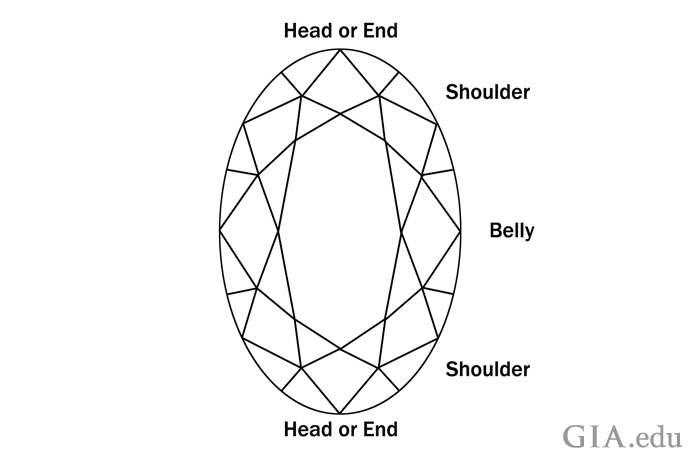
Knowing the anatomy of an oval diamond will help you pick one you love. Illustration: GIA
You’ll typically find oval diamonds cut in the brilliant faceting style, which means the diamond has 57 or 58 facets, like a standard round brilliant, giving it similar visual qualities. An oval diamond can have a variety of facet arrangements, but the most common is eight bezel facets on the crown combined with eight main facets on the pavilion.
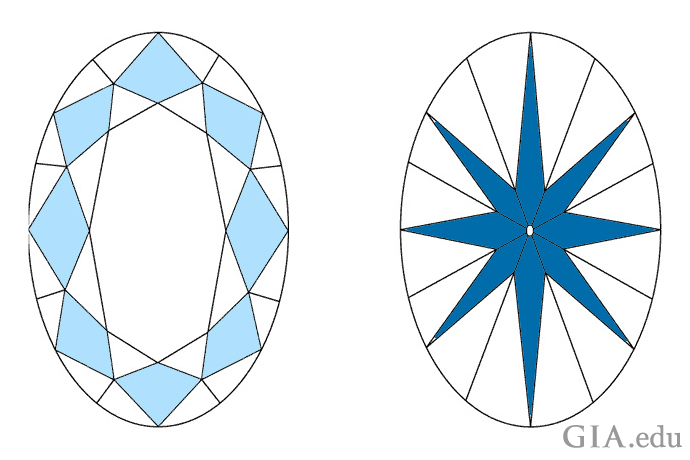
A common facet arrangement for oval diamonds: eight bezel facets on the crown, pictured in light blue (left); eight main pavilion facets, pictured in dark blue (right). Illustration: GIA
There are compelling reasons why many people love oval diamonds: Because the oval diamond has a larger surface area than a round diamond of equal carat weight, it can appear larger to the eye. The oval shape can make the finger seem longer. And because the shape doesn’t have sharp angles or corners, an oval diamond is less prone to chipping compared to other fancy shapes.
The brilliant faceting style was first introduced circa 1700. Brilliant-cut cushion shaped diamonds predominated because cutters tended to follow the outline of the rough crystal. But diamonds were available in a variety of shapes, including oval. At this time, diamonds were not described by their shapes – they were simply called “brilliants.” It isn’t until the late 1800s that we first see mention of oval diamonds in literature.
Modern appeal for the oval diamond began in 1957. The oval diamond enjoyed a resurgence between 1998 and 2001, driven in part by marketing campaigns, and now it’s making a comeback. According to Town & Country magazine, the oval diamond ranked 6th in popularity with American consumers in 2016 (round diamonds were still no. 1).
The 105.60 carat (ct) Koh-i-Noor is probably the most famous oval diamond. It was so valuable that it was said that “whoever owned the Koh-i-Noor ruled the world.” Following centuries in the possession of rulers from Persia and India, the diamond was presented to Britain’s Queen Victoria on July 3, 1850. It is now set in the Queen Mother’s crown, which was fashioned for Queen Elizabeth, wife of George VI (and mother of Elizabeth II), for their 1937 coronation. You can see it in the Tower of London with the other Crown Jewels.
The 31.06 ct Wittelsbach-Graff (long known as the Wittelsbach Blue) is another famous oval diamond with a royal provenance. The rough probably came from India’s famed Golconda District. In about 1666, it was given as part of a dowry for the marriage of Infanta Margarita Teresa of Spain into the House of Hapsburg. In 1722, it was used again as part of a dowry, this time for a marriage into the House of Wittelsbach. In 1931, the Wittelsbach Blue vanished from sight and was hidden for 30 years, until it was rediscovered in 1961. After it was sold at auction for $24.3 million in December 2008 to London Jeweler Lawrence Graff, the original 35.56 ct cushion modified brilliant diamond was recut to a 31.06 ct oval to make it a Fancy Deep blue, Internally Flawless gem, and was renamed the Wittelsbach-Graff.

Pictured here is the 31.06 ct Wittelsbach-Graff diamond, recut from the historic Wittelsbach Blue. The recut diamond was graded Fancy Deep blue according to GIA’s colored diamond color grading system. Photo: Robert Weldon/GIA
Another oval diamond made international news in April 2017, when Hong Kong jeweler Chow Tai Fook bought a 59.60 ct Internally Flawless, Fancy Vivid pink diamond for $71.2 million. Known to many as the Pink Star or Steinmetz Pink, it became the most expensive diamond ever sold at auction. The retailer renamed it the CTF Pink Star. The diamond was mined in Botswana in 1999. It took cutters two years to turn the 132.50 ct rough into its final shape.

The Pink Star, now called the CTF Pink Star, smashed auction records when it sold for $71.2 million in April 2017. The 59.60 ct Internally Flawless, Fancy Vivid pink diamond is a stunning example of an oval shaped diamond. Courtesy: Sotheby’s
Turn to the 4Cs of diamond quality when shopping for an oval diamond. GIA uses the same criteria for determining carat weight, color and clarity for oval diamonds as it does for round brilliants. This can help you narrow your search.
Length-to-Width Ratio
Keep proportion in mind when looking at oval diamonds. Consumers and trade professionals tend to prefer a longer oval shape, according to a comprehensive survey of shape preferences GIA conducted in 2009. The survey showed that the most popular length-to-width ratio for ovals was 1.7:1. However, it is not practical to cut such long oval diamonds from the original rough, so you’ll rarely find one. More typical are ovals with ratios ranging from 1.3:1 to 1.4:1.

This 1.06 ct oval diamond has a 1.71:1 length-to-width ratio. It is rare to find oval diamonds this long. Photo: Kate Waterman/GIA
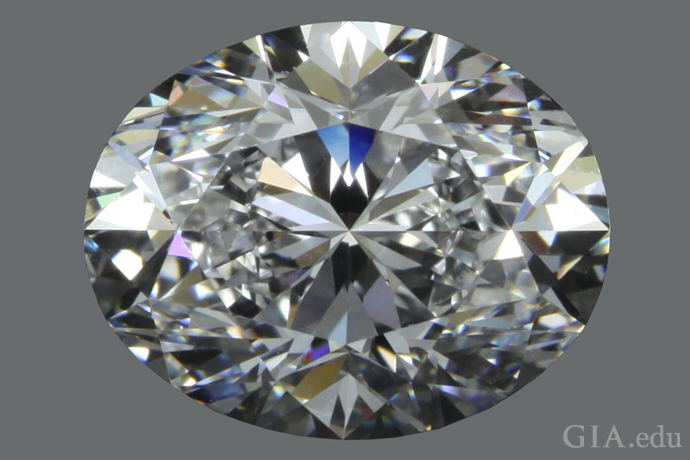
This 3.01 ct oval diamond has a 1.26:1 length-to-width ratio, which is a little shorter than most oval diamonds. Photo: Kate Waterman/GIA
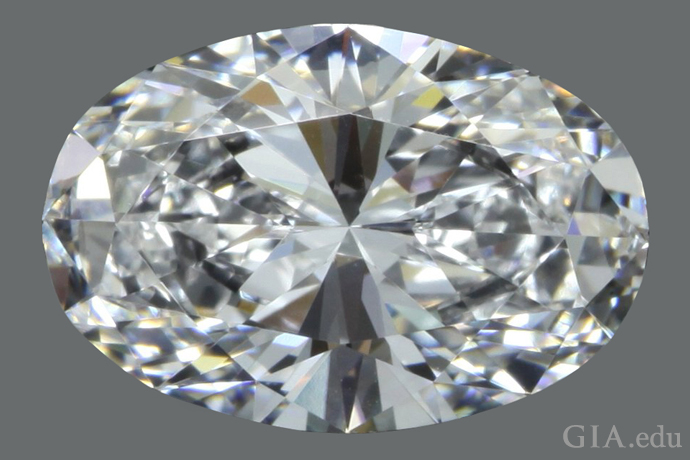
This 2.28 ct oval diamond has a 1.48:1 length-to-width ratio. Even this length is a little hard to find. Photo: Kate Waterman/GIA
Symmetry
Symmetry is important in creating the beauty of an oval diamond. To determine if an oval diamond is symmetrical, draw an imaginary line down the center. The shape and faceting of the two halves should mirror each other. Then draw an imaginary line across the middle of the oval. Again, the shape and faceting of the two halves should be identical.
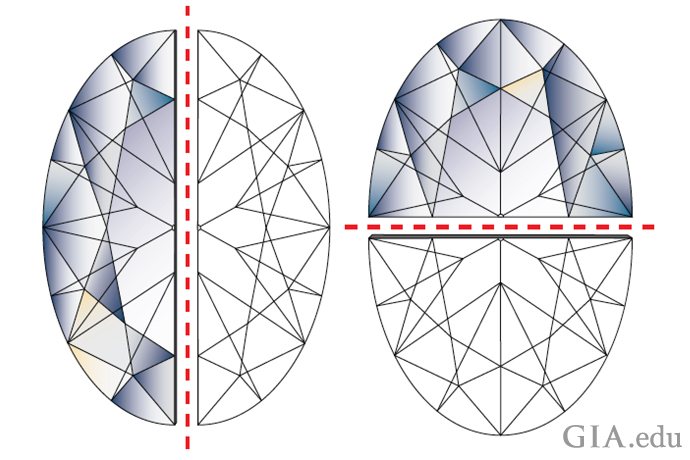
Symmetry is based on how closely the shape and facets on either side of these imaginary center lines mirror each other. Illustration: Peter Johnston/GIA
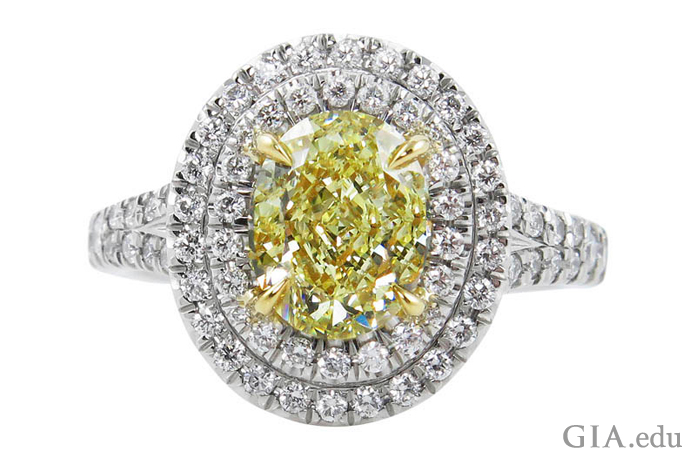
The allure of an oval diamond is easy to see in this 1.58 ct Fancy yellow oval. The two halos surrounding it contain D-to-F color melee diamonds totaling 1.20 carats. Courtesy: TrueFacet.com
Shape Appeal
Look for an oval diamond with a graceful outline and harmoniously proportioned parts. To find one that’s attractive to you, it pays to compare several different oval diamonds. Here are some common shape variations:
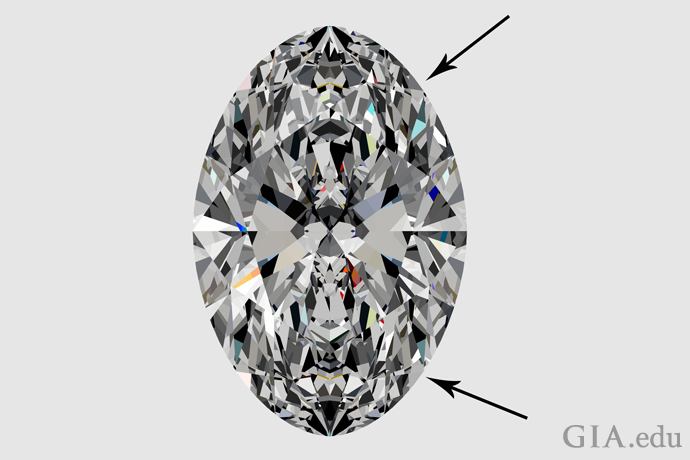
This oval cut has flat shoulders, which many in GIA’s survey considered less graceful. Image: Al Gilbertson/GIA
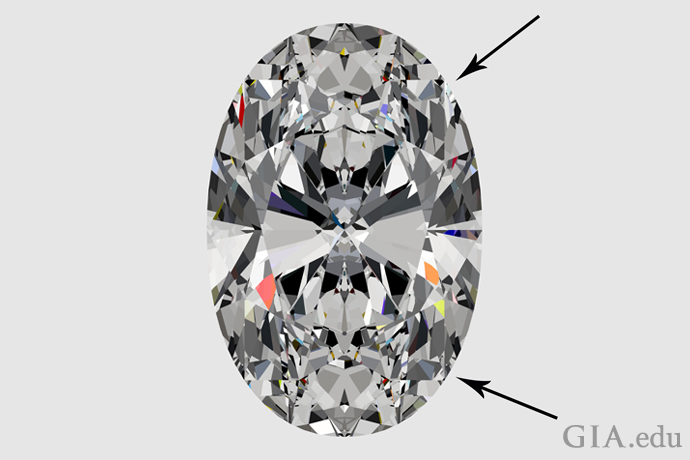
This oval cut has bulging shoulders – an aspect that many of those surveyed also considered less graceful. Image: Al Gilbertson/GIA

This oval cut has no shoulder bulge. Its overall symmetry and well-proportioned shape contribute to its visual appeal. Image: Al Gilbertson/GIA
Girdle Thickness
The girdle is the intersection of the crown and pavilion. It defines the perimeter of the diamond and functions as its setting edge. Girdle thickness is judged the same way in fancy shapes as in rounds. Be sure to look at the diamond’s proportion diagram in its GIA Diamond Grading Report. The diagram will show the stone’s average girdle thickness percentage and indicate if the girdle is too thick or too thin. An overly thick girdle can contribute to a heavier diamond than its face-up appearance warrants, and a thin girdle can increase the risk of damage such as chipping.
Bow-tie Effect
Expect to see a bow tie. A “bow tie” in diamond parlance is a dark bow-shaped pattern across the table of the diamond.
What causes a bow tie? A diamond’s facets act like a series of mirrors that gather light from around you and return it to your eye. As you look at the stone, the dark contrast you see is a reflection of your head and shoulders blocking light from entering the diamond. The closer your face is to the diamond, the more pronounced the bow tie will be.
If the diamond is cut well, the bow tie will be minimal, but once you are in front of the diamond, there will always be some measure of a bow tie.

The grayed-out area across the table in this illustration is where you’ll likely see the bow-tie effect. Illustration: Peter Johnston/GIA
You’ll have lots of choices for engagement ring settings for oval diamonds. And each setting can create a dramatically different look. Here are some options.
Halo Setting
A halo of smaller diamonds around the oval center stone is a lovely addition. It accentuates the shape and makes the diamond appear larger. Choosing a different color of metal or side stones can create an arresting look.
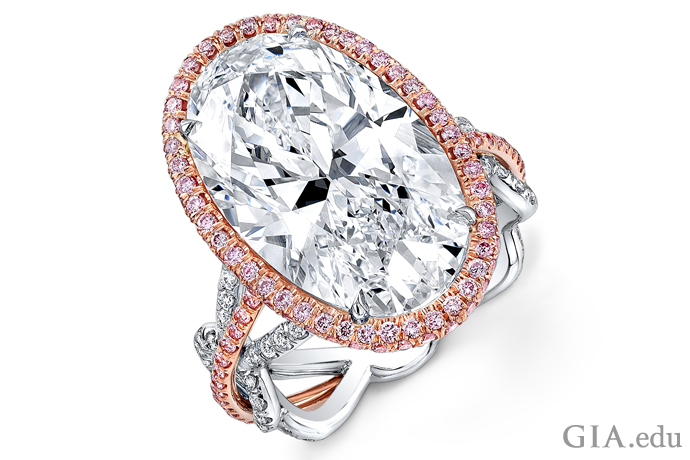
A mesmerizing sight, this oval diamond engagement ring features a 10.92 ct center stone, accented with a halo of fancy pink melee diamonds. Courtesy: Rahaminov Diamonds
Prong Setting
Prong settings are good choices for an oval diamond. Not only do they protect the diamond from loss, but they can also add height, raising the diamond from the band and drawing the eye to the gem.

An oval diamond makes a dramatic statement in a prong setting. A halo of smaller diamonds adds even more panache. Courtesy: Rahaminov Diamonds
Bezel Setting
A bezel setting, which completely encloses the perimeter of the diamond in metal, is a great choice if you lead an active life. It’s an effective way to protect the diamond and also enhances the beauty of the oval shape.

A 0.84 ct oval shape diamond sits in a platinum bezel setting. Courtesy: 1stdibs.com
Side Stones
An oval diamond goes well with virtually any kind of side stone. Half-moon diamonds echo its shape, so they can be an attractive choice. Baguettes and tapered baguettes offer an opportunity to create contrast, as do colored gems. If you want your diamond side stones to match the center oval, choose side stones that are within one or two color grades of the larger diamond so they don’t compete with its beauty.

Contrasting colors and shapes bring life to this engagement ring. It features a 0.90 ct oval center stone, flanked by two round sapphires and round diamonds. Courtesy: EraGem.com
Wide Band
Because of its shape, an oval diamond works well with a wider band.

Three oval diamonds look at home in a wide band. It especially suits the 1.57 ct center stone. Courtesy: EraGem.com
An oval diamond is beautiful…classic…and a little different. It’s a wonderful option for an engagement ring.
If you’re looking to create a diamond engagement ring that’s out of the ordinary, there are many more fancy shapes to choose from. A marquise diamond just might be for you.
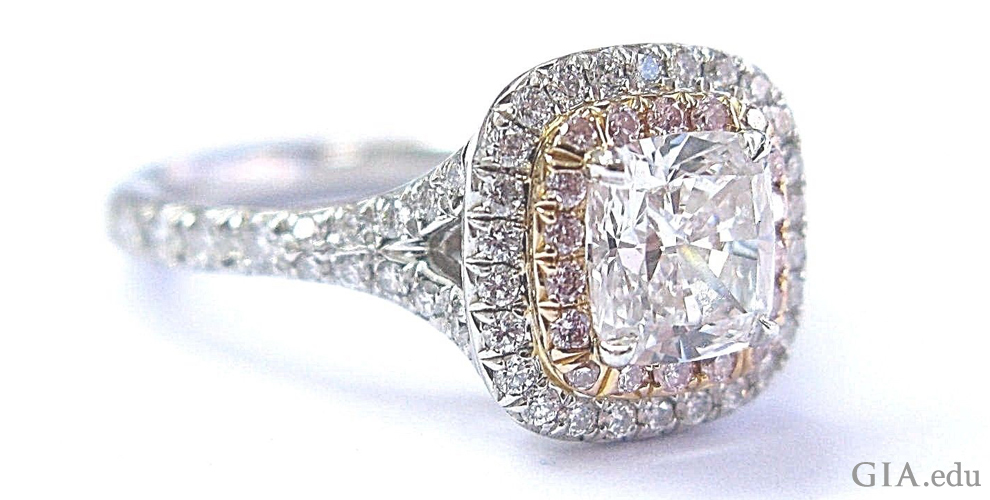
If you’re shopping for a diamond, carat weight is probably one of the important things you’re considering. It seems like a straightforward measurement, but there is more to it than a simple number. Here’s essential information you need to know.
In this post, we cover:
What Is Carat Weight?
Diamond weight is stated in metric measurements called carats. One carat is equal to 200 milligrams, which is 1/5 of a gram or 0.20 gram. There are 142 carats in an ounce. Carat is also the standard unit of weight for most gemstones.
The modern carat system has its roots in the carob seed, which comes from the locust tree. Because the small seeds are fairly uniform in size and weight, they were a useful standard for determining the weight of a gem. Early gem merchants and jewelers used carob seeds as counterweights in hand-held balance scales.
Carat weight was standardized as 0.20 gram in the early twentieth century. This gave trade professionals a uniform and universally accepted weight standard for diamonds.

Notice that the seeds from the carob pods are nearly identical in size. Photo: Orasa Weldon/GIA
Carat is abbreviated as “ct” and weights are typically given to two decimal places: 1.00 ct, 0.76 ct, 1.57 ct.
Like the dollar, a carat is made up of 100 parts, called “points” and abbreviated as “pt.” An easy way to remember this is to think of carats as dollars and points as pennies. They’re even written the same way: $1.34 means one dollar and 34 cents, and 1.34 ct means one carat and 34 points.”
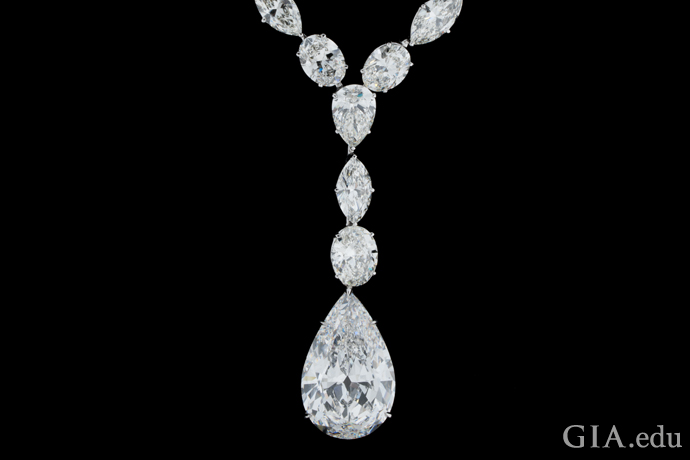
If you like big diamonds, you’ll love this necklace. The large pear shape weighs 25.04 ct, and it is suspended from another 64.24 carats of glittering diamonds. Photo: Robert Weldon/GIA. Courtesy: Chatila
How Does GIA Measure Diamond Carat Weight?
When a diamond is submitted to GIA, one of the first steps in the grading process is to determine its weight. To ensure precision, accuracy and consistency, GIA uses an electronic micro-balance scale to weigh each diamond. GIA adheres to strict calibration and maintenance procedures for its devices. These procedures exceed the manufacturer’s recommendations. In addition, the laboratory monitors and controls environmental conditions that might affect the quality of the results, such as room temperature and humidity.

Diamonds submitted to GIA are weighed on an extremely sensitive electronic micro-balance scale. Photo: Valerie Power/GIA
The diamond’s dimensions are also measured. An optical measuring device captures the diamond’s measurements (length and width), as well as its proportions and facet angles, which will eventually inform the diamond’s cut grade.
Diamond Carat Weight and Rounding Up (or Down)
While most trade professionals typically weigh diamonds to a thousandth of a carat (three decimal places), GIA weighs diamonds to the fifth decimal place – a hundred thousandths of a carat, to ensure maximum precision and provide an identifying characteristic.
The rounding rules GIA follows are also stricter than normal mathematical rounding rules. As mentioned above, a diamond’s carat weight is conventionally stated to two decimal places (0.71 ct, 1.34 ct). To arrive at this number, GIA rounds up to the next higher hundredth only if there’s a nine in the thousandth place. For example, a diamond that weighs 1.769 ct would be rounded up to 1.77 ct, but one that weighs 1.768 ct would be rounded down to 1.76 ct. Such differences in carat weight might seem small, but they can make a significant difference in price.

Get a sense of relative diamond size with this photo. From left to right: a yellow princess cut (0.86 ct), a pink round brilliant cut (0.68 ct), a gray-blue round brilliant (0.56 ct), a gray round brilliant (0.30 ct) and a blue-green round brilliant (0.15 ct). Photo: Robert Weldon/GIA
Once the diamond has been graded, its carat weight and dimensions — as well at its color, clarity and cut grade (if applicable) — are clearly documented on a GIA diamond grading report. Also included is full disclosure of any diamond treatments detected during the process.

The diamond’s weight is prominently stated on a GIA Diamond Grading Report. Photo: GIA
Why Is Carat Weight Important?
All other factors being equal, the price of a diamond increases as its carat weight increases. Since diamonds 1.00 ct or larger are comparatively rare, prices jump dramatically for these gems.
Carat weight also helps you compare prices between diamonds with different weights but the same color, clarity and cut grades, allowing you to compare the per carat price for each stone to see where you’re getting the best value.
Carat Weight and Shopping Considerations
Here are a few concepts related to carat weight that you should be aware of as you’re shopping:
Carat Weight and Gemstone Size – Two Different Things
It’s a common mistake to equate a gem’s carat weight with its physical dimensions. After all, it seems logical that a larger stone will weigh more. This is true if you’re comparing two stones of the same gem material – like a diamond to a diamond, or an aquamarine to an aquamarine.
However, size is a function of the gem material’s specific gravity – the ratio of the weight of a gem to that of an equal volume of water. Materials with different specific gravities (densities) will have different sizes for the same weight (think of an ounce of lead compared to an ounce of feathers). For example, the specific gravity of diamond (3.52; that is, 3.52 times the same volume of water) is lower than that of ruby (4.0), so a one-carat diamond will be larger than a one-carat ruby.
The bigger the diamond, the more bang for your buck?
Not always. When it comes to diamonds, greater carat weight does not guarantee that the diamond will look bigger. For example, a poorly cut diamond may be too deep and have weight hidden below the girdle. You won’t see this weight when the diamond is mounted, and it won’t make the diamond more appealing – but the diamond will weigh more.

Excessive bulge, shown by the gray areas on either side of the outline, adds to a diamond’s weight without contributing to its beauty or perceived size when viewed face-up. Illustration: Peter Johnston/GIA
Magic Sizes
As mentioned earlier, for diamonds that are equal in every way, diamond value increases as weight increases. At certain weight boundaries, called “magic sizes,” the price per carat increases significantly. That’s because these boundaries or thresholds coincide with popular weights, and popularity means greater demand and therefore higher prices for these weights. This is especially true at the magic one-carat size.
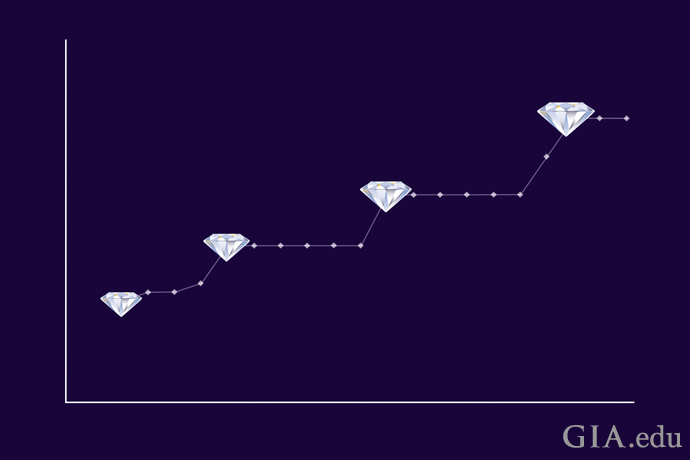
Diamonds increase in price at magic sizes like 0.25 ct, 0.50 ct, 0.75 ct and 1.00 ct. Illustration: Peter Johnston/GIA
A quick comparison of two diamonds shows how magic sizes can affect price. If one diamond weighs 0.96 ct and another weighs 1.02 ct, the 6 pt (0.06 ct) difference in size is almost imperceptible. But if both are D-color round brilliants with identical clarity and cut, the difference in cost is significant. The fact that the second diamond is slightly over the “magic” one-carat threshold may cause its price to be as much as 20 percent more.
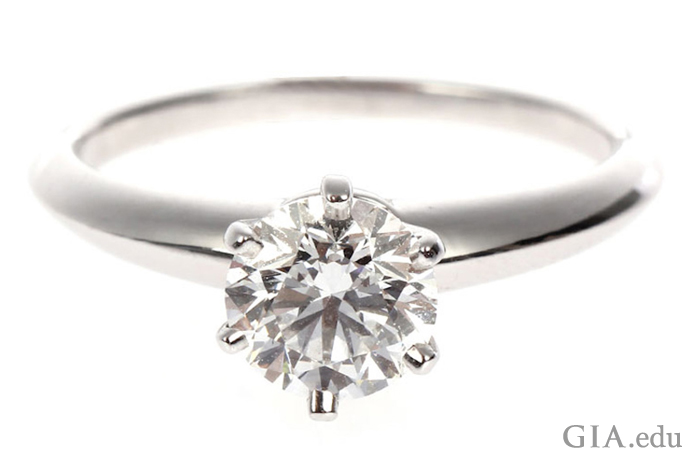
The 1.07 ct diamond in this Tiffany & Co. ring is a magic size. Courtesy: TrueFacet
Nevertheless, for some people carat weight is symbolic, so they will pay the higher price to reach the magic size.
There is another side to magic sizes – if you think they’re unimportant, you can look for a diamond that weighs slightly less than one of these boundaries and save money.
Carat weight isn’t everything
If you want the largest diamond you can afford, you’ll have to sacrifice clarity, color and/or cut, which may mean sacrificing beauty and sparkle. Choosing a diamond means prioritizing the 4Cs, and then making some compromises. Here is a thoughtful look at determining what’s the most important C for you.
Total Carat Weight
Understanding diamond terminology is essential if you’re going to make a smart purchase decision. “Total carat weight” (abbreviated tcw) is the combined weight of all the diamonds in a piece of jewelry that only contains diamonds.
An engagement ring set with many small melee diamonds weighing 2.15 tcw will cost significantly less than a solitaire engagement ring set with a single 2.15 ct diamond. Again, think size/rarity/price.

This Tiffany & Co. engagement ring has a cushion cut diamond, weighing 0.84 ct, surrounded by 0.06 carats of natural pink diamonds and 0.34 carats of melee. The total carat weight is 1.24 tcw. Courtesy: TrueFacet.
If an engagement ring has gems other than diamonds in it, the combined weight of all the stones is called “total gem weight.”
The Difference between Carats, Karats and Carrots
Here’s a last bit of terminology that we need to explain. As you know by now, a carat is a metric unit of measure to describe the weight of a diamond and other gemstones. Karat (abbreviated as K) is the measure of the purity of gold. A karat has 24 parts, so 18K gold would mean that the metal is 18 parts gold and 6 parts of other metals (such as copper, silver and/or zinc). Carrots, well, that’s something rabbits are famous for eating.
A diamond engagement ring is a once-in-a-lifetime purchase that is a symbol of your love. Understanding carats and points can help you with this “weighty” decision.
In addition to carat weight, a GIA grading report contains a wealth of information about your diamond. If you’d like to dig deeper, you’ll be interested in the other articles in this series:
GIA Diamond Grading Reports: Understanding the Diamond Color Grade
GIA Diamond Grading Reports: Understanding the Diamond Clarity Plotting Diagram
GIA Diamond Grading Reports: Understanding Diamond Cut Grades
With spring in full bloom and summer just around the corner, emerald is the perfect choice for the May birthstone. Kings and queens have prized the sought-after green gem for centuries. Here’s how you can pick a breathtaking one.
In this post, we cover:
Gemological Qualities of Emerald
Emerald History & Lore
Where Emerald Comes From
Emerald Qualities to Look For
Emerald Care & Cleaning
May Birthstone: Gemological Qualities of Emerald
Emerald’s green has been the standard by which other green gemstones have been measured for thousands of years. It is the rich green to bluish green variety of beryl, a mineral species that also includes aquamarine and varieties in other colors.
Trace elements that cause emerald’s color include chromium, vanadium and iron. As a general rule, the higher the chromium or vanadium content, the more intense the green color. The more iron present, the greater the degree of blue. When iron content is relatively high, emerald is a bluer green. When iron content is relatively low, the May birthstone is a purer green.
The difference between an emerald and a less-expensive green beryl is a matter of debate among gem experts. Some in the trade describe the May birthstone as any green beryl colored by chromium. However, gemologists, gemological laboratories and most colored stone dealers, think it is incorrect to call a green beryl an emerald when its color is “too light.” There are differences of opinion even in this group about the definition of “too light.” GIA settles the debate by using lab-graded comparison stones to determine if the green color is sufficiently dark and saturated to be called emerald.
Gemologists love the May birthstone for its inclusions. Emeralds from Colombia can have fascinating characteristic inclusions – called three-phase inclusions – that consist of tiny crystals of rock salt, a liquid and a bubble of gas.
The best emerald crystals are also gorgeous flat-topped green hexagonal columns that can rival the beauty of faceted stones.
Weighing in at 47 carats, this rough emerald crystal from the Muzo mine in Colombia is so beautiful that it may put to rest all debates about color. Photo: Robert Weldon/GIA. Courtesy: Jon Sigerman
May Birthstone: Emerald History & Lore
From Egyptian pharaohs to Inca emperors, emerald has enchanted royalty. Cleopatra was known to have a passion for emerald, and used it in her royal adornments. The legendary Crown of the Andes, fashioned in colonial South America, is one example of how the Spanish revered the May birthstone. According to lore, its largest stone—now called the Atahualpa emerald—was taken from the last Inca emperor, Atahualpa, by conquistador Francisco Pizarro. The modern recovery of the Spanish galleon Nuestra Señora de Atocha shows the length generations of treasure hunters would go to recover its sunken loot.
The word “emerald” comes from smaragdos, ancient Greek for a green gem. Roman author Pliny the Elder, who died in the 79 CE eruption of Mt. Vesuvius, wrote in his encyclopedic Natural History that “nothing greens greener.” He also stated that the May birthstone had therapeutic properties that helped gem cutters: “(they) have no better method of restoring their eyes than by looking at the emerald, its soft, green color comforting and removing their weariness and lassitude.” Science now proves this belief: The color green relieves stress and eye strain.
An emerald necklace sure to soothe the eye, this beauty has 52 emeralds, with a total weight of 32.86 carats, and 160 diamonds, with a total weight of 9.11 carats. Photo: Robert Weldon/GIA. Courtesy: Ismael Daoud
Emerald was also thought to have magical powers. By placing it under the tongue, one could see into the future. Some believed the May birthstone offered protection against evil spells, cholera and malaria. Others thought it made one an eloquent speaker and exposed lovers who made false promises.
Emerald is traditionally given for the 20th and 35th wedding anniversaries.
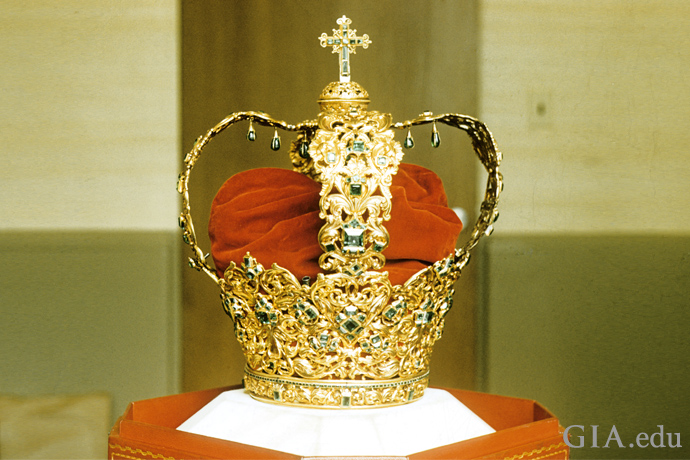
The Crown of the Andes, now at the Metropolitan Museum of Art in New York City, boasts an impressive 24 ct emerald center stone and 442 additional emeralds set in the golden headpiece. Photo: Dr. E. J. Gübelin/GIA
May Birthstone: Where Emerald Comes From
Colombia has been the source of the finest emeralds for more than 500 years, and they have been the standard by which all others are measured. Three mining sites in Colombia are particularly noteworthy: Muzo, Chivor and Coscuez. Emeralds of slightly different hues are found at each of these sites. Each locality produces a range of colors, but generally speaking, darker tones of pure green emeralds come from Muzo. Emeralds that are lighter in tone and slightly bluish green are associated with Chivor. Slightly yellowish green emeralds are unearthed in Coscuez.
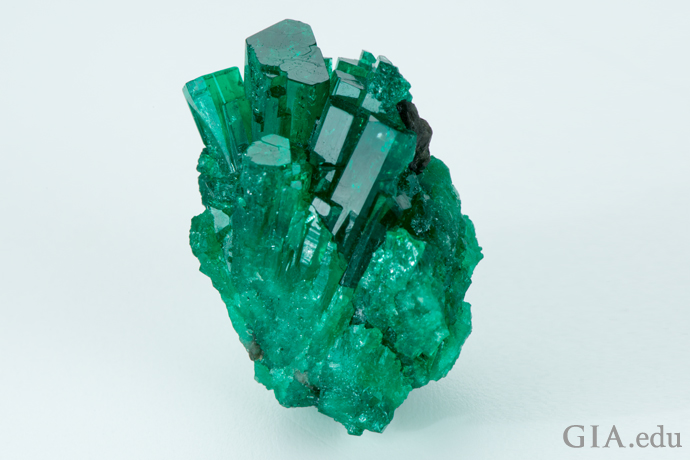
This 38 carat cluster of emerald crystals originated from Colombia’s Muzo Mine. Photo: Robert Weldon/GIA. Courtesy: Ismael Daoud
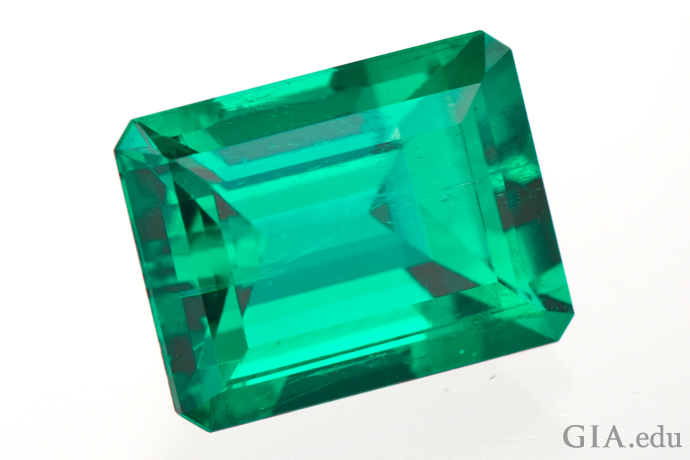
Chivor, Colombia is the source of this 4.50 ct emerald. Photo: Robert Weldon/GIA
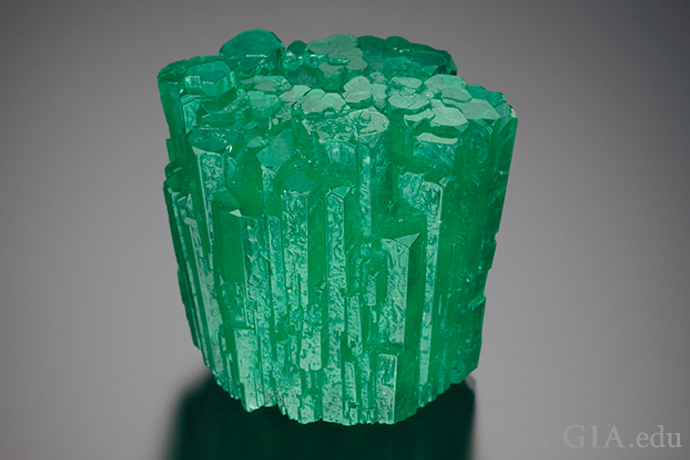
This 88.4 gram emerald crystal cluster is from Coscuez, Colombia. Photo: Robert Weldon/GIA. Courtesy: Gene Meieran
Emeralds are also found in the state of Minas Gerais, Brazil. One of the most productive sites for the May birthstone is the sophisticated Belmont Mine. Capoeirana is another important locality, a rugged region worked largely by independent miners and small-scale operations.
An independent miner at the Capoeirana mining area holds a rough emerald. Photo: Eric Welch/GIA
The May birthstone can also be found in Africa. Zambia is a major source, and mines in the Ndola Rural Restricted Area are known for producing emeralds that are bluish green and darker in tone. Pakistan and Afghanistan are important producers as well.
The 240 carats of emeralds in this drop necklace come from Zambia. Photo: Robert Weldon/GIA. Courtesy: Sanjay Chordia, BEACAB GEMS INC.
May Birthstone: Emerald Qualities to Look For
Color: The most important quality factor in the May birthstone is color. Emeralds that are bluish green to green, with strong to vivid saturation and medium to medium-dark tone, are the most coveted. Emeralds that are highly transparent are especially valuable.
Clarity: Emeralds typically contain inclusions that are visible to the unaided eye. Because of this, jewelry professionals and some consumers understand and accept the presence of inclusions in emeralds. Eye-clean emeralds are especially valuable because they’re so rare.
Emerald inclusions are often described as looking mossy or garden-like. They’re sometimes called jardin, which is French for “garden.”
In colored stones, transparency and clarity are closely linked. This is especially true for emeralds. Jewelry professionals generally accept some eye-visible inclusions in higher-quality emeralds. But when the quantity or nature of the inclusions has a negative effect on transparency and clarity, they also dramatically reduce value.
Cut: Emerald crystals are difficult to cut. Almost all rough emeralds have significant fractures (sometimes called fissures) and a gem cutter must work to minimize the effect of those fractures on the appearance of the finished stone.
These inherent fissures make emeralds more brittle than other gems. Consequently, they are vulnerable to damage during cutting, polishing and setting–or even from careless daily wear.
The famous rectangular “emerald cut,” with its beveled corners and two, three or four concentric rows of facets, maximizes the shape and weight of the original emerald crystal. It also helps protect against damage because the vulnerable corners are faceted and provide a comparatively safe place for prongs.
Carat Weight: Fashioned emeralds come in a wide range of sizes. There are emeralds in museums and private collections that weigh hundreds of carats. At the other extreme are tiny emeralds that weigh fractions of a carat.

Take extra caution when caring and cleaning for emerald jewelry like this 3.69 ct emerald ring flanked with six diamond side stones. Photo: Robert Weldon/GIA. Courtesy: Ismael Daoud
May Birthstone: Emerald Care & Cleaning
Emerald is a 7.5 to 8 on the Mohs scale of hardness, so it is more susceptible to scratching than a diamond, which ranks 10 on the scale. The May birthstone is often treated to improve its color and clarity. Common treatment methods include:
Emerald requires some special care; avoid exposure to heat, changes in air pressure (such as in an airline cabin) and harsh chemicals. Never put an emerald in an ultrasonic cleaner. Filled emeralds can also be damaged by exposure to hot water used for washing dishes.
The May birthstone is perfectly suited to the celebration of life blooming everywhere. Now you can treat yourself – or a loved one – to an emerald that captures the exuberance of the season. Learn more about how to pick a beautiful emerald with our Emerald Buying Guide.