Please ensure Javascript is enabled for purposes of website accessibility.
Search
Search
Search

GIA 4Cs Diamond Blog

GIA 4Cs Diamond Blog

Nine Things About Diamond Carat Weight You Need to Know

If you’re shopping for an engagement ring, you need to know about carat weight – the measurement of how much a diamond weighs. Carat weight is important because it helps determine a diamond’s price and reflects its rarity. We take a closer look. (more…)

Buying Guide: Colored Gemstone Engagement Rings

Colored gemstone engagement rings are hot. They’re showing up on royalty and celebrities alike. They’re beautiful. They’re unusual. And they can be a great value. Here’s what you need to know when you go shopping.

In this blog, we cover:

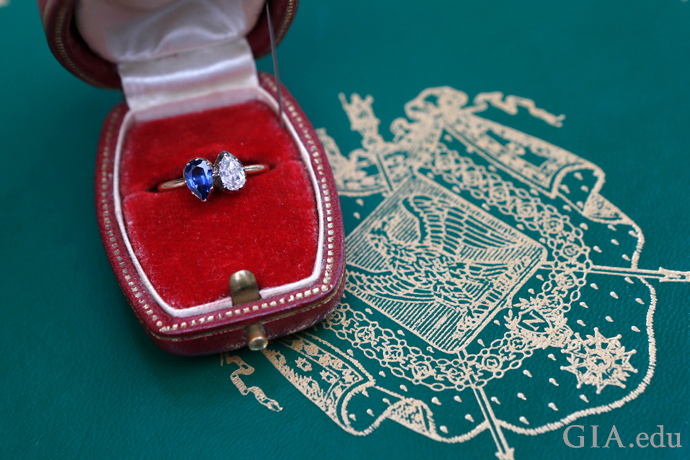
The Empress Josephine toi and moi engagement ring featuring a 1 carat pear shaped sapphire and diamond mounted in 18K gold.

The Empress Josephine toi et moi (“you and me”) engagement ring features a 1 carat (ct) pear shaped sapphire and diamond mounted in 18K gold. Photo: PATRICK KOVARIK. Courtesy: AFP/Getty Images

Why the trend in colored gemstone engagement rings

Colorful gemstone engagement rings are decorating the fingers of royals and other style makers, reviving a not-so-new trend for adding pops of color – and personality – to traditional colorless diamond engagement rings.

Some stylistas are achieving the color-me look with pink, yellow or blue diamonds, while others turn to the world of colored gemstones to find their splash of color.

More than 200 years ago, in 1796, Napoleon Bonaparte gave his future empress, Joséphine, a sapphire and diamond toi et moi (“you and me”) ring for their engagement.

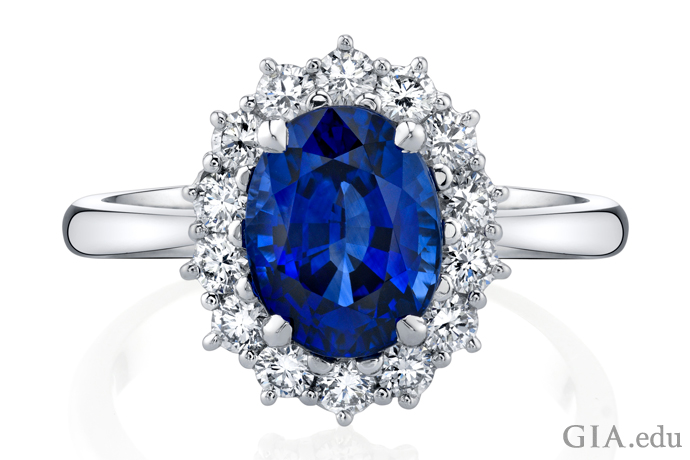
Today, Kate Middleton, the Duchess of Cambridge, wears what is probably the most famous colored gemstone engagement ring. A beautiful creation that once belonged to Princess Diana, it boasts a 12 ct sapphire encircled by diamonds.

A 2.73 ct oval sapphire engagement ring accented by 0.56 carats of diamonds.

If you like Kate Middleton’s engagement ring, then you’re sure to love this beauty. A 2.73 ct oval sapphire glows the brighter for being accented by 0.56 carats of diamonds. Courtesy: Omi Privé

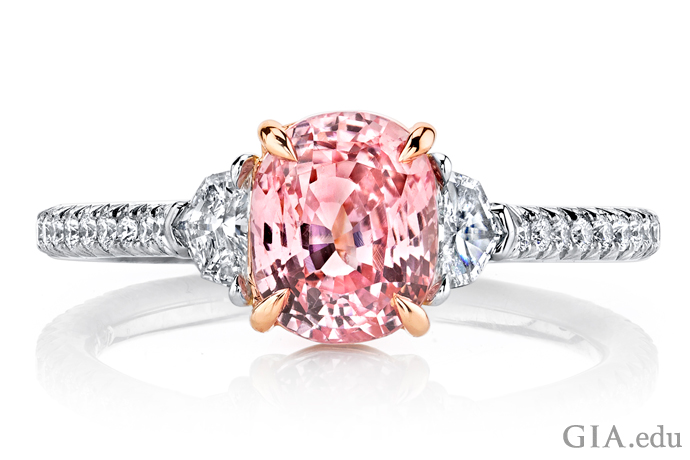
Kate’s recently engaged cousin by marriage, Princess Eugenie, daughter of Prince Andrew and Sarah Ferguson, opted for a slightly orangy pink padparadscha sapphire, surrounded by round brilliant cut diamonds. The style somewhat resembles the engagement ring her mother (the Duchess of York) received – a ruby with a halo of diamonds.

A 2.02 ct padparadscha sapphire and diamond ring.

Like Princess Eugenie’s engagement ring, this 2.02 ct padparadscha sapphire and diamond ring is both beautiful and unusual. Courtesy: Omi Privé

In the celebrity world, actress Jenny McCarthy wears a 10 ct yellow sapphire engagement ring framed by diamonds. Ashlee Simpson’s vintage-style ring features a marquise diamond surrounded by calibré cut rubies. Elizabeth Hurley sports a 9 ct blue sapphire framed by two trilliant cut diamonds in a classic design.

For these trendsetters – and many other brides – incorporating colored gemstones into an engagement ring offers myriad options to display their individual style and personality. It’s a look that’s both timeless and contemporary.

What’s great about colored gemstone engagement rings

There’s a lot to love about colored gemstone engagement rings. First, there’s the obvious: color. Explore the world of colored gems and you’ll find a rainbow, from the deep reds of ruby and blues of sapphire, to the grassy greens of tsavorite garnet and kaleidoscopic colors of spinel. There’s a gem for every hue imaginable.

Second, with colored gemstones you can add more depth of meaning to the engagement ring. For example, you could include your birthstone and your partner’s birthstone, alone or with diamonds. Colored gemstones also come with historic symbolism, and you could pick one that inspires you. Take sapphire – it has traditionally been associated with sincerity, truth and faithfulness.

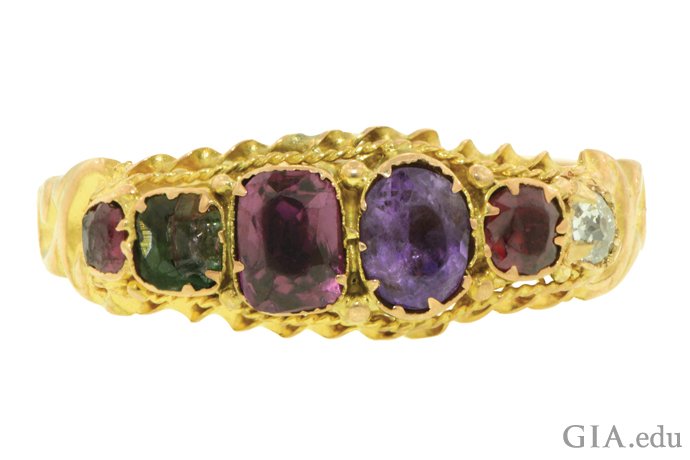
You can also use colored gemstones to send secret messages. The Victorians turned this into an art form with acrostic jewelry – using the first letter of each gemstone to spell a word. For example, a diamond, emerald, amethyst and ruby set together would spell the word “dear.” Acrostic jewelry can also be designed to spell birthdays, private messages or a secret shared between you and your beloved.

A Victorian era acrostic ring featuring ruby, emerald, garnet, amethyst, ruby and diamond.

This acrostic ring was made in England during the Victorian era (1837–1901). The gems spell “regard” from left to right: ruby, emerald, garnet, amethyst, ruby and diamond. Courtesy: Doyle & Doyle

Finally, there’s affordability. Colored gemstones are a great way to add size to an engagement ring. This is especially true if you look beyond rubies and sapphires toward gems that are less well known but equally as beautiful – and usually significantly less expensive. Examples include the pink beryl morganite, the many colors of spinel and tourmaline, or intense green, red or orange garnets.

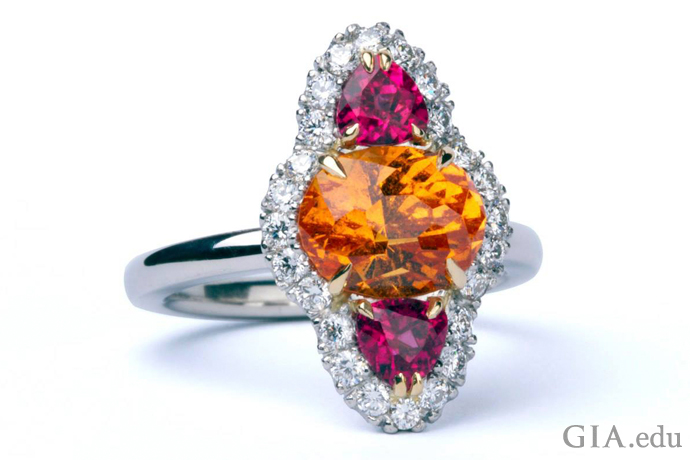
A gemstone engagement ring featuring a spessartine garnet center stone cut by John Dyer, pink tourmaline side stones and diamond melee.

If your bride-to-be’s favorite colors are orange and pink, this ring featuring a spessartine garnet center stone cut by John Dyer, pink tourmaline side stones and diamond melee is sure to please. Courtesy: John Dyer & Co.

A 7.07 carat Art Deco style morganite cocktail set in18K white gold with a double-halo of diamonds.

The color of morganite can be very similar to that of a pink diamond, but this 7.07 ct morganite is a striking – and more affordable – option. Courtesy: 1stdibs.com

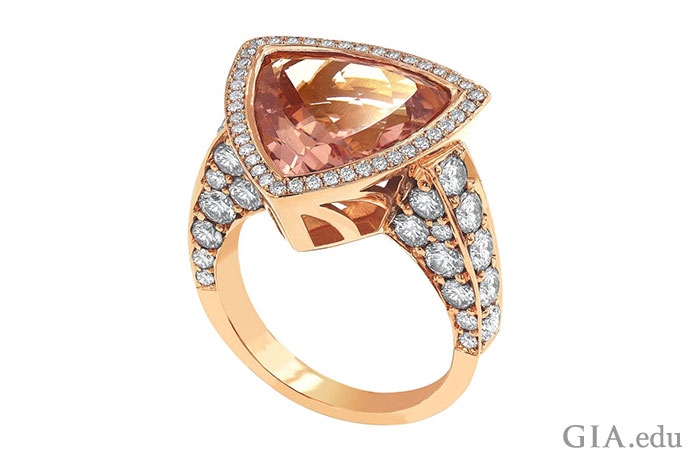
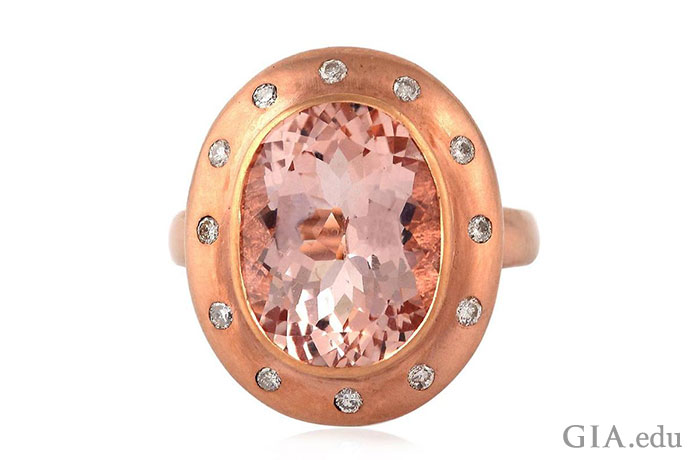
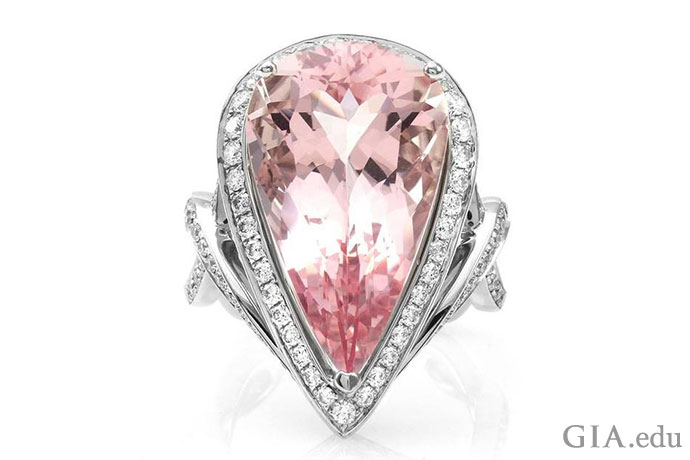
Morganite engagement rings are recent favorites with brides-to-be – and for good reason. Pink has traditionally been the color of romance, and morganite ranges from pastel pink to purplish, yellowish or orangy pink. Similar hues are seen in pink diamonds, but you can have a large, attractive morganite for a small fraction of their cost.

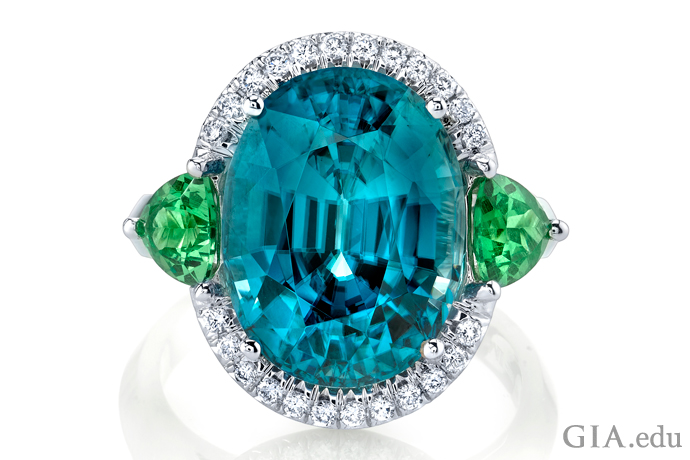
Blue zircon, with its high dispersion, is often mistaken for blue diamonds. Yet while the cost of even a 1 ct blue diamond would be prohibitive for most buyers, a 3 or 4 ct blue zircon engagement ring is obtainable for far less than an average month’s salary.

A 6.74 ct cushion cut zircon ring accented with trilliant cut tsavorite garnet side stones and round brilliant cut diamonds set in 18K white gold.

Find beauty in blue with this 6.74 ct cushion cut zircon ring accented with trilliant cut tsavorite garnet side stones and round brilliant cut diamonds set in 18K white gold. Courtesy: Omi Privé

Spinel and tourmaline are two other gems that offer a wide range of color options and great value. They occur in colors that are very similar to those of fine ruby or sapphire, but a top-quality 5 ct red tourmaline (rubellite) could be purchased for less than a third of the cost of a comparable 2 ct ruby – delivering more bling for your buck.

One of the most exciting, if less well known, colored gemstones seen in engagement rings is the green garnet known as tsavorite. More durable and often brighter than emerald, whose color it mimics, a fine tsavorite garnet is usually less expensive than its counterpart.

A 2.86 ct tsavorite ring with diamond accents, set in platinum.

An alternative and more durable option than emerald, this 2.86 ct tsavorite ring with diamond accents stands out from the crowd. Photo: Emily Lane/GIA. Courtesy: Sara and Bret Keller

With so many different colored gemstones available, your challenge will be finding one that sets your heart aflame – and making sure the gem is tough enough for daily wear.

Durability and colored gemstone engagement rings

Durability is a major consideration when searching for an engagement ring gemstone. The gem you choose must withstand the bumps and bangs of daily wear, plus the effects of heat, light, household chemicals and low or high humidity. Different gemstones have different properties and, as a result, different tolerances to these stressors.

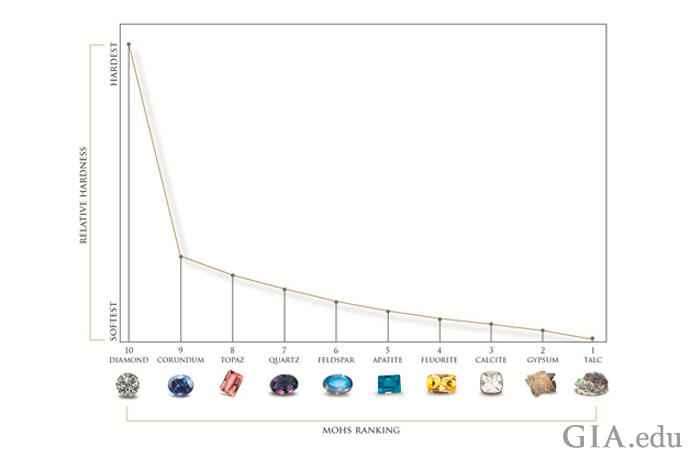
The Mohs scale ranks gem and mineral hardness in a range from 1 (least hard – talc) to 10 (hardest of all – diamond).

Introduced in the early 19th century, the Mohs scale ranks gem and mineral hardness in a range from 1 (least hard – talc) to 10 (hardest of all – diamond). Illustration: GIA

One aspect of gemstone durability is hardness. The Mohs scale ranks gem and mineral hardness on a scale of 1 (least hard – talc) to 10 (hardest of all – diamond). Ruby and sapphire rank 9, meaning they are able to resist scratching and abrasions. This makes them great choices for engagement rings that will see a lifetime of active wear. Although less hard, spinel (8), morganite (7.5–8), zircon (7.5), and tsavorite garnet and tourmaline (both 7–7.5) are considered durable enough for everyday wear provided care is exercised (no rock climbing!).

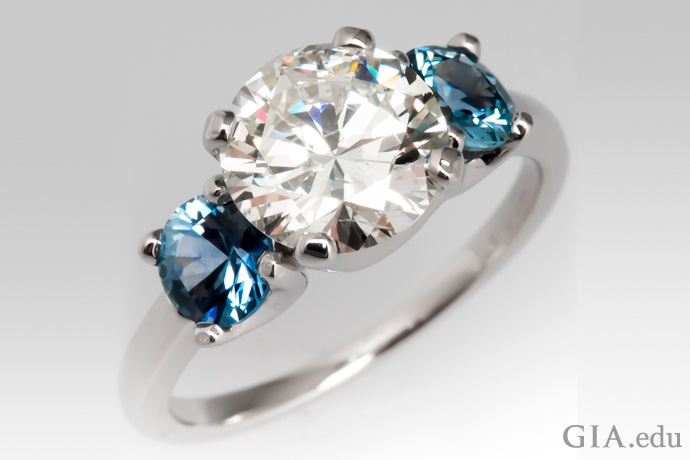
Two Montana sapphires weighing a total of 1.19 carats bookend a 2.05 ct round brilliant diamond.

Two Montana sapphires weighing a total of 1.19 carats bookend a 2.05 ct round brilliant diamond. Courtesy: EraGem.com

Toughness and stability are two additional factors that determine a gemstone’s durability.

Toughness indicates how well a gemstone resists breaking, chipping or cracking. The way the atoms of a gem bond together and the strength of these bonds determine gemstone toughness. Examples of not-so-tough gems are opal and tanzanite which, if set in rings, are best reserved for special occasions – not everyday wear.

Stability refers to how well a gemstone can withstand exposure to chemicals, light and changes in temperature or humidity. Extreme temperature changes can damage some gems like opal and tanzanite. Opals can crack or craze in low humidity or with exposure to heat. Citrine, amethyst and topaz may fade or change color from prolonged exposure to sunlight. Light and/or heat can also negatively affect most organic gems – such as pearls, coral and amber – as will exposure to household chemicals.

A 9.30 carat tanzanite center stone is surrounded by 1.18 carats of diamonds in this ring.

Tanzanite is a beautiful gem that calls for special occasions. At 6 to 7 on the Mohs scale with fair-to-poor toughness, it’s not ideal for an engagement ring that will see a lifetime of daily wear. Courtesy: Omi Privé

It’s important to note that many colored gemstones are routinely treated to improve their color and/or clarity. Designed to bring out the inherent beauty of a gem, many of these treatments are widely accepted in the gem trade. However, you should be aware that some treatments can also affect stability. As a result, your gem may require special care.

For example, treatments such as coating and fracture filling can be removed by heat and strong chemicals. Although emerald ranks 7.5–8 on the Mohs scale, it is not a tough gem and is often treated with oil and/or resin to improve clarity. This treatment also disguises fractures in the stone that can cause it to break if banged against a hard surface. If you have your heart set on a green gemstone engagement ring you plan to wear every day, you might want to consider a more durable tsavorite garnet instead, reserving emeralds for earrings or pendants. Garnets are rarely treated and have good toughness.

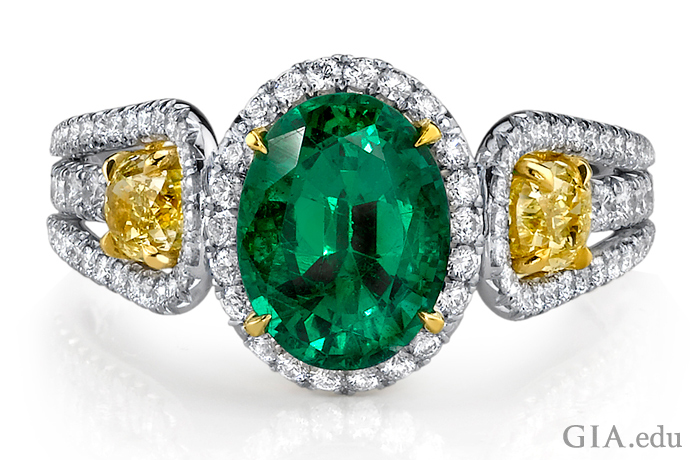
A halo of diamonds creates contrast with the emerald and helps protect this popular but fragile stone. Two yellow diamonds add more color and drama to the ring.

A halo of diamonds creates contrast with the emerald and helps protect this popular but fragile stone. Two yellow diamonds add more color and drama to the ring. Courtesy: Omi Privé.

Other qualities to look for in colored gemstone engagement rings

Color is king

Like colorless diamonds, the quality of a colored gemstone is determined by a combination of the 4Cs: color, clarity, cut and carat weight. For colored gems, however, color is by far the most important factor. In some cases, such as whether a gem is called pink sapphire or ruby, or green beryl or emerald, the distinction may be made based on color alone. Clarity is important, but for most colored gems there is no universal grading system or set of standards to evaluate clarity. And cut may vary greatly from stone to stone. The goal is typically to maximize size and color – or, as in the case of fantasy cuts, to create a work of art.

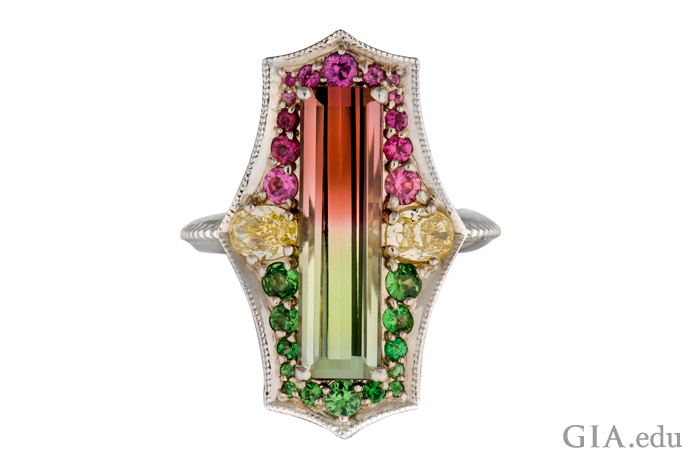
A 9.05 ct bi-colored tourmaline ring set in 14K white gold features yellow diamonds, tsavorites and rubellites.

A piece of art to stand the test of time, this 9.05 ct bi-colored tourmaline ring set in 14K white gold features yellow diamonds, tsavorites and rubellites. Photo: Orasa Weldon/GIA. Gift of Derek Katzenbach. In Memory of Nicholas Scott Golden, University of Maine geology student.

There are, however, some important considerations to look for when assessing the quality of a colored gemstone in addition to the durability factors discussed above. Many gems show more than one color. This can be an asset in a bi-colored tourmaline – for the bride-to-be who wants a truly unique colored stone engagement ring.

In other gems, such as blue sapphire, colorless zones seen on close inspection may detract from the overall appearance of the gem. And while high clarity is desirable in most colored gems, as it is in diamonds, a few identifying inclusions in an inconspicuous area (such as the culet) may ensure that the colored gem is natural (not synthetic) and untreated.

Optical phenomena
Colored gemstones also offer the possibility of certain phenomena, such as chatoyancy (the cat’s-eye effect) and asterism (a star), that are not seen in diamonds. These phenomena are caused by the reflection of light off dense inclusions of minerals in gems cut as cabochons. Such phenomenal stones provide exciting design options for a colored gemstone engagement ring.

A 7.57 ct cat’s-eye chrysoberyl ring surrounded by a halo of round brilliant cut diamonds.

This 7.57 ct cat’s-eye chrysoberyl seems to symbolize two lives united as one. Add a sparkling halo of round brilliant cut diamonds for strength and you have the perfect sentiment for an engagement ring. Photo: Robert Weldon/GIA. Courtesy: Richard Krementz Gemstones

Where the gem comes from
For some gems, such as ruby and sapphire, country of origin may also play a significant role in determining value. For example, a ruby from Myanmar (“Burmese” ruby) can cost significantly more than a comparable ruby from another locality, such as Mozambique. Similarly, there is a premium for sapphires from Kashmir, due to both their distinctive “cornflower blue” color and their rarity: There has not been major production from this region for more than a century.

Who owned it before
Another important factor in determining price is historical provenance. An antique or vintage colored gemstone engagement ring may come with its own story, and that story may have value. In one of the most striking examples, when the Empress Josephine sapphire and diamond engagement ring mentioned above was offered at auction in 2013, the auction house estimated its value at $20,000 based largely on the gems alone. Ultimately, the winning bidder paid more than $1 million – a huge premium for the ring’s storied association with Napoleon Bonaparte and his first bride.

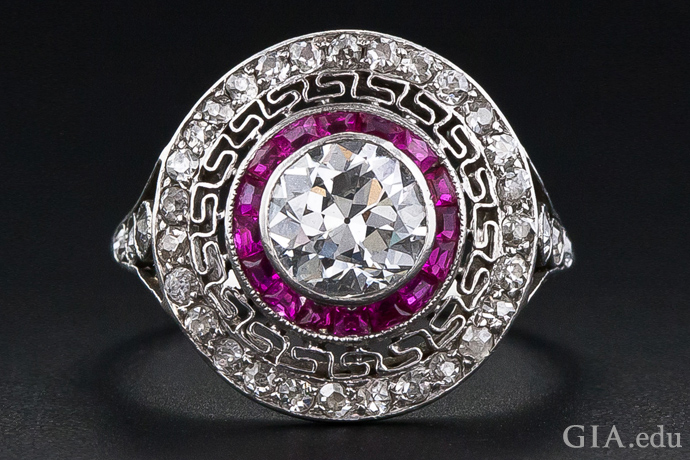
A ring of Burmese rubies encircles an Old European cut diamond in this Art Deco–era ring.

A ring of Burmese rubies encircles an Old European cut diamond in this Art Deco–era ring. A Greek key motif made of platinum circles the rubies, while another ring of diamonds completes the design. Courtesy: LangAntiques.com

Quality and rarity drive value
Like diamonds, colored gems of high quality are rare, so buyers typically pay a premium for top-quality colored stones. Once you’ve decided on a gemstone for your engagement ring, it pays to comparison shop to understand its quality factors and how they affect value. You should also learn as much as you can about your gemstone of choice. GIA’s Gem Encyclopedia is a good place to start. It provides in-depth information for 29 of the most popular gems on the market. You’ll also find detailed buying guides for each gem describing the specific qualities to look for, the gem’s durability, common treatments and more.

Caring for colored gemstone engagement rings

After you’ve purchased your colored gemstone engagement ring, you’ll want to keep it like new. The right way to clean it will vary depending on the gem material you’ve chosen and whether or not it’s been treated. Usually, gentle cleaning solutions specially formulated for delicate gems – or just warm, soapy water and a soft cloth – are all you need. If you’re uncertain about the durability of your gem, avoid using ultrasonic cleaners and off-the-shelf cleaning solutions.

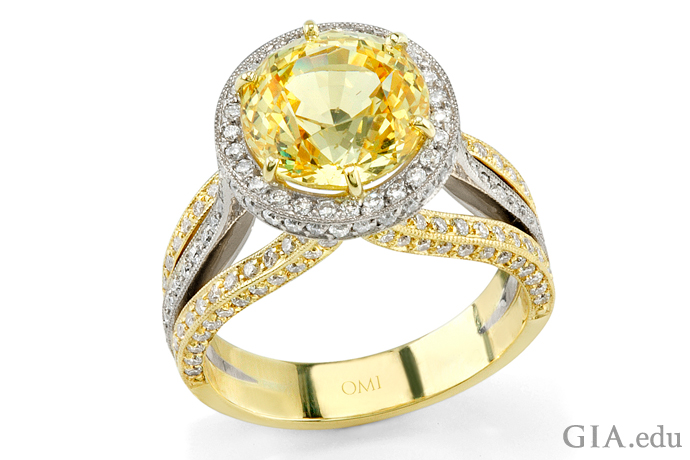
A 5.11 ct yellow sapphire engagement ring, surrounded by 128 round diamonds weighing 0.75 carats.

Washing with warm, soapy water is the safest way to clean this 5.11 ct yellow sapphire engagement ring, which is surrounded by 128 round diamonds weighing 0.75 carats. Courtesy: Omi Privé

Setting styles for colored gemstone engagement rings

Engagement ring settings must secure the gems they hold as well as show them to their best advantage. Bezels, halos and other protective settings can play an important role in preventing the chipping or cracking of colored gemstones. But who said practical can’t also be beautiful? Settings serve as an essential design element, defining an engagement ring’s style and overall look. Settings let you introduce contrasts in color or harmonize them to get just the right amount of color pop in your ring. Consider these examples:

  • A three-stone engagement ring. A three-stone engagement ring is rich in symbolism: The gems represent yesterday, today and tomorrow. Wear it and you’ll proclaim that your love is eternal. The style has also withstood the test of time – three-stone diamond engagement rings date to at least the 17th century. Adding color with rubies, emeralds, sapphires and onyx to a white canvas of diamonds and platinum was popular in the Art Deco era.
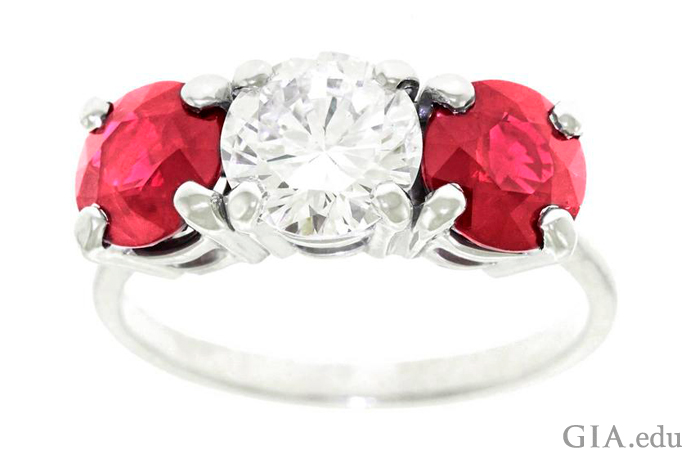
Three-stone gemstone engagement ring featuring two rubies and a round brilliant diamond.

Create a fiery look in an engagement ring by using this three-stone ring for inspiration. The two rubies (1.41 ct and 1.37 ct) bracketing the 1.39 ct round brilliant diamond are sure to catch the eye. Courtesy: 1stdibs.com

  • A halo setting. This setting features a circle of gems surrounding the center stone. Diamond engagement rings with halo settings have been particularly popular these past several years because they’re beautiful, add sparkle and make the center stone look larger. The halo setting is also a favorite for colored gemstone engagement rings. You’ll often see the center stone providing a bold splash of color, while a circle of diamonds or colored stones adds sparkle and contrast – as well as protection for the gem they surround.
A gemstone engagement ring featuring a 2.57 ct spinel encircled by 0.20 carats of round diamonds.

Need more proof that colored gemstones can bring excitement to an engagement ring? This stunning creation features a 2.57 ct spinel encircled by 0.20 carats of round diamonds. Courtesy: Omi Privé

  • A bypass ring. Want an engagement ring that looks a bit different and has color? Consider the bypass ring – a style where the band overlaps, instead of completing the circle. Bypass rings were popular in the Victorian era. The sentiment behind these toi et moi rings has an undeniably romantic cachet.
A Victorian-era diamond and sapphire bypass ring.

The diamond and sapphire in this Victorian-era bypass ring make for a delicate pairing. Courtesy: Treasurly by Dima

Jewelry designers are putting a contemporary stamp on three-stone, halo and bypass rings with colored gemstones. Their modern updates are a beautiful melding of past and present – pieces that pop with color and life. Look around and you’ll find a number of creative interpretations.

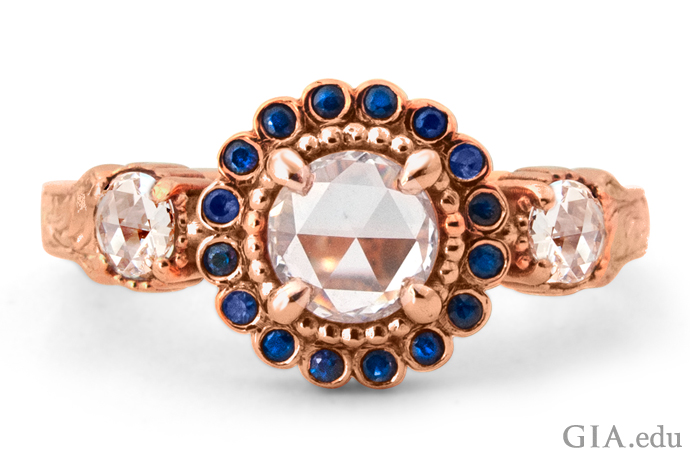
Blue sapphires surround a rose cut diamond in this modern ring with a design borrowed from the Victorian era.

Something old. Something new. Something borrowed. Something blue. Blue sapphires surround a rose cut diamond in this modern ring with a design borrowed from the Victorian era. Courtesy: Shelly Purdy Studio

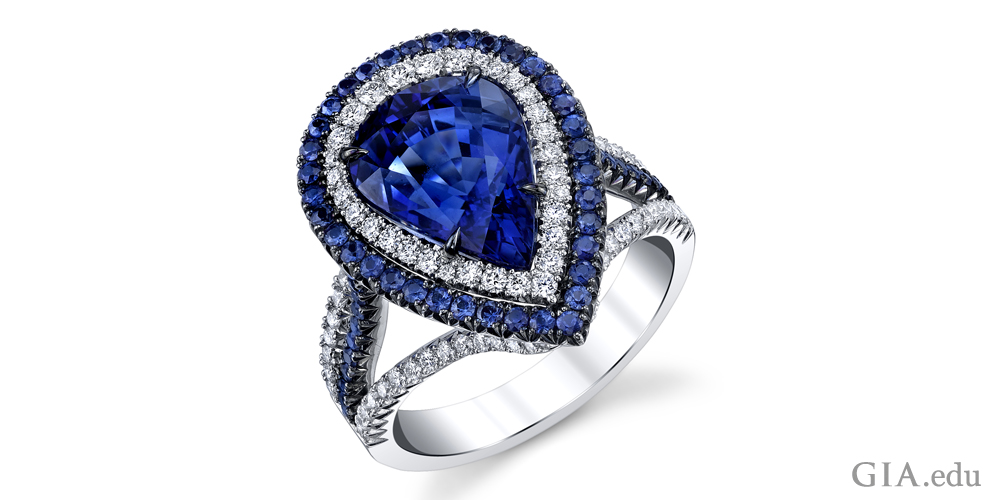
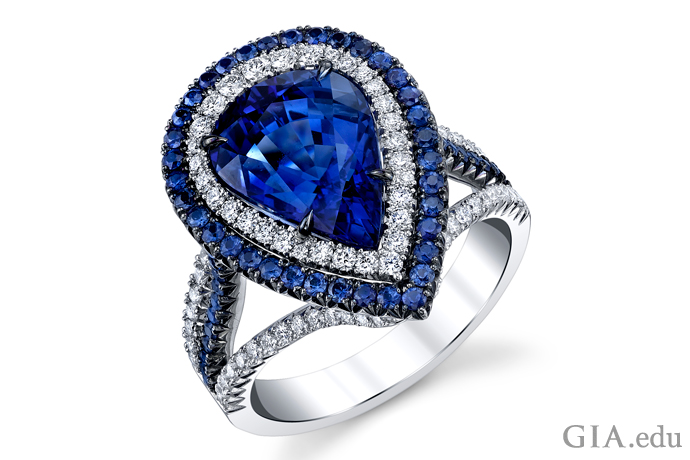
A pear shaped sapphire is surrounded by colorless diamonds and a second halo of sapphires.

A pear shaped sapphire is surrounded by colorless diamonds and a second halo of sapphires. Diamonds and sapphires spill down the shank of the ring. The bold contrasting colors create a visual richness sure to please. Courtesy: Omi Privé

How to buy colored gemstone engagement rings

Now that you know about colored gemstone engagement rings, you’re ready to start shopping. But where? The GIA Retailer Look Up lets you easily find local retailers who have GIA-trained staff to help you through your gemstone selection process.

GIA Colored Stone Report

Before you decide on a colored gemstone engagement ring, ask for a GIA Colored Stone Identification Report.

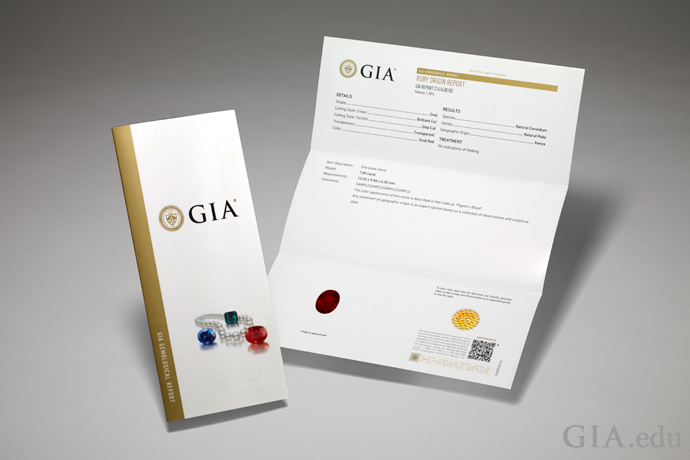
To make sure you get the best value, ask for an unbiased GIA Colored Stone Identification Report. The report will validate the gem’s identity and include detailed descriptions of its size, color and measurements, along with a color photograph. The report will also indicate whether the gem has been treated and, if it has, identify the type of treatment – important to knowing how to care for your gem. Depending on the gemstone, you may also be able to get information on its geographic origin.

Need more inspiration for colorful engagement rings? Read our article on how to buy antique and vintage engagement rings for some exciting examples.

GIA Diamond Cut Grade: Six Things You Need to Know

A GIA diamond cut grade is key to knowing how well your round brilliant diamond will sparkle. Cut is the most complex of a diamond’s 4Cs. Let’s cover some essentials so you can pick the perfect round brilliant diamond engagement ring.

In this blog, we cover:

  1. Diamond cut quality and why it’s important
  2. What goes into a GIA diamond cut grade
  3. Diamond sparkle and face-up appearance
  4. Why diamond proportions are important
  5. Design, craftsmanship and the GIA diamond cut grade
  6. How GIA assigns a diamond cut grade

1. Diamond cut quality and why it’s important

The most popular diamond in the marketplace is the round brilliant. Experts estimate that this cut alone accounts for more than 70% of all diamonds sold today. The quality of a round brilliant diamond’s cut determines how much the diamond sparkles. To pick a diamond whose flashes of light enchant the eye, you need to know the 4Cs of diamond quality, the universal standard for judging diamonds: color, cut, clarity and carat weight. All else being equal, the better the cut grade, the more valuable the diamond.

Some professionals consider cut the most important C of diamond quality. A well-cut round brilliant delivers that unmistakable, stop-in-your-tracks light show that telegraphs “diamond” across a crowded room. If the diamond is well cut, most compromises in clarity, color and even carat weight can be forgiven. A diamond’s cut grade is also an indication of how well it was designed and crafted. So, understanding the diamond cut grade is key to picking a round brilliant that’s not only beautiful, but also the best value.

2. What goes into a GIA diamond cut grade

In arriving at its cut grading system, GIA spent 15 years studying how light behaves within a round brilliant cut diamond. GIA’s aim was to understand the factors that contribute to a round brilliant’s appearance and to determine which of those factors – or combination of factors – produce diamonds that people consider attractive.

GIA’s research included the use of advanced computer modeling to analyze tens of thousands of possible proportion combinations. GIA then validated its research with human subjects, conducting more than 70,000 observations on actual diamonds, to determine which diamonds people found appealing and why.

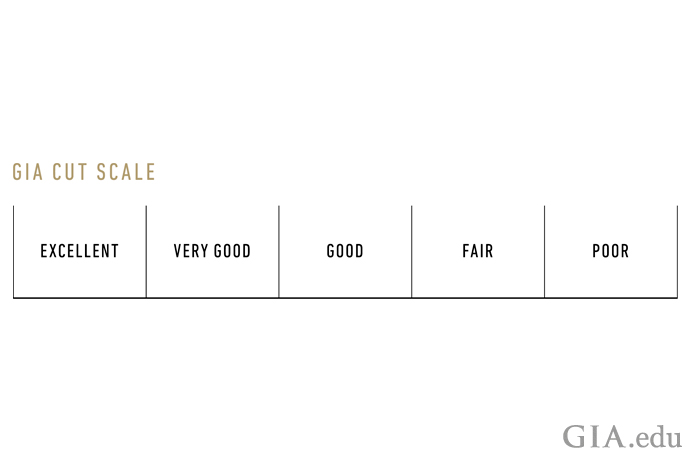
The result was the GIA Cut Grading System, which evaluates the cut quality of a round brilliant diamond along a five-point scale ranging from Excellent to Poor.

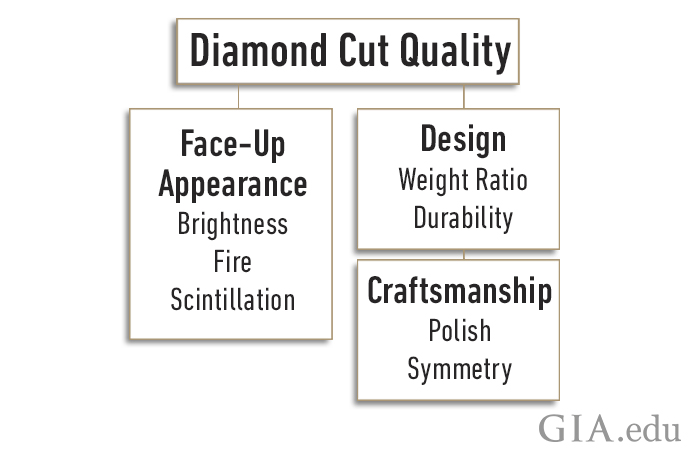
A GIA cut grade evaluates:

  1. How the diamond appears when viewed face-up based on the attributes of brightness, fire and scintillation
  2. How well the diamond was designed to ensure durability and optimal weight
  3. The quality of the workmanship or craftsmanship that went into aligning and polishing the diamond’s facets
The GIA diamond cut grade is based on seven factors: brightness, fire, scintillation, weight ratio, durability, polish and symmetry.

The GIA diamond cut grade is based on seven factors: brightness, fire, scintillation, weight ratio, durability, polish and symmetry.

A 2.02 carat round brilliant cut diamond engagement ring with excellent cut, polish and symmetry.

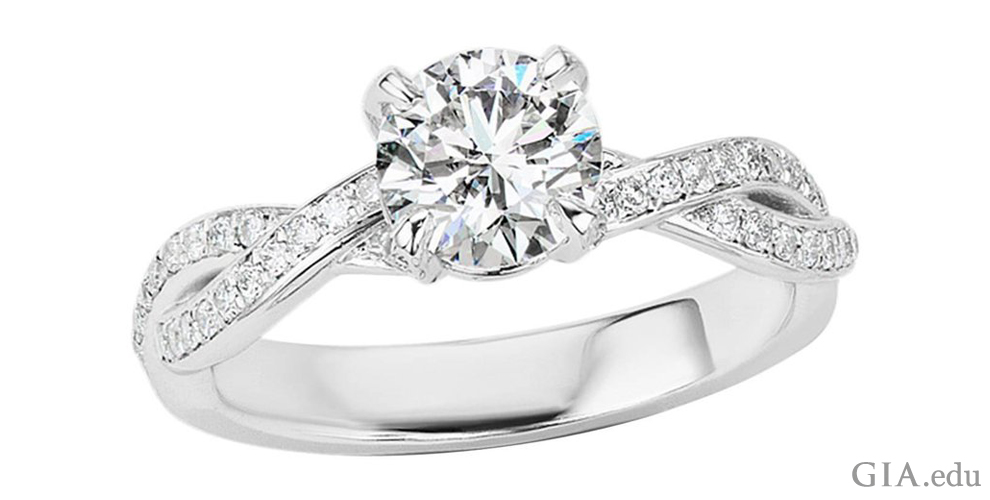
This 2.02 carat (ct) round brilliant has excellent cut, polish and symmetry. Courtesy: 1stdibs.com

A 1.01 ct round brilliant cut diamond engagement ring that received an Excellent cut grade from GIA.

The reason behind the sparkle of this 1.01 ct round brilliant cut diamond engagement ring is the quality of the diamond’s cut. The diamond received an Excellent cut grade from GIA. Courtesy: 1stdibs.com

3. Diamond sparkle and face-up appearance

A key component of a GIA diamond cut grade is the diamond’s face-up appearance – or how the diamond looks when viewed from above, as if it was set in an engagement ring. People love diamonds for their dazzling interplay with light – which the layperson often translates as “sparkle.” But there’s a lot more going on here.

When you see internal and external white light reflected from a diamond, you’re noticing “brightness.” If you see the scattering of light into all the colors of the rainbow, you’re being treated to “fire.” Sparkle is actually “scintillation,” the pattern of bright and dark areas caused by reflections within the diamond as it or the light source moves. What you might consider “sparkle” is really the overall visual effect of these three factors. A GIA cut grade includes an assessment of how well a diamond delivers on each of these attributes.

Round brilliant cut diamond showing good brightness, fire and scintillation when the diamond is moved.

This round brilliant cut diamond shows good brightness and fire. Scintillation, the pattern of light and dark areas and the flashes of light, or sparkle, can only be seen when a diamond is moved. Copyright: GIA & Harold and Erica Van Pelt

4. Why diamond proportions are important

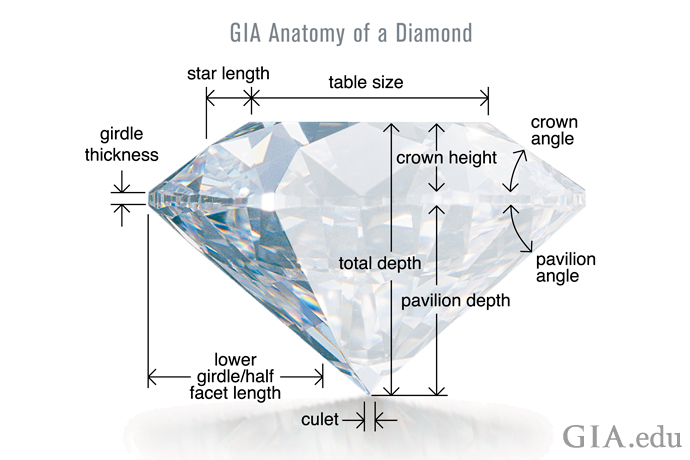
A diamond’s proportions – its crown and pavilion angles and the relative measurements of its facets – are key contributors to a diamond’s overall face-up appearance. Remember that facets are tiny mirrors. Their size and placement will influence how light behaves as it passes through the diamond and back to your eye.

A diamond’s proportions can help predict how well a diamond will deliver brightness, fire and scintillation. However, an important outcome of GIA’s cut research was the finding that there is no single set of proportions that defines a well-cut round brilliant diamond. In fact, diamonds with different proportions can receive the same cut grade. The diamonds may look and perform differently but they will still have a similar impact on the observer. So, as a diamond shopper, you need to look beyond the measurements on a grading report. Be sure to view a diamond in person to see if it’s the right choice for you.

An illustration demonstrating the proportions that affect a diamond’s cut grade.

This graphic illustrates the proportions that affect a diamond’s cut grade. The crown and pavilion angles and the relative measurements of its facets contribute to a diamond’s brightness, fire and scintillation.

5. Design, craftsmanship and the GIA diamond cut grade

While face-up appearance is all about how a diamond looks, design and craftsmanship evaluate the quality of the diamond’s manufacture. Poor design could add unnecessary weight to a diamond or cause durability issues that would prevent you from enjoying it for a lifetime. A diamond with poor craftsmanship won’t deliver much in the way of brightness, fire and scintillation. In evaluating these two components, the GIA Cut Grading System takes into account the diamond’s physical shape, its proportions, its weight ratio, and the care that went into fashioning and polishing its facets.

Design
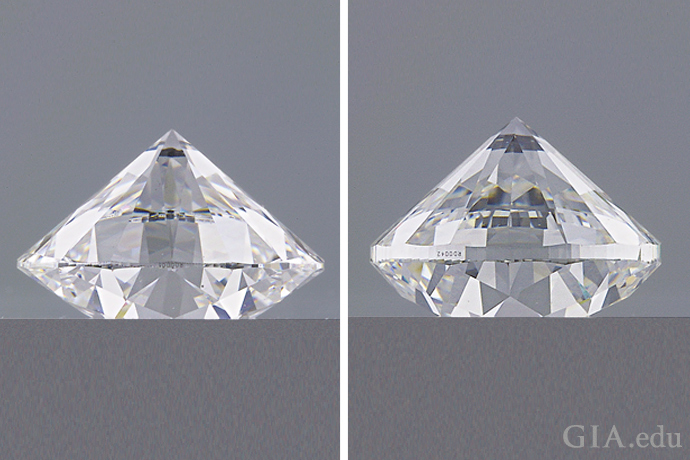
Design refers to decisions made during the fashioning process that determine the diamond’s physical shape, as seen in its proportions, weight ratio and durability. Weight ratio is the diamond’s weight in relation to its average girdle diameter (a fairly complex mathematical equation). A diamond with a smaller girdle diameter relative to its weight might appear smaller face-up than its well-designed counterpart, because much of the weight would be “hidden” in the overall depth of the diamond. For example, while a diamond with a thicker girdle could look great, the girdle is hiding unnecessary weight. As a result, you might end up paying more for a heavier diamond with no greater visual impact for the added cost. The bottom line: A diamond should not weigh more than its face-up size would indicate.

Image showing a diamond with a much thicker girdle (right) than the diamond on the left.

These pictures show the importance of weight ratio. Both of these diamonds have the same average girdle diameters, so face-up they appear to be the same size. But the diamond on the right has a much thicker girdle, so it weighs more (0.71 ct vs. 0.61 ct). The thicker girdle has no visual benefit, but the added weight will make the diamond more expensive. Photos: Maha Tannous/GIA

Durability in the case of a round brilliant diamond refers to the risk of damage that might result from an extremely thin girdle. Such a girdle can make a diamond highly vulnerable to damage during the jewelry setting procedure or even normal wear. Considering how much a diamond costs and its emotional significance, you want to avoid one that is susceptible to damage. A GIA Diamond Grading Report can eliminate this concern.

A 1.35 carat diamond with girdle areas very think to extremely thin.

Here is an example of why durability is important. This 1.35 ct diamond has girdle areas that are very thin to extremely thin, making it more susceptible to damage during everyday wear. Courtesy: Gary Roskin, G.G., F.G.A.

Craftsmanship

Craftsmanship describes the care that went into fashioning the diamond, as seen in its polish and symmetry. Polish refers to the overall quality and condition of the facet surfaces. It includes evaluation of any blemishes created by the polishing process or during wear. Polish is critical to the mirror-like performance of a diamond’s facets.

Diamond (left) showing lines created during polishing and diamond (right) with abraded facet junctions.

The diamond on the left shows lines created during the polishing process. The diamond on the right has abraded facet junctions caused by wear. Polish lines and abraded facet junctions can also affect a diamond’s clarity grade. Photos: Mitchell Moore/GIA

Symmetry is the exactness of a finished diamond’s shape and the arrangement and placement of its facets. A symmetrical diamond has an even display of brightness, fire and scintillation. A diamond with poor symmetry will have poor light performance, meaning that it’s likely to look flat.

An illustration showing all eight sections of a round brilliant identically. Illustration: GIA

All eight sections of a round brilliant cut diamond should be identical. This symmetry will help produce even brightness, fire and scintillation. Illustration: GIA

6. How GIA assigns a diamond cut grade

GIA evaluates a round brilliant diamond’s cut based on seven components – brightness, fire, scintillation, weight ratio, durability, polish and symmetry – to arrive at a GIA diamond cut grade, which ranges from Excellent to Poor. The grade is set by the lowest assessment the diamond receives for five of the seven components. In other words, if a diamond receives a Poor grade for brightness, then the highest its overall cut grade can be is Poor. The exceptions are polish and symmetry, which are assessed using standard GIA grading methodology: A diamond with Very Good polish and/or symmetry, for example, may receive an Excellent cut grade.

A GIA Diamond Grading Report contains the diamond’s full cut assessment, in addition to a diagram showing the diamond’s proportions and relative measurements. Consider the report an invaluable tool in helping you pick a dazzling diamond.

The official GIA Cut Scale for round brilliant cut diamonds.

The official GIA Cut Scale for round brilliant cut diamonds. Illustration: GIA

While knowing a diamond’s cut grade is essential, it shouldn’t be a substitute for seeing a diamond in person. As mentioned above, a diamond cut grade represents a range. For example, two diamonds with an Excellent Cut Grade may look – and perform – very differently. In addition, a diamond will look different under various lighting conditions, so you should take it for a test drive, so to speak. Last, you need to fall in love with the diamond – and no report can substitute for what stirs your heart.

A 2.03 carat round brilliant cut diamond engagement ring with Excellent cut.

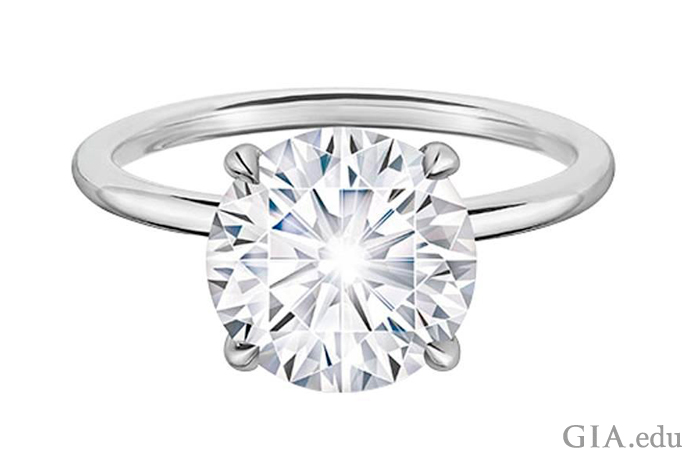
An Excellent cut grade makes this 2.03 ct round brilliant diamond mesmerizing. Courtesy: 1stdibs.com

Diamond cut is extremely important. So is diamond color. Learn about it, too, so you can pick a spellbinding diamond.

How to Choose a Yellow Diamond Engagement Ring

A yellow diamond engagement ring is a stunning choice to celebrate your love. But picking the perfect engagement ring requires knowing about yellow diamonds, mountings, the effect of metals on appearance, treatments and more. We offer help.

Here are a few things you’ll need to know:
A fancy-color yellow diamond falls outside the GIA D-to-Z color range
GIA assigns one of six “fancy” color grades to your yellow diamond engagement ring
Don’t expect a round diamond for your yellow diamond engagement ring
Mountings can make a yellow diamond look darker
The metal used affects the appearance of a yellow diamond engagement ring
Some yellow diamonds might be treated, lab grown or both
Make sure GIA grades the diamond in your yellow diamond engagement ring
A yellow diamond engagement ring is rare because yellow diamonds are rare

A fancy-color yellow diamond falls outside the GIA D-to-Z color range

Understanding diamond color is essential before you go shopping for a yellow diamond engagement ring. Most colorless or near-colorless gem-quality diamonds are graded based on the absence of color, using GIA’s D-to-Z diamond color-grading system. Yellow diamonds are considered to be colored diamonds and are graded as “fancy” when they have more color than the Z masterstone.

Here is another important difference between yellow diamonds and colorless diamonds. Diamonds in the D-to-Z range usually decrease in value as the color becomes more obvious. The opposite happens with fancy-color diamonds. Their value generally increases with the strength and purity of the color.

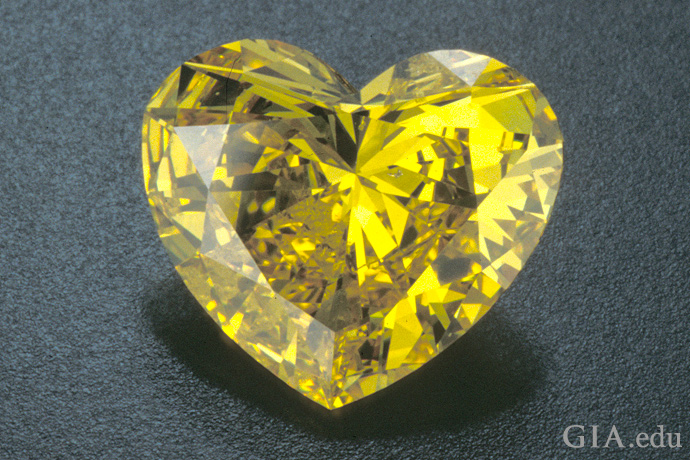
Natural intense yellow heart shaped diamond

Colored diamonds graded Fancy Intense are often prized over those with other fancy grades. This yellow heart shaped diamond speaks of the first blush of love. Photo: Robert Weldon/GIA

A 5.33 carat Fancy Yellow pear shaped diamond.

Fancy-color diamonds are often cut into fancy shapes, like a pear shape, to bring out the color. Sunny days lie ahead for the bride wearing this 5.33 carat (ct) Fancy Yellow pear shaped diamond. Courtesy: 1stdibs.com

GIA assigns one of six “fancy” color grades to your yellow diamond engagement ring

The names used to describe colors are often quite subjective. Consider that the color yellow includes variations like butter, lemon, golden and more. To bring objectivity and standardization to the grading of the rare beauties that are colored diamonds, GIA created the GIA Colored Diamond Color Grading System in the 1950s and refined it over the decades. This grading system not only defined the processes for determining a diamond’s color, but it also established the terms, or color grades, for describing it.

GIA’s grading system places most colored diamond in one of nine categories based on the diamond’s hue, tone and saturation: Faint, Very Light, Light, Fancy Light, Fancy, Fancy Intense, Fancy Dark, Fancy Deep and Fancy Vivid. The first three grades aren’t used for yellow diamonds, so the scale for yellow begins with Fancy Light. The majority of yellow diamonds in the jewelry industry are graded Fancy Light, Fancy, Fancy Intense and Fancy Vivid.

In general, the more color a colored diamond has, the better. Fancy Deep and Fancy Vivid diamonds, for example, have more color than Fancy Light diamonds—and are usually more valuable. However, tone (the degree of darkness or lightness of a color) is also important. For example, a diamond that is extremely dark (Fancy Dark) may be less desirable than a lighter stone graded Fancy Intense.
It is not unusual for a yellow diamond to have a hue modifier, such as orangy yellow or greenish yellow. A modifier does not indicate that the color is any less strong or pure.

 A chart shows the subtle transitions in GIA’s color grading of yellow diamonds.

This chart shows the subtle transitions in GIA’s color grading of yellow diamonds. Note, too, that the fancy grades represent a range of color sensations, not a “single” color sensation. Photo: Elizabeth Schrader and C. D. Mengason/GIA

Don’t expect a round diamond for your yellow diamond engagement ring

Round diamonds cut in the brilliant faceting style are the most popular diamonds for engagement rings, but you may have a challenging time finding a round stone for your yellow diamond engagement ring. That’s because yellow diamonds typically display a more intense face-up color appearance when they’re cut in a shape other than round. These non-round shapes are called fancy shapes, which include oval, pear, marquise and heart, plus square or rectangular cuts like princess, radiant and emerald.

A 10.12 carat Fancy Vivid yellow pear shaped diamond.

This 10.12 ct Fancy Vivid yellow pear shape is an example of a fancy-shape diamond. This shape was most likely selected to intensify the yellow color. Photo: Elizabeth Schrader/GIA. Courtesy: The Scarselli Family

Mountings can make a yellow diamond look darker

If your heart is set on a yellow diamond engagement ring, you will probably look at a number of loose yellow diamonds. Be aware that the yellow diamond that has caught your eye may appear darker when set in a mounting.

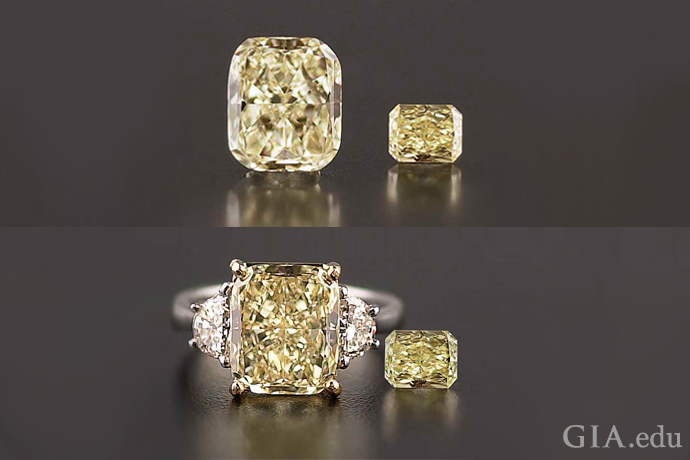
Look at the photos below. The diamond on the left in the top image was graded Y–Z range, just on the light yellow/Fancy Light yellow boundary. It is shown next to a Fancy yellow reference diamond. In the bottom image, the larger diamond is mounted in a ring and placed next to the same reference diamond.

An image showing a loose yellow diamond and a mounted yellow diamond.

A yellow diamond is likely to look darker once it’s set in a mounting. Photos: Elizabeth Schrader/GIA. Courtesy: The Scarselli Family

This effect can actually work to your advantage, particularly if you’re deciding between a less expensive “light yellow” diamond at the very low end of the D-to-Z color scale and a more expensive Fancy yellow diamond.

The metal used affects the appearance of a yellow diamond engagement ring

Diamonds are highly reflective. Their facets are like tiny mirrors, reflecting their surroundings, which include the color of the ring and the prongs holding the gem. Because of this, the color of the metal will affect a diamond’s appearance.

You’ll typically have three choices when picking a metal for your yellow diamond engagement ring:

Do you want your engagement ring to highlight the color of the yellow diamond? White metals and rose gold will create contrast between the mounting and the stone. White gold makes for a streamlined, sophisticated look. A rose gold mounting will create a warmer contrast.

Do you want your ring to complement the color of the diamond? A yellow gold mounting will harmonize with a yellow diamond. Take a look at Art Deco style engagement rings, Retro style engagement rings and ring styles typical of the Victorian era, times when yellow gold was in fashion, to see if these are designs you’d like to recreate for your yellow diamond engagement ring.

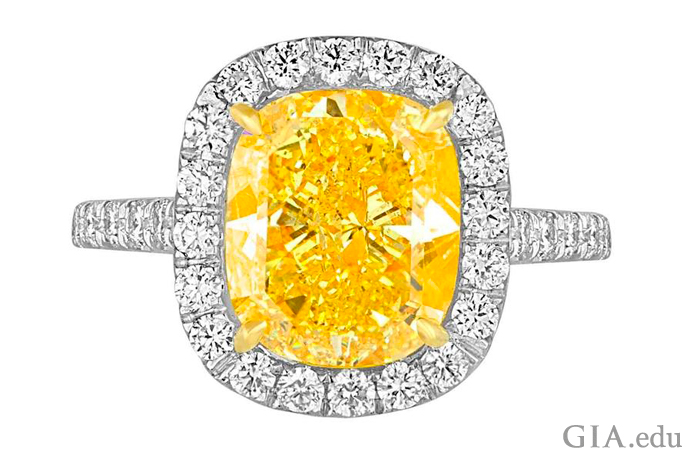
A 4.76 ct Fancy Vivid yellow diamond engagement ring surrounded by a halo of colorless diamonds.

Want your yellow diamond to pop? Set it in a white metal ring. This 4.76 ct Fancy Vivid yellow diamond is so bright that it appears to have captured a ray of the sun. A halo of colorless diamonds surrounds it. Courtesy: 1stdibs.com

A 3.46 ct yellow oval diamond engagement ring set in rose gold.

Rose gold is another way to create contrast with a yellow diamond. In this ring, it acts as a subtle counterpoint to the 3.46 ct yellow oval diamond. Courtesy: 1stdibs.com

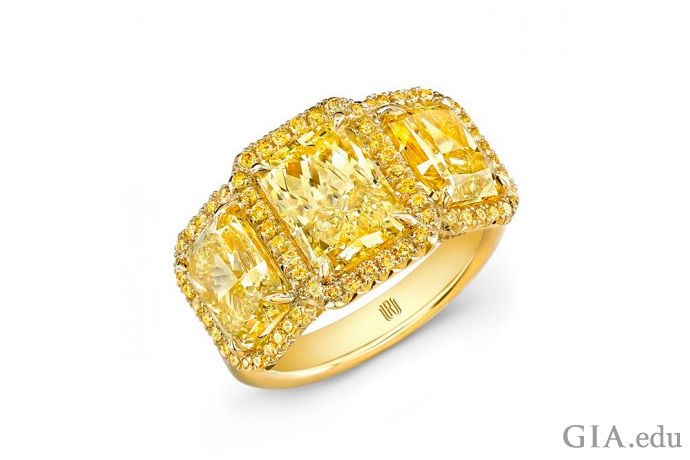
A three-stone yellow diamond engagement ring set in yellow gold.

A yellow gold band paired with yellow diamonds creates a harmonious look. The three yellow diamonds set in 18K yellow gold are sure to soothe the eye as they captivate it. Courtesy: Rahaminov Diamonds

Some yellow diamonds might be treated, lab grown or both

Off-color diamonds that are brownish or yellowish can be treated to modify their color. Manufacturers typically use one or both of two different processes:

  • High-pressure, high-temperature (HPHT) annealing can change some diamonds to yellow.
  • Artificial irradiation with subsequent heating (annealing) above about 500°C can be used to induce a deep yellow color in a diamond.

In both cases, the treatment is considered permanent under normal conditions of wear and care. Non-permanent treatments, like coatings, are also possible. All else being equal, diamonds that have not been treated are more expensive than diamonds that have been treated. Legally, the seller must disclose any treatments. GIA can detect these treatments, and it identifies them in the GIA Colored Diamond Grading Report. It also laser inscribes “HPHT PROCESSED” or “IRRADIATED” on the girdle of diamonds treated by either of these methods.

A 22.27 ct Fancy Vivid yellow emerald cut diamond that was artificially irradiated and annealed.

This 22.27 ct Fancy Vivid yellow emerald cut diamond was identified as artificially irradiated and annealed. Treated diamonds of this size and this attractively saturated color are rare. Photo: Sood OIl (Judy) Chia/GIA

Synthetic yellow diamonds – with properties that match their natural counterparts – are also being manufactured. The first synthetic diamonds were grown by HPHT processes that mimic the high-pressure, high-temperature conditions of natural diamond formation in the earth. Today, chemical vapor deposition (CVD) is another common method whereby synthetic diamonds are grown in an apparatus that uses high temperatures and low pressures in a vacuum chamber. The CVD process involves heating a mixture of a hydrocarbon gas (such as methane) and hydrogen, which releases carbon atoms that then settle onto the cooler, typically square-shaped seed plate of natural or, more likely, synthetic diamond. With both techniques, subsequent treatments may be used to change the color of the original crystal.

GIA can detect synthetic diamonds grown using either HPHT or CVD, and it issues distinctive reports for these synthetic or lab-grown diamonds. The GIA Synthetic Colored Diamond Grading Report offers the same information as the GIA Colored Diamond Grading Report issued for a natural diamond (see below), but it provides a more general description of the color and clarity. For additional disclosure and identification, GIA laser inscribes the diamond’s girdle with the stone’s unique report number and a statement that it is laboratory grown. The report itself looks markedly different from those issued for natural diamonds.

A 0.40 ct square-shaped diamond grown using the CVD process.

This 0.40 ct square-shaped diamond was grown using the CVD process. Photo: Sood OIl (Judy) Chia/GIA

Make sure GIA grades the diamond in your yellow diamond engagement ring

A yellow diamond engagement ring is a symbol of your love. It’s also a significant emotional and financial investment. So you’ll want to make sure the diamond is graded by a trusted, unbiased lab like GIA. GIA’s meticulous grading process involves testing to determine whether the diamond is natural or lab grown and to identify any known treatments used to enhance its appearance.

Highly trained colored-diamond graders observe the diamond face-up using controlled lighting in a specially designed viewing box that eliminates distractions and shields the stone from external light. These specialists determine the diamond’s characteristic color based on a combination of its size, shape, faceting arrangement and color. They then bracket the diamond using side-by-side comparisons under the same lighting conditions with two or more color references. On the basis of these comparisons, they select one of 27 hues (such as orangy yellow, yellow or greenish yellow) and assign a specific “fancy” grade based on the hue’s tone and saturation.

A GIA Colored Diamond Grading Report provides a full quality assessment of a colored diamond including the color grade, color origin (natural or treated), carat weight, clarity and a plotting diagram of its clarity characteristics. As an optional service, a full-color image of the diamond may also be included.

A GIA Colored Diamond Grading Report.

A GIA Colored Diamond Grading Report is your assurance that your yellow diamond is a natural diamond, graded to GIA’s exacting standards. It also provides full disclosure of any known treatments discovered during the grading process. Photo: GIA

A 2.03 ct Fancy Vivid yellow cushion cut diamond set in platinum.

If you’re looking for a unique engagement ring, this 2.03 ct Fancy Vivid yellow cushion cut diamond set in platinum will surely stand out. Courtesy: EraGem.com

A yellow diamond engagement ring is rare because yellow diamonds are rare

When you wear a yellow diamond engagement ring, you’ll have something unusual on your finger. In the early 2000s, for example, yellow diamonds represented only 2.4% of all diamonds submitted to GIA for various grading reports over the course of a single year. If unearthing a diamond is noteworthy, then discovering a yellow diamond is like finding a golden needle in a haystack.

Still yearning for a yellow diamond engagement ring? Dig a little deeper to learn more about yellow diamonds.

Fact Checking Diamond Fluorescence: 11 Myths Dispelled

If you’re shopping for a diamond engagement ring, you’ve probably heard about diamond fluorescence, along with varying opinions about its pros and cons. Let’s dig into a few common myths about fluorescence and D-to-Z color diamonds.

In this blog, we cover:
Myth #1: All diamonds fluoresce
Myth #2: You can see diamond fluorescence – no matter the lighting
Myth #3: Diamond fluorescence can always be detected
Myth #4: Diamond fluorescence influences a diamond’s color grade
Myth #5: Diamond fluorescence is given a grade, just like color, clarity and cut
Myth #6: Diamonds only show blue fluorescence
Myth #7: Strong blue diamond fluorescence is bad
Myth #8: Diamond fluorescence detracts from a diamond’s sparkle and beauty
Myth #9: Fluorescence means the diamond is a “real” natural diamond
Myth #10: Fluorescence can make a diamond less durable
Myth #11: Diamond fluorescence does/doesn’t affect value


Myth #1: All diamonds fluoresce
FACT: The majority of diamonds do not fluoresce. In a study of more than 26,000 diamonds submitted for grading to GIA, researchers found that only approximately 25% to 35% of them exhibited some degree of diamond fluorescence when examined with a standard long-wave UV lamp. So, it’s likely that the diamond you’re eyeing does not fluoresce.


Myth #2: You can see diamond fluorescence – no matter the lighting
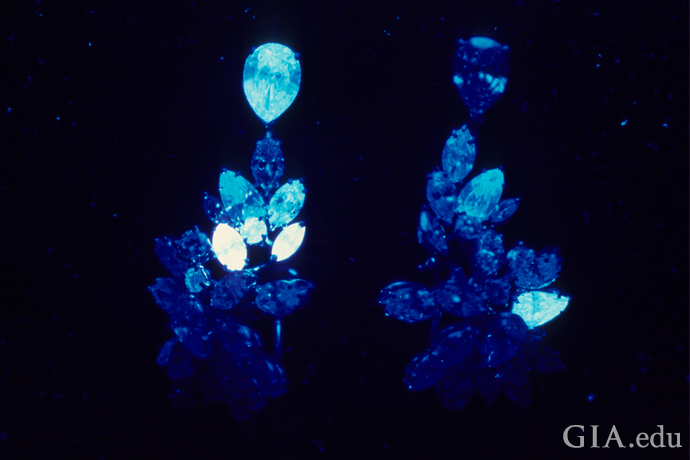
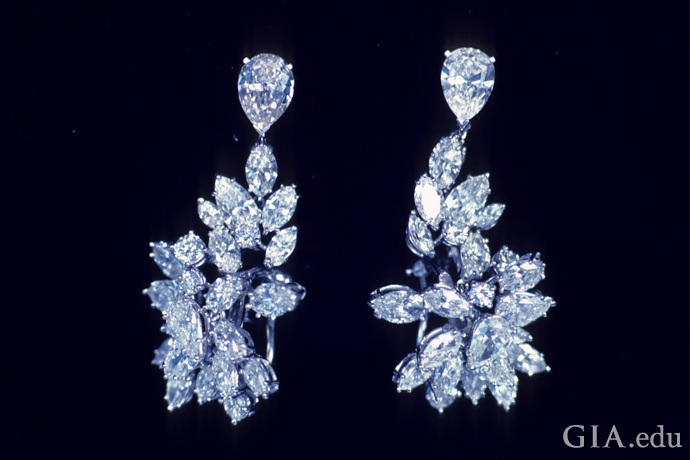
FACT: Diamonds that fluoresce only do so when they are exposed to invisible UV rays and other higher energy radiation sources such as X-rays and lasers. You might see your diamond fluoresce under a bright sun, in a tanning bed, at a dance club or in other places where strong fluorescent or black lights are used. But once the light source is removed, the diamond will stop fluorescing. Incandescent lighting will not cause a diamond to fluoresce.

Diamond earrings shown under incandescent light appear to be the same color.

When viewed with incandescent light, all the diamonds in these earrings appear to be the same color. Photo: GIA

Diamond earrings viewed under a UV lamp showing different degrees of diamond fluorescence.

When viewed with a UV lamp, the diamonds in the earrings show different degrees of diamond fluorescence. Photo: GIA


Myth #3: Diamond fluorescence can always be detected
FACT: Diamond fluorescence cannot always be detected. You need conditions where UV rays are present and the intensity of the fluorescence is strong enough to be observed. A reputable grading laboratory, like GIA, follows strict protocols to determine the presence of fluorescence. It also adheres to set standards in describing its intensity, to ensure objective and consistent reporting.

 A 1.42 carat step cut diamond engagement ring set in platinum.

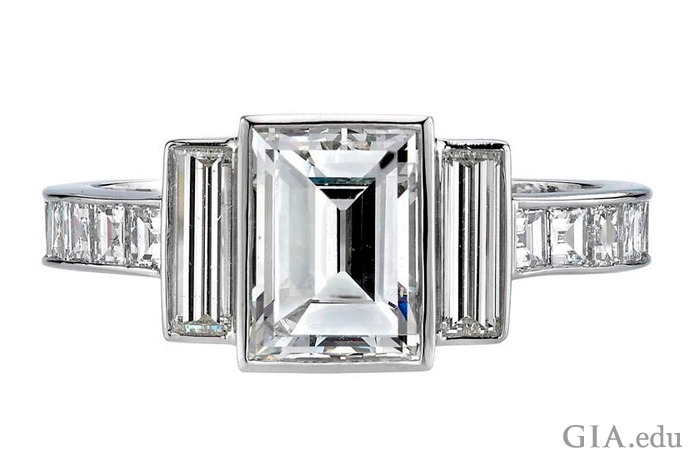
Fluorescent or not, this 1.42 carat (ct) diamond engagement ring, with diamonds lining the band, captivates with its bold, clean lines. Courtesy: 1stdibs.com


Myth #4: Diamond fluorescence influences a diamond’s color grade
FACT: In assigning a diamond color grade, GIA examines the gem in a highly controlled viewing environment, designed to minimize the influence of fluorescence and to produce an accurate and objective assessment of the diamond’s color.

However, the way you perceive a diamond’s color grade may be affected by the extent to which it fluoresces – in a positive way. In a diamond lower on the GIA D-to-Z color scale (say, I to N) with a yellow tint, moderate-to-strong blue fluorescence may cancel out some of the yellow for a better color appearance than what its color grade would indicate. See Myth #7.


Myth #5: Diamond fluorescence is given a grade, just like color, clarity and cut
FACT: Diamond fluorescence is not one of the 4Cs – like color, clarity, cut and carat weight – which describe the quality of a diamond. GIA considers fluorescence an identifying characteristic – additional information that helps distinguish one diamond from another.

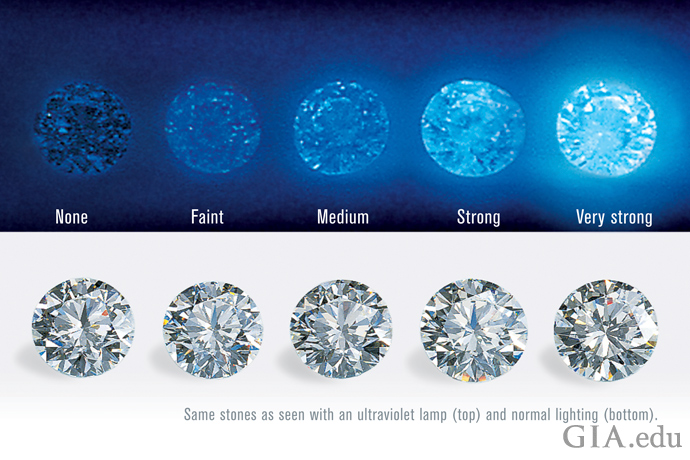
GIA diamond grading reports describe the intensity of fluorescence as None, Faint, Medium, Strong and Very Strong. If the fluorescence is Medium, Strong or Very Strong, the color of the fluorescence will be noted on the grading report.

Photo showing the intensity of diamond fluorescence described as: None, Faint, Medium, Strong and Very Strong under UV lighting (top) and under normal lighting (bottom).

A GIA Grading Report describes the intensity of a diamond’s fluorescence as: None, Faint, Medium, Strong and Very Strong. Composite photo in UV: Maha DeMaggio/GIA. Composite photo in normal light: Harold and Erica Van Pelt/GIA


Myth #6: Diamonds only show blue fluorescence
FACT: Diamonds can fluoresce in a variety of colors. These include orangy yellow, yellow, orange, red, white and green. Variations in the atomic structure, such as the number of nitrogen atoms present, cause the phenomenon. Blue, however, is by far the most common color of diamond fluorescence.

Rough diamonds displaying a range of colors when exposed to UV light.

These rough diamonds exhibit a range of colors when exposed to UV light. Photo: GIA


Myth #7: Strong blue diamond fluorescence is bad
FACT: GIA studied the influence of blue fluorescence on the appearance of a diamond under normal viewing conditions. The Institute found that average observers (meant to represent the jewelry buying public) could not consistently discriminate any fluorescence-related effects in the viewing environments most similar to those in which jewelry is purchased and worn.

However, GIA also found that strong blue diamond fluorescence could be beneficial. The results of its study revealed that, as noted for Myth #4, some strongly blue fluorescent diamonds were perceived to have a better color appearance than their color grade would suggest when viewed table-up, with no discernible trend table-down.

Composite photo of diamond necklace and one earring shown under normal lighting conditions (left) and a long-wave UV lamp (right).

Bejeweled fireworks: Half the diamonds in this necklace (132 carats total weight) and the one earring (3.20 ct center stone) in this composite photo are shown under normal lighting conditions (left), and the other half of the necklace and the same earring are shown as they appear under a long-wave UV lamp (right). Composite photo: Harold and Erica Van Pelt/GIA. Courtesy: Harry Winston Inc., New York


Myth #8: Diamond fluorescence detracts from a diamond’s sparkle and beauty
FACT: Diamond fluorescence has little to no effect on a diamond’s sparkle, and research shows that it doesn’t impact beauty either.

A diamond’s sparkle is determined primarily by its cut, not by whether the diamond fluoresces or not. A diamond’s cut – that is, the angles and relative measurements of its facets, as well as its other proportions, design and craftsmanship – determines how well light performs when it strikes the diamond and how well it will sparkle.

A 1.29 carat round brilliant cut diamond engagement ring with diamond melee in the shank.

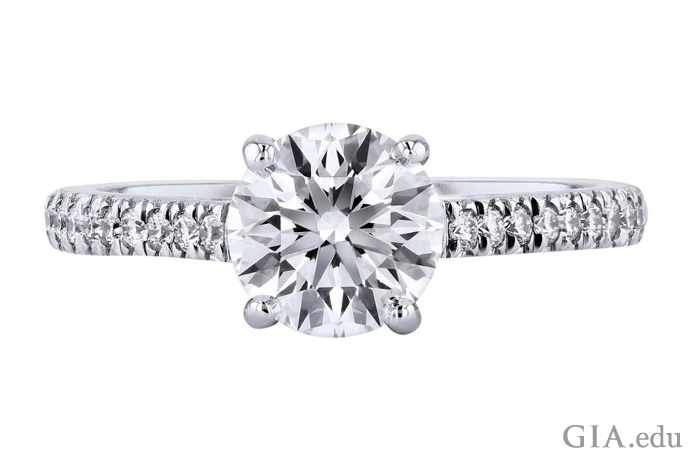
Even strong blue fluorescence would not affect the beauty of this 1.29 ct E color diamond engagement ring in normal lighting. Courtesy: 1stdibs.com


MYTH #9: Fluorescence means the diamond is a “real” natural diamond
FACT: Absolutely not. The presence or absence of fluorescence should not be used as a DIY test to determine if your diamond is real. First, not all natural diamonds fluoresce under the standard UV lamp used by gemologists (see Myth #1). Second, some synthetic or lab grown diamonds do fluoresce to these wavelengths. Although differences have been noted in the intensity, color and pattern of fluorescence between natural and synthetic diamonds, there is overlap. Finally, some materials used to impersonate diamond – like cubic zirconia – can display fluorescence.

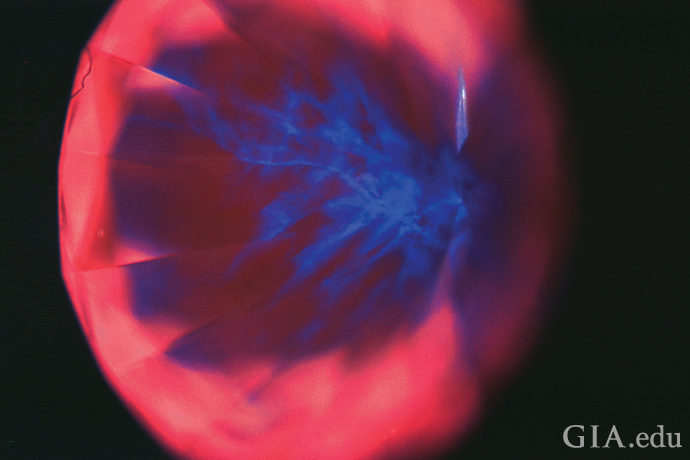
CVD diamond displaying strong pinkish orange fluorescence, with regions of strong blue or violet, when exposed to high-intensity ultra-short wavelengths.

Synthetic diamonds made by the chemical vapor deposition method may display strong pinkish orange fluorescence (among other colors), with regions of strong blue or violet, when exposed to high-intensity ultra-short wavelengths. Photo: Wuyi Wang/GIA


Myth #10: Fluorescence can make a diamond less durable
FACT: A diamond that fluoresces under a standard UV lamp has the same structural integrity as one with no reaction to it. Nothing in the submicroscopic structures that cause fluorescence inherently weakens the diamond.


Myth #11: Diamond fluorescence does/doesn’t affect value
FACT: Jewelry professionals disagree about whether fluorescence adds to or detracts from the value of a diamond. Some trade professionals believe those very rare diamonds at the high end of the D-to-Z color scale that have extremely strong blue fluorescence are worth less than their nonfluorescent counterparts because the fluorescence can affect their transparency by giving them a hazy or milky appearance. Conversely, some traders pay higher prices for blue-fluorescing diamonds of a lower color grade because, as noted above, they believe the fluorescence masks the faint to very light yellow color of these diamonds.

Diamond fluorescence and its effect on value is not a simple question, and there isn’t a simple answer. We recommend that you compare diamonds in a variety of lighting environments and choose the stone that you like best. Ultimately, GIA believes the beauty of a diamond is truly in the eye of the beholder.

A 1.67 ct diamond engagement ring set in platinum, surrounded by 0.56 carats of diamonds in the halo and shank.

Wouldn’t it be awesome if this 1.67 ct center diamond fluoresced in a night club? Courtesy: 1stdibs.com

Is there a diamond fluorescence “fact” you’d like to verify? Leave us a comment below. In the meantime, if you enjoyed this post, you might like reading about common engagement ring myths.

Pear Shaped Diamond: Tips for Picking the Perfect One

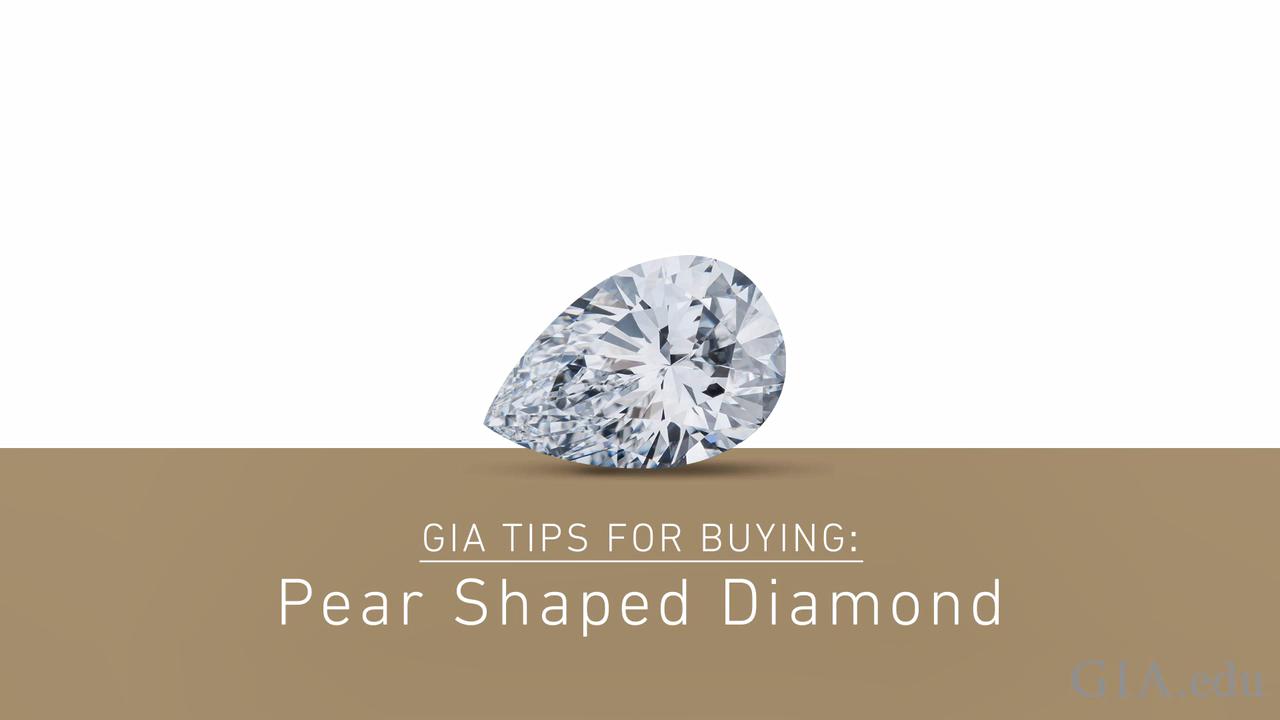
With its graceful, tapered outline, a pear shaped diamond is an elegant and flattering choice for an engagement ring. Here are the essentials for selecting the perfect pear shape.

  1. Learn the anatomy of a pear shaped diamond
  2. Look for symmetry in a pear shaped diamond
  3. The ideal length-to-width ratio is the one you prefer
  4. Check culet placement and position of inclusions
  5. Make sure the table is centered on a pear shaped diamond
  6. Avoid the bow-tie on a pear shaped diamond
  7. Choose a setting that protects the point of a pear shaped diamond
  8. Point up or down? You decide how to wear a pear shaped diamond

1. Learn the anatomy of a pear shaped diamond

Jewelers consider the pear shaped diamond a “fancy shape,” meaning it’s a shape other than round. Reminiscent of a tear drop, a pear shaped diamond blends the best of the round and marquise diamond shapes.

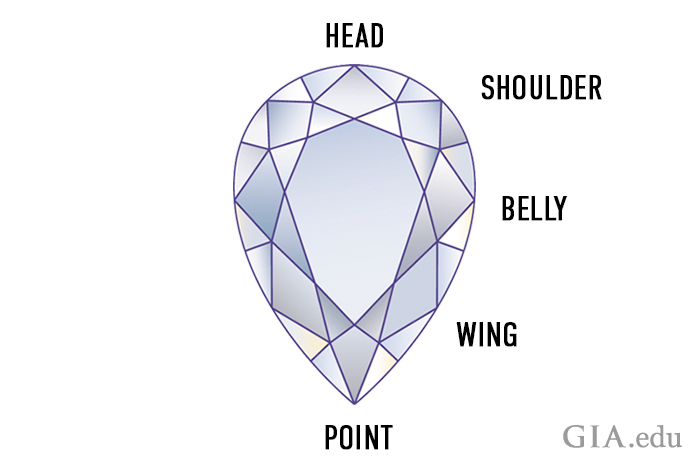
Since the parts of a pear shaped diamond contribute to its beauty, you should get to know them. Then you can shop for a pear shaped diamond engagement ring with a discerning eye.

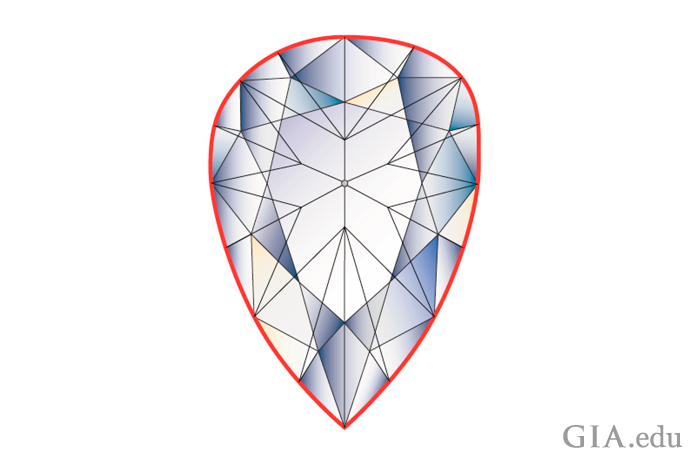
Illustration showing the parts of a pear shaped diamond.

You’ll want to be able to name the parts of a pear shaped diamond when you’re looking at various stones. This shows the retailer you’re an informed buyer. Illustration: Peter Johnston/GIA

Look at the diamond face-up and pay attention to its outline. A pear shaped diamond should have gently rounded shoulders and wings. The wings should form attractive arches. If they’re too flat, they make the stone look too narrow. If they’re too rounded, they make it look short and stubby.

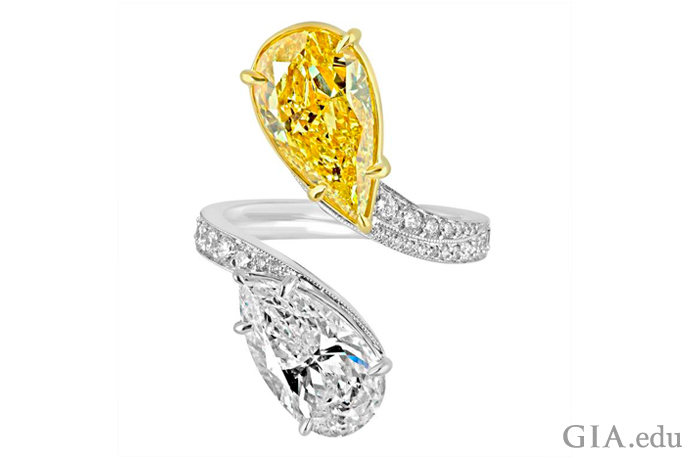
A 4.04 ct yellow pear shaped diamond and 3.02 ct colorless pear shaped diamond in a bypass engagement ring setting.

A bejeweled pair of pears: a 4.06 carat (ct) yellow pear shaped diamond is nestled against a 3.02 ct colorless diamond. The band, which flows from 18K white gold to yellow gold, echoes the colors of the stones. Courtesy: 1stdibs.com

The pear shaped diamond, like the round brilliant diamond, is faceted to deliver the most sparkle and brilliance. Here are the names of important parts of a faceted diamond, which you should know and are used in this blog:

  • Culet: The culet is a small facet at the bottom of the pavilion of a finished gem intended to prevent chipping and abrasion of the fragile tip. Some gems have no facet in this area, which is often called a closed culet.
  • Crown: The top part of a gem located above the girdle.
  • Girdle: A narrow band that circumscribes the edge of the plane separating the crown and pavilion.
  • Pavilion: The portion of a polished gem that is below the girdle. The purpose of pavilion facets is to reflect light toward the crown.
  • Table: A large facet in the center of the crown.
 A 3.83 ct pear shaped diamond.

On a black background, this 3.83 ct pear shaped diamond shines like a star in the night sky. Photo: Robert Weldon/GIA. Courtesy: Atelier Marisa

Like many other fancy shapes (such as the marquise or heart shape), a pear shaped diamond tends to hold more color than a round brilliant. Therefore, it is best to choose a diamond that is high on the GIA color scale or a fancy-color diamond.

A 1.21 ct Fancy purplish pink pear shaped diamond engagement ring set in 18K gold.

Because pear shaped diamonds tend to hold more color than round brilliant diamonds, it is best to choose a diamond that is high on the GIA color scale or a fancy-color diamond like this 1.21 ct Fancy purplish pink diamond engagement ring set in 18K gold. Courtesy: 1stdibs.com

2. Look for symmetry in a pear shaped diamond

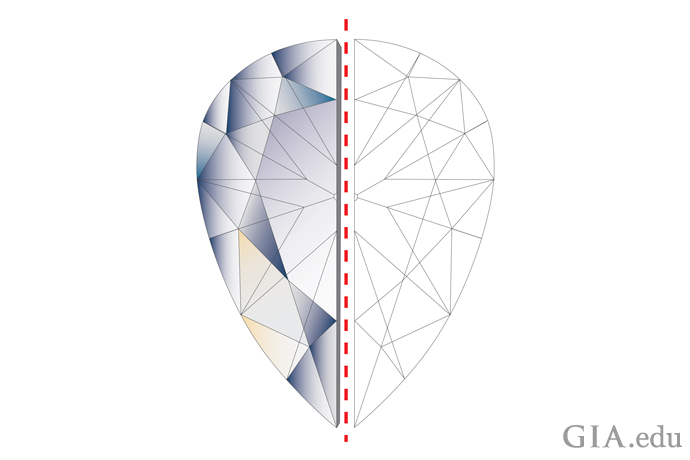
Symmetry is key to the overall beauty of gemstones, but it’s even more important in some fancy-shape diamonds like oval diamonds, heart shaped diamonds, marquise diamonds and pear shapes. To see if a pear shaped diamond is symmetrical, draw an imaginary line down the length of the gem and examine the two halves. The more closely they mirror each other, the better the symmetry is.

Notice how the shoulders, bellies and wings in the illustration below are identical on either side of the line, and how the shape, size and placement of the facets in each half of the stone mirror one another. This is an ideal pear shape. You can use the illustration as a guide when picking a pear shaped diamond.

Illustration demonstrating perfect symmetry in a pear shaped diamond.

Illustration: Peter Johnston/GIA

When GIA diamond graders evaluate the symmetry of fancy-shape diamonds, which includes pear shapes, they also look for things like a balanced and even outline. Certain types of asymmetry and uneven proportions are considered by most in the jewelry trade to have a negative effect on the appearance of a pear shaped diamond. These include:

  • High shoulders
  • Flat wings
  • Bulged wings
  • Undefined points

Uneven shoulders and uneven wings are other variations that will detract from the appearance of a pear shaped diamond. The illustration below has both.

Illustration showing an uneven outline of a pear shaped diamond with asymmetry in its shoulders, belly and wings.

The uneven outline of this pear shape reveals the asymmetry of its shoulders, belly and wings. You might want to avoid a diamond cut like this. Illustration: GIA

3. The ideal length-to-width ratio is the one you prefer

You might run into the phrase “length-to-width ratio” (comparison of the length and width of the outline of many fancy-shape diamonds, determined by dividing the diamond’s length by its width and stated as a ratio, like 1.75:1). Many experts prefer a length-to-width ratio that lies in the range of about 1.50–1.75:1. Others in the trade believe that a ratio isn’t enough to convey a diamond’s beauty. You may want to let your heart and eye guide you.

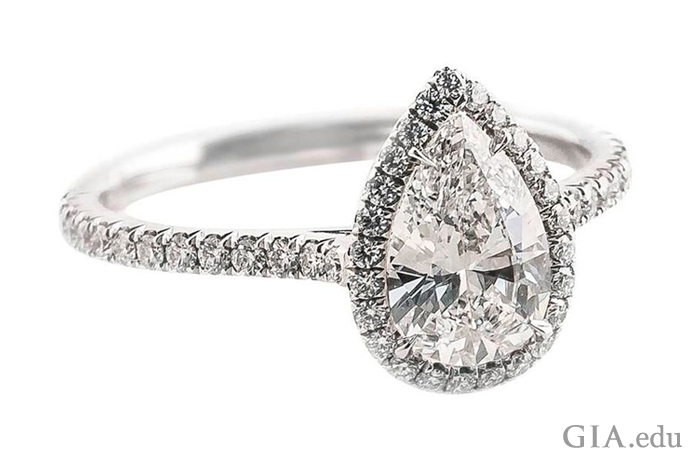
A 0.88 ct pear shaped diamond engagement ring accented with a halo of diamonds and melee in the shank.

Falling in love with any diamond is more than finding the perfect symmetry and length-to-width ratio. Are you infatuated with this 0.88 ct pear shaped diamond? Courtesy: 1stdibs.com

4. Check culet placement and position of inclusions

The placement of the culet on a pear shaped diamond can affect its appearance. It should be the same distance from the two sides of the diamond. A culet that is off-center will affect the diamond’s symmetry and is likely to make it less attractive. In some pear shapes, the culet is included in a keel line that extends down the length of the diamond where the pavilion facets meet. Like the culet, the keel line should be equidistant from either side of the diamond.

An Illustration of a pear shaped diamond showing an off-center culet.

The culet on this pear shaped diamond is off-center. It should be symmetrically placed at the same distance from either side of the gem. Illustration: GIA

Note, too, whether the diamond has any inclusions, especially near its point, as this is the area of that is most sensitive to damage. In addition, if the pear shaped diamond has a larger table facet, inclusions could be more apparent, so good clarity is a consideration.

5. Make sure the table is centered on a pear shaped diamond

A poorly placed table facet can also make a pear shaped diamond look less attractive. For maximum brightness and fire, the table should be centered on the line of symmetry.

An illustration of a pear shaped diamond showing an off center table.

If the table is off-center, the crown facets on one side of the pear shaped diamond will appear larger than the facets on the opposite side. Illustration: GIA

6. Avoid the bow-tie on a pear shaped diamond

Many pear shaped diamonds show a dark pattern that resembles a bow-tie. This pattern typically runs across the width of the stone from the center of the table. The bow-tie on a well-cut pear shaped diamond should be minimal, but there will still be good contrast between light and dark areas in the stone.

A bow-tie can vary from light gray to black. The darker or larger it is, the more it detracts from the face-up appearance of a pear shaped diamond. A bow-tie gets darker as the difference between a diamond’s length and width increases and pavilion angle variations (the measured angle between the pavilion main facet plane and the table plane) become more extreme.

If you find the bow-tie effect distracting, be sure to examine a variety of pear shaped diamonds from different angles under the lighting conditions in which the engagement ring will be worn. You may not be able to avoid a bow-tie altogether, but you should be able to find a stone in which it is subtle.

These pear shaped diamonds display a bow-tie effect, the dark area that extends across the width of each stone.

These pear shaped diamonds display a bow-tie effect, the dark area that extends across the width of each stone. Photo: Nicholas DelRe/GIA

7. Choose a setting that protects the point of a pear shaped diamond

The most vulnerable part of a pear shaped diamond is the point. This area can be protected by placing a V-prong on the point or choosing a bezel setting around the entire stone.

An 8.25 ct pear shaped diamond engagement ring in a V-prong platinum setting.

A V-prong protects the point – an area susceptible to chipping – of this 8.25 ct pear shaped diamond. Four more prongs hold the diamond securely in place. Courtesy: 1stdibs.com

A bezel setting ensures that this 0.40 ct pear shaped diamond is well protected.

A bezel setting ensures that the 0.40 ct pear shaped diamond is well protected. Courtesy: Doyle & Doyle

8. Point up or down? You decide how to wear a pear shaped diamond

The traditional way to wear a pear shaped diamond engagement ring is to have the tip pointing away from you (down). According to many in the trade, this makes the finger look more slender. But tradition has its limits. Some brides choose to wear this shape with the point toward them (up). And some prefer a horizontal setting that gives this classic diamond shape a distinctive, contemporary look.

Like all matters of the heart, let yours decide which way the pear should point.

A 1.34 ct Art Deco style pear shaped diamond engagement ring with radiant cut diamonds and sapphires.

Whether the tip of the 1.34 ct pear shaped diamond points toward or away from you, an engagement ring like this will look spectacular on the finger. The center stone is surrounded by 43 radiant cut diamonds weighing 0.41 carats and 1.03 carats of sapphires. Courtesy: 1stdibs.com

Among the most elegant of the fancy shapes, a pear shaped diamond conveys both the delicacy of a single tear and the strength of the brightest star. While there are many factors to consider when searching for the perfect stone for your diamond engagement ring, it is a journey well worth taking. When deciding between different pear shaped diamonds, the overall appearance is more important than the specific proportion details. Often, what makes a pear shaped diamond attractive is a matter of personal taste. So enjoy looking at different pear shaped diamond engagement rings until you fall in love with the perfect one.

Before you go shopping, be sure to read our 12 tips for buying an engagement ring.

Diamond Color: Seven Things You Need to Know

If you’re shopping for a diamond engagement ring, you need to know about what diamond color is if you want to understand quality and how diamonds are valued. If you are curious about what colors diamonds come in and how color grade impacts value, check out our seven essential things about diamond color you should know.

In this blog we cover:

  1. Diamond value is based (in part) on the absence of color.
  2. A diamond’s color grade should be determined by a grading laboratory.
  3. Colored diamonds are graded and valued differently from colorless diamonds.
  4. Treatments can improve diamond color.
  5. Diamond fluorescence has little to no impact on diamond color.
  6. Engagement ring settings can influence the perception of diamond color.
  7. To be sure of a diamond’s color, get a GIA grading report.

1. Diamond value is based (in part) on the absence of color

Diamond color is important: Most diamonds used in engagement rings are near-colorless with hints of yellow or brown. All things being equal, the more colorless a diamond is, the rarer it is, and this rarity will be reflected in its price.

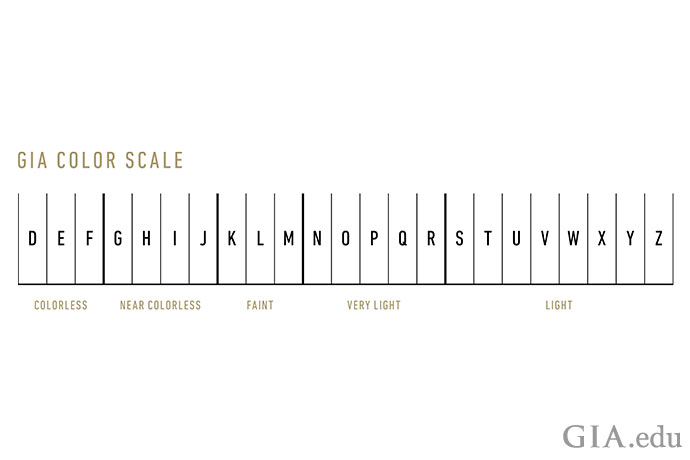
GIA D-to-Z diamond color scale.

The GIA D-to-Z Color Scale allows for precise measurement of diamond color. Illustration: GIA

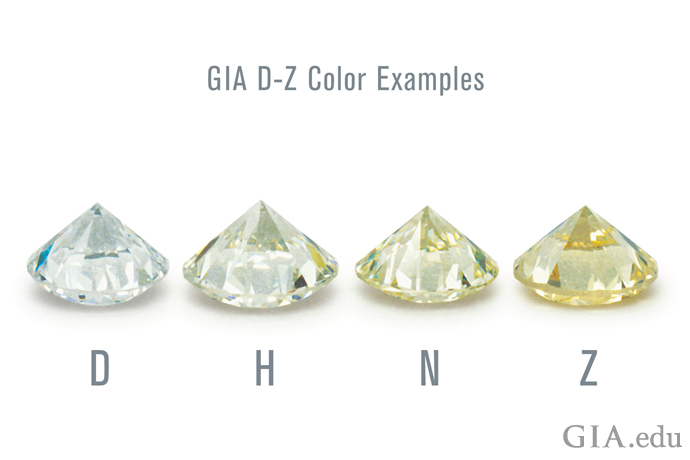
GIA’s D-to-Z Color Scale is used to measure the degree of colorlessness of a diamond. The letter “D” represents a colorless diamond, with each following letter representing a diamond that has slightly more yellow or brown.

GIA organizes diamond color into five groups:

  • Colorless (D-F): The most rare, and therefore the most valuable
  • Near-colorless (G-J): Color is often unnoticeable except by trained graders
  • Faint (K-M): Color is still difficult to see by the untrained eye
  • Very Light (N-R): Subtle color can be seen in larger stones by an untrained eye
  • Light (S-Z): Color can be seen in stones of different sizes. The diamonds appear slightly yellow or brown but do not have sufficient color to be considered a “fancy” colored diamond
GIA D-to-Z diamond color scale showing diamonds at either end of the grading spectrum.

When diamonds at either end of the grading spectrum are placed side by side, it is easy to see the differences in diamond color. Photo: GIA

2. A diamond’s color grade should be determined by a grading laboratory

The distinctions between diamond color grades can be so subtle that they are undetectable to the untrained eye. But they do make a very big difference in diamond price. That’s why determining a diamond’s color grade is best left to a gemological laboratory, like GIA, that has the expertise and processes to ensure objective, unbiased color grading.

In working to evaluate what color a diamond is, GIA graders follow a strict protocol that dictates the type of lighting and neutral background used, as well as precisely how the diamond should be held and viewed during the assessment. A color grade is determined by comparing the diamond to masterstones – a set of color-comparison diamonds of known position on the GIA D-to-Z color grading scale – when all are placed table down in a grading tray. This viewing position reduces the complex appearance of a faceted colorless to near-colorless diamond when viewed face up.

A 6.75 carat round brilliant cut diamond engagement ring featuring a diamond melee halo and band.

One look at this 6.75 carat (ct), F-color, SI-clarity round brilliant and you’ll know why diamonds are the universal symbol of love. Courtesy: 1stdibs.com

3. Colored diamonds are graded and valued differently from colorless diamonds

Diamond color is arguably the most important factor in colored diamonds. Some common colors that diamonds come in are yellow, brown, pink, red, blue, orange, purple, green, gray or black. This does not include diamonds in the normal color range that are slightly yellowish, slightly brownish or slightly grayish. When the color is natural, the diamonds are called fancy-color diamonds, fancy diamonds or fancies.

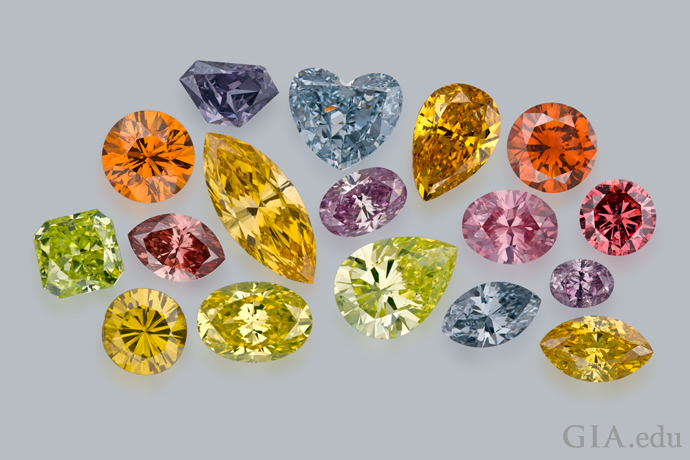
Colored diamonds come in a rainbow of hues.

Colored diamonds come in a rainbow of hues. Photo: Robert and Orasa Weldon/GIA

GIA grades colored diamonds differently from colorless diamonds. Unlike GIA’s D-to-Z grading system for colorless to light yellow diamonds, which is based on the absence of color when the diamond is viewed table down, the grading system for colored diamonds is based on the presence of color when the diamond is viewed face up. Terms used by GIA to describe colored diamonds include: Faint, Very Light, Light, Fancy Light, Fancy, Fancy Dark, Fancy Intense, Fancy Deep and Fancy Vivid.

What to look for in colored diamonds? In general, the more color a colored diamond has, the better. Fancy Deep and Fancy Vivid diamonds, for example, have more color than Fancy Light diamonds—and are usually more valuable. However, tone is also important: For example, a diamond that is extremely dark (Fancy Dark) may be less desirable than a lighter stone graded Fancy Intense.

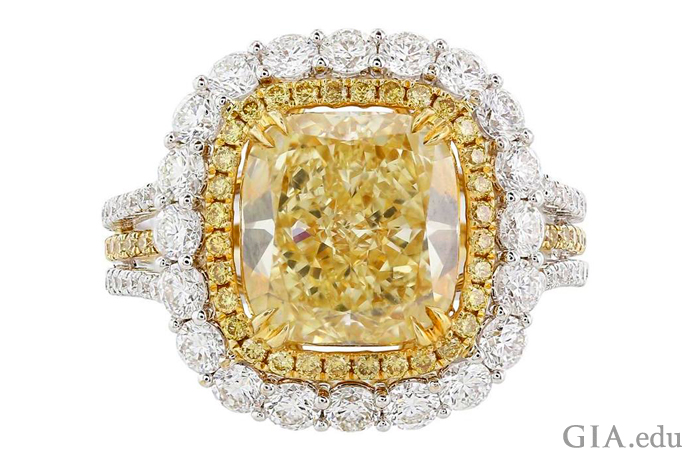
A 3.66 ct Fancy Yellow diamond engagement ring with two halos containing 0.37 carats of yellow diamonds and 1.50 carats of colorless diamonds.

Colored diamonds can be far more expensive than colorless diamonds. Here a 3.66 ct Fancy Yellow glows like a ray of sunshine. Two halos encircle it: the inner containing 0.37 carats of yellow diamonds; the outer, 1.50 carats of colorless diamonds. Courtesy: 1stdibs.com

Fancy-color diamonds are, for the most part, far rarer than diamonds in the D-to-Z color range. Some experts estimate that only two percent of total rough diamond production is fancy colored. Since rarity influences price, it’s not surprising that spectacular blue, pink, green, orange and other colored diamonds can sell for millions of dollars at auction.

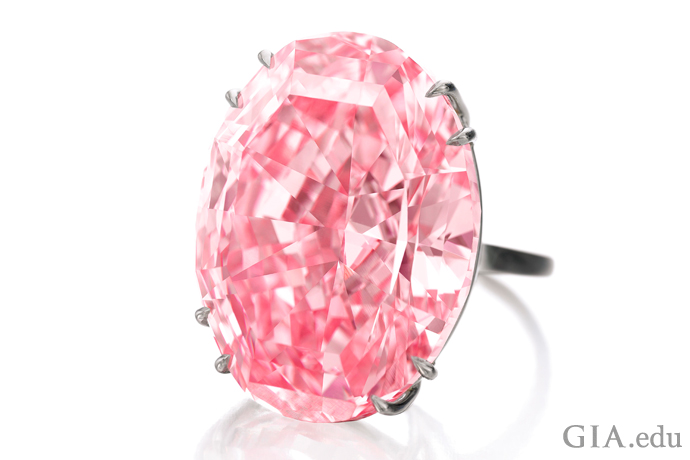
The Pink Star ring, which sold at a Sotheby’s auction for $71 million, contains a 59.60 ct Fancy Vivid pink diamond graded by GIA.

The GIA-graded Fancy Vivid pink 59.60 ct Pink Star diamond sold for $71 million at the April 4, 2017 Sotheby’s auction in Hong Kong. Courtesy: Sotheby’s

4. Treatments can improve diamond color

Diamond color can be altered by treatments. All else being equal, diamonds that have not been treated are more expensive than diamonds that have been treated. Legally, the seller must disclose any treatments. If you are aware what diamond color is, it’s easier to understand how they have been treated. 

High pressure, high temperature (HPHT) processing is perhaps the most common technique used to alter, enhance or remove color. HPHT treatment can change some brown diamonds into colorless ones or into other colors like yellow, greenish yellow or green. This process is also associated with treated pink, blue and orange-yellow diamonds. The resulting color is considered permanent, but HPHT treatment should always be disclosed.

Annealing is another process that uses controlled heating and cooling to change the color of a gem material, especially after irradiation. Irradiating a diamond or coating it are other methods used to enhance a diamond’s color.

.

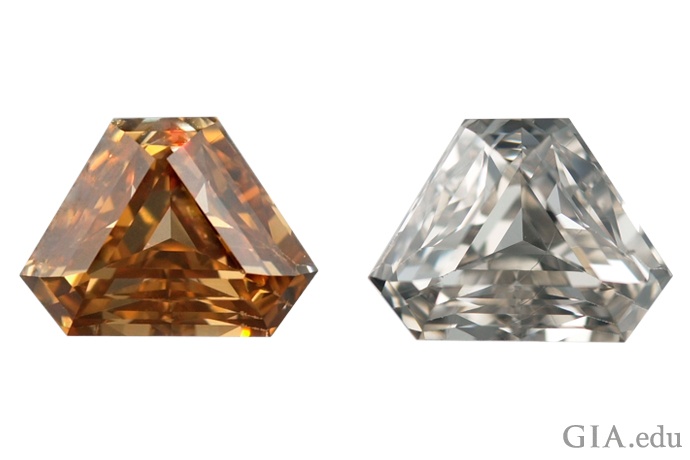
A 6.61 ct Fancy yellow brown diamond (left) before annealing and the same diamond (right), graded L (faint yellow) after annealing.

Before HPHT annealing to remove color, this 6.61 ct diamond was a Fancy yellow brown (left). After annealing (right), GIA graded the diamond an L (faint yellow). Photo: Robert Weldon/GIA

5. Diamond fluorescence has little to no impact on diamond color

Diamond fluorescence is visible light temporarily emitted by some diamonds when they are exposed to ultraviolet (UV) rays from the sun, fluorescent lamps or other sources. This emitted light can display various colors (often blue in diamonds), intensities (faint to very strong) and distribution patterns. When the light source is removed, the fluorescence is no longer visible.

Many in the diamond trade believe that strong blue fluorescence can make a light yellow diamond look closer to colorless when exposed to a UV source such as sunlight. Blue and yellow are color opposites and tend to cancel each other out, so blue fluorescence masks the yellow color. In rare cases, some diamonds with extremely strong fluorescence may appear slightly hazy or oily. Fewer than 0.2% of the fluorescent diamonds submitted to GIA exhibit this effect.

.

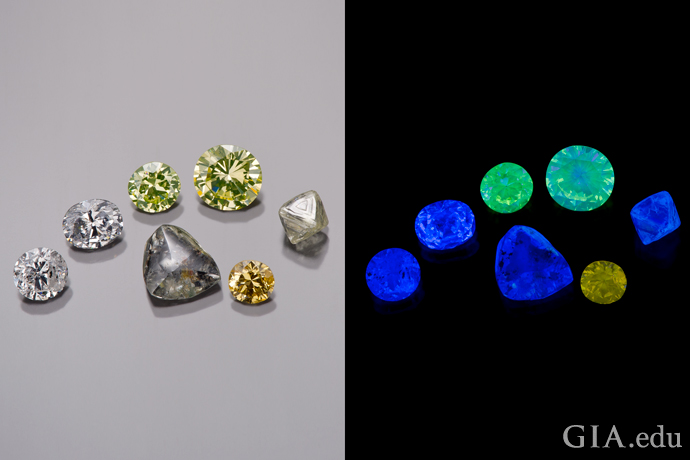
A group of seven diamonds shown under daylight-equivalent illumination (left) and exposed to long-wave UV irradiation (right).

The same group of seven diamonds is shown here under daylight-equivalent illumination (left) and when exposed to long-wave UV irradiation (right). Photos: Kevin Schumacher/GIA

To answer questions from consumers and the trade about the impact of fluorescence on diamond color in the D-to-Z range, GIA conducted extensive observer testing. Here’s what its researchers found: “For the average observer, meant to represent the jewelry buying public, no systematic effects of fluorescence were detected [on the face-up appearance of the groups of diamonds]. Even the experienced observers did not consistently agree on the effects of fluorescence from one stone to the next.” As a result, GIA considers diamond fluorescence to be an identifying characteristic, not a grading factor – meaning, it has little to no impact on what color the diamond is.

6. Engagement ring settings can influence the perception of diamond color

Diamonds are highly reflective – their facets are essentially an arrangement of tiny mirrors reflecting light and the surroundings. So it should come as no surprise that the color of a ring’s prongs and shank can influence the color you see in the diamond. A white metal like platinum or white gold can emphasize the absence of color in a diamond that is colorless or near-colorless, while a gold band might make a diamond lower on the D-to-Z scale appear more yellow.

Learn more about how metal affects a diamond’s color appearance.

A 8.03 carat D color marquise cut diamond engagement ring set in platinum, flanked by two tapered baguettes weighing 0.72 carats.

The 8.03 ct marquise cut diamond in this engagement ring is D color. It is flanked by two tapered baguettes weighing a total of 0.72 carats. The platinum band and prongs highlight the beauty of the diamond. Courtesy: 1stdibs.com

7. To be sure of a diamond’s color, get a GIA grading report

A GIA Diamond Grading Report and GIA Diamond Origin Report provides an in-depth assessment of a diamond’s quality based on the 4Cs: diamond color, clarity, cut and carat weight. A report not only contains an objective color grade, but it also discloses other identifying characteristics like fluorescence, as well as any treatments detected. Learn what diamond color information is included in a GIA report.

An engagement ring is profoundly intimate and symbolic – it represents your love and commitment. A GIA Diamond Grading Report lets you make this most important purchase with peace of mind.

Now that you understand  what diamond color is and  its importance, here are 12 tips for buying an engagement ring.

Lead image courtesy of 1stdibs.com

December Birthstone: What You Need to Know About Tanzanite, Turquoise and Zircon

If you had to pick one December birthstone, which would it be: tanzanite, turquoise or zircon? From the blue to bluish purple of tanzanite, to the intense blue and green of turquoise, to the rainbow varieties of zircon, there’s a color for you. We help you pick one.

In this blog, we cover:

Tanzanite: The Newest December Birthstone
Gemological properties of tanzanite
Tanzanite history & lore
Where tanzanite comes from
Qualities to look for in tanzanite
Tanzanite treatments, care & cleaning

Turquoise: The Historic December Birthstone
Gemological properties of turquoise
Turquoise history and lore
Where turquoise comes from
Qualities to look for in turquoise
Turquoise treatments, care & cleaning

Zircon: The Colorful December Birthstone
Gemological properties of zircon
Zircon history & lore
Where zircon comes from
Qualities to look for in zircon
Zircon treatments, care & cleaning

TANZANITE: THE NEWEST DECEMBER BIRTHSTONE
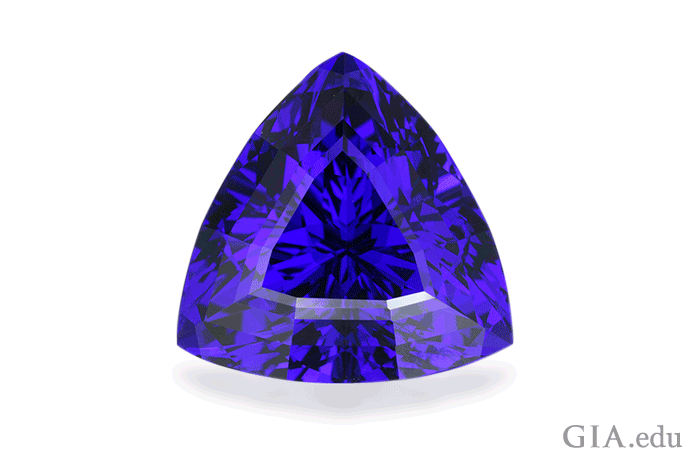
A trilliant cut tanzanite with an exceptional violetish blue color captivates as the December birthstone. Photo: Robert Weldon/GIA

A trilliant cut tanzanite with an exceptional violetish blue color captivates as the December birthstone. Photo: Robert Weldon/GIA

Gemological properties of tanzanite

Tanzanite is the blue to violet to bluish purple variety of the mineral zoisite. This December birthstone is mined commercially in only one area of the world — the Merelani Hills of Tanzania — from where it gets its name.

Tanzanite’s appearance is influenced greatly by its pleochroism – the different colors some gemstones show when viewed from different directions. Tanzanite can be violetish blue or deep blue – similar to a sapphire color – or much more purplish. Often, both the violetish blue and purple are readily visible in a fashioned stone when it is gently rocked and tilted. This December birthstone is rather fragile, ranking 6 to 7 on the Mohs scale of hardness; a diamond is a 10. The scale is exponential, meaning that a diamond is many times harder than tanzanite. Tanzanite’s toughness (the ability of a gem material to resist breaking, chipping or cracking) is fair to poor because it has one direction of cleavage (the tendency of a crystalline mineral to break along atomic planes) and is sensitive to sudden temperature changes.

Gemologists love tanzanite because it shows different colors when viewed from different directions.
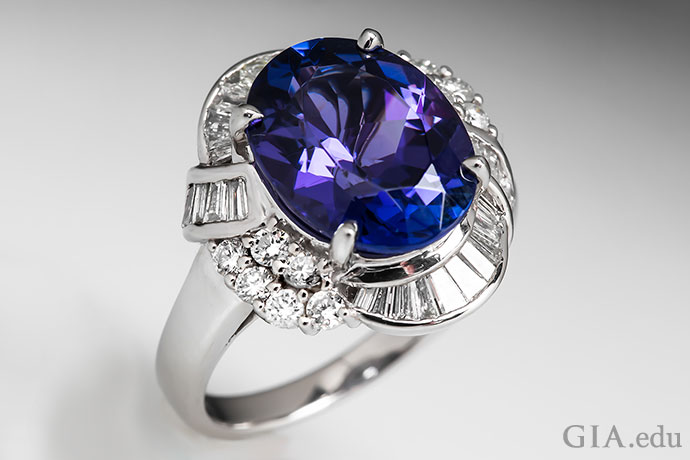
5.59 carat (ct) oval tanzanite contrasted with 28 channel set tapered baguettes and 12 round brilliant cut diamonds.

The vault of the evening sky and a field of stars is conjured by this 5.59 carat (ct) oval tanzanite contrasted with 28 channel set tapered baguettes and 12 round brilliant cut diamonds. Courtesy: EraGem.com

Tanzanite history & lore

Tanzanite may be a relative newcomer to the world of colored stones, but it was one of the most exciting gem discoveries of the 20th century. Blue stones emerging from Tanzania were identified as the mineral zoisite in 1962 by Polish expatriate George Kruchluk. Not until 1967, though, did prospector Manuel D’Souza — with the help of a Masai tribesman — locate the primary source: the Merelani Hills. D’Souza filed four mining claims. Word spread and 90 more claims were quickly registered – even though at the time there was some confusion as to the identity of the gem material.

Tiffany & Co. believed that tanzanite had international appeal and became its main distributor. In 1968, Tiffany launched a major advertising campaign to promote it. With its vivid colors, high clarity and potential for large cut stones, tanzanite quickly became a sensation. Today, it is not only a December birthstone, but it is also the gem for the 24th wedding anniversary.

Where tanzanite comes from

Grass-covered hillsides, scrub brush, rocky soil and an occasional tree form the landscape of the Merelani Hills. In the major mechanized operations there, thousands of workers recover tanzanite from mines dug over a hundred meters deep into the earth. North of the mines tower the snow-covered slopes of Mount Kilimanjaro.
Peeking out from the clouds is the domed summit of Mount Kilimanjaro. Tanzanite is mined in its shadow.

Peeking out from the clouds is the domed summit of Mount Kilimanjaro. Tanzanite is mined in its shadow. Photo: Eric Welch/GIA

Qualities to look for in tanzanite

Color: The most prized color in tanzanite is a pure blue similar to fine sapphire or an intense violet-blue. Tanzanite with a bluish purple body color is also popular, but less valuable. In any hue, pale colors are less prized than saturated ones.
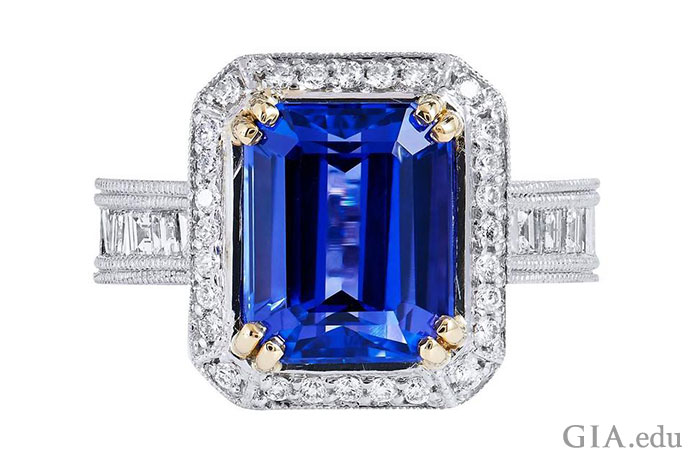
4.91 ct tanzanite, which mimics the deep blue of fine sapphire, and its regal frame of diamonds.

Be mesmerized by the rich color of this 4.91 ct tanzanite, which mimics the deep blue of fine sapphire, and its regal frame of diamonds. Courtesy: 1stdibs.com

Clarity: Tanzanite is usually free of eye-visible inclusions. If any inclusions are present – especially those that pose a durability problem, such as fractures – they typically lower the value.

Cut: Tanzanite is available in a wide range of shapes, but cushion and oval cuts are more common. Because of its pleochroism, cutting direction determines the gem’s overall face-up color. Cutting a tanzanite to emphasize the bluish purple color usually wastes less rough than cutting it to get a pure blue or violetish blue color. The cutter has to make a choice between a smaller top-color gem and a larger bluish purple one.

Carat Weight: Fine tanzanite with a strong, deep color can be found in pieces weighing 5.00 carats or more. Smaller sizes in less saturated colors are commonly seen in mass market jewelry.
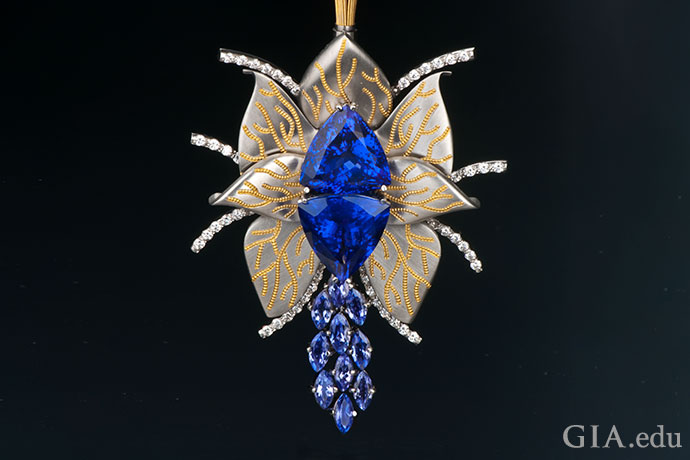
Some 17.67 carats of tanzanite blossom in Sir Zoltan David’s magical "Flowerfly" necklace.

Some 17.67 carats of tanzanite blossom in Sir Zoltan David’s magical “Flowerfly” necklace. The piece won the Tanzanite Foundation’s “Be Born to Tanzanite” Competition in 2007. Photo: Robert Weldon/GIA. Courtesy: Zoltan David

Tanzanite treatments, care & cleaning

Tanzanite is stable under normal wearing conditions, which means it’s resistant to the effects of normal heat, light and common chemicals. Still, the December birthstone may crack if exposed to very high temperatures or sudden temperature changes. It can be attacked by hydrochloric and hydrofluoric acids.

Warm, soapy water is always the best way to clean this December birthstone. Ultrasonic and steam cleaners are never recommended for tanzanite.

Untreated, tanzanite is typically brown. Tanzanite is routinely heat treated to modify its color to a predominantly blue to bluish purple. The treatment is stable with no additional durability concerns.

TURQUOISE: THE HISTORIC DECEMBER BIRTHSTONE

A shoreline of diamonds surround an ocean of turquoise in this captivating ring.

A shoreline of diamonds surround an ocean of turquoise in this captivating ring. Courtesy: Arya Esha

Gemological properties of turquoise

Turquoise is found in only a few places on Earth: dry and barren regions where acidic, copper-rich groundwater seeps downward through deeply altered or broken rocks where it reacts with minerals that contain phosphorus and aluminum. The result of this process is a porous, semitranslucent-to-opaque hydrous phosphate of copper and aluminum.

This December birthstone owes its texture to its structure and composition. Turquoise is an aggregate of microscopic crystals that form a solid mass. If the crystals are packed closely together, the material is less porous, so it has a finer texture. Fine-textured turquoise has an attractive, waxy luster when it’s polished. Turquoise with a less-dense crystal structure has higher porosity and a coarser texture, resulting in a duller luster when it’s polished.

Porosity and texture don’t just affect appearance: They also affect the durability of turquoise. This December birthstone is fairly soft—it ranks 5 to 6 on the Mohs scale of hardness. Turquoise with a coarse texture might have poor toughness, too, so it fractures easily. Samples with finer texture have fair to good toughness.

Gemologists love this December birthstone because turquoise often contains matrix: spiderweb-like veins that provide evidence of the rock in which it formed. They also like how turquoise is colored by copper, which creates some of the most vivid blues and greens in the gem kingdom.
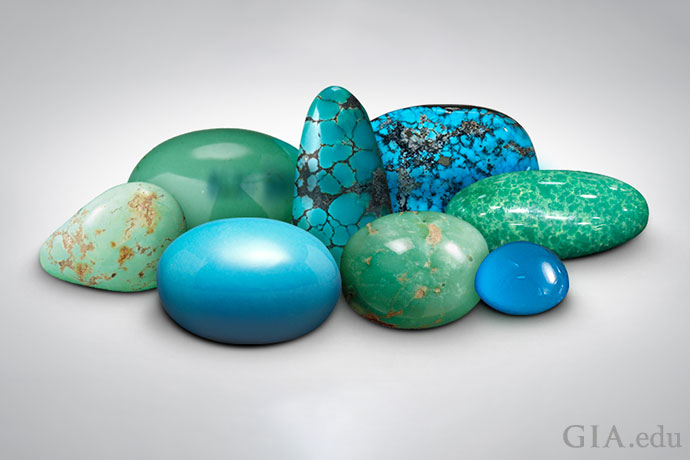
Whether opaque, semitranslucent or checkered with spiderwebs, turquoise enchants

Whether opaque, semitranslucent or checkered with spiderweb-like veins, turquoise enchants. Composite photo: Eric Welch, Robert Weldon, Terri Weimer/GIA, Dr. Edward J. Gübelin collection. Courtesy (far right): Barlow’s

Turquoise history & lore

Turquoise has been cherished for millennia. The pharaohs and other rulers of ancient Egypt adorned themselves with it. Chinese artisans carved it more than 3,000 years ago.

This December birthstone was thought to possess many beneficial powers, like guaranteeing health and good fortune. From the 13th century on, it was believed to protect the wearer from falling (especially off horses), and would break into several pieces at the approach of disaster. Hindu mystics maintained that seeing a turquoise after beholding the new moon ensured fantastic wealth.

Turquoise played an important role in the lives of Native Americans. The Apache thought turquoise could be found by following a rainbow to its end. They also believed that attaching the December birthstone to a bow or firearm made one’s aim more accurate. The Pueblo maintained that turquoise got its color from the sky, while the Hopi thought the gem was produced by lizards scurrying over the earth.
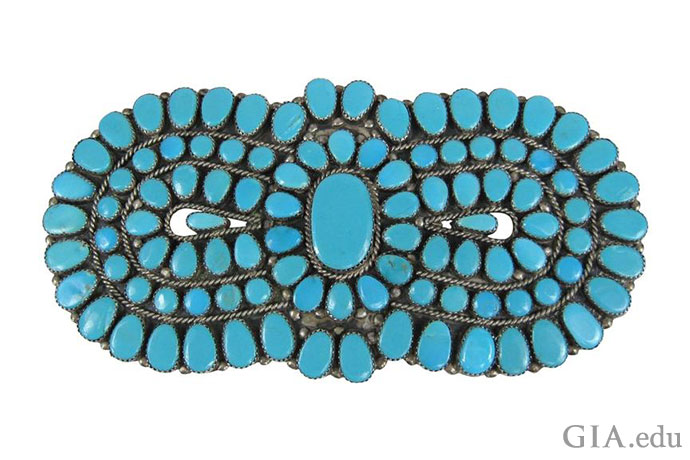
An artisan from the Zuni tribe made this turquoise brooch.

An artisan from the Zuni tribe made this turquoise brooch. Courtesy: 1stdibs.com

Turquoise adorns the funerary mask of King Tut, who ruled Egypt more than 3,000 years ago. It also appears in jewelry belonging to more modern royalty, such as the Jordan turquoise demi-parure (turquoise, diamond and sapphire necklace and earrings) in the collection of Britain’s Queen Elizabeth II. Wallace Simpson (1896-1986), Duchess of Windsor, wore a famous amethyst and turquoise necklace made by Cartier. Turquoise is also the gem of the 11th wedding anniversary.

A dazzling display of color, Cartier’s bib necklace for the Duchess of Windsor features a sea of turquoise cabochons and faceted amethyst.

A dazzling display of color, Cartier’s bib necklace for the Duchess of Windsor features a sea of turquoise cabochons and faceted amethyst. Courtesy: N. Welsh, Cartier Collection © Cartier

Where turquoise comes from

Turquoise has been mined in the Nishapur district of Iran for more than 1,000 years. The even-colored, intense blue turquoise from this region is dubbed “robin’s egg blue,” “sky blue” and “Persian blue.” Trade professionals now use these terms to describe turquoise of this color – regardless of the source.
This is the view on the way to Nishapur.

This is the view on the way to Nishapur. Courtesy: Dr. Edward J. Gübelin Collection

Although New Mexico was the largest producer of turquoise in the U.S. until the 1920s, today most of the U.S. production of this December birthstone comes from Arizona and Nevada. Mines have evocative names like Dry Creek, Easter Blue, Emerald Valley and Fox. The Kingman mine in Arizona is a historically important source that is known for producing intense blue turquoise. Now closed to turquoise mining, the Sleeping Beauty mine was a prolific producer for more than four decades.

The intense blue turquoise beads in this necklace came from Arizona’s Sleeping Beauty mine.

The intense blue turquoise beads in this necklace came from Arizona’s Sleeping Beauty mine. Photo: Robert Weldon/GIA. Courtesy: Somewhere In The Rainbow

China is now the world’s largest producer of fine turquoise. Hubei Province, in central China, is the source of most of the gem-quality turquoise currently being mined there.

Qualities to look for in turquoise

Color: The color of turquoise usually ranges from light to medium blue or greenish blue. It’s often mottled, and sometimes it has dark splotches. It might also have veins of matrix running through it.

The most-prized turquoise color is an even, intense, medium blue, with no matrix and the ability to take a good polish. But some consumers prefer a greenish blue, and some contemporary designers seek turquoise referred to as “avocado” and “lime green.”

Clarity: Turquoise can be semitranslucent to opaque. Semitranslucent stones are preferred.

Note the even color in the clusters of turquoise dangling from gold chains in this one-of-a-kind piece.

Note the even color in the clusters of turquoise dangling from gold chains in this one-of-a-kind piece. Courtesy: Denise James

Cut: Turquoise is most often fashioned as cabochons. The smoothly rounded dome shape sets off turquoise’s color, texture and any matrix beautifully. In addition, manufacturers and artisans fashion turquoise rough into round or oblong beads for necklaces, and into small, flat pieces that are popular as jewelry inlays. Other rough material might be tumbled into “nuggets” or polished as free-form shapes that reflect the shape of the original rough. There are also examples of top-color blue turquoise engraved with Persian or Arabic inscriptions that are then inlaid with gold.

Carat Weight: Turquoise is available in a wide range of sizes. All sizes, even very small ones, are used in Native American jewelry, and large pieces have been popular for carvings. For any size, the quality and evenness of the color is the overriding value factor.
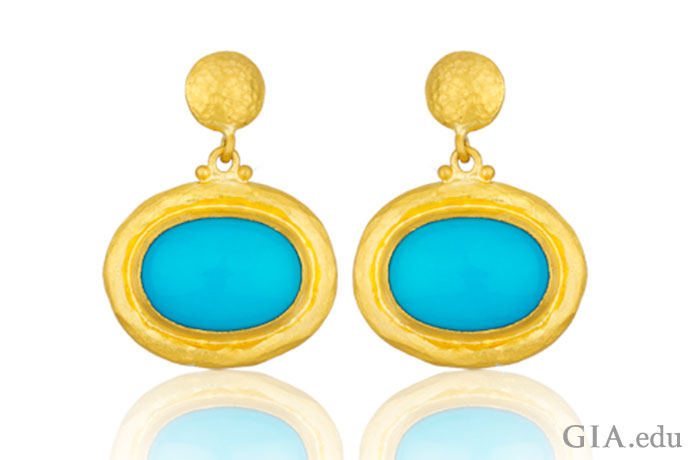
Rich blue turquoise surrounded by 24K gold makes these earrings a mesmerizing sight.

Rich blue turquoise surrounded by 24K gold makes these earrings a mesmerizing sight. Courtesy: Lika Behar

Turquoise treatments, care & cleaning

A colorless wax or polymer is often used to improve the color and luster of turquoise. Other treatments include applying epoxy to thin turquoise slices to strengthen them, applying coatings of lacquer or epoxy, and filling cavities with imitation pyrite inclusions made of metal-filled epoxy.

It’s safe to clean turquoise jewelry with warm, soapy water, but this December birthstone should never be cleaned with steam or ultrasonic cleaners. Heat or solvents can damage the treated surfaces on some turquoise.

Turquoise is generally stable to light, but high heat can cause discoloration and breakage. Turquoise can be damaged by acids, and it can be discolored by certain chemicals, cosmetics and even skin oils or perspiration.

ZIRCON: THE COLORFUL DECEMBER BIRTHSTONE

A 19.76 ct orangy brown zircon is ringed by 0.51 carats of diamonds.

A 19.76 ct orangy brown zircon is ringed by 0.51 carats of diamonds. Courtesy: 1stdibs.com

Gemological properties of zircon

Zircon comes in a wide and varied palette of yellow, green, red, orange, brown and blue hues, making it a favorite among collectors and knowledgeable consumers. This December birthstone is 6 to 7.5 on the Mohs scale of hardness.

The zircons in this colorful array originate from Sri Lanka, Cambodia, Thailand, Tanzania and other locations.

Zircon comes in a wide array of attractive colors. Photo: Robert Weldon/GIA, Dr. Edward J. Gübelin Collection.

Colorless zircon is known for its brilliance and flashes of multicolored light, called fire. These two zircon properties are close enough to the properties of diamond to account for centuries of confusion between the two gems.

This 11.41 ct oval blue zircon with its diamond halo is like a lake that invites the viewer to peer into infinity. The tsavorite garnet side stones are leafy touches to the icy scene.

This 11.41 ct oval blue zircon with its diamond halo is like a lake that invites the viewer to peer into infinity. The tsavorite garnet side stones are leafy touches to the icy scene. Courtesy: Omi Privé

Gemologists love zircon because its radioactive trace elements are a geologic clock that tells us about the early Earth. This December birthstone also has very high luster, high refractive indices (the measure of the extent to which light is bent as it leaves a gemstone at an angle other than perpendicular to the surface) and strong dispersion, which is responsible for the brilliance and rainbow flashes of fire.

Zircon history & lore

The origins of the word zircon have elicited colorful debate. Some scholars believe it comes from the Arabic word zarkun, meaning “cinnabar” or “vermilion.” Others think the source is the Persian word zargun, or “gold colored.” Considering the color range for this December Birthstone, either derivation seems possible.

Zircon comes with pleasing lore. In the Middle Ages, it was thought to lull one into a deep sleep and scare off evil spirits. In the Hindu religion, zircon alternates with hessonite garnet as one of the nine gems of the navaratna. When worn together, the nine gems protect the wearer and bring good health, wealth and wisdom.

Victorians had a fondness for blue zircon. Fine specimens can be found in English estate jewelry from the 1880s.
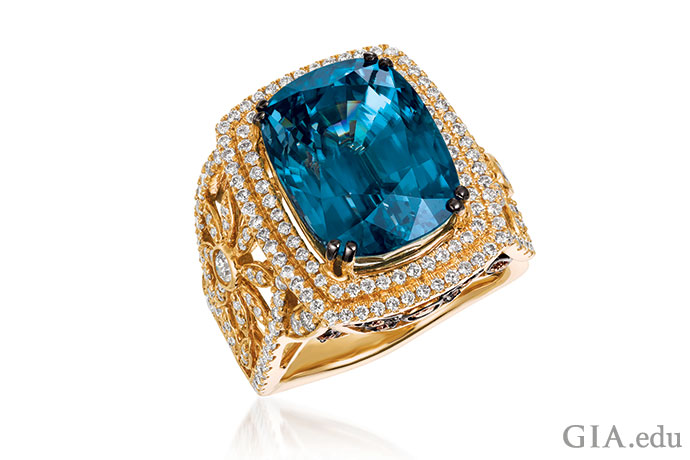
Regal rings like this show why blue zircon is a popular gem

Regal rings like this show why blue zircon is a popular gem. Courtesy: LeVian

Where zircon comes from

Sri Lanka’s wealth of gems is legendary: Sapphire in various colors, ruby, alexandrite, spinel, tourmaline, moonstone and quartz are some of the gem minerals unearthed there. So is zircon. Elahera, a region in central Sri Lanka, is one of the country’s most productive areas. Mountains, jungles and restless streams make for a dramatic landscape.
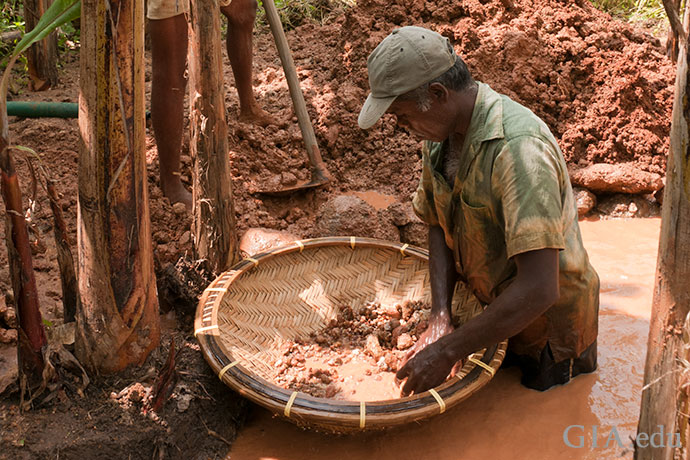
An artisanal miner searches for gems in the Elahera region of Sri Lanka.

An artisanal miner searches for gems in the Elahera region of Sri Lanka. Photo: Vincent Pardieu/GIA

Australia’s Harts Range is known for producing zircons in yellow-brown, orangy brown, pink and purple. Go there and you’ll see open savannahs, dry stream beds and low-lying hills that meet the horizon. Zircon Hill is where the gem is mined. The nearby city of Alice Springs is known for its outback culture, aboriginal art and quirky sporting events like a regatta race held in a dry river bed.

Zircon is often located near sapphire sources. Countries where the two overlap include Sri Lanka, Myanmar, Vietnam, Cambodia and Australia.

Qualities to look for in zircon

Color: Some zircons display warm autumnal earth tones such as yellowish and reddish brown. Red and green zircons have market value as collectors’ stones, and cat’s-eye zircons occasionally appear on the market. There are also colorless zircons.
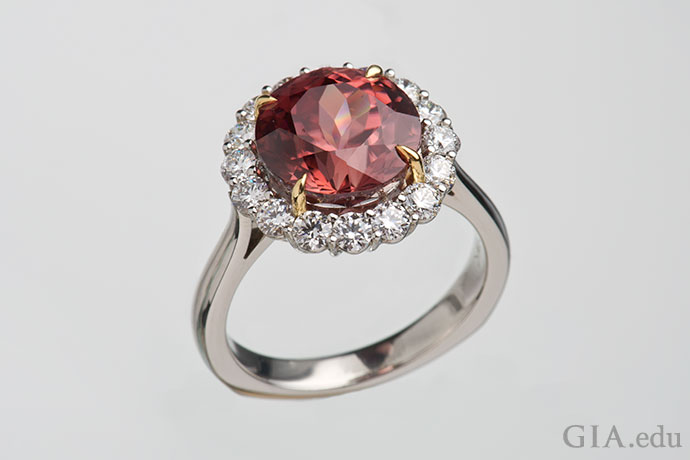
A brisk autumn day, a fireplace and apple cider would be the perfect backdrop for this ring, which features a 7.96 ct zircon.

A brisk autumn day, a fireplace and apple cider would be the perfect backdrop for this ring, which features a 7.96 ct zircon. Photo: Robert Weldon/GIA. Courtesy: Richard Krementz Gemstones

Although collectors clearly love zircon’s variety of colors, consumers seem most enamored of just one hue: blue. Gem dealers report that at least 80 percent of the zircons they sell are blue. Because they’re in greater demand, blue zircons usually command higher prices than any of the other varieties.
A blue zircon takes center stage in the “Reine de Glace” pendant designed by Lisa Krikawa.

A blue zircon takes center stage in the “Reine de Glace” pendant designed by Lisa Krikawa. Courtesy: Krikawa Jewelry Designs. Blue zircon by John Dyer & Co.

Clarity: Zircons are relatively free of inclusions. But many untreated zircons have a cloudy or smoky appearance that, if extreme, can be a negative factor with buyers. In Victorian times, this smokiness made zircon a popular gem for mourning jewelry. Today, most faceted zircon is free of inclusions that are visible to the unaided eye. Eye-visible inclusions cause a drop in zircon value. Rarely, zircon might contain long, parallel inclusions that create a cat’s-eye effect when the stone is cut as a cabochon.

Cut: It’s a challenge to cut zircon because the gem is brittle. Cutters usually fashion zircon in the brilliant style to take advantage of its brilliance and fire. Zircon can also be found in step cuts, which have rows of parallel facets, and mixed cuts, which are a combination of brilliant and step-cut facets.
A richly colored 7.23 ct zircon set in an ornate 18K gold ring looks like it belongs on the finger of European royalty.

A richly colored 7.23 ct zircon set in an ornate 18K gold ring looks like it belongs on the finger of European royalty. Courtesy: 1stdibs.com

Carat Weight: The supply of this December birthstone is generally limited, and typical zircon sizes depend on color. Blue or green stones normally range from one carat to 10 carats, with yellows and oranges up to around five carats. Reds and purples are usually smaller.

Zircon treatments, care & cleaning

Warm, soapy water is recommended for cleaning zircon. Ultrasonic and steam cleaners are not recommended for this December birthstone.

Zircon is commonly heat treated to produce blue and colorless varieties, as well as orange, yellow and red. The gem is generally stable when exposed to light, but some heat-treated stones might revert to their original colors (usually light brown) after prolonged exposure to bright light. Exposure to heat can alter the color of some zircon. Zircon is stable when exposed to chemicals.

Because zircon tends to abrade, it is best to avoid wearing it in rough conditions, such as while gardening, playing sports or doing dishes.
The color of the 14.48 ct zircon in this ring evokes a forest … fields … grassy expanses.

The color of the 14.48 ct zircon in this ring evokes a forest … fields … grassy expanses. Courtesy: 1stdibs.com

Ready to go shopping for the December birthstone?  Be sure to take our Tanzanite Buying Guide and Turquoise Buying Guide with you when you go!

Engagement Ring Buying: How to Compare Loose Diamonds

Comparing loose diamonds for an engagement ring? Don’t be dismayed by the dizzying array of choices. The important thing is understanding how to compare loose diamonds. Here are six easy steps to help you pick a diamond that’s beautiful and a smart purchase.

(more…)

November Birthstone: What You Need to Know About Topaz and Citrine

Those with a November birthstone have two beautiful options to choose from: topaz and citrine. Topaz comes in a rainbow of colors; citrine is known for its charming yellow and orange hues. The two gems give you countless options. Your challenge will be deciding which one to pick. We offer help.

In this post, we cover

Gemological properties of topaz
Topaz history & lore
Where topaz comes from
Qualities to look for in topaz
Topaz treatments, care & cleaning
Gemological properties of citrine
Citrine history & lore
Where citrine comes from
Qualities to look for in citrine
Citrine treatments, care & cleaning

November birthstone: Gemological properties of topaz

The November birthstone topaz has an exceptionally wide color range that, in addition to brown, includes various tones and saturations of blue, green, yellow, orange, red, pink and purple. Colorless topaz is plentiful, and is often treated to give it a blue color.

Pictured here are some of the many colors of topaz, the November Birthstone. From left to right: a 9.21 ct colorless emerald cut, a 15.01 ct light blue emerald cut, a 18.41 ct purplish pink emerald cut and a 12.54 ct orange-red emerald cut.

Pictured here are some of the many colors of topaz. From left to right: a 9.21 carat (ct) colorless emerald cut from Nigeria; a 15.01 ct light blue emerald cut from Brazil; an 18.41 ct purplish pink emerald cut from Pakistan; and a 12.54 ct orange-red emerald cut from Brazil. Photo: Robert Weldon/GIA

Color varieties of the November birthstone are often identified simply by hue name—blue topaz, pink topaz and so forth—but there are also a couple of special trade names. Imperial topaz is typically a medium reddish orange to orange-red though some dealers, especially those in Brazil, apply the term to yellow, pink and red topaz as well. The reddish pleochroic color (pleochroism is the display of different body colors from different viewing directions) of Imperial topaz often appears at the ends of fashioned gems–like pears and ovals–that have an otherwise yellow-to-orange body color. Red is one of the most sought-after (and least available) topaz colors.

Sherry topaz—named after sherry wine—is a yellowish brown or brownish yellow to orange. Stones in this color range are often called precious topaz to help distinguish them from the similarly colored but less expensive citrine and smoky quartz.

Topaz is an 8 on the Mohs Scale of Hardness. It’s not very tough, so a hard blow might split it, and extreme pressure or sharp temperature changes might cause it to break. The November birthstone is best set in a protective mounting like a bezel or used in pieces that aren’t subjected to heavy wear, like pendants and pins.

Pink topaz set in a diamond and platinum butterfly brooch.

A pink topaz set in a diamond and platinum butterfly brooch is a delightful sight. Photo: Robert Weldon/GIA. Courtesy: Richard Krementz Gemstones

Gemologists love topaz because it comes in some of the gem world’s largest crystals: The largest are measured in kilos, not carats. They also love the fact that faceted topaz takes such a high polish and is slightly slippery to the touch.

November birthstone: Topaz history & lore

Topaz was long thought to have many benefits. The ancient Greeks believed that topaz gave them strength. From the 1300s to the 1600s, Europeans thought it could thwart magic spells and dispel anger. The November birthstone was also believed to have curative powers. To treat “dimness of vision,” 12th century abbess St. Hildegard recommended placing topaz in wine for three days and then rubbing the moistened topaz on the patient’s eyes.

Imperial topaz has aristocratic cachet. It is commonly believed that the name originated with the Russian royal family’s insistence on keeping the finest colors of this gem, which was mined in Russia’s Ural Mountains, exclusively for their use. An alternate explanation, especially popular in Brazil, is that it dates from an 1881 visit by Brazilian Emperor Pedro II to Ouro Preto—the town closest to Brazil’s most productive topaz mines–and the gift of a reddish topaz to him. Regardless of the source of the designation, there is no question all believed this beautiful gem was fit for a king.

Oval cut Imperial topaz.

Want a gem with an aristocratic cachet? Imperial topaz might be the one for you. Photo: Robert Weldon/GIA

Blue topaz is the gem of the fourth wedding anniversary, and Imperial topaz is the gem of the 23rd wedding anniversary.

A 38.56 ct blue topaz

The artistic carving of this 38.56 ct blue topaz intensifies the color. Photo: Lydia Dyer. Courtesy: John Dyer & Co.

November birthstone: Where topaz comes from

Minas Gerais, a state in Brazil, is one of the most important sources for high-quality topaz. Yellow to orange, red, pink, violet and blends of red with orange or purple are some of the colors unearthed here. The nearby town of Ouro Preto is a fitting companion. In this UNESCO world heritage site, majestic colonial churches checker the skyline and quaint cobblestone streets crisscross the city.

Necklace set with a 24.13 ct fancy-cut topaz and the accompanying 44.11, 71.21 and 66.66 ct loose stones.

Topaz mined from the Ouro Preto region of Minas Gerais, Brazil comes in a lovely range of hues, as displayed in this necklace set with a 24.13 ct fancy-cut topaz and the accompanying 44.11, 71.21 and 66.66 ct loose stones. Photo: GIA and Harold & Erica Van Pelt. Courtesy: Amsterdam Sauer Co.

Northwestern Pakistan is known for producing pink topaz. Ghundao Hill, close to the small town of Katlang, has been mined since 1972. The most sought-after shade of pink topaz from Katlang has a tinge of violet, which some in the gem trade call cyclamen pink. But even at Ghundao Hill, only rarely is fine pink topaz found.

Ghundao Hill, a valley carpeted in green in Northwestern Pakistan, is known for producing topaz the November birthstone.

Ghundao Hill’s setting is quite picturesque: A valley carpeted in green starts at the base. The towering Hindu Kush Mountains rise in the distance. Photo: Dr. Edward J. Gübelin/GIA

Other topaz sources include Namibia, on the western coast of southern Africa, and the gem-rich island of Madagascar. Today, some topaz is also found in the historic Russian localities and elsewhere including, Africa, China, India, Myanmar, Sri Lanka and Vietnam, as well as the United States and Mexico.

November birthstone: Qualities to look for in topaz

Color: Blue topaz and colorless topaz are widely available and very affordable. Most of the blue topaz on the market today has been color treated, as described in the next section. Red and pink topaz varieties are rare, highly cherished and will carry a significantly higher price tag per carat. Imperial topaz is also highly prized.

An 11.11 ct Imperial topaz ring accented with 0.29 carats of rubies and 0.75 carats of diamonds, all set in rose gold.

A royal enchantment: This 11.11 ct Imperial topaz is accented with 0.29 carats of rubies and 0.75 carats of diamonds, all set in rose gold. Courtesy: Omi Privé

Clarity: Faceted blue topaz is almost always free of eye-visible inclusions. Topaz in colors that are not as plentiful may be included. Depending on the rarity of the color, inclusions may not have a significant effect on value.

Cut: Topaz is cut in a wide variety of shapes and styles, including emerald, cushion, oval, pear, round, triangular, marquise and fantasy cuts.

Carat weight: If the color of the topaz is considered rare, the per-carat price may rise dramatically as size increases.

A 1,002 ct fantasy cut topaz

This 1,002 ct fantasy cut topaz is a work of art. Photo: Orasa Weldon/GIA

November birthstone: Topaz treatments, care & cleaning

To clean this November birthstone, do not use steam cleaning or ultrasonic cleaners to clean topaz: Warm, soapy water works best.

Topaz is often treated. Since naturally colored blue topaz is extremely rare, colorless topaz is often processed with irradiation followed, in some cases, by heating to turn it various shades of blue. The three irradiation techniques used are exposure to gamma rays in a cobalt irradiator, bombardment with electrons in an accelerator and bombardment with neutrons in a nuclear reactor. Gems that are treated in an accelerator or nuclear reactor may become radioactive, but the U.S. National Regulatory Commission (NRC) does not allow release of such stones into the trade until radioactivity levels fall below certain limits. The NRC advises that “any dose from these gems would be extremely small” and would continue to go down. Dealers use terms like “London blue,” “Swiss blue,” “super blue” and “maxi blue” to describe darker blues, and “sky blue” for paler hues. In general, darker blues cost slightly more than lighter hues, but both are typically affordable.

A blue topaz that has undergone irradiation to achieve a color result often referred to as “Mystic Topaz” or “Caribbean Topaz”.

This blue topaz has undergone irradiation to achieve this color result often referred to as “Mystic Topaz” or “Caribbean Topaz” by the trade. Photo: Valerie Power/GIA

Also common, is the heating of yellow to reddish brown topaz to create pink gems. Both irradiation and heat treatment are permanent under normal conditions of wear and care. For the most part, they are undetectable.

High heat or sudden temperature changes can cause internal breaks in topaz. The gem’s color is generally stable to light, but prolonged exposure to heat or sunlight might cause fading in yellow-to-brown, reddish brown or dark brown gems. Topaz may be affected slightly by some chemicals.

In addition to irradiation and heat treatment, colorless topaz is sometimes coated with a thin metallic film to change the color or produce a fanciful iridescent effect. The coating can resist daily wear and tear, but abrasive cleaners or buffing wheels will remove it. Only a mild soap solution should be used to clean a topaz treated in this manner.

November birthstone: Gemological properties of citrine

Citrine is the transparent pale yellow to brownish orange variety of quartz. The finest citrine color is a saturated yellow to reddish orange free of brownish tints. Its color comes from traces of iron. However, this November birthstone is actually rare in nature: Most citrine on the market is the result of heat treating amethyst.

Citrine’s attractive color, plus the durability and affordability it shares with most other quartzes, makes it the top-selling yellow-to-orange gem. Gemologists love this November birthstone because it has a modest price tag, and the price per carat does not rise dramatically for larger sizes.

The Jolie Citrine Necklace features 64 graduated bezel-set cushion cut citrines, highlighted by a 177.11 ct pear shaped citrine drop.

The Jolie Citrine Necklace, once owned by American actress Angelina Jolie and now part of the National Gem Collection at the Smithsonian Institution, features 64 graduated bezel-set cushion cut citrines, highlighted by a 177.11 ct pear shaped citrine drop. Courtesy: RP Studio

November birthstone: Citrine history & lore

This November birthstone is a variety of quartz, which has been used in jewelry for thousands of years. The ancient Greeks carved rock crystal ornaments that glistened like permafrost. Roman pontiffs wore rings set with massive purple amethysts and citrine has been reported in Roman jewelry. It was particularly popular in colorful Scottish jewelry from the Victorian era. Citrine, believed to derive from the French word for lemon (citron), is given for the thirteenth wedding anniversary.

A 43.49 ct fantasy cut citrine.

A fantasy cut unleashes the fire within this 43.49 ct citrine. Photo: Priscilla Dyer. Courtesy: John Dyer & Co.

November birthstone: Where citrine comes from

The top sources for natural citrine are Bolivia, Spain, Madagascar, Mexico and Uruguay. Amethyst that’s typically heat treated to a citrine color is mined mostly in Brazil.

Citrine and diamond butterfly earrings

These citrine and diamond butterfly earrings remind us of the beauty surrounding the Anahí mine in Bolivia. Photo: C. D. Mengason/GIA. Gift of Denoir

Deep in the world’s largest freshwater wetland lies Bolivia’s Anahí mine, an important source for natural, unheated citrine. Fields of wild flowers, brightly plumed birds, kaleidoscopes of butterflies, Howler monkeys and jaguars are some of the actors on this vast stage. The story of the mine is worthy of the setting. Discovered by a Spanish conquistador in the 1600s, it was given to him as dowry when he married Anahí, a princess from the Ayoreos tribe of Paraguay. The mine was lost for three centuries, until it was rediscovered in the 1960s.

The Anahí mine in Bolivia, an important source for the November birthstone citrine.

Cradled between the two mountains lies the Anahí mine in Bolivia. Photo: Robert Weldon/GIA

The Anahí mine produces a unique combination of amethyst and citrine in the same crystal; when the two colors appear together in a fashioned gem, it is known as ametrine. The citrine produced at the Anahí mine typically ranges from orange-yellow to brownish/greenish yellow.

Citrine, amethyst and ametrine gems produced at the Anahí mine in Bolivia.

The Anahí mine produces citrine, amethyst and ametrine gems in a broad range of hues. Photo: GIA & Tino Hammid

November birthstone: Qualities to look for in citrine

  • Color: The finest citrine colors are saturated, with little to no brown component, and range from yellow to orange-yellow to reddish orange. Look for warm, sunny hues.
  • Clarity: Citrine is usually “eye clean,” meaning it lacks eye-visible inclusions. Visible inclusions in a pale-colored gem greatly reduce the citrine’s value.
  • Cut: Citrine is available in a wide variety of standard shapes and cutting styles. In addition, many high-end gem carvers have fashioned the warm yellow gem into unusual fantasy cuts for distinctive jewelry and objets d’art. Citrine rough with minor inclusions is often used to make beads or is used occasionally for cabochons or more conventional carvings.
  • Carat weight: Citrine crystals occur in a wide range of sizes, and faceted stones up to 20 carats are readily available in jewelry.
A citrine and diamond ring set in 18K gold.

Like an ember, citrine glows in this ring. Courtesy: Arya Esha

November birthstone: Citrine treatments, care & cleaning

Citrine can be safely cleaned with warm, soapy water. While it is usually okay to clean citrine in an ultrasonic machine, steam cleaning is risky since citrine should not be subjected to heat.

As noted above, most of the citrine on the market is the result of heat treatment, which causes some amethyst to change color from an undesirable pale violet to an attractive yellow. In some cases, a darker starting material is used, as the amethyst’s original hue can determine the richness of the resulting citrine’s yellow color.

A 15 ct citrine pendant encircled by 0.30 carats of diamonds.

Spring Bouquet, a pendant made for Rio Tinto’s “Diamonds with a Story” marketing campaign, glows with a 15 ct citrine encircled by 0.30 carats of diamonds. Courtesy: Matthew Campbell Laurenza

Love topaz? Craving citrine? You’ll find our Topaz Buying Guide and Citrine Buying Guide to be extremely helpful.

How to Pick a Morganite Engagement Ring

Morganite engagement rings are trending – and for good reason. Morganite is a beautiful, durable and a comparatively affordable pink gem. It has also benefited from a lot of buzz. Here’s what you need to know about morganite engagement rings.

In this blog, we’ll cover:
Why is morganite so popular?
What type of gem is morganite?
Where does morganite come from?
Morganite qualities to look for
Adding diamonds to a morganite engagement ring
Setting ideas for morganite engagement rings
Caring for and cleaning a morganite engagement ring

Why is Morganite so popular?

4.08 carat (ct) center stone encircled by diamonds that trail down the shank. The 18K rose gold setting accentuates the morganite’s color.

Morganite is a picture of romance in this ring featuring a 4.08 carat (ct) center stone encircled by diamonds that trail down the shank. The 18K rose gold setting accentuates the morganite’s color. Courtesy: 1stdibs.com

Interest in morganite engagement rings may have started in 2002, when Ben Affleck proposed to Jennifer Lopez with a 6.1 carat (ct) pink diamond. Pink picked up more momentum when Apple introduced its now iconic rose gold iPhone in 2013 and Pantone named “Marsala” — an earthy red hue that morganite compliments beautifully — the 2015 Color of the Year.

Fashion trends aside, pink has long been associated with love, romance, femininity and tenderness – so it’s not surprising that pink gems have an irresistible appeal. The color pink also flatters any skin tone.

The affordability of morganite engagement rings – especially compared to pink diamonds – puts the look within reach of brides-to-be. It is easy to see why morganite engagement rings, especially those with rose gold settings, have become so popular.

What type of gem is Morganite?

20.03 ct morganite ring. Decorating the halo and band are 1.07 carats of diamonds.

All that seems to be missing from this 20.03 ct morganite ring is the bride who will wear it. Decorating the halo and band are 1.07 carats of diamonds. Courtesy: 1stdibs.com

Morganite is a delicate pastel pink to purplish pink (“rose”), yellowish pink (“peach”) or orangey pink (“salmon”) variety of beryl, a mineral species that also includes emerald, aquamarine and beryls in other colors. Its color is caused by traces of manganese. Strong hues in morganite are rare, and gems usually have to be fairly large to achieve the finest color.

Morganite is a 7.5 to 8 on the Mohs scale of hardness. This makes a morganite engagement ring suitable for everyday wear, although it is not as durable as harder gems like diamond or ruby and sapphire.

A fun piece of lore: Morganite was named to honor American financier and gem enthusiast J. P. Morgan (1837–1913). George Kunz, then Tiffany’s colored stone specialist and a noted gem scholar, proposed the name in 1910 after examining early samples of the beautiful pink beryl from Madagascar.

A 5.94 ct morganite is the star of this ring set in 14K rose gold with 0.70 carats of round brilliant cut diamonds.

A 5.94 ct morganite is the star of this ring set in 14K rose gold with 0.70 carats of round brilliant cut diamonds. Courtesy: 1stdibs.com

Where does Morganite come from?

It takes the skilled hands of a lapidary to turn a piece of morganite rough into a gem fit for an engagement ring.

It takes the skilled hands of a lapidary to turn a piece of morganite rough into a gem fit for a morganite engagement ring. Photo: Robert Weldon/GIA. Gift of Dave Wilber

Most of the morganite on the market today comes from Minas Gerais, Brazil. Minas Gerais is a gemological treasure chest: emerald, aquamarine, tourmaline, alexandrite, amethyst and topaz are some of the other gems found there.

Afghanistan, Pakistan, Mozambique, Namibia and the United States are also sources of morganite, but for the most part, production is minor and inconsistent. While it is no longer a major producer today, the original Madagascar deposit still sets the standard for the best material.

Morganite qualities to look for

It’s easy to fall in love with this charming morganite engagement ring. It features a 1.69 ct morganite and 0.08 carats of diamonds decorating the shank.

It’s easy to fall in love with this charming morganite engagement ring. It features a 1.69 ct morganite and 0.08 carats of diamonds decorating the shank. Courtesy: 1stdibs.com

As you shop for a morganite engagement ring, keep in mind these tips for picking the perfect gem.

Color: The most prized morganite colors are strong pink, often the result of heat treatment. Untreated material, especially from Brazil, may be a salmon-like orangy pink. Morganite’s color is often pale, increasing in intensity with the size of the stone. Darker colors are usually more desired and thus cost more.

Morganite is almost always heat treated to improve its pink color. Heat drives off the yellow or orange tinge, leaving a purer and more attractive pink. The treatment is not detectable, and the resulting color is stable and won’t fade unless exposed to temperatures over 400°C.

This 10 ct oval morganite makes quite a fashion statement set horizontally in the trendy east-to-west style. The 18K rose gold setting includes four diamond accents in the prongs.

Morganite is often found in large sizes and cut into a variety of shapes. This 10 ct oval morganite makes quite a fashion statement set horizontally in the trendy east-to-west style. The 18K rose gold setting includes four diamond accents in the prongs. Courtesy: 1stdibs.com

Clarity: Faceted morganite often does not have eye-visible inclusions, though they are more likely to be present in larger sizes. Stones with numerous eye-visible inclusions are usually carved or cut as cabochons. Liquid inclusions (liquid trapped in what were once voids in the gem) and fractures are two types of internal features that might be visible to the naked eye.  Liquid inclusions tend to have irregular shapes. A fracture looks like a bright, shiny flat surface. It’s worth mentioning again that faceted morganite usually does not have eye-visible inclusions.

Cut: The shape of a morganite gem should have minimal effect on its beauty. Like a diamond, a morganite engagement ring can be attractive as a round brilliant, emerald cut, marquise or oval. Light-color material might be cut slightly deep to help intensify the color. Morganite is a popular material for unique fantasy cuts and carvings.

Carat weight: Although available (and affordable) in large stones, morganite is often cut in calibrated sizes to fit common jewelry mountings.

A solitaire is said to symbolize love, commitment and fidelity. This round morganite solitare set in rose gold brings the power of pink to a traditional engagement ring style.

A solitaire is said to symbolize love, commitment and fidelity. This round morganite solitaire set in rose gold brings the power of pink to a traditional engagement ring style. Courtesy: 1stdibs.com

Pear shaped stones help give fingers a longer, slimmer look, and this 5.76 ct morganite ring is sure to flatter almost any hand. The delicate halo of diamonds totaling 0.58 carats adds to its feminine feel.

Pear shaped stones help give fingers a longer, slimmer look, and this 5.76 ct morganite ring is sure to flatter almost any hand. The delicate halo of diamonds totaling 0.58 carats adds to its feminine feel. Courtesy: TrueFacet.com

Adding diamonds to a morganite engagement ring

A romantic pairing: A 6.40 ct morganite with 2.45 carats of diamonds that form a halo and cascade down the shank as an enchanting counterpoint.

A romantic pairing: A 6.40 ct morganite with 2.45 carats of diamonds that form a halo and cascade down the shank as an enchanting counterpoint. Courtesy: 1stdibs.com

Now that you know what to look for when picking a beautiful morganite gemstone for your engagement ring, you might want to add a bit of drama to it. Morganite and diamonds form an elegant combination. The brilliance of the diamonds creates a dramatic contrast to the subtle blush of the morganite. Diamonds in a halo setting or flanking morganite as side stones are two can’t-fail choices. Here are a few things to keep in mind when selecting diamonds for your morganite engagement ring:

  • The diamonds will probably reflect some of the pink of the morganite, so they may end up with a pinkish appearance.
  • Diamonds that have a hint of yellow will probably complement the morganite, making for a softer look.
  • Diamonds that are more colorless will contrast with the morganite, making for a bolder look.
Placing a diamond on either side of the central gem is another way to add diamonds to a morganite engagement ring. Here, an 8.68 ct morganite is framed by two pear shaped diamonds weighing a total of 0.40 carats.

Placing a diamond on either side of the central gem is another way to add diamonds to a morganite engagement ring. Here, an 8.68 ct morganite is framed by two pear shaped diamonds weighing a total of 0.40 carats. Courtesy: 1stdibs.com

Setting ideas for Morganite Engagement Rings

Morganite works well in virtually all popular engagement ring setting styles. It’s stately enough to hold its own as a solitaire. It looks glorious with a halo (a ring of smaller diamonds placed around the center stone). And it is artfully framed and protected in a bezel setting (a jewelry setting style in which a thin metal strip is pushed or hammered around a gem to hold it in place).

Since morganite is a 7.5 to 8 on the Mohs scale of hardness, it is more vulnerable to chipping and breakage than a harder gem like a diamond. Because of this, you’ll want to put it in a setting that affords more protection. A bezel setting is an excellent choice, as the metal surrounding the morganite protects the gem from damage. Four- and six-prong settings are also common, but they offer less protection and aren’t an ideal choice for physically active individuals. All options considered, a bezel setting is the safest choice.

6.19 ct morganite surrounded by 18K rose gold and 0.22 carats of diamonds.

An antique frame cradling a magical mirror is a poetic description for this 6.19 ct morganite surrounded by 18K rose gold and 0.22 carats of diamonds. The rose gold setting not only protects the gemstone, but is also reflected in it, adding even more depth to the morganite’s pink hue. Courtesy: 1stdibs.com

If you’re looking for an engagement ring setting to complement morganite, consider the metal color and the overall look you’re trying to achieve. For a soft color palette, a rose gold band and prongs will enhance the gem’s pink hues, while yellow gold will bring out any yellow in the stone. Or you can opt to go bolder, by using white metal prongs or band (or both) to contrast with the morganite.

Consider the metal when choosing a setting for your morganite ring. You can use yellow gold to your advantage to bring out the yellow hues in some morganite, as in this morganite and diamond ring.

Consider the metal when choosing a setting for your morganite ring. You can use yellow gold to your advantage to bring out the yellow hues in some morganite, as in this morganite and diamond ring. Courtesy: Denise James

Caring for and Cleaning a Morganite Engagement Ring

Warm, soapy water is always a safe cleaning method for a morganite engagement ring. Cleaning by ultrasonic and steam cleaners is also usually safe, unless the stone has liquid inclusions or fractures. Rarely, morganite is fracture filled – a glass-like substance is used to fill a fracture to make it less visible and to improve the stone’s apparent clarity. These stones should only be cleaned with warm, soapy water.

A morganite engagement ring can be damaged by some acids, including those found in certain cleaning products. Morganite is safe to wear during most everyday activities. However, like all other gemstones, morganite can be damaged, so we recommend that you remove your ring before gardening, cleaning, playing sports or participating in other strenuous activities.

This 12.18 ct pear shaped morganite is framed by a halo of 1.06 carats of pavé diamonds.

This 12.18 ct pear shaped morganite is framed by a halo of 1.06 carats of pavé diamonds. The white metal setting creates a strong contrast with the gem’s pink hue, making the morganite the star of the show. Courtesy: 1stdibs.com

Morganite in an engagement ring is sweet, romantic and trendy. It is also a charming choice – an eye-pleasing look that evokes the splendor of love.

Loretta Castoro’s “Love Doves” ring has a 2 ct round morganite accented with diamonds in the shank.

Ready for romance? Loretta Castoro’s “Love Doves” ring has a 2 ct round morganite accented with diamonds in the shank. Courtesy: Loretta Castoro Signature Collection

Now that you’re well into your search for a center stone, learn how to select flattering engagement ring styles.

The History of the 4Cs of Diamond Quality

The term 4Cs we know today had its start in the early 1940s, as the brainchild of GIA founder Robert M. Shipley. A former retail jeweler, Shipley was fiercely committed to professionalizing the American jewelry industry. He established an institute (GIA) to provide jewelers with formal training and was a tireless advocate for greater knowledge, ethics and standards when it came to buying and selling gems.

Robert M. Shipley, GIA Founder.

Robert M. Shipley founded the Gemological Institute of America in 1931. Photo: GIA

Shipley developed the 4Cs as a mnemonic device to help his students remember the four factors that characterize a faceted diamond: color, clarity, cut and carat weight. The concept was simple, but revolutionary.

Throughout history, diamond merchants used a variety of different, usually broad, terms to talk about these four factors, rarely with any consistency. Terms such as river or water were used to describe diamonds that were the most colorless, with Cape assigned to pale yellow diamonds from South Africa’s Cape of Good Hope region. To describe clarity, they referred to diamonds as being “without flaws” or “with imperfections.” Cut was described as “made well” or “made poorly.” As a result, it was very difficult for jewelers to communicate those elements of value to their customers or for their customers to remember them. Only the term carat to describe weight has been used consistently from the 1500s to today.

Under Shipley’s direction, the term 4Cs became part of the American gem industry’s vernacular, popularized through advertising campaigns, lectures and GIA education courses. Within decades, they were integrated into the international nomenclature as well.

The 4Cs and the Diamond Grading Scales

Jewelers welcomed Shipley’s innovation, but GIA did not stop there. Shipley’s successor as president, Richard T. Liddicoat (affectionately known as “RTL” by later generations of GIA staff) – along with colleagues Lester Benson, Joseph Phillips, Robert Crowningshield and Bert Krashes – expanded on the 4Cs.

Richard T. Liddicoat, president of GIA from 1952 to 1983.

Richard T. Liddicoat, president of GIA from 1952 to 1983, integrated the 4Cs into GIA’s curriculum and laboratory reports. Courtesy: Norman B. Samuels Portrait Photographers, Los Angeles

Their work included not only development of the now famous GIA D-to-Z Color Scale and GIA Clarity Scale for diamonds, but also the scientific methods and procedures for objectively grading a diamond’s quality.

2.78 carat (ct) D-color round brilliant diamond that is internally flawless.

A 2.78 carat (ct) D-color round brilliant diamond that is internally flawless is a wonder of nature. GIA invented the color- and clarity-grading terminology that is now used internationally to describe diamond quality. Photo: Robert Weldon/GIA. Courtesy: Rogel & Co. Inc.

Color: The GIA D-to-Z Color Scale

Before the 4Cs and RTL’s contributions, a confusing alphabet soup was used to describe a diamond’s color. In communicating color quality to consumers, retailers used competing systems with descriptors like “A,” “AA” and “AAA.” There was virtually no agreement among firms as to what was considered an “A” grade. Most diamond wholesalers used terms like rarest white and top Wesselton, in addition to those mentioned above. In short, there were no standards that allowed for consistent evaluation and comparison.

Since the 1930s, GIA had been working on an accurate, objective color-grading system for colorless to light yellow diamonds. The goal was to develop a system based on absolutes, instead of relative terms and vague descriptions. In 1953, GIA, under RTL’s direction, introduced the GIA D-to-Z color scale, choosing the letter “D” for the top grade (colorless) precisely because the letter had negative associations and so was unlikely to be misinterpreted or misused.

GIA's D-to-Z Color Scale is the industry standard for grading the color of colorless to light yellow diamonds.

GIA’s D-to-Z Color Scale is the industry standard for grading the color of colorless to light yellow diamonds.

In addition to establishing a color scale, RTL and his colleagues defined the methods that would be used to grade a diamond’s color accurately and consistently. These included determining the type of lighting and neutral background with which a diamond should be evaluated, prescribing precisely how the diamond should be held and viewed, and developing master stones: sets of diamonds of predetermined color value against which the subject diamond is carefully compared.

The D-to-Z diamond color terminology RTL and his colleagues pioneered is now used around the world, and strict color-grading procedures are followed by the GIA laboratory.

This engagement ring has a 1 ct center stone surrounded by four diamond side stones. Melee diamonds in a halo setting frame the design and continue down the shoulders of the ring.

Understanding the 4Cs is essential if you’re shopping for a diamond engagement ring. This one has a 1 ct center stone surrounded by four diamond side stones. Melee diamonds in a halo setting frame the design and continue down the shoulders of the ring. Courtesy: Sylvie Collection

The GIA Clarity Scale contains 11 grades that range from Flawless (FL) to Included (I3).

The GIA Clarity Scale contains 11 grades that range from Flawless (FL) to Included (I3).

Clarity:  The GIA Diamond Clarity Scale – Flawless to I3

Diamond clarity grading was another area that was plagued by inconsistencies in terminology and methods. Some trade professionals used terms like perfect in addition to without flaws and with imperfections, which were vague and imprecise. Others used terms we recognize today, such as VS, VVS, and included, but without any agreed-upon definitions.  RTL and Benson used these terms in creating a clarity-grading scale, but defined precise categories and expanded the number of grades within each category to account for the array of diamonds in the market. Fine-tuned in subsequent years, the GIA Clarity Scale today consists of six categories ranging from Flawless to Included and contains 11 specific grades.

This precision in clarity grading was made possible by another GIA innovation: the introduction of the gemological microscope as a tool for clarity grading. Using the microscope, GIA graders plot the inclusions and blemishes in all diamonds for which a full GIA Diamond Grading Report has been requested.

A plotting diagram, a feature of all GIA Diamond Grading Reports, uses specific symbols to map a diamond’s various inclusions and blemishes.

A plotting diagram, a feature of all GIA Diamond Grading Reports, uses specific symbols to map a diamond’s various inclusions and blemishes.

Cut: Evaluating a Diamond’s Interaction with Light

The impact of Cut – how well a diamond interacts with light – was another attribute that RTL and his associates wanted to better explain and standardize. Originally, RTL turned to the work of Belgian mathematician and diamond cutter Marcel Tolkowsky to help determine “ideal” proportions for a round brilliant cut diamond. RTL’s contribution included a rating system with deductions for proportions that deviated from those.

Because of GIA’s efforts to standardize the evaluation of diamond cut, round brilliants such as these can now be objectively graded.

Because of GIA’s efforts to standardize the evaluation of diamond cut, round brilliants such as these can now be objectively graded. Courtesy: Supreme Jewelry

GIA’s system for evaluating cut has been modified over the decades. In 2006, after years of extensive research that included advanced computer modeling and observational studies, GIA introduced the GIA cut grading system for round brilliant cut diamonds. Today, the GIA Cut Scale, ranging from Excellent to Poor, describes how successfully a diamond interacts with light to deliver the brightness, fire and scintillation we associate with a fine round brilliant.

The GIA Cut Scale assesses the overall cut quality of each diamond individually, taking into account such features as proportions, table size, polish and symmetry.

The GIA Cut Scale assesses the overall cut quality of each diamond individually, taking into account such features as proportions, table size, polish and symmetry.

Many factors contribute to the evaluation of a diamond’s cut, including the size of the facets, girdle thickness and total depth.

Many factors contribute to the evaluation of a diamond’s cut, including the size of the facets, girdle thickness and total depth.

More than the 4Cs: The World Standard

Using the latest scientific advances to establish grading standards that provide consistent, repeatable results, GIA has revolutionized the jewelry industry. With the framework provided by the 4Cs, it has transformed the way diamond quality is determined and communicated and, ultimately, how diamonds are bought and sold.

These standards are strictly followed by the GIA laboratory in its nine locations worldwide. They allow GIA to deliver objective, consistent diamond grading results anywhere in the world. It is important to note that although the terminology introduced by GIA has been adopted by other laboratories worldwide, only the GIA laboratory has the proprietary equipment and procedures to grade diamonds to these standards.

All this critical information becomes part of a GIA Diamond Grading Report. With it, you’ll know the essential facts about the diamond you’re considering.

1.37 ct H-color, VS1-clarity round brilliant in a platinum Tiffany & Co. setting.

The GIA Diamond Grading System provides a complete description of diamonds such as this 1.37 ct H-color, VS1-clarity round brilliant in a platinum Tiffany & Co. setting. Courtesy: 1stdibs.com

Why ask for a GIA Diamond Grading Report? Read more and decide for yourself.