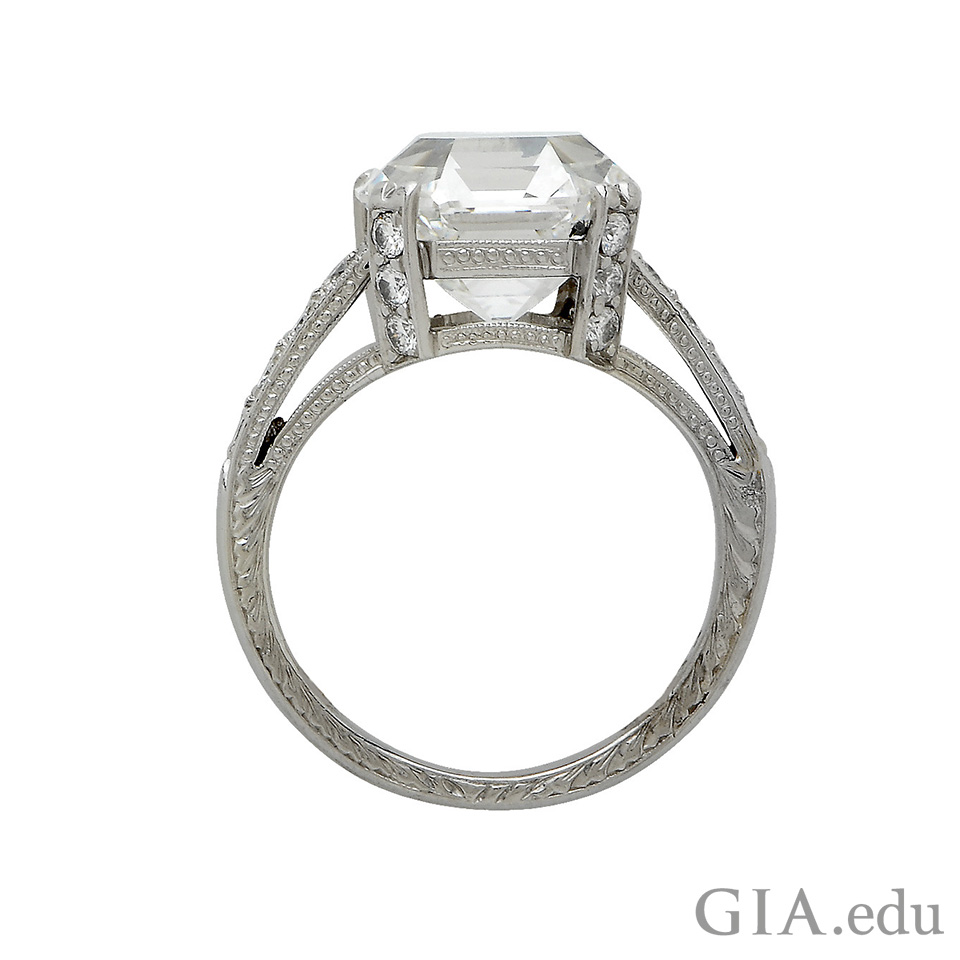
Sleek, elegant and beautifully understated, an emerald cut engagement ring is a great choice for someone who’s romantic and sophisticated. If you’re looking for diamond engagement ring inspiration, read on! (more…)


This article was originally published on July 26, 2016. It was updated on October 21, 2026 with minor edits for clarity and accuracy.
There’s no shortage of Internet advice on how to tell a diamond from a look-a-like, yet much of this information can be misleading, and some at-home testing methods may even damage your jewelry. Read on to learn how natural and laboratory-grown diamonds differ from diamond simulants and the best ways to tell them apart.
Natural diamonds form deep within the Earth over millions to billions of years and are brought to the surface through natural geological processes. Synthetic diamonds, on the other hand, also called laboratory-grown or man-made diamonds, have the same chemical composition, crystal structure and physical properties as natural diamonds. However, they are grown in a laboratory over days or weeks.
Natural gems that might look like diamonds to the average consumer include colorless sapphire, colorless topaz, and colorless zircon. Many natural gems also have synthetic (i.e., lab-grown) counterparts, such as synthetic colorless sapphire, synthetic colorless topaz, etc.
There are also synthetic diamond simulants that do not have natural gem counterparts. These are solely the product of man’s ingenuity in the laboratory, like YAG (yttrium aluminum garnet), GGG (gadolinium gallium garnet), CZ (synthetic cubic zirconia), and synthetic moissanite.
Laboratory testing by a reputable gemological laboratory is the safest way to determine whether a stone is natural or synthetic. A trusted lab, like GIA, will have the expertise and technology to distinguish between natural diamonds, laboratory-grown diamonds, diamond simulants (or imitations), and to detect diamond treatments.
If your diamond already has a GIA diamond report, like a GIA Diamond Grading Report or a GIA Diamond Dossier®, you know you have a natural diamond. The reports not only identify the diamond, they also provide an unbiased assessment of your diamond’s quality according to the 4Cs: color, clarity, cut and carat weight. The reports also disclose any treatments your diamond may have undergone to improve its color or clarity.
You can even verify your report by visiting GIA Report Check, GIA’s online database, and entering your diamond’s report number to see the grading details of your diamond.
If you don’t have a GIA report and would like to get one, you can ask your local fine jeweler to send your stone to GIA for you. Your jeweler will be familiar with any shipping and insurance requirements and will be able to explain the contents of your GIA report once it’s returned to you. Find a jeweler near you.

Natural diamond and various diamond simulants. Top row (left to right): Natural diamond, synthetic rutile, gadolinium gallium garnet (GGG), and synthetic spinel. Bottom row (left to right) strontium titanate, synthetic corundum, yttrium aluminum garnet (YAG), and colorless zircon. Photo: Robert Weldon/GIA.
Here are some tests we’ve found online – and reasons why you should avoid them!
Myth: Use a jeweler’s loupe to examine a stone. A diamond will have inclusions. A simulant will be perfect.
Fact: Most consumers have difficulty using a loupe and spotting inclusions. Unless you have some experience looking at diamonds, the reflections and facet junctions can make it difficult to see small inclusions. Also, some diamonds are flawless and you won’t see inclusions!
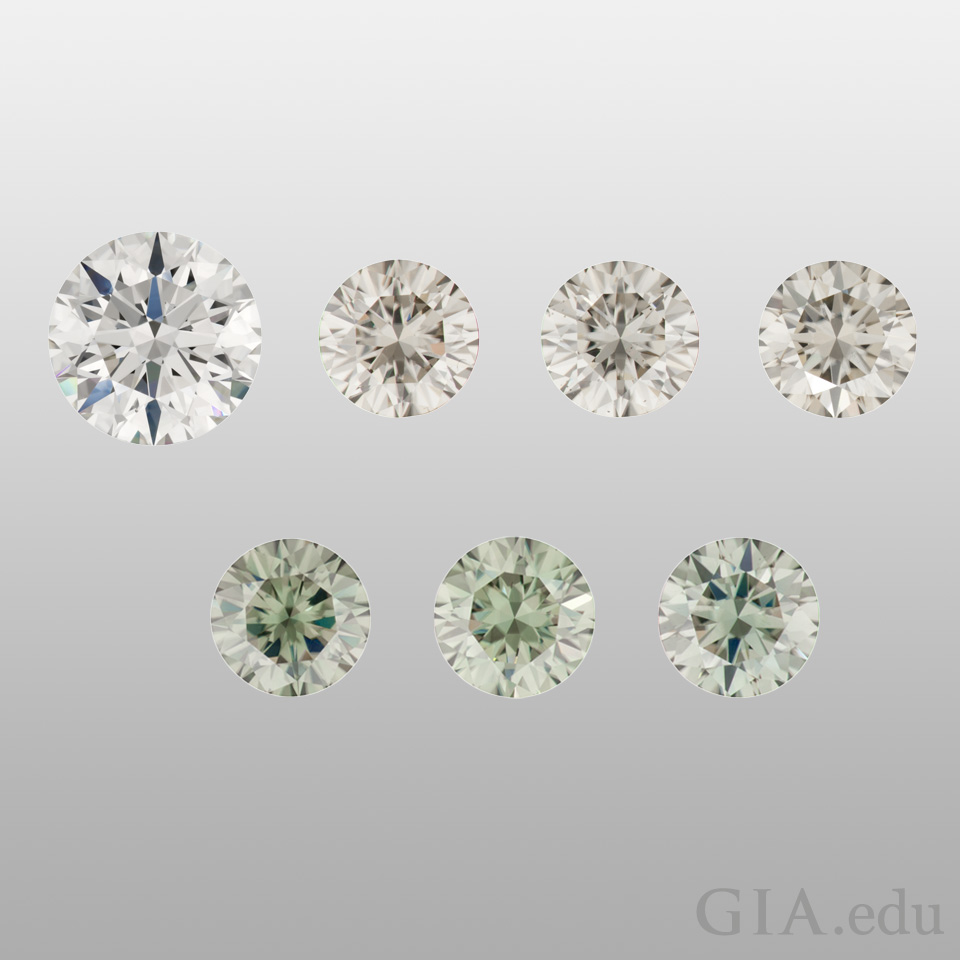
A natural diamond (upper left) with six smaller laboratory grown moissanite in the near colorless to greenish range. Photo: Robert Weldon/GIA
While it’s true that most diamonds, as products of nature, will have inclusions, it is a myth that diamond imitations, whether they are natural or lab-grown, will not have inclusions. Inclusions are the result of a gem’s crystal growth process and can occur in any gem, natural or synthetic. In fact, inclusions help gemologists identify natural and lab-grown gems. Also, glass imitations can have gas bubbles, which could look like natural inclusions to an untrained eye.
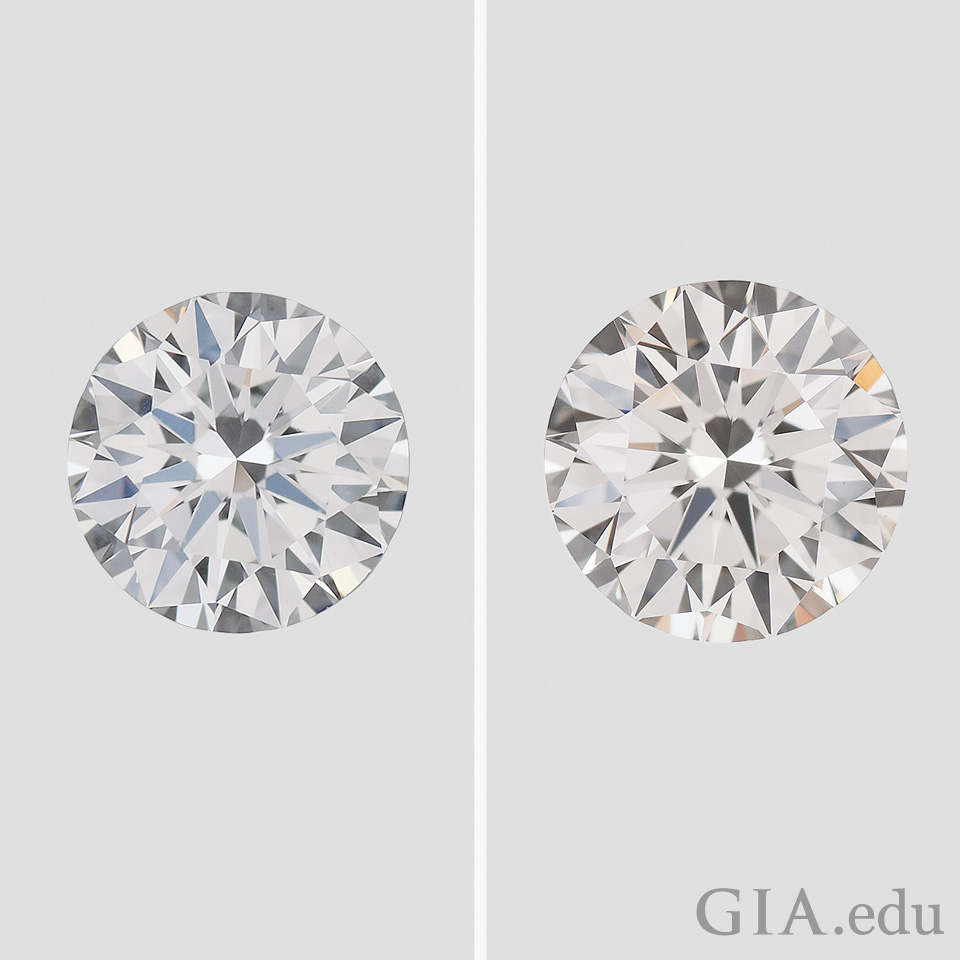
Two synthetic diamonds graded by GIA. The 0.39 carat (ct) on the left was graded F color and VVS2 clarity. The 0.83 ct diamond on the right was graded J color and VVS2 clarity. Photo: Jian Xin (Jae) Liao/GIA
Myth: A diamond will have sharp edges; a simulant will not.
Fact: A natural diamond will have sharp edges, but so will lab-grown diamonds and any gem material used to imitate diamond. The only gems that don’t are imitations that are made in a mold, like plastic and some glass. In addition, any gem, natural or lab-grown, can have abraded facet junctions (the line where two facets meet) caused by damage or wear and tear.
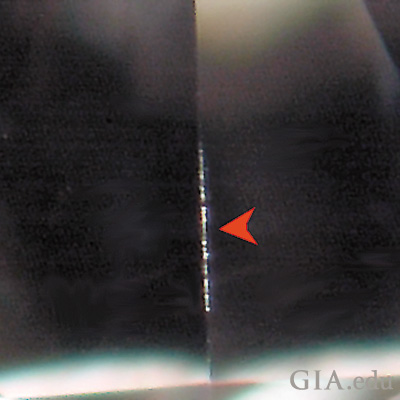
Contrary to popular myth, real diamonds don’t always have sharp edges. Diamonds can have abrasions: a series of minute nicks along the facet junctions that give the diamond’s edges a white or fuzzy appearance. This clarity characteristic will be noted on GIA diamond grading reports. Photo: Mitchell Moore/GIA
Myth: You can spot a diamond by the quality and metal of its setting.
Fact: While natural diamonds are often set in gold or platinum, the metal alone is not a definitive clue. Because of the high cost of gold and platinum, diamonds today are sometimes set in silver, too. Antique jewelry can contain diamonds set in a mix of gold and silver.
The style of the setting is also not a good clue. Diamonds are set in a variety of mountings, and a poor-quality setting does not necessarily mean the diamonds aren’t real. The quality could just be a sign of general wear and tear or work done by an inexperienced jeweler.
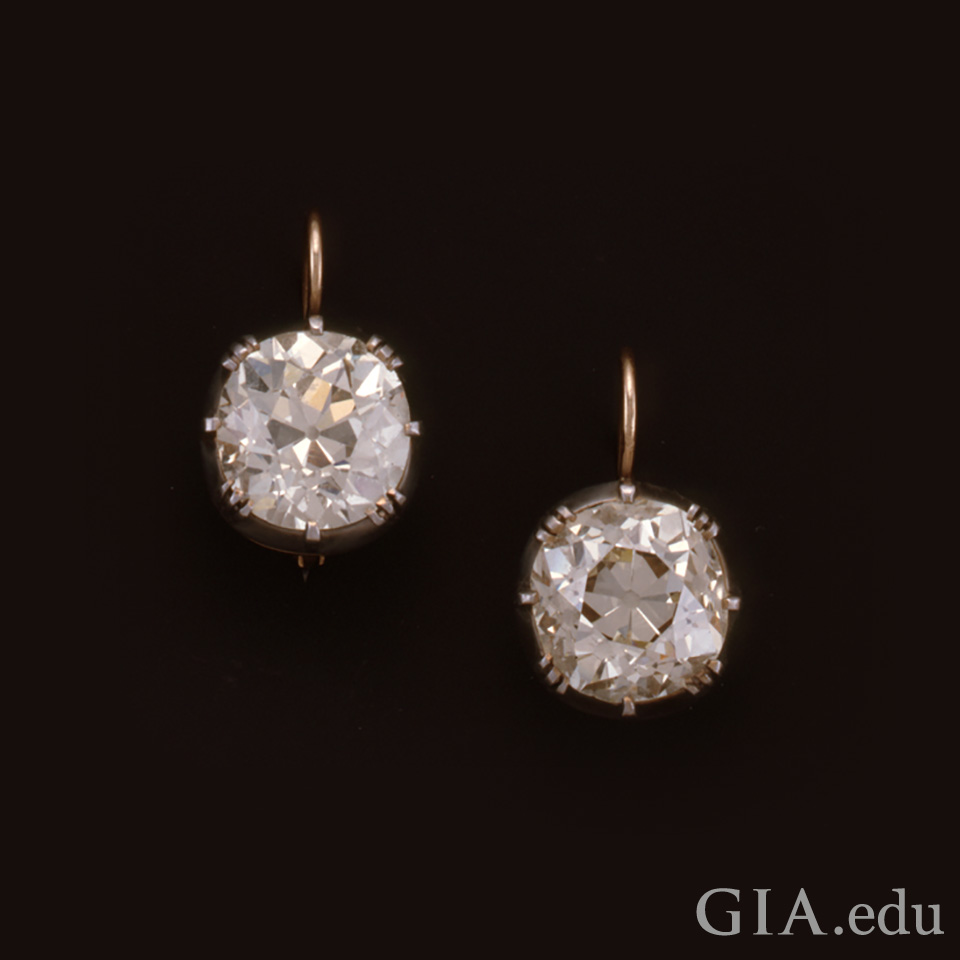
If you’re unfamiliar with antique jewelry, the settings of these circa 1860 Victorian gold and silver earrings may not seem like the highest quality. But don’t be too quick to write off the gemstones based on setting alone. The earrings feature a pair of old mine-cut diamonds with a total weight of 11.94 carats. Photo: David Behl. Copyright: Janet Mavec & GIA
Myth: Rub the gem with sandpaper. A diamond won’t be scratched.
Fact: This is a destructive test and should never be used! Diamond ranks 10 on the Mohs hardness scale, making it harder than most abrasives found on ordinary sandpaper, which typically range from 7– 9 on the Mohs scale. However, this test is both dangerous and unreliable for several reasons:
Myth: The fog test: Breathe on the gem. A diamond will not fog.
Fact: This test cannot be replicated with consistent results. Internet advice doesn’t tell us how long one must breathe on the gem to see results. Nor does it tell us how large the surface area of the gem needs to be so that you can actually see the fogging. Lab-grown diamonds and natural diamonds will react in exactly the same way. Ambient humidity might also affect your results.

Cutting style can have an effect on a diamond’s visual appearance. The round brilliant cut natural diamond (top) appears brighter than the emerald cut natural diamond (bottom). Both diamonds are set in platinum. Courtesy: JK & Co. Jewelers
Myth: If it sparkles, it must be a diamond.
Fact: Many consumers use the word “sparkle” in a very generic way to describe the overall visual effect of a faceted gemstone’s interaction with light. To the untrained eye, almost any faceted gem like synthetic moissanite, synthetic cubic zirconia (CZ), or a colorless natural zircon will sparkle.
On the other hand, an emerald cut diamond does not sparkle like some of these round brilliant diamond simulants.
When gemologists refer to a diamond’s sparkle, it means something very specific: scintillation. In addition to sparkle, scintillation also refers to the pattern of light and dark areas caused by reflections within the diamond. Scintillation is only one aspect of a diamond’s appearance; other factors are brightness (the internal and external white light reflected from a diamond when it is viewed face-up) and fire (the dispersion of white light into all the colors of the rainbow). It’s the combination of these factors that give diamonds their unique visual appearance.
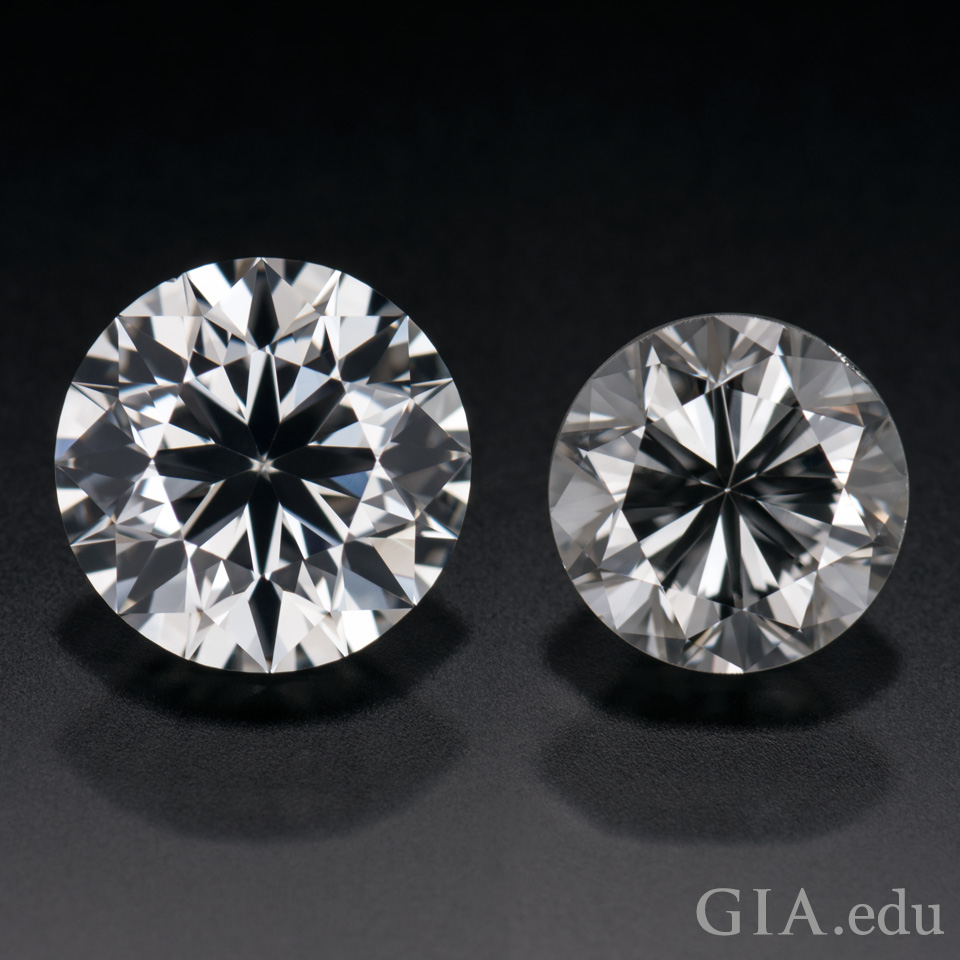
Two round brilliant cut diamonds selected to show how the quality of the cut affects visual characteristics. The Excellent cut (left) is much brighter than the Poor cut (right). Photo: Kevin Schumacher/GIA
Sparkle, or more accurately scintillation, depends on many variables:
Myth: The newspaper test: You can’t see the type through a diamond.
Fact: This is another problematic test. The logic behind it is that a well-cut modern round brilliant diamond is highly refractive, meaning that as light passes through it, the light slows down and bends. As you look through the diamond to the newspaper, the refraction causes a visual distortion, making the newsprint unreadable.
While this test can give a quick indication if you’re a trained and experienced gemologist, it can be very confusing and misleading for the average consumer, and should never be used as a definitive test. Many variables can affect the results—for instance, lighting conditions and
surroundings, whether the stone is clean or dirty, the placement of the stone on the newspaper, the tester’s eyesight, the shape and proportions of the gemstone being tested, and/or whether it is mounted.

A round brilliant cut natural diamond complemented by 14 round brilliant diamonds in 18K rose gold. Courtesy: JK & Co. Jewelers
Unfortunately, there are no easy and reliable at-home tests that will conclusively tell you if your gemstone is a diamond or some other material. Your best recourse is to take your jewelry to a trained jeweler for examination and, if necessary, request to have the gemstone tested by an independent gemological laboratory.
Ready to dig deeper into diamonds? Learn all about where diamonds come from.