Please ensure Javascript is enabled for purposes of website accessibility.
Search
Search
Search

GIA 4Cs Diamond Blog

GIA 4Cs Diamond Blog

The Allure of an Oval Diamond

An oval diamond has an elongated round shape that evokes an understated elegance, but with a difference. When it is faceted in the brilliant style, its fire can rival that of a round brilliant. So get ready to pick the perfect oval diamond.

In this blog, we cover:
Anatomy of an Oval Diamond
History of the Oval Diamond
Famous Oval Diamonds
What to Look for in an Oval Diamond
Oval Diamond Engagement Ring Settings

Anatomy of an Oval Diamond

An oval diamond is a fancy shape. You can think of it as a round brilliant diamond stretched on its sides, or a rounded version of a cushion shape or cushion brilliant. To pick a beautiful oval diamond, you need to know its parts.

Head or end: The “tips” of the oval.

Shoulder: The curved area reaching from the head/end to the belly.

Belly: The central area where the sides curve out the most.
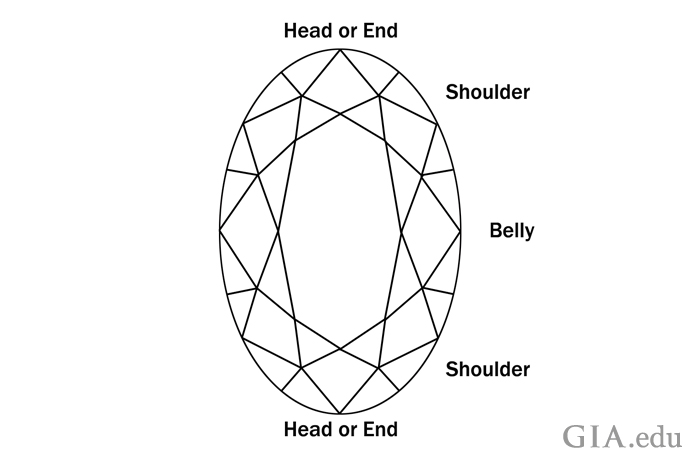
An illustration showing the anatomy of an oval diamond

Knowing the anatomy of an oval diamond will help you pick one you love. Illustration: GIA

You’ll typically find oval diamonds cut in the brilliant faceting style, which means the diamond has 57 or 58 facets, like a standard round brilliant, giving it similar visual qualities. An oval diamond can have a variety of facet arrangements, but the most common is eight bezel facets on the crown combined with eight main facets on the pavilion.
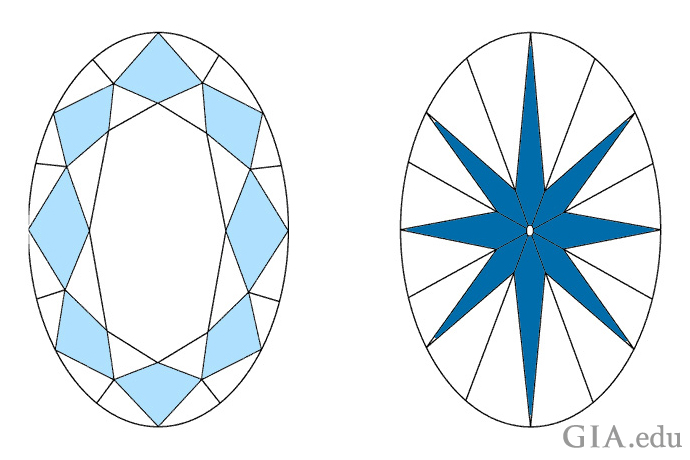
Line diagram of an oval diamond’s crown and pavilion views.

A common facet arrangement for oval diamonds: eight bezel facets on the crown, pictured in light blue (left); eight main pavilion facets, pictured in dark blue (right). Illustration: GIA

There are compelling reasons why many people love oval diamonds: Because the oval diamond has a larger surface area than a round diamond of equal carat weight, it can appear larger to the eye. The oval shape can make the finger seem longer. And because the shape doesn’t have sharp angles or corners, an oval diamond is less prone to chipping compared to other fancy shapes.

History of the Oval Diamond

The brilliant faceting style was first introduced circa 1700. Brilliant-cut cushion shaped diamonds predominated because cutters tended to follow the outline of the rough crystal. But diamonds were available in a variety of shapes, including oval. At this time, diamonds were not described by their shapes – they were simply called “brilliants.” It isn’t until the late 1800s that we first see mention of oval diamonds in literature.

Modern appeal for the oval diamond began in 1957. The oval diamond enjoyed a resurgence between 1998 and 2001, driven in part by marketing campaigns, and now it’s making a comeback. According to Town & Country magazine, the oval diamond ranked 6th in popularity with American consumers in 2016 (round diamonds were still no. 1).

Famous Oval Diamonds

The 105.60 carat (ct) Koh-i-Noor is probably the most famous oval diamond. It was so valuable that it was said that “whoever owned the Koh-i-Noor ruled the world.” Following centuries in the possession of rulers from Persia and India, the diamond was presented to Britain’s Queen Victoria on July 3, 1850. It is now set in the Queen Mother’s crown, which was fashioned for Queen Elizabeth, wife of George VI (and mother of Elizabeth II), for their 1937 coronation. You can see it in the Tower of London with the other Crown Jewels.

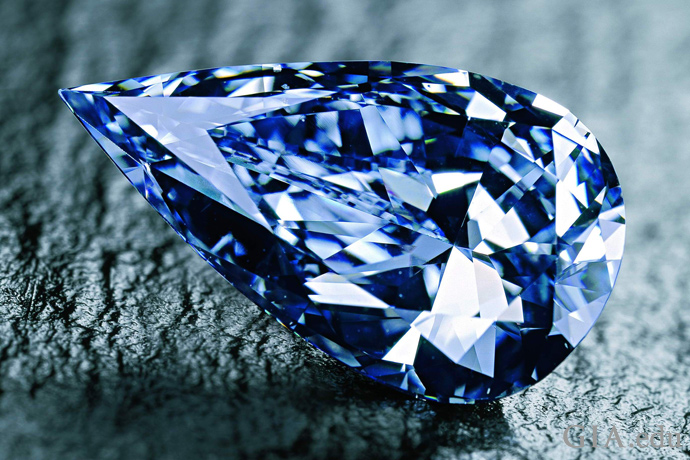
The 31.06 ct Wittelsbach-Graff (long known as the Wittelsbach Blue) is another famous oval diamond with a royal provenance. The rough probably came from India’s famed Golconda District. In about 1666, it was given as part of a dowry for the marriage of Infanta Margarita Teresa of Spain into the House of Hapsburg. In 1722, it was used again as part of a dowry, this time for a marriage into the House of Wittelsbach. In 1931, the Wittelsbach Blue vanished from sight and was hidden for 30 years, until it was rediscovered in 1961. After it was sold at auction for $24.3 million in December 2008 to London Jeweler Lawrence Graff, the original 35.56 ct cushion modified brilliant diamond was recut to a 31.06 ct oval to make it a Fancy Deep blue, Internally Flawless gem, and was renamed the Wittelsbach-Graff.

The 31.06 ct Wittelsbach-Graff diamond, recut from the historic Wittelsbach Blue

Pictured here is the 31.06 ct Wittelsbach-Graff diamond, recut from the historic Wittelsbach Blue. The recut diamond was graded Fancy Deep blue according to GIA’s colored diamond color grading system. Photo: Robert Weldon/GIA

Another oval diamond made international news in April 2017, when Hong Kong jeweler Chow Tai Fook bought a 59.60 ct Internally Flawless, Fancy Vivid pink diamond for $71.2 million. Known to many as the Pink Star or Steinmetz Pink, it became the most expensive diamond ever sold at auction. The retailer renamed it the CTF Pink Star. The diamond was mined in Botswana in 1999. It took cutters two years to turn the 132.50 ct rough into its final shape.

The Pink Star, a 59.60 ct Internally Flawless, Fancy Vivid pink oval diamond

The Pink Star, now called the CTF Pink Star, smashed auction records when it sold for $71.2 million in April 2017. The 59.60 ct Internally Flawless, Fancy Vivid pink diamond is a stunning example of an oval shaped diamond. Courtesy: Sotheby’s

What to Look for in an Oval Diamond

Turn to the 4Cs of diamond quality when shopping for an oval diamond. GIA uses the same criteria for determining carat weight, color and clarity for oval diamonds as it does for round brilliants. This can help you narrow your search.

Length-to-Width Ratio

Keep proportion in mind when looking at oval diamonds. Consumers and trade professionals tend to prefer a longer oval shape, according to a comprehensive survey of shape preferences GIA conducted in 2009. The survey showed that the most popular length-to-width ratio for ovals was 1.7:1. However, it is not practical to cut such long oval diamonds from the original rough, so you’ll rarely find one. More typical are ovals with ratios ranging from 1.3:1 to 1.4:1.

 A 1.06 ct oval diamond with a 1.71:1 length-to-width ratio

This 1.06 ct oval diamond has a 1.71:1 length-to-width ratio. It is rare to find oval diamonds this long. Photo: Kate Waterman/GIA
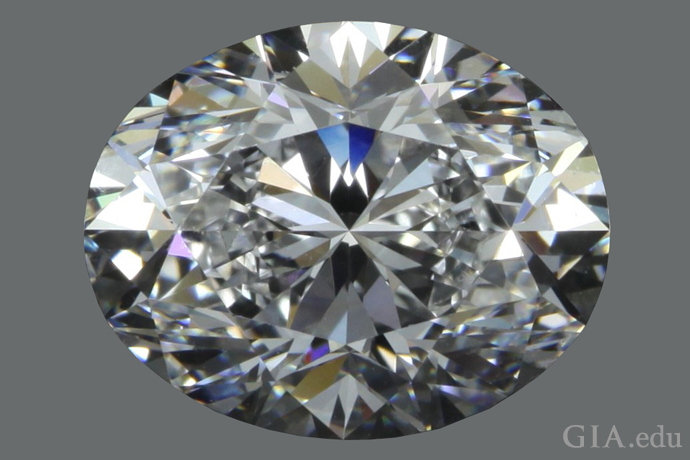
A 3.01 ct oval diamond with a 1.26:1 length-to-width ratio

This 3.01 ct oval diamond has a 1.26:1 length-to-width ratio, which is a little shorter than most oval diamonds. Photo: Kate Waterman/GIA
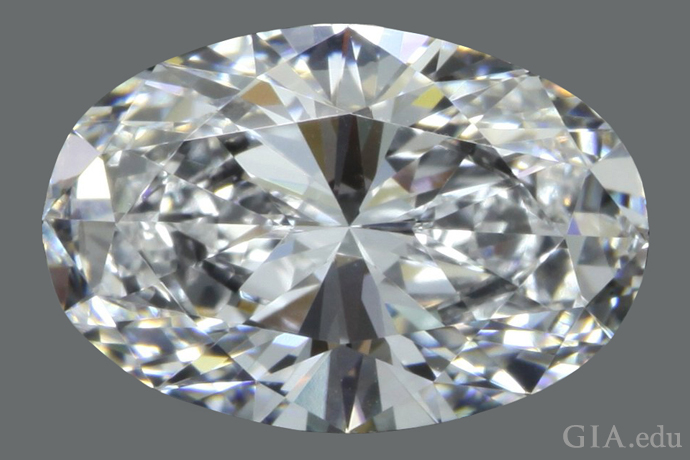
A 2.28 ct oval diamond with a 1.48:1 length-to-width ratio

This 2.28 ct oval diamond has a 1.48:1 length-to-width ratio. Even this length is a little hard to find. Photo: Kate Waterman/GIA

Symmetry

Symmetry is important in creating the beauty of an oval diamond. To determine if an oval diamond is symmetrical, draw an imaginary line down the center. The shape and faceting of the two halves should mirror each other. Then draw an imaginary line across the middle of the oval. Again, the shape and faceting of the two halves should be identical.
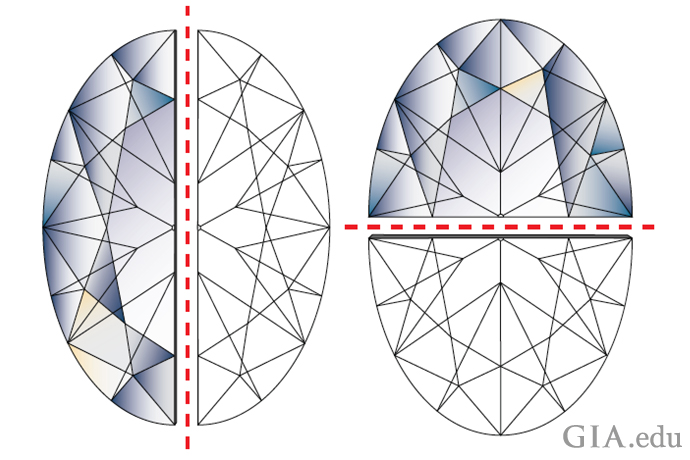
A diagram showing two lines of symmetry for an oval diamond: One that runs vertically along the length and another across the width, creating four equal parts

Symmetry is based on how closely the shape and facets on either side of these imaginary center lines mirror each other. Illustration: Peter Johnston/GIA
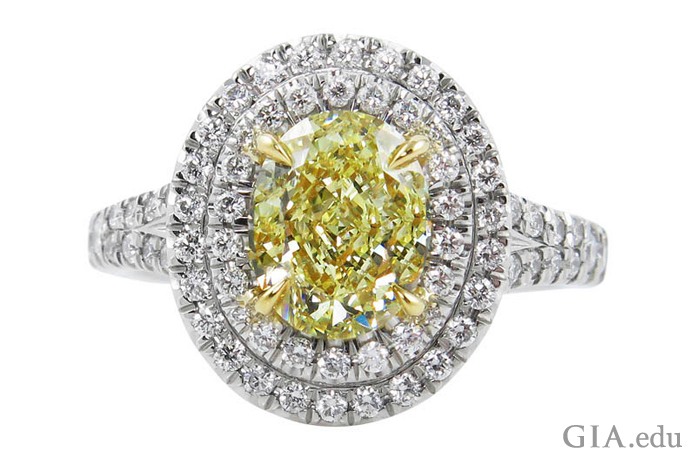
A 1.58 ct Fancy yellow oval diamond surrounded by two halos of melee diamonds

The allure of an oval diamond is easy to see in this 1.58 ct Fancy yellow oval. The two halos surrounding it contain D-to-F color melee diamonds totaling 1.20 carats. Courtesy: TrueFacet.com

Shape Appeal

Look for an oval diamond with a graceful outline and harmoniously proportioned parts. To find one that’s attractive to you, it pays to compare several different oval diamonds. Here are some common shape variations:
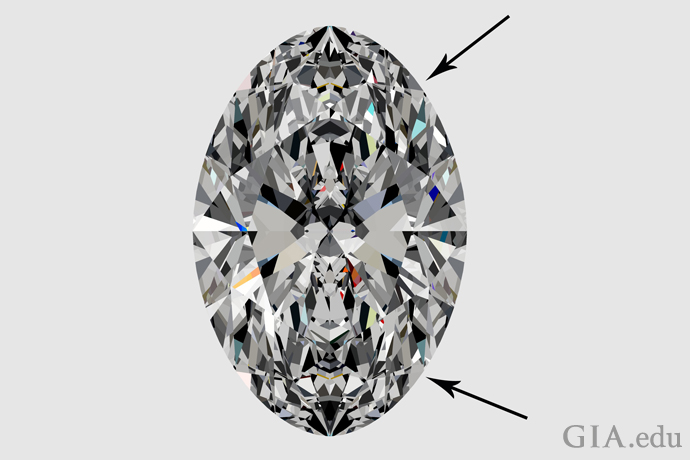
An oval diamond with flat shoulders

This oval cut has flat shoulders, which many in GIA’s survey considered less graceful. Image: Al Gilbertson/GIA
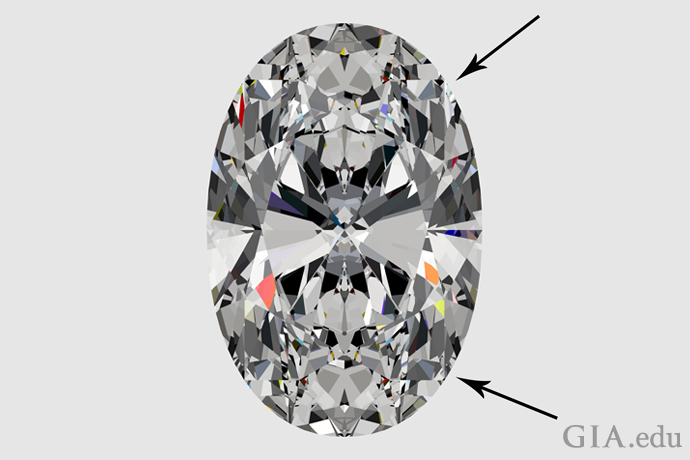
An oval diamond with bulging shoulders

This oval cut has bulging shoulders – an aspect that many of those surveyed also considered less graceful. Image: Al Gilbertson/GIA

An oval diamond with no shoulder bulge

This oval cut has no shoulder bulge. Its overall symmetry and well-proportioned shape contribute to its visual appeal. Image: Al Gilbertson/GIA

Girdle Thickness

The girdle is the intersection of the crown and pavilion. It defines the perimeter of the diamond and functions as its setting edge. Girdle thickness is judged the same way in fancy shapes as in rounds. Be sure to look at the diamond’s proportion diagram in its GIA Diamond Grading Report. The diagram will show the stone’s average girdle thickness percentage and indicate if the girdle is too thick or too thin. An overly thick girdle can contribute to a heavier diamond than its face-up appearance warrants, and a thin girdle can increase the risk of damage such as chipping.

Bow-tie Effect

Expect to see a bow tie. A “bow tie” in diamond parlance is a dark bow-shaped pattern across the table of the diamond.

What causes a bow tie? A diamond’s facets act like a series of mirrors that gather light from around you and return it to your eye. As you look at the stone, the dark contrast you see is a reflection of your head and shoulders blocking light from entering the diamond. The closer your face is to the diamond, the more pronounced the bow tie will be.

If the diamond is cut well, the bow tie will be minimal, but once you are in front of the diamond, there will always be some measure of a bow tie.

An illustration of an oval diamond showing the bow-tie effect

The grayed-out area across the table in this illustration is where you’ll likely see the bow-tie effect. Illustration: Peter Johnston/GIA

Oval Diamond Engagement Ring Settings

You’ll have lots of choices for engagement ring settings for oval diamonds. And each setting can create a dramatically different look. Here are some options.

Halo Setting

A halo of smaller diamonds around the oval center stone is a lovely addition. It accentuates the shape and makes the diamond appear larger. Choosing a different color of metal or side stones can create an arresting look.
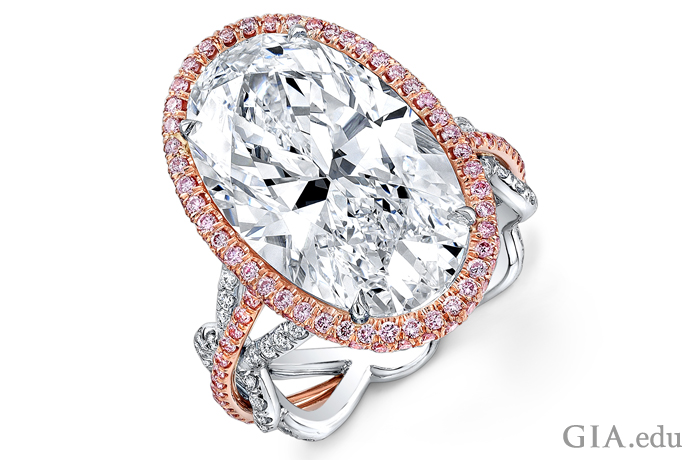
A 10.92 ct oval diamond engagement ring, accented with a halo of Fancy pink melee diamonds

A mesmerizing sight, this oval diamond engagement ring features a 10.92 ct center stone, accented with a halo of fancy pink melee diamonds. Courtesy: Rahaminov Diamonds

Prong Setting

Prong settings are good choices for an oval diamond. Not only do they protect the diamond from loss, but they can also add height, raising the diamond from the band and drawing the eye to the gem.

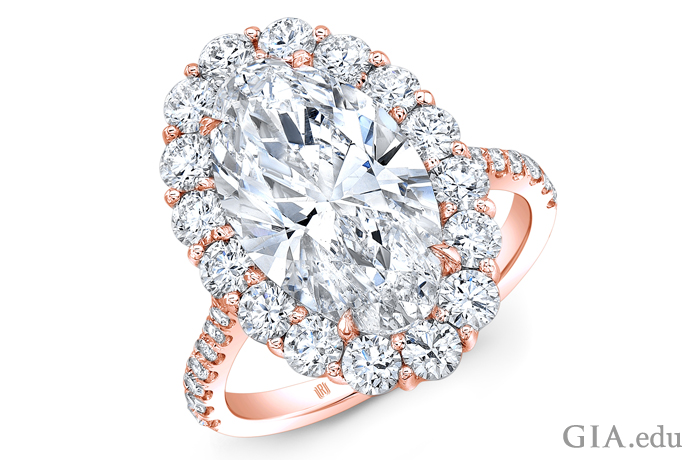
An oval diamond mounted in an 18K rose gold prong setting

An oval diamond makes a dramatic statement in a prong setting. A halo of smaller diamonds adds even more panache. Courtesy: Rahaminov Diamonds

Bezel Setting

A bezel setting, which completely encloses the perimeter of the diamond in metal, is a great choice if you lead an active life. It’s an effective way to protect the diamond and also enhances the beauty of the oval shape.

A 0.84 ct oval diamond mounted in a platinum bezel setting

A 0.84 ct oval shape diamond sits in a platinum bezel setting. Courtesy: 1stdibs.com

Side Stones

An oval diamond goes well with virtually any kind of side stone. Half-moon diamonds echo its shape, so they can be an attractive choice. Baguettes and tapered baguettes offer an opportunity to create contrast, as do colored gems. If you want your diamond side stones to match the center oval, choose side stones that are within one or two color grades of the larger diamond so they don’t compete with its beauty.

A 0.90 ct oval diamond engagement ring, flanked by two round sapphires and round diamond side stones

Contrasting colors and shapes bring life to this engagement ring. It features a 0.90 ct oval center stone, flanked by two round sapphires and round diamonds. Courtesy: EraGem.com

Wide Band

Because of its shape, an oval diamond works well with a wider band.

An oval diamond three stone engagement ring

Three oval diamonds look at home in a wide band. It especially suits the 1.57 ct center stone. Courtesy: EraGem.com

An oval diamond is beautiful…classic…and a little different. It’s a wonderful option for an engagement ring.

If you’re looking to create a diamond engagement ring that’s out of the ordinary, there are many more fancy shapes to choose from. A marquise diamond just might be for you.
Engagement Ring Settings to Make Your Diamond Look Bigger

Engagement ring settings should be both beautiful and practical. A setting defines your ring style, adds drama to the diamond and protects it from loss or damage. The right setting and band can also make your diamond look bigger and even more sparkling.
If you’re looking to create an illusion of size, here are some tips for engagement ring settings that can make your diamond “grow.” But first, let’s start by debunking some dubious recommendations floating around the internet.

What Doesn’t Make a Diamond Look Bigger

Diamond shape and carat weight: While a diamond’s outline – round, rectangular, oval, pear, marquise — can have some influence on the overall perception of diamond size, the shape of a diamond alone does not guarantee the stone will look bigger. The same is true for diamond carat weight. Just because one diamond weighs more than another of the same shape doesn’t mean it will look bigger. Similarly, one diamond might look bigger than another of the same shape and weight, but may be less appealing overall. That’s because there might be many factors at play, especially those related to the quality of the diamond’s cut and how its weight is distributed.

Illustration showing diamond with bulge on either side of the pavilion.

A diamond’s shape – and even its carat weight – won’t guarantee a large-looking gem. Excessive bulge, shown here by the shaded areas on either side of the pavilion, adds to a diamond’s weight without contributing to the stone’s perceived size. Illustration: Peter Johnston/GIA

Here are some examples:

  • A diamond with shallow cut proportions may be physically wider and longer, but it will be far less appealing. That’s because a lot of the light that enters the crown of a shallow diamond might exit through the pavilion, making the diamond look dull and unattractive.
  • A shallow pavilion depth – less than 38 percent – can create a “fish eye” effect, seen as an unattractive gray ring under the table. (Pavilion depth is measured as the distance from the bottom of the girdle plane to the culet.) As above, the diamond may be physically wider and longer, but the stone will have a dull, flat look.

What’s a crown, pavilion, girdle and culet? Learn more about diamond anatomy.

  • On marquise, pear and heart shaped diamonds, the sides near the points are called wings. If they’re too flat, they make the stone look too narrow. If they’re too rounded, they make it look short and stubby.
Flat wings contribute to this marquise shaped diamond looking too narrow.

On the left, flat wings contribute to this marquise shaped diamond looking too narrow. On the right, rounded wings contribute to this marquise shaped diamond looking stubby. Photos: Kate Waterman/GIA

White metal band: A common misconception about engagement ring settings is that a white metal band can act like a mirror to reflect and amplify a diamond’s size. The logic seems sound until you consider that a rose gold or yellow gold band could serve as a dramatic counterpoint to the diamond, making it look bigger. So a white metal band is not a foolproof solution.

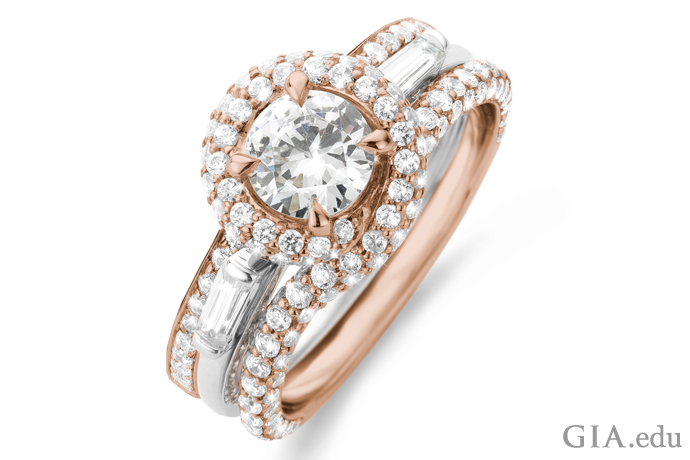
Diamond ring with 5.31 carats of diamonds in a rose gold setting.

You decide if the 5.31 carats of diamonds in this ring pop because of the rose gold setting. Courtesy: Rahaminov Diamonds

Colored gemstones: Colored accent stones provide dramatic contrast to a center stone, but do they make the diamond look larger? Not necessarily. One could convincingly argue that a colored stone would compete with a diamond, thus distracting the eye.

Slender prongs: A potentially troublesome myth about engagement ring settings is that the less a prong covers a diamond, the more of the gem that’s shown, so the bigger it will look. While this may be true technically, it is not advisable. Prongs serve an essential function: they hold a diamond securely in place. Skimp on the necessary size and number of prongs, and you risk losing the diamond.

What Does Make a Diamond Look Bigger

Here are some engagement ring settings to consider if you’re looking to boost the appearance of your diamond’s size.

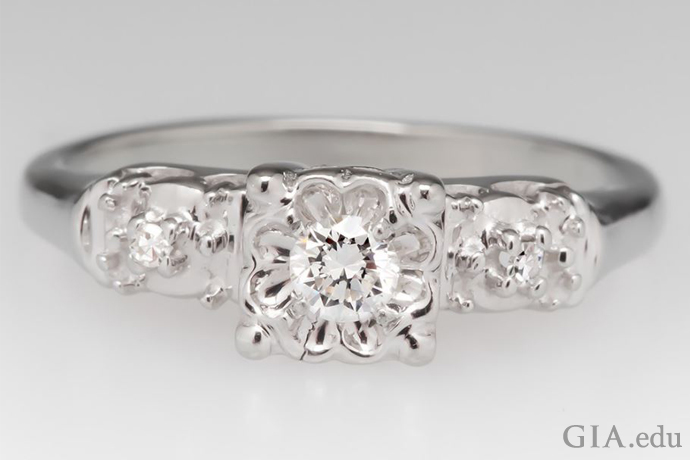
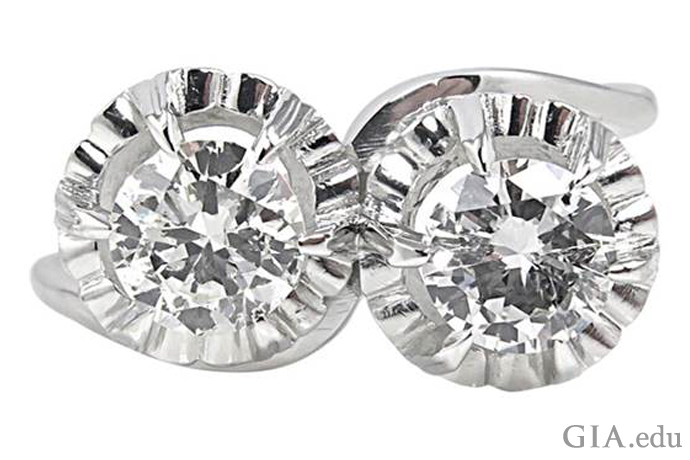
Illusion setting: During the Great Depression of the 1930s, when few could afford large diamonds, jewelers sometimes set a diamond in a head made of a fluted white metal. The shiny metal was made with ripples, so the whole head looked like the diamond it reflected. This setting was so successful in delivering an illusion of size that it’s still used today.

  • TIP: The purpose of the illusion setting is to make a near-colorless diamond look larger, and white metal is required to achieve this particular effect. If the diamond is yellow in color, then a yellow gold illusion setting is a better choice.
  • TIP: Diamonds smaller than 0.50 carat (ct) are good candidates for illusion engagement ring settings. You’d probably want to showcase a diamond 0.50 ct or larger on its own, instead of relying on the illusion setting to work its optical magic.
Engagement ring with illusion setting and diamonds with a total weight of 0.12 carats

The total weight of diamonds in this ring is just 0.12 carats, but the illusion setting makes them appear much larger than they really are. Courtesy: EraGem

Toi et Moi engagement ring in an illusion setting featuring two diamonds with a total weight of 1.18 carats.

Here’s an example of a Toi et Moi (“You and Me”) engagement ring in an illusion setting. The total weight of the two diamonds is 1.18 carats, but they look larger because of the illusion setting. Courtesy: TrueFacet

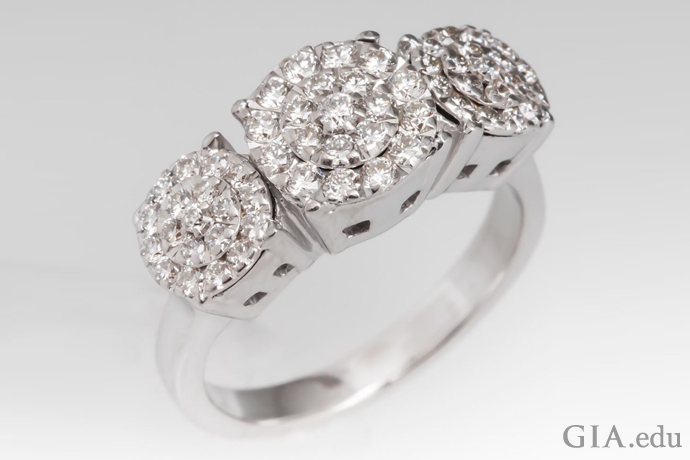
Cluster setting: This engagement ring setting places several small diamonds of similar size next to each other. This technique maximizes sparkle and gives the illusion of a single diamond that is much larger in size (and more costly) than the melee diamonds used to make it.

  • TIP: Diamonds of the same or similar color grades work best in a cluster setting. Diamond manufacturers know this, and match color grades when producing these kinds of rings. So you won’t have to worry about selecting the many smaller diamonds that will be part of your cluster setting.
  • TIP: The more metal surrounding a stone, the more it is protected. Cluster settings have lots of metal. So your diamonds will be better safeguarded against damage.
Diamond ring with a cluster setting creates the illusion of three large gems using only 0.29 carats of diamonds.

Three diamonds or 58? You might not be able to tell from a distance. In this ring, the cluster setting creates the illusion of three large gems using only 0.29 carats of diamonds. Courtesy: EraGem

Halo setting: When a ring of smaller diamonds is artfully placed around a center stone, the center stone can appear to be the size of the halo.

  • TIP: Engagement ring manufacturers select the melee that makes the halo, so you won’t have to worry about picking the many small diamonds that will go into the engagement ring setting.
  • TIP: A diamond center stone weighing 0.50 ct or more works best in this kind of setting because the melee in the halo will enhance it. You probably wouldn’t want to use a smaller diamond, since it would be too close in size to the melee. That combination would probably look like a pavé set ring with one diamond (the center stone) somewhat larger than the rest.
  • TIP: The prongs on halo diamonds tend to wear out faster. Should you go with this style, be sure to have your ring routinely checked by your jeweler.
Diamond engagement ring with double halo setting surrounding a 1.17 carat cushion cut center stone.

Where does the center stone end and the halo start? Here’s how the trick of the eye works. This double halo set with 0.50 carats of diamonds makes the 1.71 ct cushion cut center stone look even larger. Courtesy: 1stdibs.com

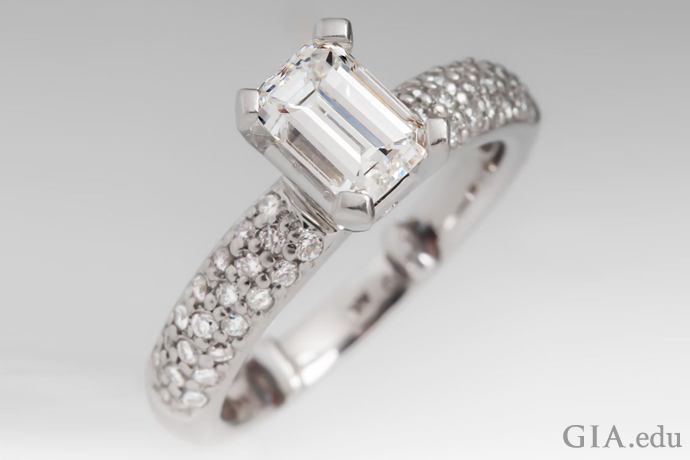
Pavé setting: To achieve this popular technique, many diamonds 0.20 ct or smaller are set into tapered holes in a metal surface, nestled close to the melee stones next to them. Pavé creates an appearance of uninterrupted diamonds in the band, which can make the center stone look larger.

  • TIP: Pavé set diamonds in engagement ring settings are typically very secure, as the diamonds are set into metal. However, should a diamond fall out, it is more difficult for a bench jeweler to replace it.
  • TIP: Avoid engagement ring settings with pavé set diamonds on the bottom of the shank. This area of the ring is exposed to a lot of friction, so the diamonds are more easily lost or damaged.
Diamond engagement ring featuring pavé set diamonds and a 1.00 carat emerald cut center stone.

The pavé set diamonds in this engagement ring glitter like stars in the night sky. The center stone is a 1.00 ct emerald cut diamond. Courtesy: EraGem

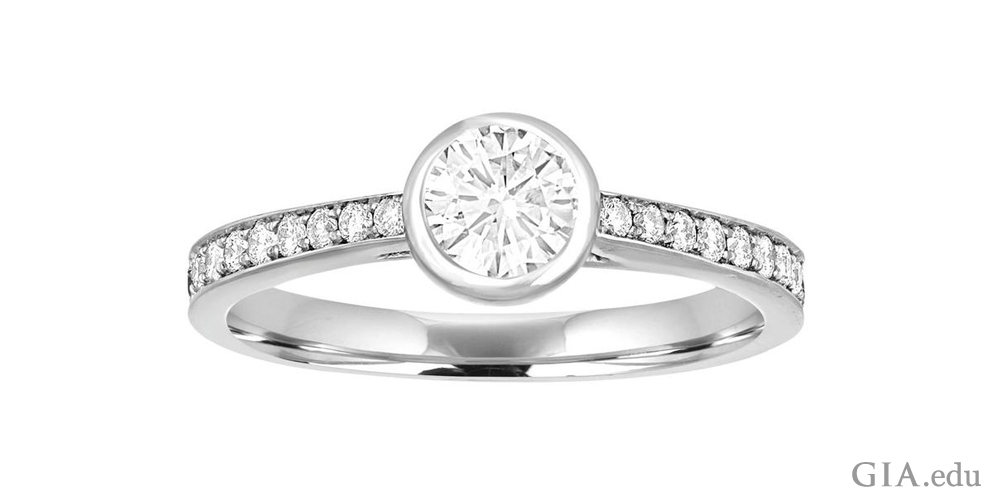
Bezel setting: In this setting style, a band of metal surrounds the diamond’s girdle. As a result, the diamond’s circumference may appear to be larger. Bezel engagement ring settings also afford extra protection against accidental bangs and bumps.

  • TIP: The bezel setting is generally used for round and oval diamonds. It is more difficult to create a bezel setting for other shapes, such as square and marquise diamonds.
  • TIP: Like rock climbing? Playing lacrosse? Vigorous exercise? The bezel setting protects the center stone, so it is a great choice for active people.
  • TIP: A bezel setting could deaden the brightness of a poorly cut diamond.
Diamond engagement ring with bezel settings.

This 0.53 ct diamond appears larger because of the bezel setting. Courtesy: 1stdibs.com

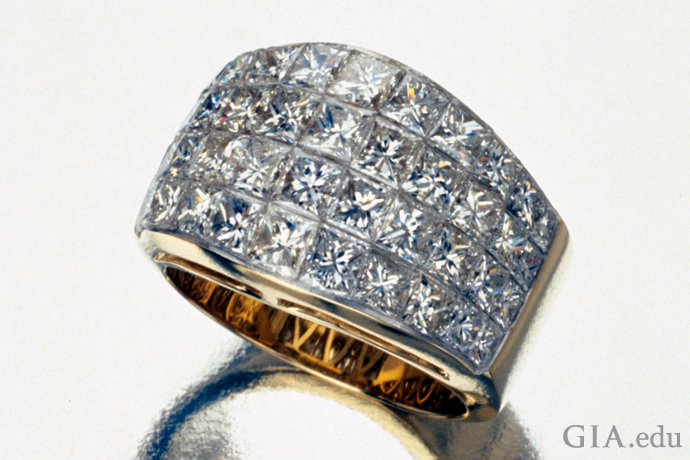
Invisible setting: For this technique, small diamonds are cut with grooved pavilions and then slipped into a thin wire framework. This eliminates the need for prongs and allows the gems to be set against each other. The result is that the entire diamond is visible, and groups of diamonds can look like one large gem.

  • TIP: There is a drawback. Should a diamond in an invisible setting be damaged, it is extremely difficult to repair or replace it. So Invisible diamond engagement ring settings are probably not a good idea for physically active individuals.
Yellow gold ring with diamonds in an invisible setting.

An invisible setting can give the appearance of a field of diamonds. Courtesy: Ambar Diamonds

More Tips to Make Your Diamond Look Bigger

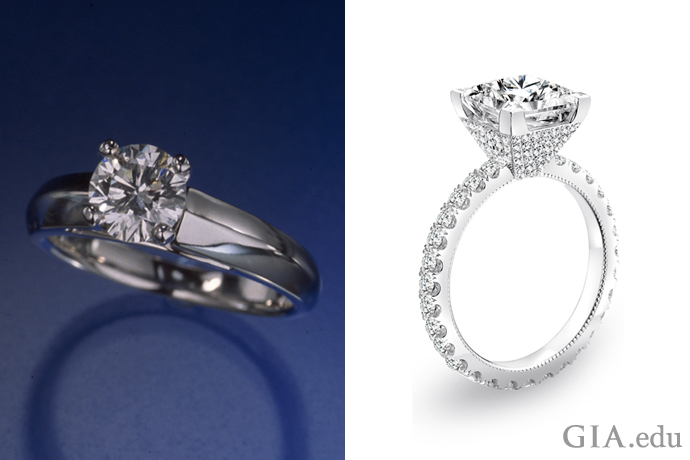
Choose a thin ring shank or band: Here’s a way to trick the eye. A thin band can make a diamond look larger. Similarly, a thick band might overshadow the diamond.

Diamond ring with thick white metal band.

Left photo: A thick band nearly overwhelms the 1.68 ct diamond center stone. Photo: Robert Weldon/GIA. Courtesy: Rogel & Co., Inc. Right photo: What a difference a band makes. The main diamond in this ring rightfully takes center stage. Courtesy: Platinum Guild International

Add side stones to your engagement ring setting: This is a great way to add sparkle and size to an engagement ring – and the options are endless. You could add a diamond baguette on each side of the center stone. You could pick colored stones to create contrast. You could use different colored metals around the side stones.

Unlike the melee used for pavé and halo settings, you may have the opportunity to choose the side stones. If you are uncomfortable making the choice, read our advice on choosing engagement ring side stones to get you started. If you have any questions, ask your jeweler for help, he/she will have a trained eye.

And last, but certainly by no means least: keep your diamond clean. While a clean diamond won’t look bigger, per se, it will display that signature sparkle that telegraphs “diamond” across a crowded room – and isn’t that what it’s all about?

Speaking of diamond sparkle, here are some tips and tricks to get the most sparkle out of your diamond engagement ring.

Melee Diamonds: Tiny Diamonds, Big Impact

Look at a beautiful engagement ring and you might see small diamonds, called melee diamonds (pronounced meh-lee), that accent the center diamond and make the ring pop. Melee diamonds are a popular way to add sparkle to diamond engagement rings.

So what do you need to know about melee diamonds to make an informed purchase?

In this post we’ll cover:
What Are Melee Diamonds
How Melee Diamonds Are Cut
Popular Ring Settings for Melee Diamonds
Melee Diamonds and Your Engagement Ring


What Are Melee Diamonds?

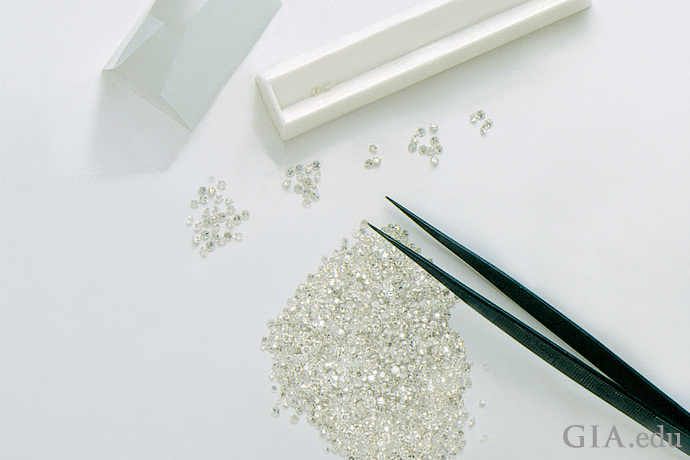
GIA defines melee as small diamonds, either single cut or full cut (see definitions below), weighing less than 1/5 carat (ct). However, the exact size range of melee varies from country to country and from one segment of the trade to another. Melee diamonds can be as small as 0.001 ct (1/1000 of a carat). They are often cut into tiny round diamonds and set around a center stone or on the band.

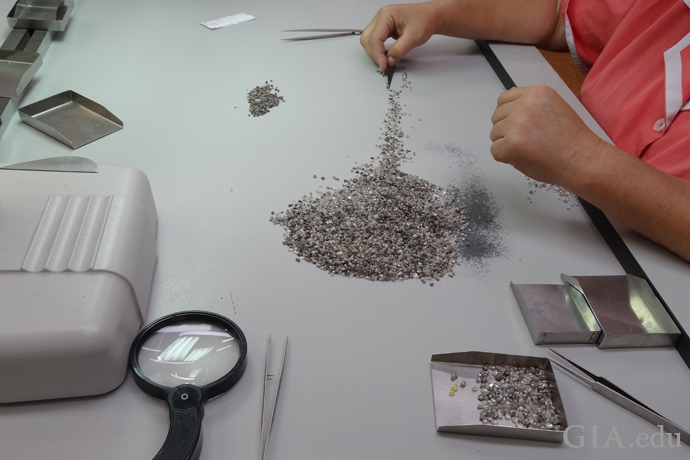
Hundreds of melee diamonds glitter on a table.

Hundreds of melee diamonds glitter on a table, waiting to be sorted. Photo: GIA


How Are Melee Diamonds Cut?

Melee diamonds are produced in large quantities in factories that use the latest diamond cutting equipment. High-tech machines have reduced the amount of labor required and improved the quality of the finished product, but cutting and sorting melee is still a labor intensive business. The city of Surat in India is an important manufacturing hub for diamonds, including melee which are faceted, sorted, and sold in parcels of 100 carats or more to jewelry manufacturers who then set them in a wide array of jewelry.

Typical faceting styles for melee include:

  • Single cut: A cutting style with a round girdle outline and 17 or 18 facets, depending on whether a culet is present, including a table, eight crown facets, eight pavilion facets and (very rarely) a culet
  • Full cut: A round brilliant-cut with 57 or 58 facets, depending on whether a culet is present, including 32 crown facets, 24 pavilion facets, a table and (usually) a culet

Sorting small rough diamonds by hand at Alrosa's Lomonosov mine,.

Sorting small rough diamonds by hand at Alrosa’s Lomonosov mine, Arkhangel, Russian Federation. Photo: Russ Shor/GIA


Popular Ring Settings for Melee Diamonds

The more diamonds in a ring, the more sparkle it has. Due to their small size, melee diamonds are inexpensive when compared to larger diamond center stones, so they are often generously used in engagement ring designs to add sparkle. You’ll also find them as dazzling accents in watch faces, earrings and pendants – really in any piece of jewelry that calls for added sparkle and brilliance.

  • Halo setting: Melee diamonds are the building blocks for this popular setting, where tiny diamonds encircle the center stone. This style can add sparkle to a ring and draw attention to the center stone and make it appear larger.

Engagement ring featuring a halo setting of melee diamonds.

A halo of melee diamonds makes this engagement ring all the more dazzling. Courtesy: Ziva

  • Pavé setting: Pronounced “pah-vey” from the French for “to pave,” is a style of bead setting in which many small gems, like melee diamonds, are set close together to create an interlocking honeycomb pattern. It makes for a dramatic, sparkling look and it’s a setting style often used to make complex designs in engagement rings and other jewelry.

Cluster ring featuring 3.35 carats of diamonds in a pavé setting.

Pavé is the central design element in this cluster ring, pavé set with 3.35 carats of diamonds. Photo: Robert Weldon/GIA

The pavé technique also allows for the creation of more affordable engagement rings, as small diamonds are generally less expensive than larger ones of comparable quality. So an engagement ring with pavé may be a good alternative for those on a budget.

Melee diamond and center stone engagement ring.

Melee diamonds transform a simple design into an intricate work of art. Courtesy: Laurence Bruyninckx – Antwerp


Melee Diamonds and Your Engagement Ring

While you’ll have to make decisions about the color, clarity, cut, and carat weight of your diamond center stone, it’s unlikely you’ll have to select the melee for your engagement ring. Melee diamonds are sorted by color and clarity prior to being packaged into parcels and sold to jewelry manufacturers, who will then match them to the diamond center stone.

An independent diamond grading report is a must-have for your diamond center stone given its cost and any reputable jeweler will provide one. A grading report is your assurance that your diamond is natural and discloses any known treatments that may have altered its color or clarity. However, don’t expect to receive grading reports for your melee diamonds. There are a number of reasons why, but the overriding one is economic: The cost of grading for melee is too high in relation to their value. Melee are sold in large parcels often containing hundreds of diamonds so it is not practical to have each one graded.

Carat Weight vs Total Carat Weight

When buying a diamond engagement ring with melee diamonds, it’s important to understand the difference between “carat weight” and “total carat weight,” because diamond weight is a driving factor in determining price. Total carat weight, often abbreviated “tcw” in the jewelry industry, is used to describe the combined weight of all the diamonds in a piece of jewelry that only contains diamonds. The description carat weight, abbreviated “ct,” only applies to an individual stone, like the center stone. A ring with many small diamonds with a combined total weight of 2.50 carats (or tcw) can cost significantly less than a solitaire engagement ring with a single diamond weighing 2.50 ct. That’s because larger diamonds are more rare than smaller ones of comparable quality, and therefore they cost more per carat.

Piaget Limelight ladies watch featuring 4.37 carats of melee diamonds.

Shining like stars in the night sky, some 4.37 carats of melee diamonds twinkle in this luxurious Piaget Limelight tonneau-shaped ladies watch. Courtesy: 1stdibs.com

The sparkle in your engagement ring telegraphs your love to the world. Melee diamonds can make it glow a bit brighter. But if you’re looking to add even more sparkle to your engagement ring, you can go beyond melee diamonds with these additional engagement ring tips.

April Birthstone: What You Need to Know About Diamonds

Diamond does double-duty: it’s the April birthstone and a near-universal symbol of love. So if you were born in April, you have two reasons to adore the gem. Here’s a crash course on it – and tips for picking a beautiful one.

In this post, we’ll cover:
Gemological Information on Diamonds
Diamond History
Diamond Lore
Where Diamonds Come From
Qualities to Look for in a Diamond
Diamond Care & Cleaning


April Birthstone: Gemological Information on Diamonds

The hardest natural material on earth, diamond ranks 10 on the Mohs Scale of Hardness and is the only gem made of a single element: It is typically about 99.95 percent carbon. The other 0.05 percent can include one or more trace elements, which are atoms that aren’t part of a diamond’s essential chemistry. Some trace elements can influence its color or crystal shape. For example, the presence of nitrogen causes diamonds to appear yellow. Boron atoms are often responsible for the color of natural blue diamonds.

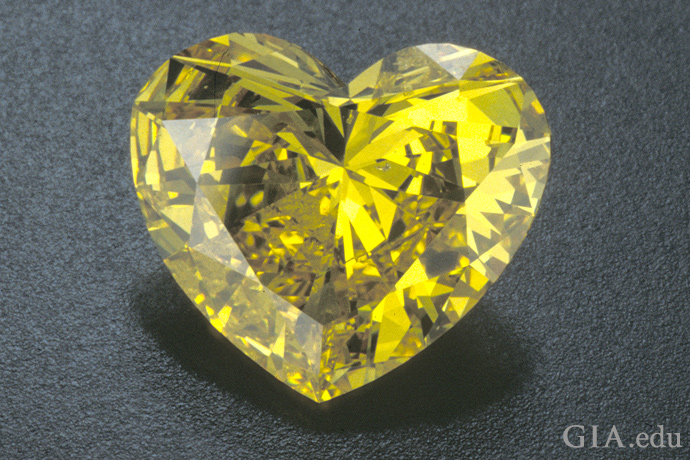
Heart-shaped yellow diamond.

Your pulse may quicken admiring this heart-shaped natural Fancy Intense yellow diamond. Photo: Robert Weldon/GIA

The Blue Empress, a 14 carat Fancy Vivid blue diamond.

Say goodbye to the blues when you admire the Blue Empress, a 14 carat (ct) Fancy Vivid blue diamond. Courtesy: Steinmetz Diamonds

Diamonds form under high temperature and pressure that exist only within a specific depth range (about 100 miles; 160 kilometers) beneath the earth’s surface. The conditions are extreme: Temperatures must be between 2102oF to 2192oF (1150 to 1200 0C); the pressure must be between 50 and 70 kilobars – 50,000 to 70,000 times greater than atmospheric air pressure at sea level. Carbon atoms in this environment in the mantle may form diamond.

A diamond’s hardness is due to the way the carbon atoms bond. Diamond’s crystal structure is isometric, which means the carbon atoms are bonded in essentially the same way in all directions. Graphite, a mineral used to make pencil lead, is also made of carbon, but because the molecules bond differently, this mineral is not nearly as hard.

Gemologists love diamonds because they are beautiful – and because many formed more than a billion years ago. Studying these ancient beauties tell us much about our planet.


April Birthstone: Diamond History

Our love for diamonds started in India, where they were gathered from the country’s rivers and streams. Traded as early as the fourth century BCE, diamonds were coveted by the wealthy. Caravans brought Indian diamonds, along with other exotic merchandise, to medieval markets in Venice. By the 1400s, diamonds were becoming fashionable accessories for Europe’s elite.

A 4 carat old mine cut diamond.

This 4 ct old mine cut diamond comes from India’s famed Golconda mines. Photo: Robert Weldon/GIA. Courtesy: Sudhir Jain (Fei)

In the early 1700s, as India’s diamond supplies began to decline, Brazil emerged as an important source. Diamonds were discovered when gold miners sifted through the gravels of local rivers. The country dominated the diamond market for more than 150 years.

The first great South African diamond deposits were unearthed in the late 1800s. The 1866 discovery of diamonds in Kimberley, South Africa, marked the beginning of the modern diamond market. Entrepreneur Cecil Rhodes established De Beers Consolidated Mines Limited in 1888 and, by 1900, De Beers controlled an estimated 90 percent of the world’s production of rough diamonds.

At the end of the 1970s, South Africa, the Democratic Republic of the Congo (previously known as Zaire) and the former Soviet Union were the world’s most important rough diamond producers. In 1982, a highly productive new mine in Botswana added to world production, making the country third in the world in total diamond recovery and second in diamond value. Diamond mining expanded dramatically with the discovery of sources in Australia in 1985 and important new diamond deposits in northern Canada in 2000.

8.52 ct rough diamond crystal

A 8.52 ct rough diamond crystal from the Kao Mine, Lesotho, Africa waits to be transformed into a breathtaking faceted diamond. Photo: Eric Welch/GIA. Courtesy: Fusion Alternatives


April Birthstone: Diamond Lore

An anonymous second-century poet believed diamond warded off the evil eye – a malevolent look believed to cause sickness, poverty and even death. Diamond was even believed to have healing powers. Over the centuries, diamond was thought to be an antidote to poison; a protection against the plague; and a boon for longevity, strength, beauty and happiness.

Jason Down diamond Empress Ring

One look at Jason Dow’s spectacular diamond Empress ring will make you believe that the April birthstone is the cure for all ills. Courtesy: Jason Dow

In addition to being the April birthstone, diamond is the gift of choice for the 60th and 75th wedding anniversaries. And, of course, the diamond engagement ring has become a near-universal symbol of love and marriage.

There are many famous diamonds. The Taylor-Burton Diamond, the Cullinan II, the Portuguese, the Jubilee and the Koh-i-Noor are just a few breathtaking examples.

Taylor-Burton 69.42 carat, D color, Flawless pear-shaped diamond.

The Taylor-Burton diamond is a 69.42 ct, D color, Flawless, pear-shaped gem. This April birthstone sold for US$1.05 million in 1969. Courtesy: Mouawad


April Birthstone: Where Diamonds Come From

Diamonds are now mined around the world – from Angola to Zimbabwe. However, the five largest producers of diamonds account for the vast majority of global production.

Top Diamond Producing Countries – 2015

Country Rough Diamond Production
Russian Federation 41.9 million carats
Botswana 20.7 million carats
Democratic Republic of the Congo 16.0 million carats
Australia 13.5 million carats
Canada 11.6 million carats

Source:The Kimberly Process

Diamond mining in eastern Siberia reads like an adventure novel. The setting: tundra, frigid temperatures and short days. The props: jet engines and explosives used to heat and soften the ice covering kimberlite pipes – vertical, columnar masses of igneous rock that can be a primary source for diamonds. The story line: In 2013, Alrosa, a Russian diamond mining company, estimated that there were 970 million carats still waiting to be found in the frozen tundra.

Diamonds in Botswana lie below the eastern plains of the country. These prolific mines have been a boon to the economy, creating a growing middle class. The country is also a diamond hub, where approximately 40% of the world’s supply of rough diamonds are sorted and valued.

The Jwaneng open pit diamond mine.

The Jwaneng diamond mine is one of the most productive in the world. Photo: John Hummel/GIA.


April Birthstone: Qualities to Look for in a Diamond

Until the middle of the twentieth century, there was no agreed-upon standard by which diamonds could be judged. GIA created the 4Cs of Diamond Quality – the first, and now globally accepted standard for describing diamonds.

  • Color: In most diamonds, the term refers to the absence of color. The less color in the stone, the more desirable it is. Differences can be subtle and difficult for the untrained eye to see, but directly impact the overall quality and value of the stone.
  • Clarity: Is a measure of the amount, size and placement of internal characteristics, called inclusions, and external characteristics, called blemishes. Grades run from ‘Flawless,’ with virtually no inclusions visible under 10× magnification, to ‘Included,’ which contain obvious inclusions.
  • Cut: Cut does not refer to a diamond’s shape, but to its proportions and the arrangement of its facets and the quality of workmanship. The amount of brilliance, sparkle and fire in a diamond is determined by cut. Cut grades range from ‘Excellent’ to ‘Poor.’
  • Carat: This measurement describes a diamond’s weight. Generally speaking, the higher the carat weight, the more expensive the stone. Two diamonds of equal carat weight, however, can have very different qualities and values when the other three Cs are considered.M

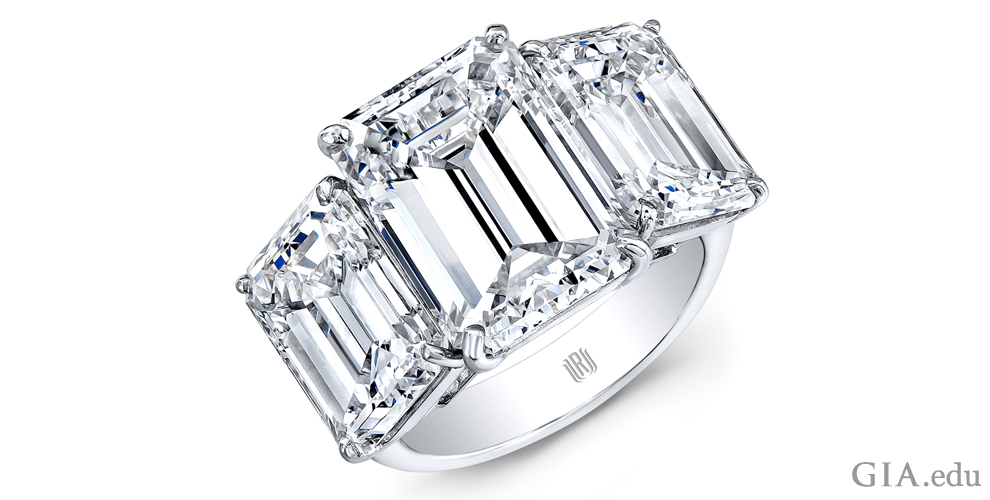
Three stone diamond ring totaling 15 carats.

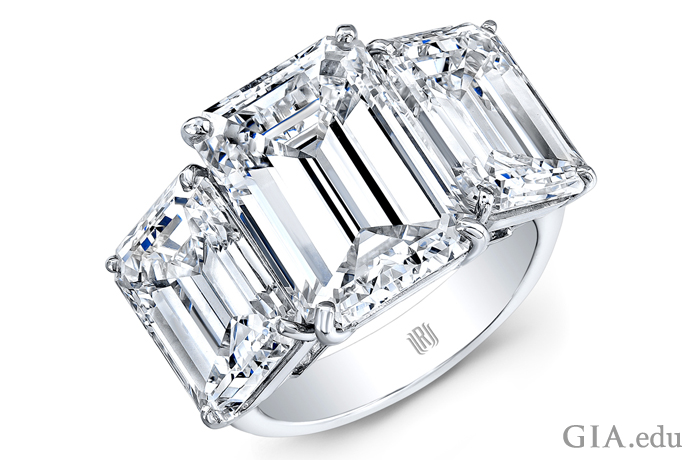
This impressive three-stone ring has 15 carats of diamonds, set in platinum. Courtesy: Rahaminov


April Birthstone: Diamond Care and Cleaning

Clean your diamond by wiping it with a lint-free cloth; or use warm water, mild soap and a soft toothbrush or a commercial jewelry cleaning solution. Also have your diamond jewelry periodically cleaned and its setting examined by a professional jeweler to maintain its beauty and integrity over time.

Yellow gold earrings set with rough diamonds.

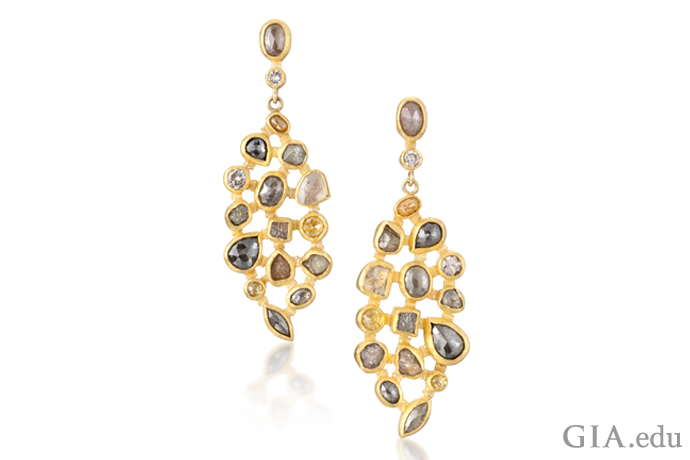
Rough diamonds have been enjoying their moment in the spotlight. They capture another side of the gem’s beauty. Courtesy: Petra Class

Now that you’ve learned something about diamonds, you’ll be a smarter shopper. And maybe you’ll have a greater appreciation for the April birthstone.

Thinking about buying a diamond? Our diamond buying guide can help you pick a stunning one.

How to Get the Most Diamond Sparkle

Diamond sparkle might be one of the most-desired requirements for an engagement ring. A diamond’s breathtaking light show is one of the reasons we love this gem. But finding a diamond that sparkles requires some knowledge. So let’s get to it!

In this post, we’ll cover:
What Makes a Diamond Sparkle
How to Choose a Diamond that Sparkles
Maximize Diamond Sparkle – What Works/What Doesn’t

A pavé set diamond halo surrounds a center stone. The diamonds weigh a total of 1.46 carats.

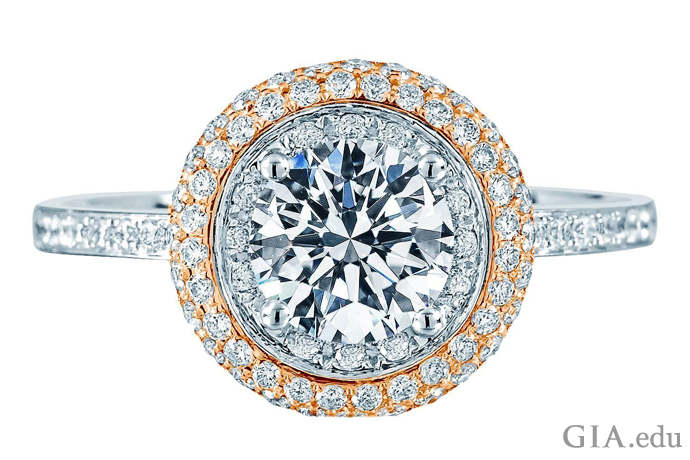
A pavé set diamond halo surrounds a center stone, creating numerous opportunities for sparkle. The diamonds weigh a total of 1.46 carats. Courtesy: 1stdibs.com


What Makes a Diamond Sparkle?

The short answer: light’s interaction with a diamond’s cut. The type and quality of the cut govern how a diamond reacts to the light around it. The angles and relative measurements of a diamond’s facets, as well as its other proportions, have a dramatic effect on how light performs when it strikes a diamond.

The long answer: You probably use the word “sparkle” in a very general way to describe the overall visual effect of a diamond’s interaction with light. But gemologists who have closely studied diamond’s signature light show break it down this way:

When light enters a diamond, it travels through it, reflecting off its interior surfaces, called facets. It then either leaves the diamond as white light, called brightness, or it divides into the spectral colors of the rainbow: red, orange, yellow, green, blue and violet, called fire.

Light leaving a diamond as spectral colors.

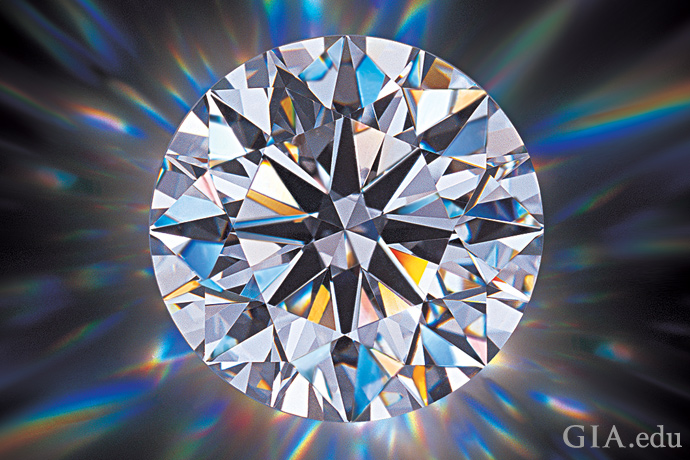
Light leaving a diamond as spectral colors can be quite breathtaking. Copyright: GIA and Harold & Erica Van Pelt.

As you or the diamond moves, an effect called scintillation occurs – visible as alternating flashes of white and spectral-colored light and the contrast of dark and light that moves around the diamond. This contrast is dynamic and causes, in layperson’s terms, sparkle.

How to Choose a Diamond that Sparkles

Since diamond sparkle is all about how well the stone interacts with light, the environment in which you view the diamond and the diamond’s cut quality are critical.

1. Be sure to examine the diamond under four different light sources. Spot lighting (or a lot of individual light sources) is the best way to see all the elements that produce sparkle. However, if there are too many spot lights and they are too bright, there will be so much glare that one diamond will look just as good as any other.

To avoid this, observe the diamond in an environment where the spot lighting is not overwhelming. Then look at the diamond in diffused lighting — fluorescent lights that bounce light off a white ceiling are best. Third, try to view it in a mixed lighting environment of spotlights and diffused lighting. And, finally, don’t forget to view the diamond in natural daylight.

Learn more about how light affects the appearance of a diamond.

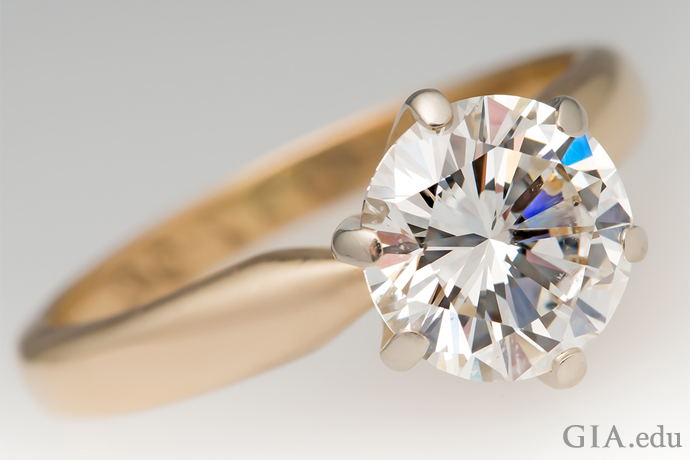
A 1.52 carat (ct) round brilliant diamond engagement ring.

A 1.52 carat (ct) round brilliant diamond is a visual delight in this engagement ring. Courtesy: EraGem

2. Pay attention to cutting style. The more facets a diamond has, the more reflective surfaces there are to bounce and scatter light. A round brilliant cut diamond with its 57 or 58 facets will appear to have more sparkle than a single-cut diamond with only 17 or 18 facets. Learn how to pick a round brilliant diamond engagement ring.

If you have your heart set on a shape other than round, you can still get the sparkle if you look for diamond shapes cut in the brilliant faceting style. These include princess, radiant, oval, pear, heart and marquise.

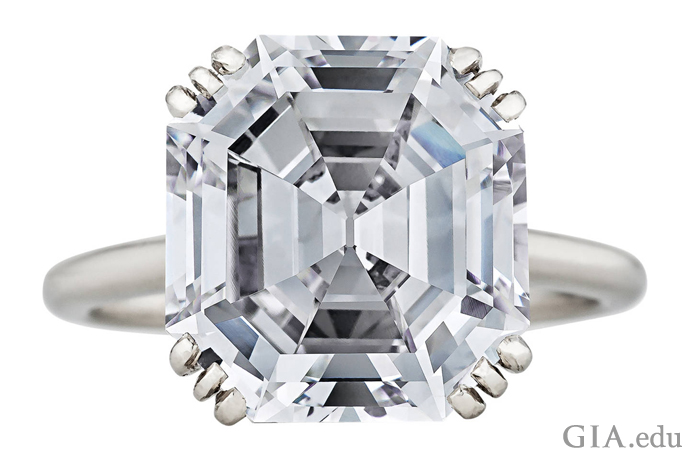
8.06 ct Asscher cut diamond from Cartier, circa 1935.

This 8.06 ct Asscher cut diamond from Cartier, circa 1935, is spectacular. Courtesy: 1stdibs.com

3. Pay attention to cut quality. There’s another solution for standard round brilliants, if you’re unsure about judging a diamond’s sparkle. A GIA Diamond Grading Report can be of great value in finding a diamond that sparkles. GIA issues one of five cut grades for a round brilliant diamond: Excellent, Very Good, Good, Fair and Poor.

A diamond with an Excellent cut grade is very bright. It shows an even pattern with good contrast between light and dark areas, so the reflections appear crisp and well balanced. This tells you that the cutter created the best possible stone from the rough.

A Very Good cut grade means the diamond has bright areas evenly distributed across the stone’s crown and few distracting areas.

A diamond with a Good cut grade isn’t quite as bright – reflections aren’t as sharp and there’s more darkness or dullness in the diamond.

A diamond with a Poor cut grade has much more prominent dark areas or dullness. Given the choice, most people would pick diamonds with either Very Good or Excellent grades.

This diamond has an Excellent cut grade: It is very bright and shows an even pattern with good contrast between light and dark areas.

This diamond has an Excellent cut grade: It is very bright and shows an even pattern with good contrast between light and dark areas. Reflections appear crisp and well balanced. If all else is equal, an Excellent cut grade pretty much guarantees an extremely attractive diamond. Photo: Al Gilbertson and Barak Green/GIA.

This diamond has a Good cut grade. Its bright-reflections aren't as sharp and there's more darkening around the girdle.

This diamond has a Good cut grade. Its bright-reflections aren’t as sharp and there’s more darkening around the girdle. Photo: Al Gilbertson and Barak Green/GIA.

This diamond has a Poor cut grade. It has significantly more prominent dark areas; there's a much smaller bright area.

This diamond has a Poor cut grade. It has significantly more prominent dark areas; there’s a much smaller bright area. Photo: Al Gilbertson and Barak Green/GIA.

Learn more about how GIA grades diamond cut.

Maximizing Diamond Sparkle – What Works/What Doesn’t

Looking for more visual bang for your buck when purchasing a diamond engagement ring? Here are some tips for getting the most diamond sparkle.

1. Bigger is not necessarily better. You may think: the larger the diamond, the more sparkle. But in reality, diamonds with identical proportions, color and clarity have the same amount of sparkle regardless of size. Visually, you might perceive a difference when comparing two diamonds that are dramatically different in size. For example, a 0.25 ct diamond may appear to sparkle less than the 1.00 ct diamond next to it. But when it comes to choosing a diamond, typically you’re making a selection between diamonds that fall within a narrow size range, so slight differences in diamond size would have no effect on your perception of sparkle. Again, this assumes the cut quality of the diamonds being compared is the same.

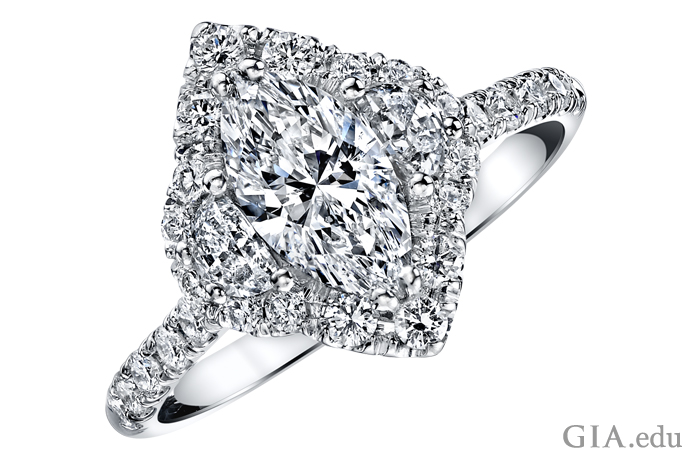
A marquise-shaped diamond in the center is flanked by two half–round brilliant cut diamonds, all of which are surrounded by more diamonds in a pavé setting that extends along the ring’s shank.

Talk about sparkle! This three-stone engagement ring seems to have it all. A marquise-shaped diamond in the center is flanked by two half–round brilliant cut diamonds, all of which are surrounded by more diamonds in a pavé setting that extends along the ring’s shank. Courtesy: ZIVA Jewels Inc.

2. Choose a diamond with good color and clarity. Researchers have found that brightness diminishes in diamonds that grade lower on the D-to-Z color range. Likewise, clarity issues in diamonds graded SI2 or I can diminish the appearance of fire. Both will reduce the sparkle in a diamond.

3. More diamonds, more sparkle. Definitely yes! More diamonds, whether big or small, will add more sparkle to your engagement ring. This is one reason why diamond side stones and pavé settings are so popular.

4. Pick the right setting. If you’re looking for a bigger visual display, a prong setting is better at allowing light to enter the diamond than bezel settings that cover more of the top surface of the diamond. Learn more about different setting styles.

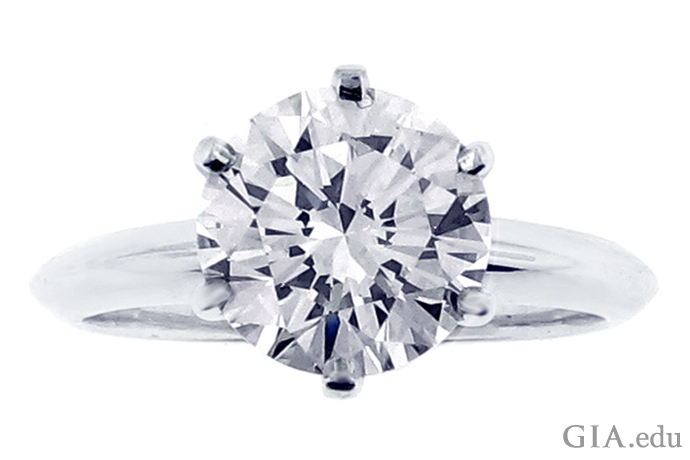
This solitaire engagement ring by Tiffany & Co. features a 2.28 ct round brilliant diamond.

You can have lots of sparkle and still have a simple ring design. This solitaire engagement ring by Tiffany & Co. features a 2.28 ct round brilliant diamond. Courtesy: Pampillonia Estate and Fine Jewelry

5. Keep the diamond clean. This is probably the most important (and affordable) tip. A diamond that’s dirty will not sparkle. Diamonds have an affinity for grease, so it’s important to clean them regularly. Find out how to keep your diamond clean.

In the end, nothing adds sparkle to an engagement ring like the love with which it’s given. So follow your heart and relish the moment — you really can’t go wrong.

If you need a little extra help as you shop, check out our glossary of common engagement ring terms. They’ll help you better communicate your needs and desires with a jeweler.

What Is a Real Diamond?

What Is a Real Diamond?

It’s unlikely that you’ll hear a professionally trained gemologist call a diamond a real diamond, or use the word “real” to describe any material. If you want to come across as a smart shopper, you’ll need to rephrase the question.

For decades, diamonds have been the gem of choice for engagement rings. But with the advent of synthetic diamonds and diamond simulants, it’s only natural to ask about real diamonds. “Real” is not a gemological term. But to the consumer, it’s an important one.

A Diamond Is a Diamond Is a Diamond

From a gem professional’s point of view, a diamond is a diamond if it has a characteristic chemical composition and crystal structure. Diamond is composed almost entirely of a single element: carbon. It forms under conditions of high temperature and pressure that cause its carbon atoms to bond in essentially the same way in all directions. Another mineral, graphite, also contains only carbon, but its formation process and crystal structure are very different. The result is that graphite is so soft that you can write with it, while diamond is so hard that you can only scratch it with another diamond.

This definition of diamond applies to diamonds that come from the earth, as well as those that are created in a laboratory. It does not apply to other materials that might masquerade as diamonds.

So, when you ask a jeweler for a real diamond, you could be asking for a diamond created by nature or one created in a lab – since both materials qualify as diamond. Reputable jewelers avoid the term “real” altogether and, following U.S. Federal Trade Commission (FTC) guidelines, clearly distinguish between natural diamonds, synthetic diamonds and diamond simulants (or imitations).

In other posts we explain synthetic diamonds and diamond imitations. Here, we’ll dig a little deeper into natural diamonds and their incredible journey from deep below the earth’s surface to the engagement ring worn by your loved one.

A Brief Description of a Natural Diamond

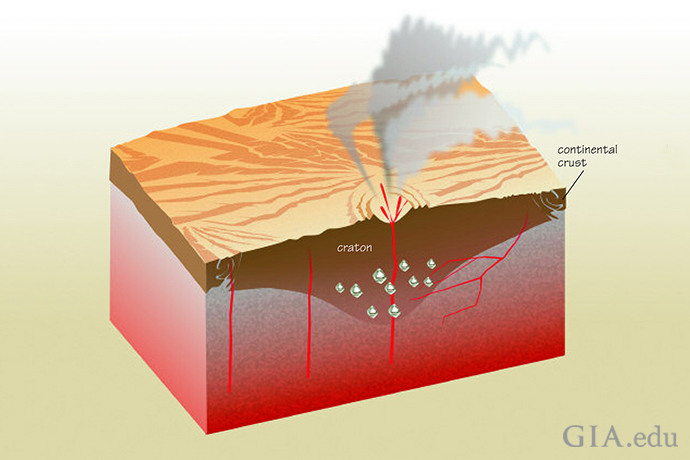
Natural diamonds are one of nature’s wonders. Billions of years old, they formed deep in the earth’s mantle and were brought to the surface by volcanic eruptions. Two types of magma, kimberlite and lamproite, sometimes carried diamond rough with them. The magma quickly solidified into a diamond-bearing kimberlite or lamproite pipe.

A craton is an ancient, deep and stable portion of a continent. Its high heat and pressure provide the right conditions for diamond formation. Conditions under a craton are also stable enough to preserve diamonds for hundreds of millions of years after formation. Illustration: Peter Johnston/GIA

A craton is an ancient, deep and stable portion of a continent. Its high heat and pressure provide the right conditions for diamond formation. Conditions under a craton are also stable enough to preserve diamonds for hundreds of millions of years after formation. Illustration: Peter Johnston/GIA

Most of the world’s diamonds are found in kimberlite, but the famed Argyle mine in Australia–once the world’s leading diamond producer– is a lamproite deposit. Major companies recover the diamonds by digging large open-pit mines to find the buried treasures. Over time, as the typically cone-shaped pipes narrow down, the companies switch to underground mining to capture the last of the diamonds.

Some diamonds end up in rivers, streams and even the ocean after forces of erosion released the crystals from their host rocks and gradually washed them into bodies of water. When diamonds are found this way, it’s called alluvial mining – a process of digging and sifting through mud, sand and gravel. While river sediments are often worked by small-scale miners using rudimentary techniques, large boats are used to scour the ocean sands off the coast of Namibia in search of fine diamonds.

A natural diamond rough in an octahedron shape.

Natural diamond rough is often shaped like an octahedron. Photo: Robert Weldon/GIA. Courtesy: Fusion Alternatives

For most of recorded history, the extreme scarcity of diamonds made them available only to the elite. In fact, up until 1730, the Golconda region of southern India and the Pacific island of Borneo were the only known diamond-producing regions in the world. Then diamonds were discovered in Brazil around the 1720s and a diamond ‘rush’ began. Soon, Brazil eclipsed India as the world’s top diamond producer, holding this title through the mid-1800s. With the discovery of large diamond-bearing kimberlite pipes in South Africa in the late 1860s, mining began on an industrial scale, increasing supply to meet broader consumer demand. Diamonds are now mined in several countries around the world, including Russia, Botswana and Canada, as well as South Africa and Australia. Learn more about where diamonds come from.

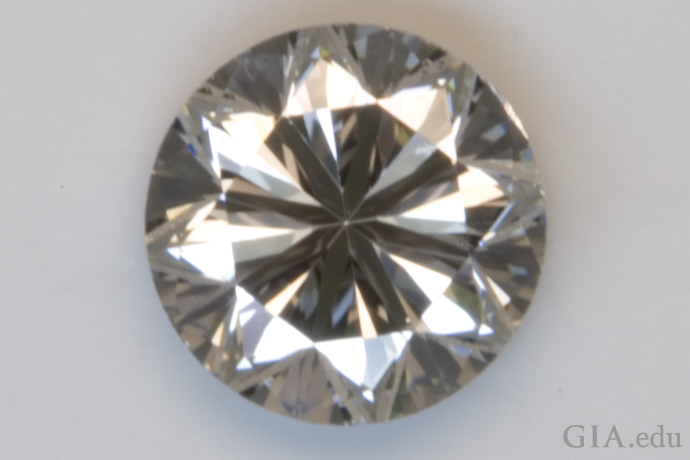
The face-up view of this diamond showcases the beauty of the round brilliant cut.

The face-up view of this diamond showcases the beauty of the round brilliant cut. Photo: Robert Weldon/GIA. Courtesy: Rogel & Col, Inc.

Turning Rough Diamonds into Polished Gems

The diamonds recovered have survived a brutal birth and then a rough ride to the earth’s surface. Diamond mining companies must remove a million parts of host rock to find one rough diamond. Workers then sort the rough diamonds into categories based on their size, shape, clarity and color. The mining company might cut a finished diamond out of the rough, or sell it to dealers and manufacturers.

Rough diamonds are often shipped to cutting centers in India, Israel, New York, Antwerp, China and Thailand. Highly skilled diamond cutters often use the latest technology, such as lasers, to transform the piece of rough into a highly polished faceted diamond. Most finished diamonds are sent to grading laboratories to determine their quality based on the GIA 4Cs standard: color, clarity, cut and carat weight. Every diamond will have unique qualities: no two will be identical.

A diamond cutter at Diacore Botswana examines the initial facets made on a fancy yellow diamond.

A diamond cutter at Diacore Botswana examines the initial facets made on a fancy yellow diamond. Photo: Robert Weldon/GIA

Diamond Treatments

Some manufacturers may try to alter the color or clarity of a diamond to make it more appealing and marketable. The methods used to alter color range from crude ones like coloring girdle facets with a permanent marker, to more sophisticated ones like covering facets with an optical thin film, subjecting the diamond to radiation, or exposing it to high pressure, high temperature annealing. The most common clarity enhancement is fracture filling. All of these may improve the appearance of the diamond, but the seller is legally bound by the FTC to disclose that the diamond has been treated.

A before and after image of a fractured filled diamond.

This diamond has been fractured filled to make it more attractive. Photo: Shane F. McClure/GIA.

A 1.05 ct diamond owed its apparent Fancy Light brown-pink color to a coating. After the coating was removed by acid cleaning, the diamond was given a color grade of J

This 1.05 ct diamond owed its apparent Fancy Light brown-pink color (left) to a coating. After the coating was removed by acid cleaning, the diamond was given a color grade of J (right). Photo: Jian Xin (Jae) Liao/GIA

Given their timelessness, resilience and durability, is it any wonder so many choose ”real” diamonds as a symbol of love and commitment? If you’re considering a natural diamond for an engagement ring, be sure to ask for a GIA Diamond Grading Report . The report is your proof that the diamond is natural and that its quality is what the seller describes, giving you the important information you need to make your purchase with confidence. And if you opt for a lab-grown diamond, a GIA Synthetic Diamond Grading Report is your assurance that the material is actually diamond and not an imitation.

Have you ever wondered about do-it-yourself tests to determine whether a specific gem is natural, synthetic or something else? Our post, How to Tell if a Diamond is Real, decodes the most common myths about such tests and why they don’t work.

What Are Simulated Diamonds?

Simulated diamonds — or diamond simulants — may look like diamonds, but they don’t have the same chemical, physical and optical properties. If you’re shopping for a diamond imitation, make sure you know the unique characteristics of the stone you are getting.
(more…)

Lab-Grown Diamond Jewelry: What are Synthetic Diamonds?

Synthetic diamonds are grown in laboratories and have essentially the same chemical composition, crystal structure and physical properties as natural diamonds. They’re real diamonds and not ‘fakes,’ but they are not the same as natural diamonds.
(more…)

How to Choose a Marquise Diamond

Are you an incurable romantic searching for an engagement ring with an aristocratic air? Consider the marquise diamond: It’s beautiful. It has a royal pedigree. And it looks fantastic on the finger. But before you shop, learn what to look for. (more…)

How to Buy Diamonds Online: Five Non-Negotiable Rules

When it comes to buying diamonds and diamond jewelry online, consumers face a dizzying array of choices in terms of quality, styles and price points. And they also face the uncertainties of buying something sight-unseen. So how can you protect yourself? How safe is it to buy diamonds online? (more…)

Black Diamonds: What You Need to Know

From cast-asides to starring roles, black diamonds have taken quite a journey. They’re even vying for position as center stones in engagement rings! But it pays to look beyond their unique appearance to learn more about this enigmatic gem. (more…)

What Is a White Diamond?

Colored diamonds have been smashing sales records at auction houses the past few years, but here’s one that hasn’t gotten a lot of press: the white diamond. Yes, white! Get ready to fall in love with this remarkable beauty. (more…)