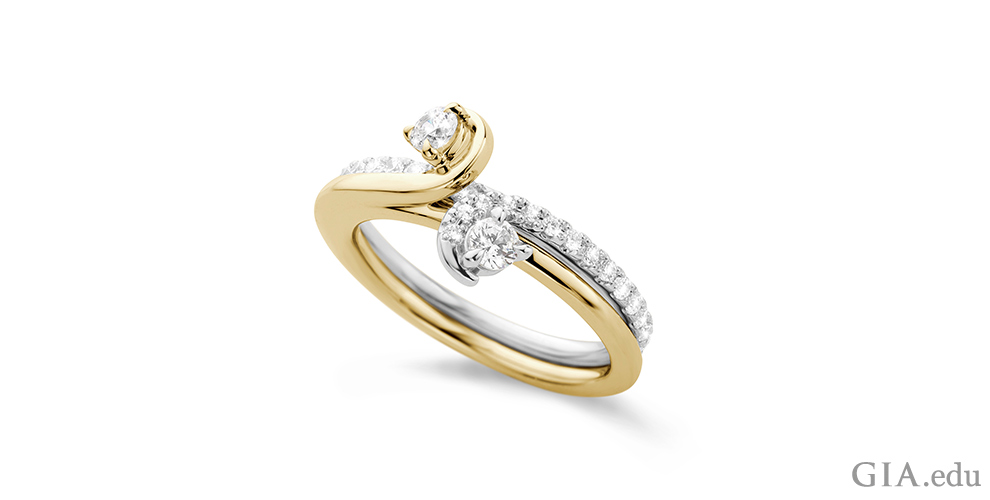
Gold engagement rings are forever favorites. But how do you pick the right color gold for your ring style and center diamond? Here’s a quick breakdown on gold alloys and what to consider when making this important engagement ring decision. (more…)

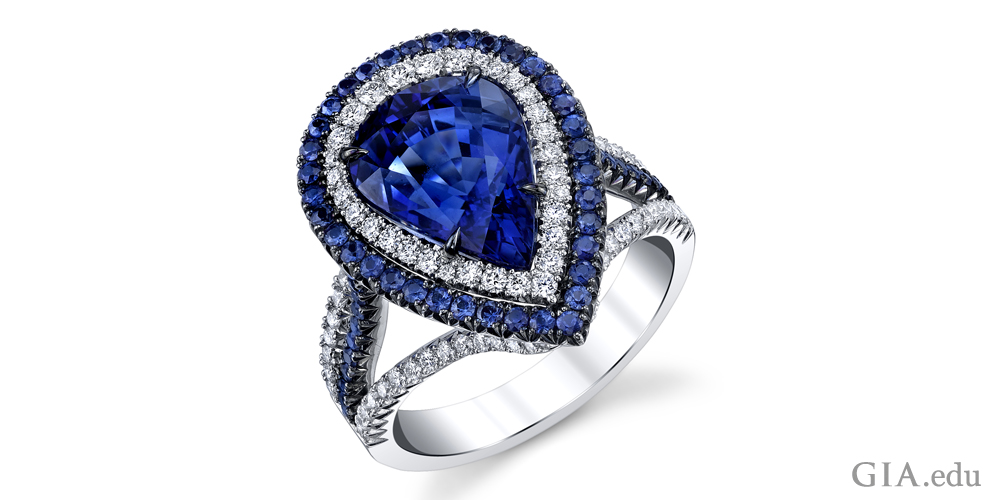
Colored gemstone engagement rings are hot. They’re showing up on royalty and celebrities alike. They’re beautiful. They’re unusual. And they can be a great value. Here’s what you need to know when you go shopping.
In this blog, we cover:
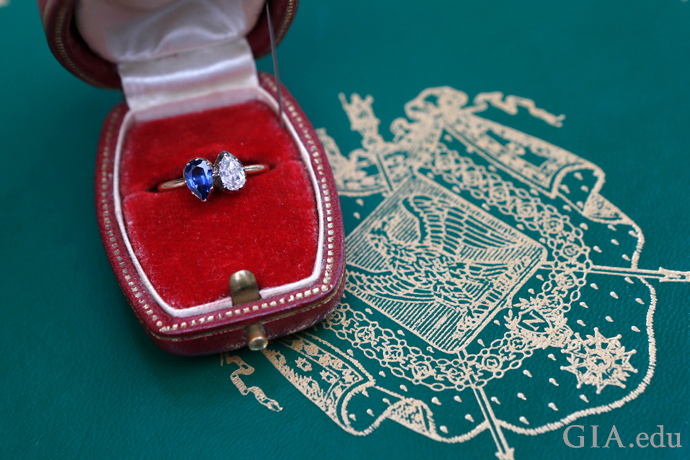
The Empress Josephine toi et moi (“you and me”) engagement ring features a 1 carat (ct) pear shaped sapphire and diamond mounted in 18K gold. Photo: PATRICK KOVARIK. Courtesy: AFP/Getty Images
Colorful gemstone engagement rings are decorating the fingers of royals and other style makers, reviving a not-so-new trend for adding pops of color – and personality – to traditional colorless diamond engagement rings.
Some stylistas are achieving the color-me look with pink, yellow or blue diamonds, while others turn to the world of colored gemstones to find their splash of color.
More than 200 years ago, in 1796, Napoleon Bonaparte gave his future empress, Joséphine, a sapphire and diamond toi et moi (“you and me”) ring for their engagement.
Today, Kate Middleton, the Duchess of Cambridge, wears what is probably the most famous colored gemstone engagement ring. A beautiful creation that once belonged to Princess Diana, it boasts a 12 ct sapphire encircled by diamonds.
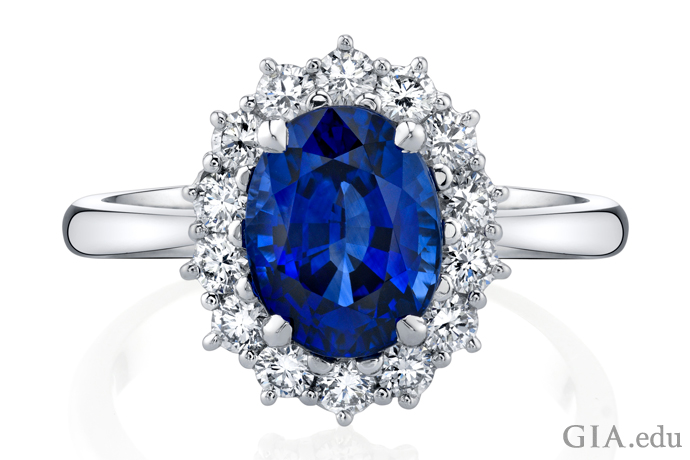
If you like Kate Middleton’s engagement ring, then you’re sure to love this beauty. A 2.73 ct oval sapphire glows the brighter for being accented by 0.56 carats of diamonds. Courtesy: Omi Privé
Kate’s recently engaged cousin by marriage, Princess Eugenie, daughter of Prince Andrew and Sarah Ferguson, opted for a slightly orangy pink padparadscha sapphire, surrounded by round brilliant cut diamonds. The style somewhat resembles the engagement ring her mother (the Duchess of York) received – a ruby with a halo of diamonds.
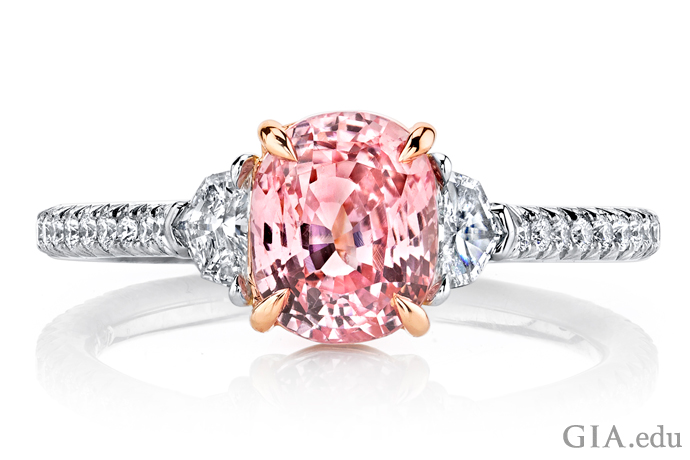
Like Princess Eugenie’s engagement ring, this 2.02 ct padparadscha sapphire and diamond ring is both beautiful and unusual. Courtesy: Omi Privé
In the celebrity world, actress Jenny McCarthy wears a 10 ct yellow sapphire engagement ring framed by diamonds. Ashlee Simpson’s vintage-style ring features a marquise diamond surrounded by calibré cut rubies. Elizabeth Hurley sports a 9 ct blue sapphire framed by two trilliant cut diamonds in a classic design.
For these trendsetters – and many other brides – incorporating colored gemstones into an engagement ring offers myriad options to display their individual style and personality. It’s a look that’s both timeless and contemporary.
There’s a lot to love about colored gemstone engagement rings. First, there’s the obvious: color. Explore the world of colored gems and you’ll find a rainbow, from the deep reds of ruby and blues of sapphire, to the grassy greens of tsavorite garnet and kaleidoscopic colors of spinel. There’s a gem for every hue imaginable.
Second, with colored gemstones you can add more depth of meaning to the engagement ring. For example, you could include your birthstone and your partner’s birthstone, alone or with diamonds. Colored gemstones also come with historic symbolism, and you could pick one that inspires you. Take sapphire – it has traditionally been associated with sincerity, truth and faithfulness.
You can also use colored gemstones to send secret messages. The Victorians turned this into an art form with acrostic jewelry – using the first letter of each gemstone to spell a word. For example, a diamond, emerald, amethyst and ruby set together would spell the word “dear.” Acrostic jewelry can also be designed to spell birthdays, private messages or a secret shared between you and your beloved.
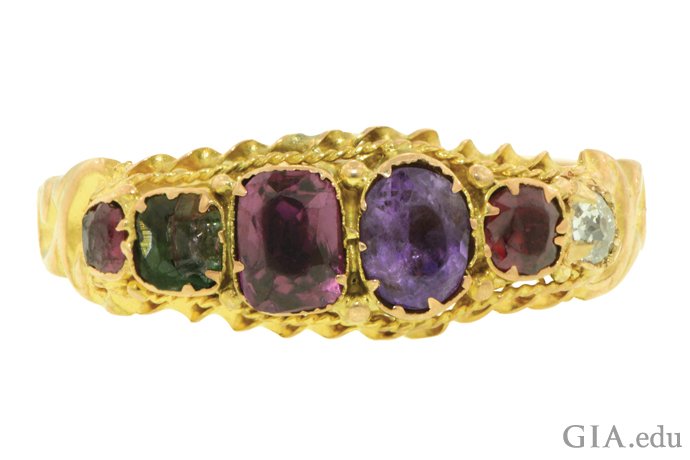
This acrostic ring was made in England during the Victorian era (1837–1901). The gems spell “regard” from left to right: ruby, emerald, garnet, amethyst, ruby and diamond. Courtesy: Doyle & Doyle
Finally, there’s affordability. Colored gemstones are a great way to add size to an engagement ring. This is especially true if you look beyond rubies and sapphires toward gems that are less well known but equally as beautiful – and usually significantly less expensive. Examples include the pink beryl morganite, the many colors of spinel and tourmaline, or intense green, red or orange garnets.
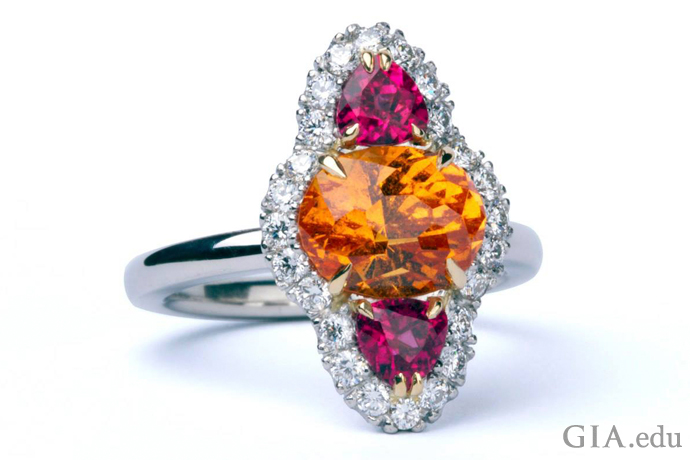
If your bride-to-be’s favorite colors are orange and pink, this ring featuring a spessartine garnet center stone cut by John Dyer, pink tourmaline side stones and diamond melee is sure to please. Courtesy: John Dyer & Co.

The color of morganite can be very similar to that of a pink diamond, but this 7.07 ct morganite is a striking – and more affordable – option. Courtesy: 1stdibs.com
Morganite engagement rings are recent favorites with brides-to-be – and for good reason. Pink has traditionally been the color of romance, and morganite ranges from pastel pink to purplish, yellowish or orangy pink. Similar hues are seen in pink diamonds, but you can have a large, attractive morganite for a small fraction of their cost.
Blue zircon, with its high dispersion, is often mistaken for blue diamonds. Yet while the cost of even a 1 ct blue diamond would be prohibitive for most buyers, a 3 or 4 ct blue zircon engagement ring is obtainable for far less than an average month’s salary.
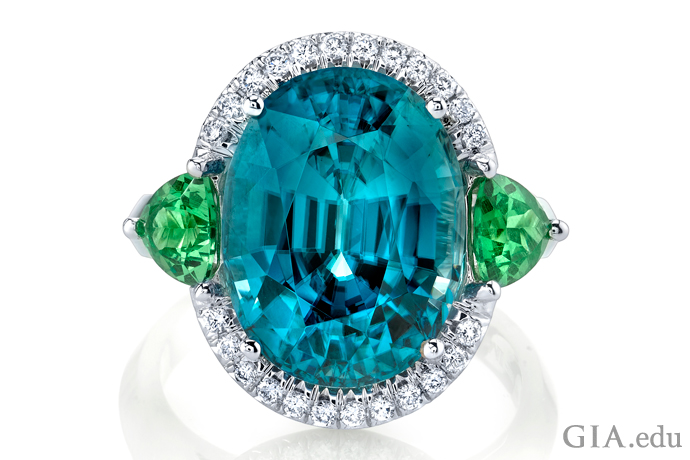
Find beauty in blue with this 6.74 ct cushion cut zircon ring accented with trilliant cut tsavorite garnet side stones and round brilliant cut diamonds set in 18K white gold. Courtesy: Omi Privé
Spinel and tourmaline are two other gems that offer a wide range of color options and great value. They occur in colors that are very similar to those of fine ruby or sapphire, but a top-quality 5 ct red tourmaline (rubellite) could be purchased for less than a third of the cost of a comparable 2 ct ruby – delivering more bling for your buck.
One of the most exciting, if less well known, colored gemstones seen in engagement rings is the green garnet known as tsavorite. More durable and often brighter than emerald, whose color it mimics, a fine tsavorite garnet is usually less expensive than its counterpart.

An alternative and more durable option than emerald, this 2.86 ct tsavorite ring with diamond accents stands out from the crowd. Photo: Emily Lane/GIA. Courtesy: Sara and Bret Keller
With so many different colored gemstones available, your challenge will be finding one that sets your heart aflame – and making sure the gem is tough enough for daily wear.
Durability is a major consideration when searching for an engagement ring gemstone. The gem you choose must withstand the bumps and bangs of daily wear, plus the effects of heat, light, household chemicals and low or high humidity. Different gemstones have different properties and, as a result, different tolerances to these stressors.
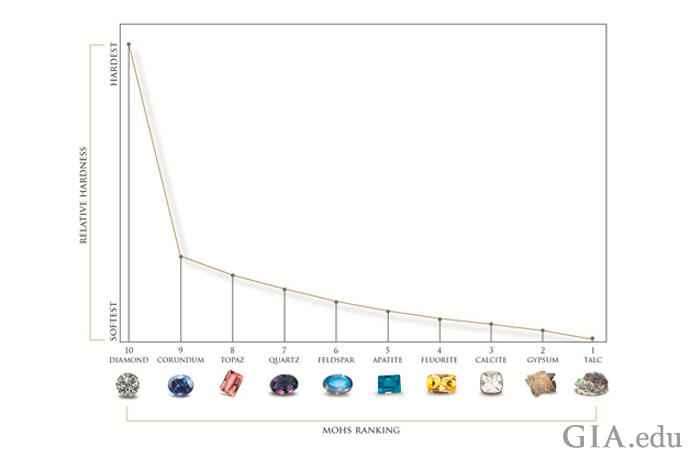
Introduced in the early 19th century, the Mohs scale ranks gem and mineral hardness in a range from 1 (least hard – talc) to 10 (hardest of all – diamond). Illustration: GIA
One aspect of gemstone durability is hardness. The Mohs scale ranks gem and mineral hardness on a scale of 1 (least hard – talc) to 10 (hardest of all – diamond). Ruby and sapphire rank 9, meaning they are able to resist scratching and abrasions. This makes them great choices for engagement rings that will see a lifetime of active wear. Although less hard, spinel (8), morganite (7.5–8), zircon (7.5), and tsavorite garnet and tourmaline (both 7–7.5) are considered durable enough for everyday wear provided care is exercised (no rock climbing!).
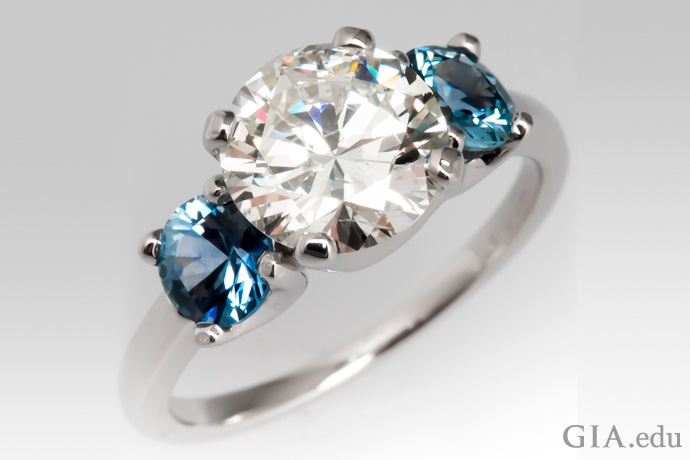
Two Montana sapphires weighing a total of 1.19 carats bookend a 2.05 ct round brilliant diamond. Courtesy: EraGem.com
Toughness and stability are two additional factors that determine a gemstone’s durability.
Toughness indicates how well a gemstone resists breaking, chipping or cracking. The way the atoms of a gem bond together and the strength of these bonds determine gemstone toughness. Examples of not-so-tough gems are opal and tanzanite which, if set in rings, are best reserved for special occasions – not everyday wear.
Stability refers to how well a gemstone can withstand exposure to chemicals, light and changes in temperature or humidity. Extreme temperature changes can damage some gems like opal and tanzanite. Opals can crack or craze in low humidity or with exposure to heat. Citrine, amethyst and topaz may fade or change color from prolonged exposure to sunlight. Light and/or heat can also negatively affect most organic gems – such as pearls, coral and amber – as will exposure to household chemicals.

Tanzanite is a beautiful gem that calls for special occasions. At 6 to 7 on the Mohs scale with fair-to-poor toughness, it’s not ideal for an engagement ring that will see a lifetime of daily wear. Courtesy: Omi Privé
It’s important to note that many colored gemstones are routinely treated to improve their color and/or clarity. Designed to bring out the inherent beauty of a gem, many of these treatments are widely accepted in the gem trade. However, you should be aware that some treatments can also affect stability. As a result, your gem may require special care.
For example, treatments such as coating and fracture filling can be removed by heat and strong chemicals. Although emerald ranks 7.5–8 on the Mohs scale, it is not a tough gem and is often treated with oil and/or resin to improve clarity. This treatment also disguises fractures in the stone that can cause it to break if banged against a hard surface. If you have your heart set on a green gemstone engagement ring you plan to wear every day, you might want to consider a more durable tsavorite garnet instead, reserving emeralds for earrings or pendants. Garnets are rarely treated and have good toughness.
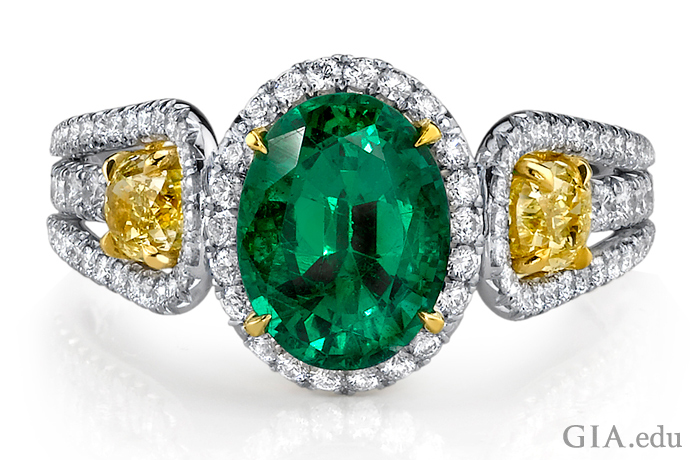
A halo of diamonds creates contrast with the emerald and helps protect this popular but fragile stone. Two yellow diamonds add more color and drama to the ring. Courtesy: Omi Privé.
Color is king
Like colorless diamonds, the quality of a colored gemstone is determined by a combination of the 4Cs: color, clarity, cut and carat weight. For colored gems, however, color is by far the most important factor. In some cases, such as whether a gem is called pink sapphire or ruby, or green beryl or emerald, the distinction may be made based on color alone. Clarity is important, but for most colored gems there is no universal grading system or set of standards to evaluate clarity. And cut may vary greatly from stone to stone. The goal is typically to maximize size and color – or, as in the case of fantasy cuts, to create a work of art.
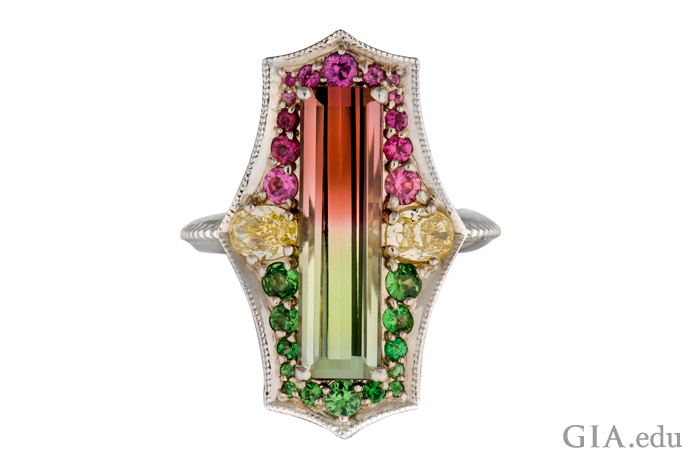
A piece of art to stand the test of time, this 9.05 ct bi-colored tourmaline ring set in 14K white gold features yellow diamonds, tsavorites and rubellites. Photo: Orasa Weldon/GIA. Gift of Derek Katzenbach. In Memory of Nicholas Scott Golden, University of Maine geology student.
There are, however, some important considerations to look for when assessing the quality of a colored gemstone in addition to the durability factors discussed above. Many gems show more than one color. This can be an asset in a bi-colored tourmaline – for the bride-to-be who wants a truly unique colored stone engagement ring.
In other gems, such as blue sapphire, colorless zones seen on close inspection may detract from the overall appearance of the gem. And while high clarity is desirable in most colored gems, as it is in diamonds, a few identifying inclusions in an inconspicuous area (such as the culet) may ensure that the colored gem is natural (not synthetic) and untreated.
Optical phenomena
Colored gemstones also offer the possibility of certain phenomena, such as chatoyancy (the cat’s-eye effect) and asterism (a star), that are not seen in diamonds. These phenomena are caused by the reflection of light off dense inclusions of minerals in gems cut as cabochons. Such phenomenal stones provide exciting design options for a colored gemstone engagement ring.

This 7.57 ct cat’s-eye chrysoberyl seems to symbolize two lives united as one. Add a sparkling halo of round brilliant cut diamonds for strength and you have the perfect sentiment for an engagement ring. Photo: Robert Weldon/GIA. Courtesy: Richard Krementz Gemstones
Where the gem comes from
For some gems, such as ruby and sapphire, country of origin may also play a significant role in determining value. For example, a ruby from Myanmar (“Burmese” ruby) can cost significantly more than a comparable ruby from another locality, such as Mozambique. Similarly, there is a premium for sapphires from Kashmir, due to both their distinctive “cornflower blue” color and their rarity: There has not been major production from this region for more than a century.
Who owned it before
Another important factor in determining price is historical provenance. An antique or vintage colored gemstone engagement ring may come with its own story, and that story may have value. In one of the most striking examples, when the Empress Josephine sapphire and diamond engagement ring mentioned above was offered at auction in 2013, the auction house estimated its value at $20,000 based largely on the gems alone. Ultimately, the winning bidder paid more than $1 million – a huge premium for the ring’s storied association with Napoleon Bonaparte and his first bride.
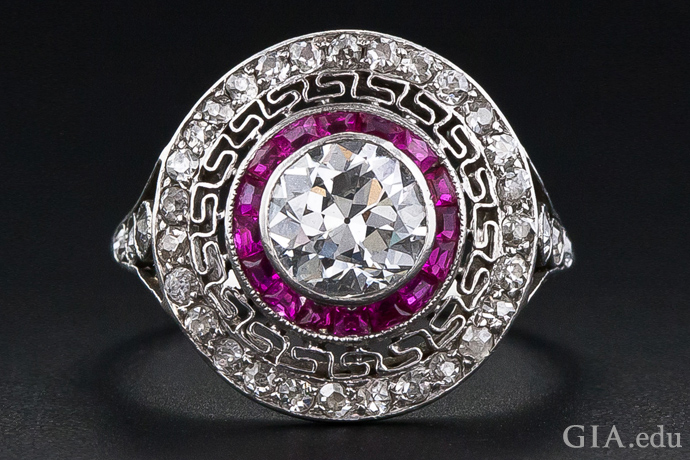
A ring of Burmese rubies encircles an Old European cut diamond in this Art Deco–era ring. A Greek key motif made of platinum circles the rubies, while another ring of diamonds completes the design. Courtesy: LangAntiques.com
Quality and rarity drive value
Like diamonds, colored gems of high quality are rare, so buyers typically pay a premium for top-quality colored stones. Once you’ve decided on a gemstone for your engagement ring, it pays to comparison shop to understand its quality factors and how they affect value. You should also learn as much as you can about your gemstone of choice. GIA’s Gem Encyclopedia is a good place to start. It provides in-depth information for 29 of the most popular gems on the market. You’ll also find detailed buying guides for each gem describing the specific qualities to look for, the gem’s durability, common treatments and more.
After you’ve purchased your colored gemstone engagement ring, you’ll want to keep it like new. The right way to clean it will vary depending on the gem material you’ve chosen and whether or not it’s been treated. Usually, gentle cleaning solutions specially formulated for delicate gems – or just warm, soapy water and a soft cloth – are all you need. If you’re uncertain about the durability of your gem, avoid using ultrasonic cleaners and off-the-shelf cleaning solutions.
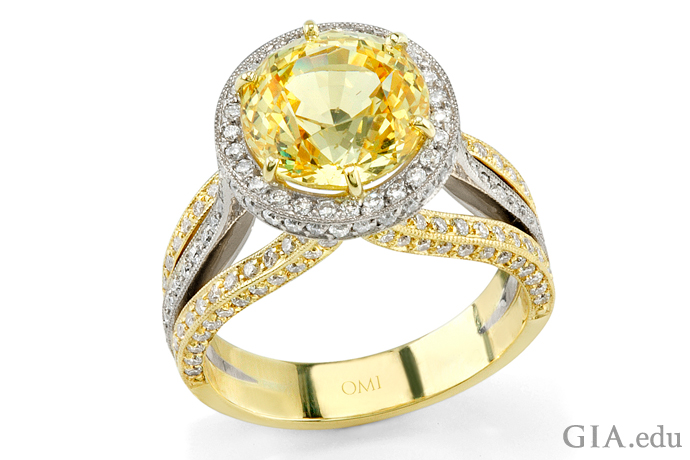
Washing with warm, soapy water is the safest way to clean this 5.11 ct yellow sapphire engagement ring, which is surrounded by 128 round diamonds weighing 0.75 carats. Courtesy: Omi Privé
Engagement ring settings must secure the gems they hold as well as show them to their best advantage. Bezels, halos and other protective settings can play an important role in preventing the chipping or cracking of colored gemstones. But who said practical can’t also be beautiful? Settings serve as an essential design element, defining an engagement ring’s style and overall look. Settings let you introduce contrasts in color or harmonize them to get just the right amount of color pop in your ring. Consider these examples:
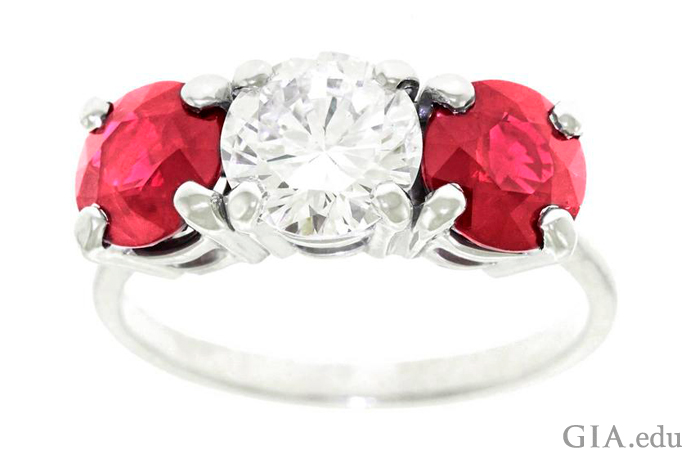
Create a fiery look in an engagement ring by using this three-stone ring for inspiration. The two rubies (1.41 ct and 1.37 ct) bracketing the 1.39 ct round brilliant diamond are sure to catch the eye. Courtesy: 1stdibs.com

Need more proof that colored gemstones can bring excitement to an engagement ring? This stunning creation features a 2.57 ct spinel encircled by 0.20 carats of round diamonds. Courtesy: Omi Privé

The diamond and sapphire in this Victorian-era bypass ring make for a delicate pairing. Courtesy: Treasurly by Dima
Jewelry designers are putting a contemporary stamp on three-stone, halo and bypass rings with colored gemstones. Their modern updates are a beautiful melding of past and present – pieces that pop with color and life. Look around and you’ll find a number of creative interpretations.
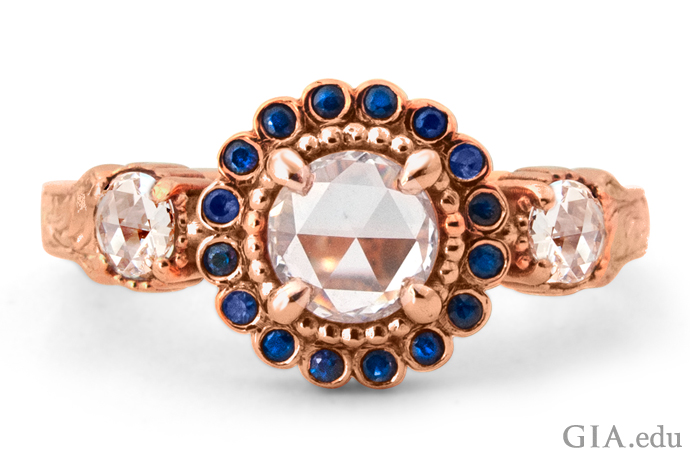
Something old. Something new. Something borrowed. Something blue. Blue sapphires surround a rose cut diamond in this modern ring with a design borrowed from the Victorian era. Courtesy: Shelly Purdy Studio
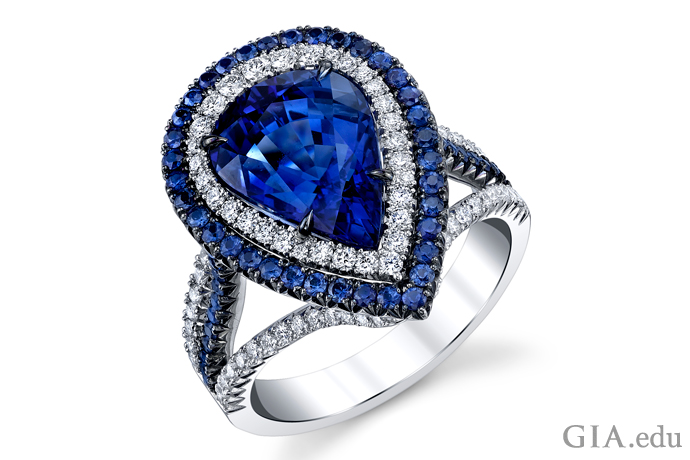
A pear shaped sapphire is surrounded by colorless diamonds and a second halo of sapphires. Diamonds and sapphires spill down the shank of the ring. The bold contrasting colors create a visual richness sure to please. Courtesy: Omi Privé
Now that you know about colored gemstone engagement rings, you’re ready to start shopping. But where? The GIA Retailer Look Up lets you easily find local retailers who have GIA-trained staff to help you through your gemstone selection process.
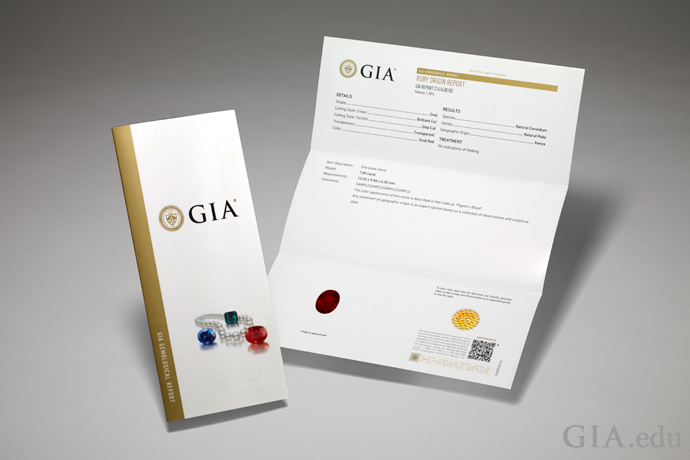
Before you decide on a colored gemstone engagement ring, ask for a GIA Colored Stone Identification Report.
To make sure you get the best value, ask for an unbiased GIA Colored Stone Identification Report. The report will validate the gem’s identity and include detailed descriptions of its size, color and measurements, along with a color photograph. The report will also indicate whether the gem has been treated and, if it has, identify the type of treatment – important to knowing how to care for your gem. Depending on the gemstone, you may also be able to get information on its geographic origin.
Need more inspiration for colorful engagement rings? Read our article on how to buy antique and vintage engagement rings for some exciting examples.
Antique and vintage engagement rings are in fashion – and for good reason. They have an undeniable charm and style. They are a beautiful piece of the past. They’re lasting symbols of love. Here’s how to pick one that you’ll cherish.
In this blog, we cover:
Establishing a budget for antique and vintage engagement rings
Understanding the difference between antique and vintage engagement rings
Important jewelry periods for antique and vintage engagement rings
Diamond cuts typical of antique and vintage engagement rings
Challenges with buying antique and vintage engagement rings
Where to find antique and vintage engagement rings
Prices for antique and vintage engagement rings run the gamut from less than $1,000 to more than $100,000. Put another way, there are beautiful rings for every budget. Deciding what to spend is a personal decision that balances practicality and love. You know what’s best for your circumstances.
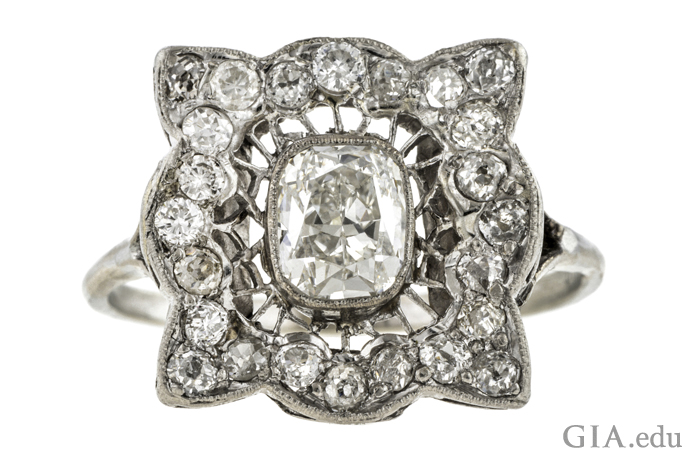
If you’re looking for an antique engagement ring, aristocratic elegance is a hallmark of the Edwardian era. In this intricate creation, a 1.12 carat (ct) cushion cut diamond nestles within approximately 0.48 carats of diamond melee. Courtesy: Doyle & Doyle
Before we dive into the details of shopping for antique and vintage engagement rings, here are a few terms you need to know:
Understanding the difference between antique and vintage engagement rings will be helpful for your search. If you’re interested in an engagement ring from a specific period, like the Victorian era, you’ll want to use the proper terminology to help the retailer find the appropriate pieces. It also shows that you’re an educated customer.

With its heart shaped moonstone cradled in a halo of diamonds, this Victorian era engagement ring sparkles with romance. Courtesy: 1stdibs.com
Throughout history, certain periods or cultural movements have had a signature jewelry style. Your delightful challenge will be finding antique and vintage engagement rings and choosing one that best captures the spirit of your love. Here are brief descriptions of rings made during some of the more important jewelry periods.
Learn more about Victorian style engagement rings.

An engagement ring with a snake motif might seem unusual to modern eyes. To Victorians, the serpent symbolized love, eternity and wisdom. Two coiled serpents are set with ruby, diamond and emerald. Courtesy: 1stdibs.com
Learn more about Art Nouveau engagement rings.

Dramatic swirling lines, a signature of Art Nouveau jewelry, infuse this ring with a sense of movement while diamonds add sparkle. Courtesy: 1stdibs.com
Learn more about Edwardian engagement rings.

This 1.63 ct elongated oval diamond is surrounded by milgrain and delicate open work that are characteristic of the Edwardian era. Courtesy: LangAntiques.com
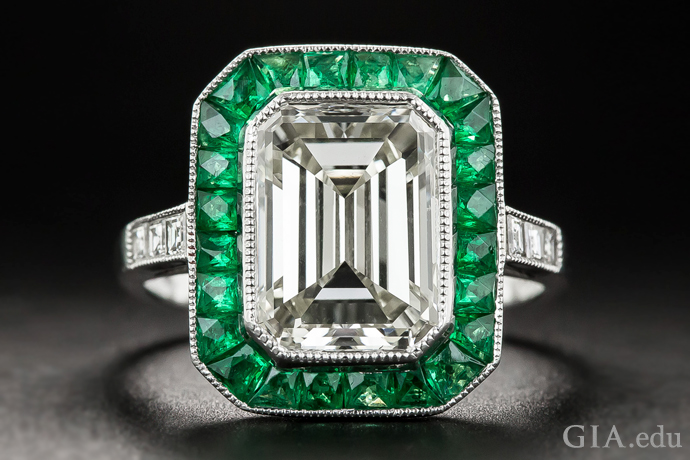
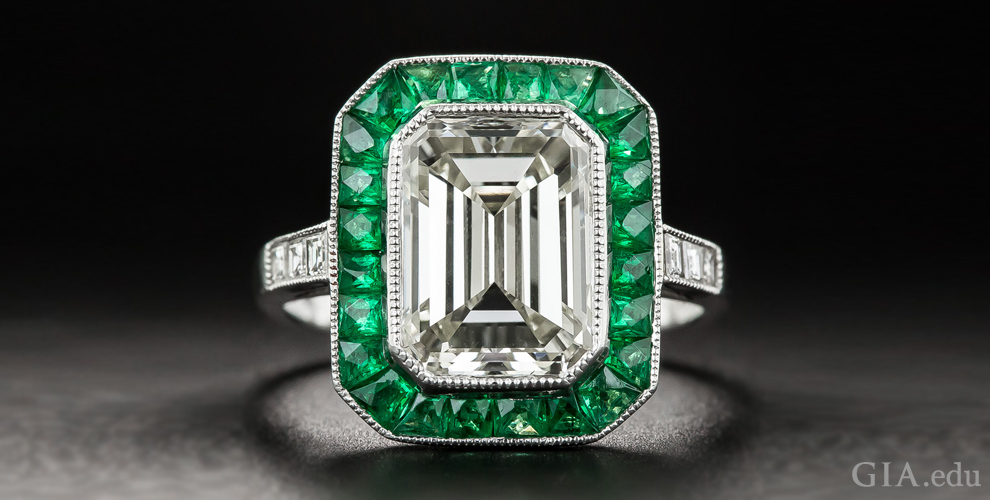
A 3.00 ct emerald cut diamond bordered by emeralds captures the geometric patterns and contrasting colors that are classic Art Deco. Courtesy: LangAntiques.com
Learn more about Art Deco engagement rings.
Learn more about Retro-style engagement rings.

Wearable sculpture is a perfect way to describe this Retro era engagement ring. The diamonds shine brighter for being juxtaposed against rubies. Courtesy: Lang Antiques.com
If you’re looking for antique engagement rings, you’re likely to come across the terms old mine cut and old European cut diamonds.
An old mine cut diamond is a squarish or cushion shaped brilliant with many proportion variations that was often used in jewelry during the Georgian (1714–1837) and early to mid-Victorian periods. Although it has 58 facets like most modern round brilliant cut diamonds, it typically has a smaller table, larger culet and higher crown. It also has short lower half facets and a girdle that is very thin in places, which contribute to its distinctive look.
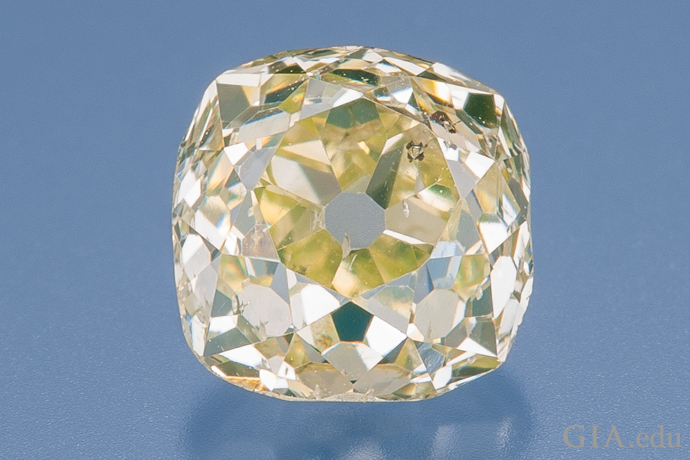
No two old mine cut diamonds are identical. This one weighs 0.68 ct. Photo: Orasa Weldon/GIA
The old European cut emerged as advances in diamond cutting technology in the late 1800s made it possible to fashion round girdles, like the modern round brilliant, though it has a higher crown, very small table and greater total depth. It is typically found in jewelry from the late Victorian era, the Edwardian era and the Art Deco period.

This 0.99 ct old European cut diamond has a stately elegance. Photo: Orasa Weldon/ GIA
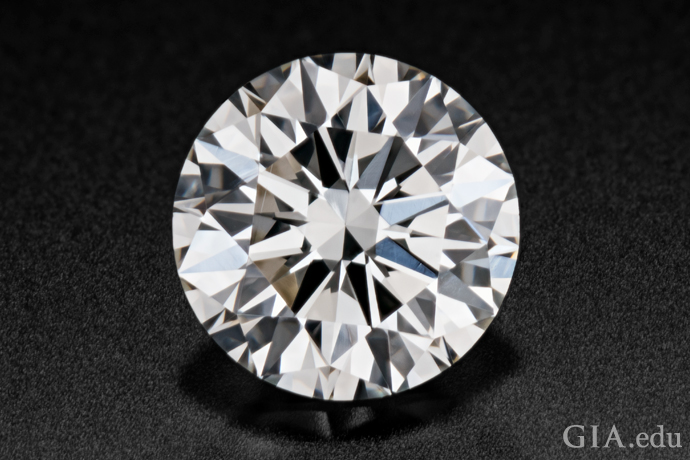
The round brilliant cut diamond, here at 0.73 carats, has been the standard for engagement rings since the mid-20th century. Photo: Kevin Schumacher/GIA
Antique and vintage engagement rings can be a unique choice for your bride-to-be, but there are some challenges you should be aware of before you make a purchase.
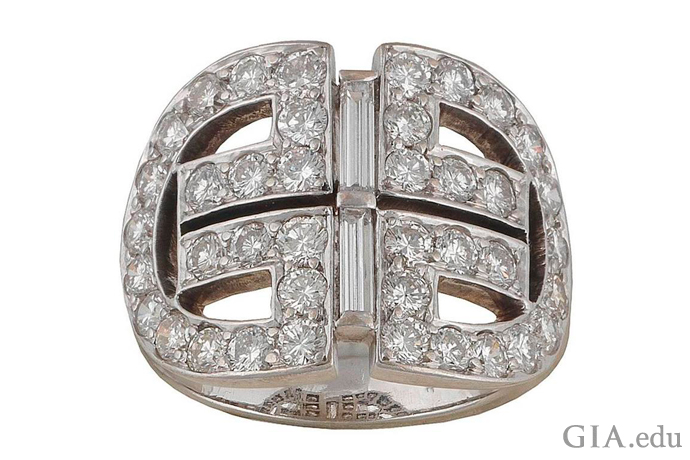
A distinctive geometric pattern with both strong angles and curves incorporates two baguette diamonds weighing approximately 0.60 carats and about 2.00 carats of melee in this Retro era ring. Courtesy: 1stdibs.com
A number of websites specialize in antique and vintage engagement rings. To determine if an online retailer is trustworthy, look to see how long they have been in business and if they are in good standing with the Better Business Bureau. Be sure to speak with retailers directly both to get answers to your questions and see if they are knowledgeable professionals. It is wise to purchase items with diamonds that come with GIA Grading Reports. Our blog on the Five Non-Negotiable Rules for Buying Jewelry Online has more essential information that may be helpful during your search.
Auction catalogs and websites that sell estate jewelry are two other sources. In addition, you can search the GIA Retailer Lookup for retailers who carry GIA-graded diamonds. Some of them also sell antique and vintage engagement rings, so it may be a good place to start.
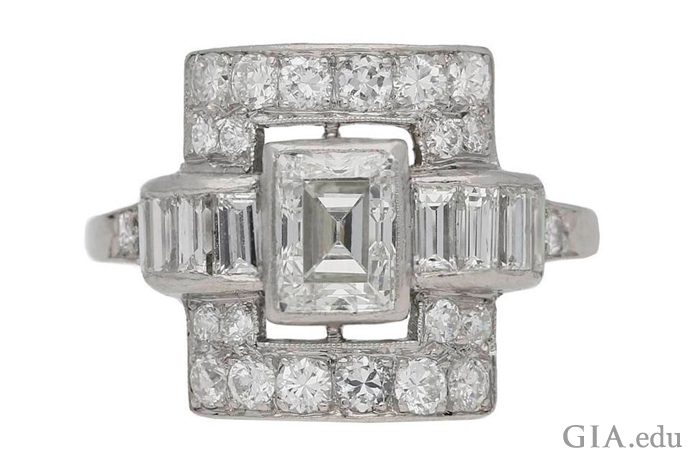
Contrasting geometric shapes create a sum greater than its parts in this Art Deco ring. A 0.85 ct octagonal emerald cut diamond is the center stone, accompanied by eight rectangular baguette cut diamonds and a group of round old European cut diamonds. Courtesy: 1stdibs.com
Once you find your perfect antique or vintage engagement ring, consider getting an unbiased appraisal from an experienced jeweler or independent jewelry appraiser. The appraisal should provide you with a full description of the piece, including its condition, as well as validate its historical period and estimate its value.
Searching for antique and vintage engagement rings can be like going through a treasure chest filled with lots of precious surprises. If you’re having a tough time finding one that’s right for you, consider creating a custom engagement ring with these antique and vintage styles in mind.

If you had to pick one December birthstone, which would it be: tanzanite, turquoise or zircon? From the blue to bluish purple of tanzanite, to the intense blue and green of turquoise, to the rainbow varieties of zircon, there’s a color for you. We help you pick one.
In this blog, we cover:
Tanzanite: The Newest December Birthstone
Gemological properties of tanzanite
Tanzanite history & lore
Where tanzanite comes from
Qualities to look for in tanzanite
Tanzanite treatments, care & cleaning
Turquoise: The Historic December Birthstone
Gemological properties of turquoise
Turquoise history and lore
Where turquoise comes from
Qualities to look for in turquoise
Turquoise treatments, care & cleaning
Zircon: The Colorful December Birthstone
Gemological properties of zircon
Zircon history & lore
Where zircon comes from
Qualities to look for in zircon
Zircon treatments, care & cleaning
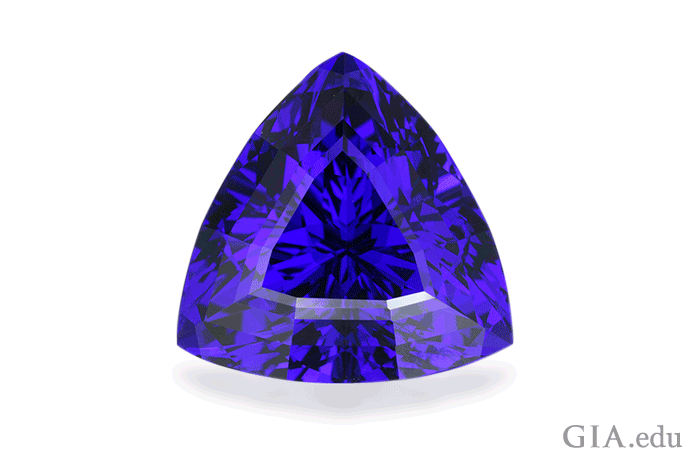
A trilliant cut tanzanite with an exceptional violetish blue color captivates as the December birthstone. Photo: Robert Weldon/GIA
Tanzanite is the blue to violet to bluish purple variety of the mineral zoisite. This December birthstone is mined commercially in only one area of the world — the Merelani Hills of Tanzania — from where it gets its name.
Tanzanite’s appearance is influenced greatly by its pleochroism – the different colors some gemstones show when viewed from different directions. Tanzanite can be violetish blue or deep blue – similar to a sapphire color – or much more purplish. Often, both the violetish blue and purple are readily visible in a fashioned stone when it is gently rocked and tilted. This December birthstone is rather fragile, ranking 6 to 7 on the Mohs scale of hardness; a diamond is a 10. The scale is exponential, meaning that a diamond is many times harder than tanzanite. Tanzanite’s toughness (the ability of a gem material to resist breaking, chipping or cracking) is fair to poor because it has one direction of cleavage (the tendency of a crystalline mineral to break along atomic planes) and is sensitive to sudden temperature changes.
Gemologists love tanzanite because it shows different colors when viewed from different directions.
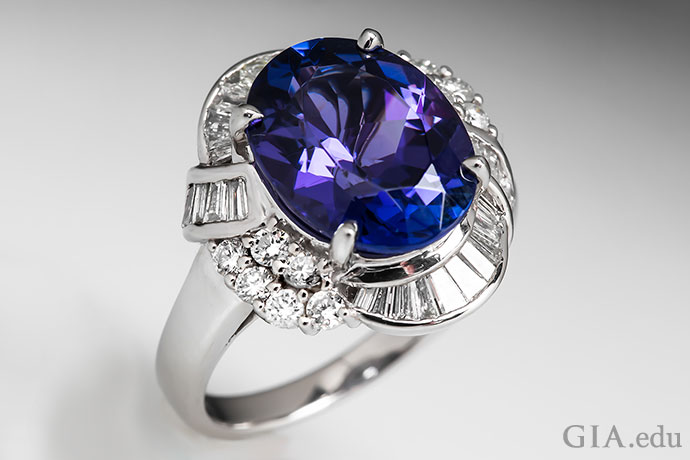
The vault of the evening sky and a field of stars is conjured by this 5.59 carat (ct) oval tanzanite contrasted with 28 channel set tapered baguettes and 12 round brilliant cut diamonds. Courtesy: EraGem.com
Tanzanite may be a relative newcomer to the world of colored stones, but it was one of the most exciting gem discoveries of the 20th century. Blue stones emerging from Tanzania were identified as the mineral zoisite in 1962 by Polish expatriate George Kruchluk. Not until 1967, though, did prospector Manuel D’Souza — with the help of a Masai tribesman — locate the primary source: the Merelani Hills. D’Souza filed four mining claims. Word spread and 90 more claims were quickly registered – even though at the time there was some confusion as to the identity of the gem material.
Tiffany & Co. believed that tanzanite had international appeal and became its main distributor. In 1968, Tiffany launched a major advertising campaign to promote it. With its vivid colors, high clarity and potential for large cut stones, tanzanite quickly became a sensation. Today, it is not only a December birthstone, but it is also the gem for the 24th wedding anniversary.
Grass-covered hillsides, scrub brush, rocky soil and an occasional tree form the landscape of the Merelani Hills. In the major mechanized operations there, thousands of workers recover tanzanite from mines dug over a hundred meters deep into the earth. North of the mines tower the snow-covered slopes of Mount Kilimanjaro.
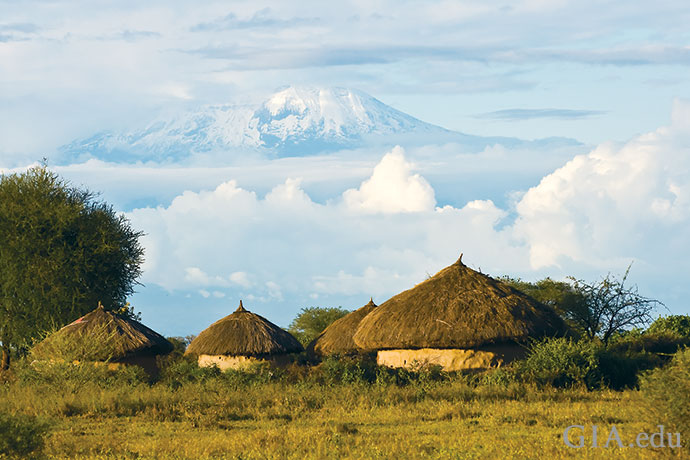
Peeking out from the clouds is the domed summit of Mount Kilimanjaro. Tanzanite is mined in its shadow. Photo: Eric Welch/GIA
Color: The most prized color in tanzanite is a pure blue similar to fine sapphire or an intense violet-blue. Tanzanite with a bluish purple body color is also popular, but less valuable. In any hue, pale colors are less prized than saturated ones.
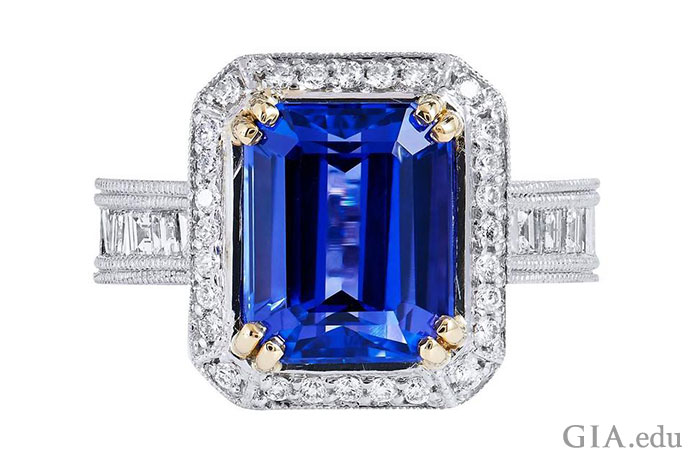
Be mesmerized by the rich color of this 4.91 ct tanzanite, which mimics the deep blue of fine sapphire, and its regal frame of diamonds. Courtesy: 1stdibs.com
Clarity: Tanzanite is usually free of eye-visible inclusions. If any inclusions are present – especially those that pose a durability problem, such as fractures – they typically lower the value.
Cut: Tanzanite is available in a wide range of shapes, but cushion and oval cuts are more common. Because of its pleochroism, cutting direction determines the gem’s overall face-up color. Cutting a tanzanite to emphasize the bluish purple color usually wastes less rough than cutting it to get a pure blue or violetish blue color. The cutter has to make a choice between a smaller top-color gem and a larger bluish purple one.
Carat Weight: Fine tanzanite with a strong, deep color can be found in pieces weighing 5.00 carats or more. Smaller sizes in less saturated colors are commonly seen in mass market jewelry.
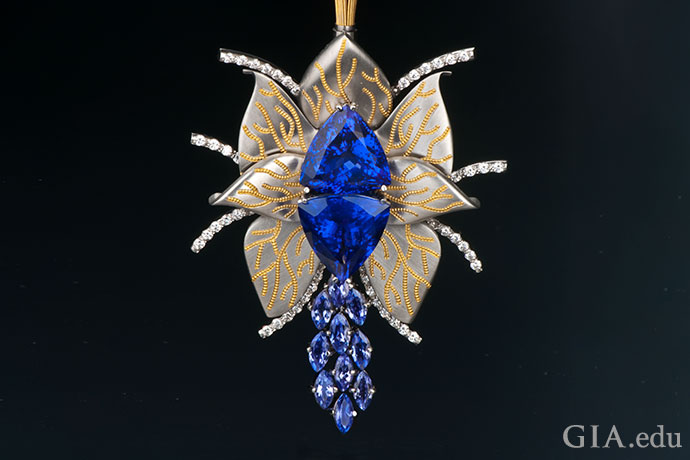
Some 17.67 carats of tanzanite blossom in Sir Zoltan David’s magical “Flowerfly” necklace. The piece won the Tanzanite Foundation’s “Be Born to Tanzanite” Competition in 2007. Photo: Robert Weldon/GIA. Courtesy: Zoltan David
Tanzanite is stable under normal wearing conditions, which means it’s resistant to the effects of normal heat, light and common chemicals. Still, the December birthstone may crack if exposed to very high temperatures or sudden temperature changes. It can be attacked by hydrochloric and hydrofluoric acids.
Warm, soapy water is always the best way to clean this December birthstone. Ultrasonic and steam cleaners are never recommended for tanzanite.
Untreated, tanzanite is typically brown. Tanzanite is routinely heat treated to modify its color to a predominantly blue to bluish purple. The treatment is stable with no additional durability concerns.

A shoreline of diamonds surround an ocean of turquoise in this captivating ring. Courtesy: Arya Esha
Turquoise is found in only a few places on Earth: dry and barren regions where acidic, copper-rich groundwater seeps downward through deeply altered or broken rocks where it reacts with minerals that contain phosphorus and aluminum. The result of this process is a porous, semitranslucent-to-opaque hydrous phosphate of copper and aluminum.
This December birthstone owes its texture to its structure and composition. Turquoise is an aggregate of microscopic crystals that form a solid mass. If the crystals are packed closely together, the material is less porous, so it has a finer texture. Fine-textured turquoise has an attractive, waxy luster when it’s polished. Turquoise with a less-dense crystal structure has higher porosity and a coarser texture, resulting in a duller luster when it’s polished.
Porosity and texture don’t just affect appearance: They also affect the durability of turquoise. This December birthstone is fairly soft—it ranks 5 to 6 on the Mohs scale of hardness. Turquoise with a coarse texture might have poor toughness, too, so it fractures easily. Samples with finer texture have fair to good toughness.
Gemologists love this December birthstone because turquoise often contains matrix: spiderweb-like veins that provide evidence of the rock in which it formed. They also like how turquoise is colored by copper, which creates some of the most vivid blues and greens in the gem kingdom.
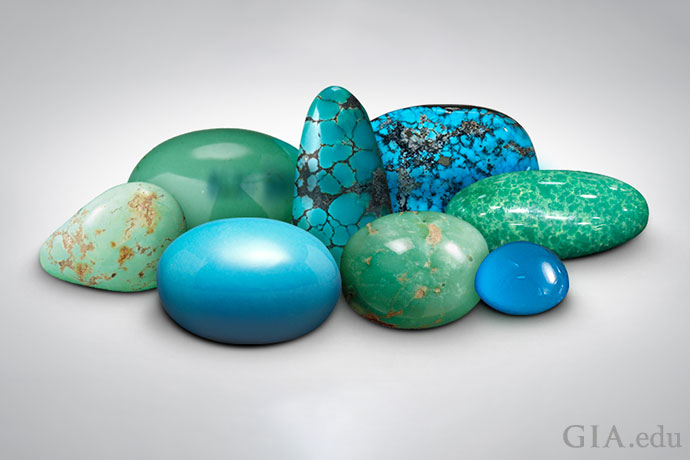
Whether opaque, semitranslucent or checkered with spiderweb-like veins, turquoise enchants. Composite photo: Eric Welch, Robert Weldon, Terri Weimer/GIA, Dr. Edward J. Gübelin collection. Courtesy (far right): Barlow’s
Turquoise has been cherished for millennia. The pharaohs and other rulers of ancient Egypt adorned themselves with it. Chinese artisans carved it more than 3,000 years ago.
This December birthstone was thought to possess many beneficial powers, like guaranteeing health and good fortune. From the 13th century on, it was believed to protect the wearer from falling (especially off horses), and would break into several pieces at the approach of disaster. Hindu mystics maintained that seeing a turquoise after beholding the new moon ensured fantastic wealth.
Turquoise played an important role in the lives of Native Americans. The Apache thought turquoise could be found by following a rainbow to its end. They also believed that attaching the December birthstone to a bow or firearm made one’s aim more accurate. The Pueblo maintained that turquoise got its color from the sky, while the Hopi thought the gem was produced by lizards scurrying over the earth.
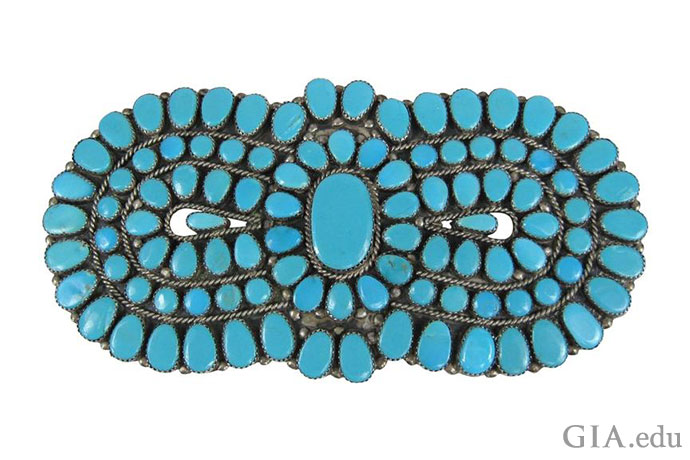
An artisan from the Zuni tribe made this turquoise brooch. Courtesy: 1stdibs.com
Turquoise adorns the funerary mask of King Tut, who ruled Egypt more than 3,000 years ago. It also appears in jewelry belonging to more modern royalty, such as the Jordan turquoise demi-parure (turquoise, diamond and sapphire necklace and earrings) in the collection of Britain’s Queen Elizabeth II. Wallace Simpson (1896-1986), Duchess of Windsor, wore a famous amethyst and turquoise necklace made by Cartier. Turquoise is also the gem of the 11th wedding anniversary.

A dazzling display of color, Cartier’s bib necklace for the Duchess of Windsor features a sea of turquoise cabochons and faceted amethyst. Courtesy: N. Welsh, Cartier Collection © Cartier
Turquoise has been mined in the Nishapur district of Iran for more than 1,000 years. The even-colored, intense blue turquoise from this region is dubbed “robin’s egg blue,” “sky blue” and “Persian blue.” Trade professionals now use these terms to describe turquoise of this color – regardless of the source.
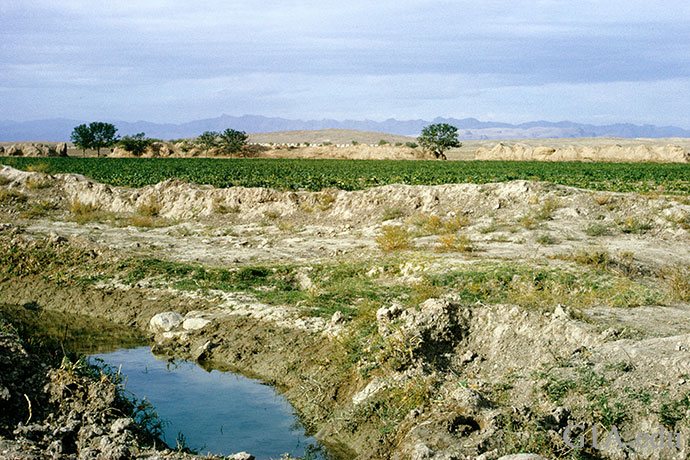
This is the view on the way to Nishapur. Courtesy: Dr. Edward J. Gübelin Collection
Although New Mexico was the largest producer of turquoise in the U.S. until the 1920s, today most of the U.S. production of this December birthstone comes from Arizona and Nevada. Mines have evocative names like Dry Creek, Easter Blue, Emerald Valley and Fox. The Kingman mine in Arizona is a historically important source that is known for producing intense blue turquoise. Now closed to turquoise mining, the Sleeping Beauty mine was a prolific producer for more than four decades.

The intense blue turquoise beads in this necklace came from Arizona’s Sleeping Beauty mine. Photo: Robert Weldon/GIA. Courtesy: Somewhere In The Rainbow
China is now the world’s largest producer of fine turquoise. Hubei Province, in central China, is the source of most of the gem-quality turquoise currently being mined there.
Color: The color of turquoise usually ranges from light to medium blue or greenish blue. It’s often mottled, and sometimes it has dark splotches. It might also have veins of matrix running through it.
The most-prized turquoise color is an even, intense, medium blue, with no matrix and the ability to take a good polish. But some consumers prefer a greenish blue, and some contemporary designers seek turquoise referred to as “avocado” and “lime green.”
Clarity: Turquoise can be semitranslucent to opaque. Semitranslucent stones are preferred.

Note the even color in the clusters of turquoise dangling from gold chains in this one-of-a-kind piece. Courtesy: Denise James
Cut: Turquoise is most often fashioned as cabochons. The smoothly rounded dome shape sets off turquoise’s color, texture and any matrix beautifully. In addition, manufacturers and artisans fashion turquoise rough into round or oblong beads for necklaces, and into small, flat pieces that are popular as jewelry inlays. Other rough material might be tumbled into “nuggets” or polished as free-form shapes that reflect the shape of the original rough. There are also examples of top-color blue turquoise engraved with Persian or Arabic inscriptions that are then inlaid with gold.
Carat Weight: Turquoise is available in a wide range of sizes. All sizes, even very small ones, are used in Native American jewelry, and large pieces have been popular for carvings. For any size, the quality and evenness of the color is the overriding value factor.
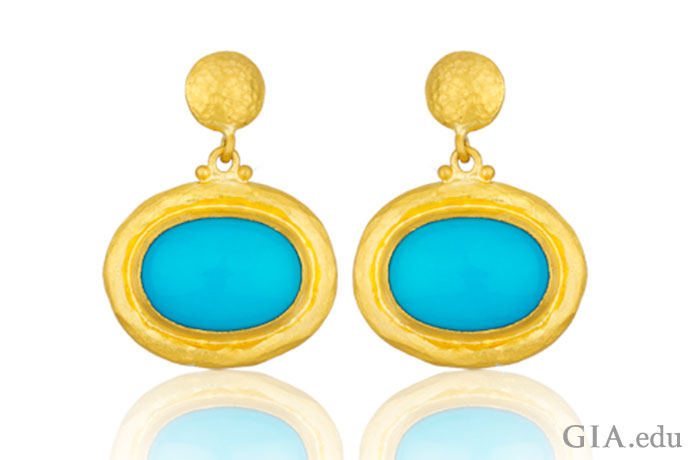
Rich blue turquoise surrounded by 24K gold makes these earrings a mesmerizing sight. Courtesy: Lika Behar
A colorless wax or polymer is often used to improve the color and luster of turquoise. Other treatments include applying epoxy to thin turquoise slices to strengthen them, applying coatings of lacquer or epoxy, and filling cavities with imitation pyrite inclusions made of metal-filled epoxy.
It’s safe to clean turquoise jewelry with warm, soapy water, but this December birthstone should never be cleaned with steam or ultrasonic cleaners. Heat or solvents can damage the treated surfaces on some turquoise.
Turquoise is generally stable to light, but high heat can cause discoloration and breakage. Turquoise can be damaged by acids, and it can be discolored by certain chemicals, cosmetics and even skin oils or perspiration.

A 19.76 ct orangy brown zircon is ringed by 0.51 carats of diamonds. Courtesy: 1stdibs.com
Zircon comes in a wide and varied palette of yellow, green, red, orange, brown and blue hues, making it a favorite among collectors and knowledgeable consumers. This December birthstone is 6 to 7.5 on the Mohs scale of hardness.

Zircon comes in a wide array of attractive colors. Photo: Robert Weldon/GIA, Dr. Edward J. Gübelin Collection.
Colorless zircon is known for its brilliance and flashes of multicolored light, called fire. These two zircon properties are close enough to the properties of diamond to account for centuries of confusion between the two gems.

This 11.41 ct oval blue zircon with its diamond halo is like a lake that invites the viewer to peer into infinity. The tsavorite garnet side stones are leafy touches to the icy scene. Courtesy: Omi Privé
Gemologists love zircon because its radioactive trace elements are a geologic clock that tells us about the early Earth. This December birthstone also has very high luster, high refractive indices (the measure of the extent to which light is bent as it leaves a gemstone at an angle other than perpendicular to the surface) and strong dispersion, which is responsible for the brilliance and rainbow flashes of fire.
The origins of the word zircon have elicited colorful debate. Some scholars believe it comes from the Arabic word zarkun, meaning “cinnabar” or “vermilion.” Others think the source is the Persian word zargun, or “gold colored.” Considering the color range for this December Birthstone, either derivation seems possible.
Zircon comes with pleasing lore. In the Middle Ages, it was thought to lull one into a deep sleep and scare off evil spirits. In the Hindu religion, zircon alternates with hessonite garnet as one of the nine gems of the navaratna. When worn together, the nine gems protect the wearer and bring good health, wealth and wisdom.
Victorians had a fondness for blue zircon. Fine specimens can be found in English estate jewelry from the 1880s.
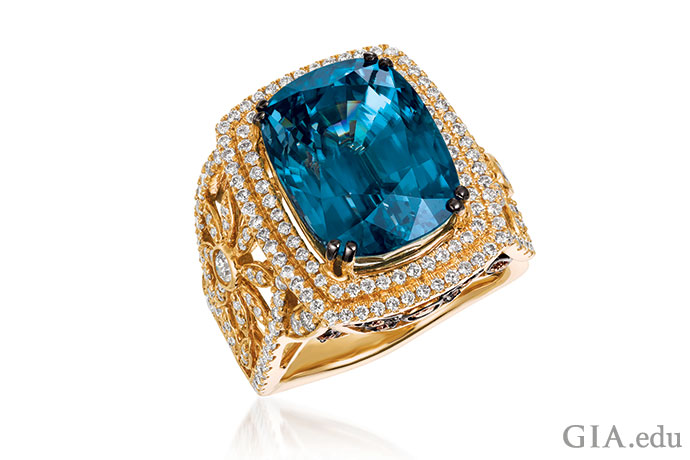
Regal rings like this show why blue zircon is a popular gem. Courtesy: LeVian
Sri Lanka’s wealth of gems is legendary: Sapphire in various colors, ruby, alexandrite, spinel, tourmaline, moonstone and quartz are some of the gem minerals unearthed there. So is zircon. Elahera, a region in central Sri Lanka, is one of the country’s most productive areas. Mountains, jungles and restless streams make for a dramatic landscape.
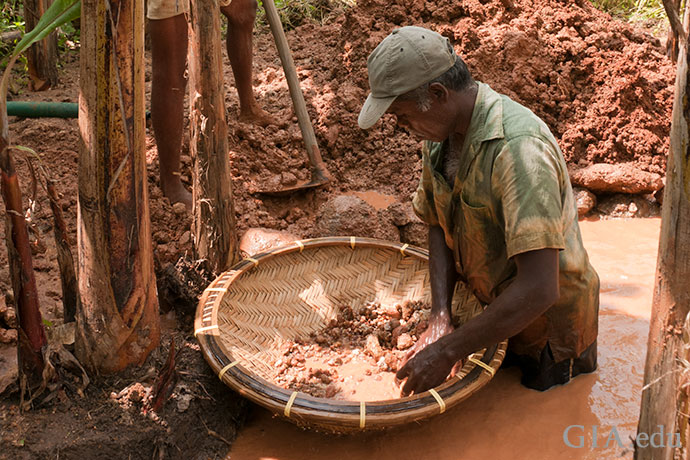
An artisanal miner searches for gems in the Elahera region of Sri Lanka. Photo: Vincent Pardieu/GIA
Australia’s Harts Range is known for producing zircons in yellow-brown, orangy brown, pink and purple. Go there and you’ll see open savannahs, dry stream beds and low-lying hills that meet the horizon. Zircon Hill is where the gem is mined. The nearby city of Alice Springs is known for its outback culture, aboriginal art and quirky sporting events like a regatta race held in a dry river bed.
Zircon is often located near sapphire sources. Countries where the two overlap include Sri Lanka, Myanmar, Vietnam, Cambodia and Australia.
Color: Some zircons display warm autumnal earth tones such as yellowish and reddish brown. Red and green zircons have market value as collectors’ stones, and cat’s-eye zircons occasionally appear on the market. There are also colorless zircons.
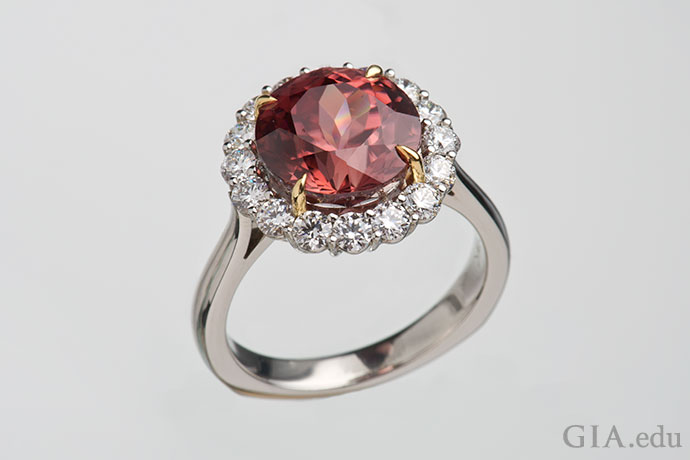
A brisk autumn day, a fireplace and apple cider would be the perfect backdrop for this ring, which features a 7.96 ct zircon. Photo: Robert Weldon/GIA. Courtesy: Richard Krementz Gemstones
Although collectors clearly love zircon’s variety of colors, consumers seem most enamored of just one hue: blue. Gem dealers report that at least 80 percent of the zircons they sell are blue. Because they’re in greater demand, blue zircons usually command higher prices than any of the other varieties.
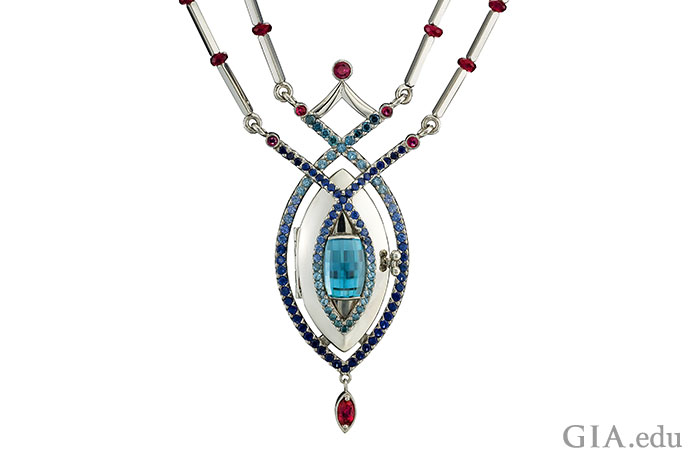
A blue zircon takes center stage in the “Reine de Glace” pendant designed by Lisa Krikawa. Courtesy: Krikawa Jewelry Designs. Blue zircon by John Dyer & Co.
Clarity: Zircons are relatively free of inclusions. But many untreated zircons have a cloudy or smoky appearance that, if extreme, can be a negative factor with buyers. In Victorian times, this smokiness made zircon a popular gem for mourning jewelry. Today, most faceted zircon is free of inclusions that are visible to the unaided eye. Eye-visible inclusions cause a drop in zircon value. Rarely, zircon might contain long, parallel inclusions that create a cat’s-eye effect when the stone is cut as a cabochon.
Cut: It’s a challenge to cut zircon because the gem is brittle. Cutters usually fashion zircon in the brilliant style to take advantage of its brilliance and fire. Zircon can also be found in step cuts, which have rows of parallel facets, and mixed cuts, which are a combination of brilliant and step-cut facets.
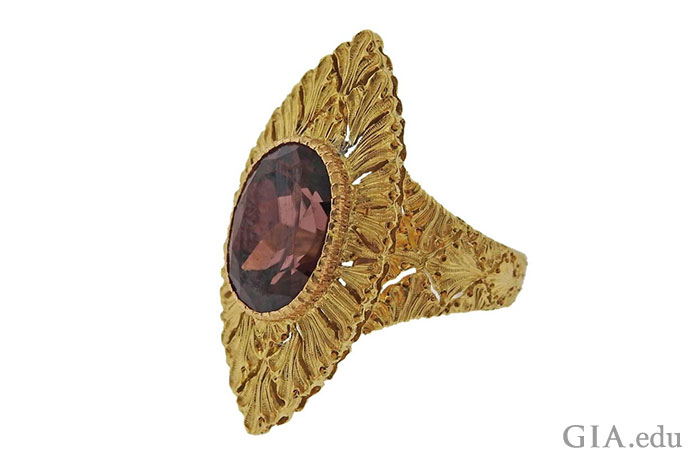
A richly colored 7.23 ct zircon set in an ornate 18K gold ring looks like it belongs on the finger of European royalty. Courtesy: 1stdibs.com
Carat Weight: The supply of this December birthstone is generally limited, and typical zircon sizes depend on color. Blue or green stones normally range from one carat to 10 carats, with yellows and oranges up to around five carats. Reds and purples are usually smaller.
Warm, soapy water is recommended for cleaning zircon. Ultrasonic and steam cleaners are not recommended for this December birthstone.
Zircon is commonly heat treated to produce blue and colorless varieties, as well as orange, yellow and red. The gem is generally stable when exposed to light, but some heat-treated stones might revert to their original colors (usually light brown) after prolonged exposure to bright light. Exposure to heat can alter the color of some zircon. Zircon is stable when exposed to chemicals.
Because zircon tends to abrade, it is best to avoid wearing it in rough conditions, such as while gardening, playing sports or doing dishes.
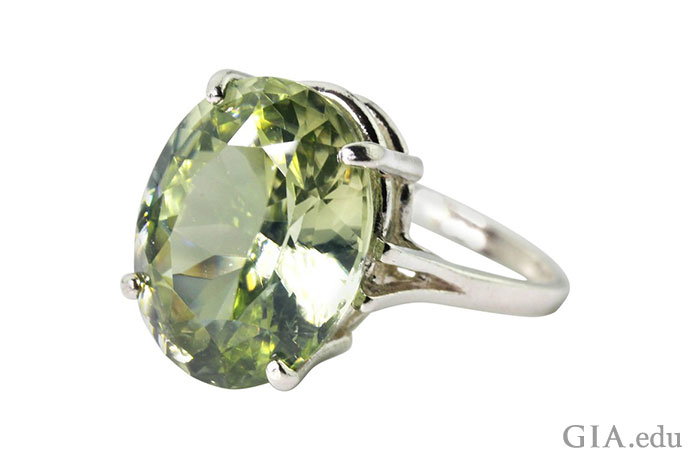
The color of the 14.48 ct zircon in this ring evokes a forest … fields … grassy expanses. Courtesy: 1stdibs.com
Ready to go shopping for the December birthstone? Be sure to take our Tanzanite Buying Guide and Turquoise Buying Guide with you when you go!
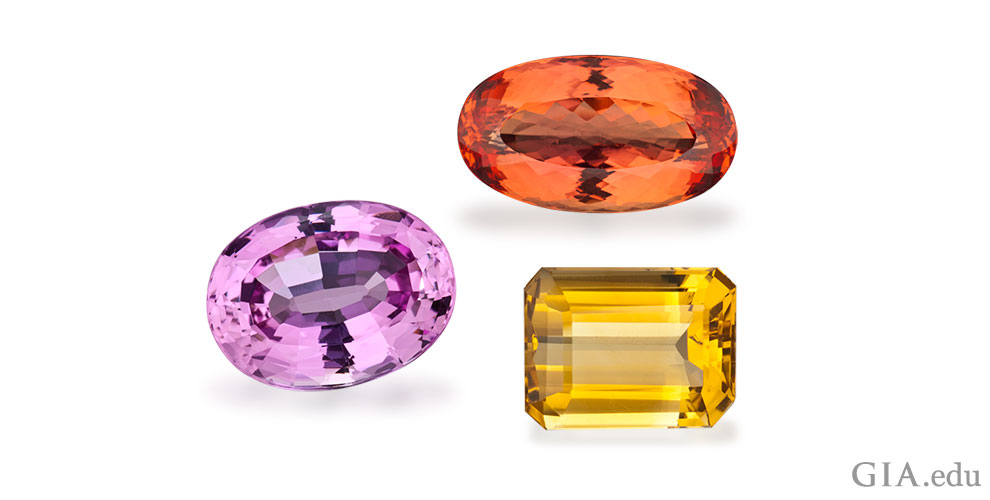
Those with a November birthstone have two beautiful options to choose from: topaz and citrine. Topaz comes in a rainbow of colors; citrine is known for its charming yellow and orange hues. The two gems give you countless options. Your challenge will be deciding which one to pick. We offer help.
In this post, we cover
Gemological properties of topaz
Topaz history & lore
Where topaz comes from
Qualities to look for in topaz
Topaz treatments, care & cleaning
Gemological properties of citrine
Citrine history & lore
Where citrine comes from
Qualities to look for in citrine
Citrine treatments, care & cleaning
The November birthstone topaz has an exceptionally wide color range that, in addition to brown, includes various tones and saturations of blue, green, yellow, orange, red, pink and purple. Colorless topaz is plentiful, and is often treated to give it a blue color.
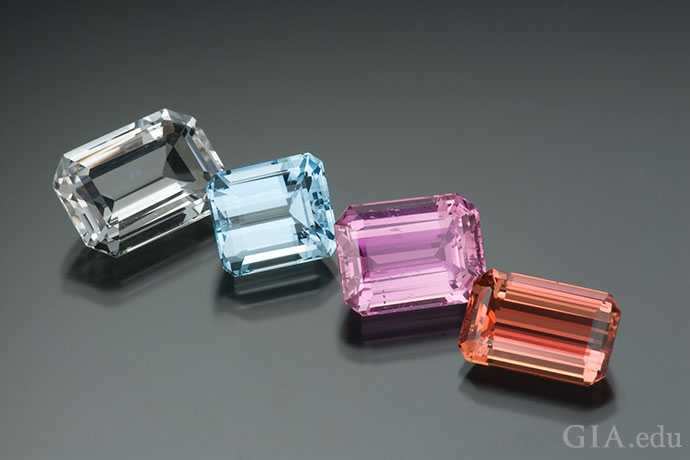
Pictured here are some of the many colors of topaz. From left to right: a 9.21 carat (ct) colorless emerald cut from Nigeria; a 15.01 ct light blue emerald cut from Brazil; an 18.41 ct purplish pink emerald cut from Pakistan; and a 12.54 ct orange-red emerald cut from Brazil. Photo: Robert Weldon/GIA
Color varieties of the November birthstone are often identified simply by hue name—blue topaz, pink topaz and so forth—but there are also a couple of special trade names. Imperial topaz is typically a medium reddish orange to orange-red though some dealers, especially those in Brazil, apply the term to yellow, pink and red topaz as well. The reddish pleochroic color (pleochroism is the display of different body colors from different viewing directions) of Imperial topaz often appears at the ends of fashioned gems–like pears and ovals–that have an otherwise yellow-to-orange body color. Red is one of the most sought-after (and least available) topaz colors.
Sherry topaz—named after sherry wine—is a yellowish brown or brownish yellow to orange. Stones in this color range are often called precious topaz to help distinguish them from the similarly colored but less expensive citrine and smoky quartz.
Topaz is an 8 on the Mohs Scale of Hardness. It’s not very tough, so a hard blow might split it, and extreme pressure or sharp temperature changes might cause it to break. The November birthstone is best set in a protective mounting like a bezel or used in pieces that aren’t subjected to heavy wear, like pendants and pins.
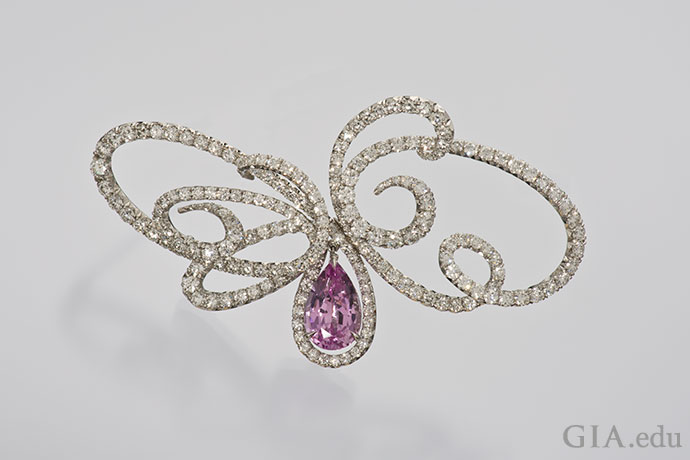
A pink topaz set in a diamond and platinum butterfly brooch is a delightful sight. Photo: Robert Weldon/GIA. Courtesy: Richard Krementz Gemstones
Gemologists love topaz because it comes in some of the gem world’s largest crystals: The largest are measured in kilos, not carats. They also love the fact that faceted topaz takes such a high polish and is slightly slippery to the touch.
Topaz was long thought to have many benefits. The ancient Greeks believed that topaz gave them strength. From the 1300s to the 1600s, Europeans thought it could thwart magic spells and dispel anger. The November birthstone was also believed to have curative powers. To treat “dimness of vision,” 12th century abbess St. Hildegard recommended placing topaz in wine for three days and then rubbing the moistened topaz on the patient’s eyes.
Imperial topaz has aristocratic cachet. It is commonly believed that the name originated with the Russian royal family’s insistence on keeping the finest colors of this gem, which was mined in Russia’s Ural Mountains, exclusively for their use. An alternate explanation, especially popular in Brazil, is that it dates from an 1881 visit by Brazilian Emperor Pedro II to Ouro Preto—the town closest to Brazil’s most productive topaz mines–and the gift of a reddish topaz to him. Regardless of the source of the designation, there is no question all believed this beautiful gem was fit for a king.

Want a gem with an aristocratic cachet? Imperial topaz might be the one for you. Photo: Robert Weldon/GIA
Blue topaz is the gem of the fourth wedding anniversary, and Imperial topaz is the gem of the 23rd wedding anniversary.
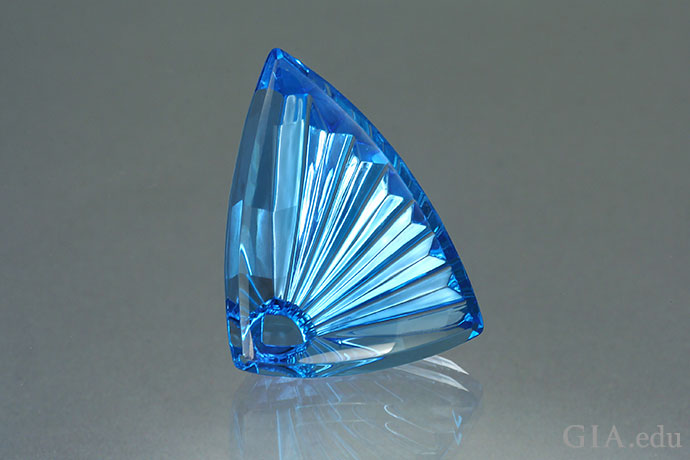
The artistic carving of this 38.56 ct blue topaz intensifies the color. Photo: Lydia Dyer. Courtesy: John Dyer & Co.
Minas Gerais, a state in Brazil, is one of the most important sources for high-quality topaz. Yellow to orange, red, pink, violet and blends of red with orange or purple are some of the colors unearthed here. The nearby town of Ouro Preto is a fitting companion. In this UNESCO world heritage site, majestic colonial churches checker the skyline and quaint cobblestone streets crisscross the city.

Topaz mined from the Ouro Preto region of Minas Gerais, Brazil comes in a lovely range of hues, as displayed in this necklace set with a 24.13 ct fancy-cut topaz and the accompanying 44.11, 71.21 and 66.66 ct loose stones. Photo: GIA and Harold & Erica Van Pelt. Courtesy: Amsterdam Sauer Co.
Northwestern Pakistan is known for producing pink topaz. Ghundao Hill, close to the small town of Katlang, has been mined since 1972. The most sought-after shade of pink topaz from Katlang has a tinge of violet, which some in the gem trade call cyclamen pink. But even at Ghundao Hill, only rarely is fine pink topaz found.
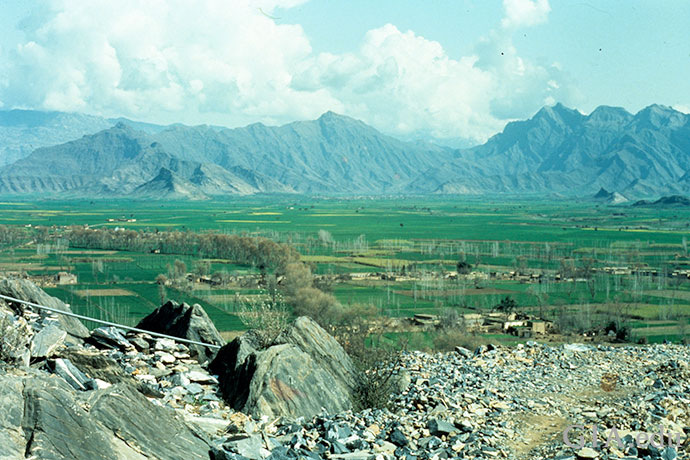
Ghundao Hill’s setting is quite picturesque: A valley carpeted in green starts at the base. The towering Hindu Kush Mountains rise in the distance. Photo: Dr. Edward J. Gübelin/GIA
Other topaz sources include Namibia, on the western coast of southern Africa, and the gem-rich island of Madagascar. Today, some topaz is also found in the historic Russian localities and elsewhere including, Africa, China, India, Myanmar, Sri Lanka and Vietnam, as well as the United States and Mexico.
Color: Blue topaz and colorless topaz are widely available and very affordable. Most of the blue topaz on the market today has been color treated, as described in the next section. Red and pink topaz varieties are rare, highly cherished and will carry a significantly higher price tag per carat. Imperial topaz is also highly prized.

A royal enchantment: This 11.11 ct Imperial topaz is accented with 0.29 carats of rubies and 0.75 carats of diamonds, all set in rose gold. Courtesy: Omi Privé
Clarity: Faceted blue topaz is almost always free of eye-visible inclusions. Topaz in colors that are not as plentiful may be included. Depending on the rarity of the color, inclusions may not have a significant effect on value.
Cut: Topaz is cut in a wide variety of shapes and styles, including emerald, cushion, oval, pear, round, triangular, marquise and fantasy cuts.
Carat weight: If the color of the topaz is considered rare, the per-carat price may rise dramatically as size increases.

This 1,002 ct fantasy cut topaz is a work of art. Photo: Orasa Weldon/GIA
To clean this November birthstone, do not use steam cleaning or ultrasonic cleaners to clean topaz: Warm, soapy water works best.
Topaz is often treated. Since naturally colored blue topaz is extremely rare, colorless topaz is often processed with irradiation followed, in some cases, by heating to turn it various shades of blue. The three irradiation techniques used are exposure to gamma rays in a cobalt irradiator, bombardment with electrons in an accelerator and bombardment with neutrons in a nuclear reactor. Gems that are treated in an accelerator or nuclear reactor may become radioactive, but the U.S. National Regulatory Commission (NRC) does not allow release of such stones into the trade until radioactivity levels fall below certain limits. The NRC advises that “any dose from these gems would be extremely small” and would continue to go down. Dealers use terms like “London blue,” “Swiss blue,” “super blue” and “maxi blue” to describe darker blues, and “sky blue” for paler hues. In general, darker blues cost slightly more than lighter hues, but both are typically affordable.
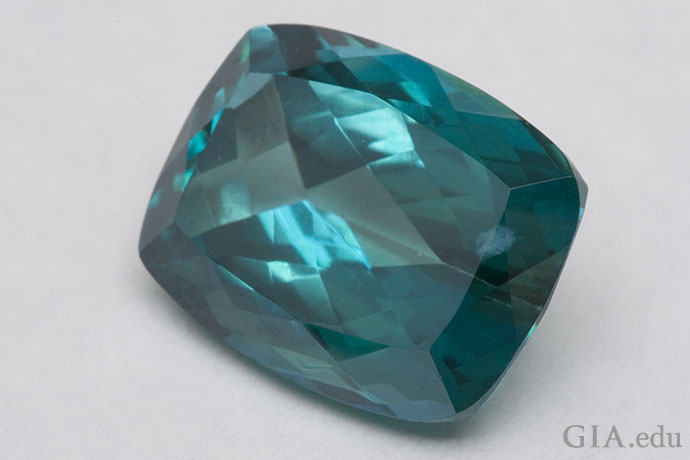
This blue topaz has undergone irradiation to achieve this color result often referred to as “Mystic Topaz” or “Caribbean Topaz” by the trade. Photo: Valerie Power/GIA
Also common, is the heating of yellow to reddish brown topaz to create pink gems. Both irradiation and heat treatment are permanent under normal conditions of wear and care. For the most part, they are undetectable.
High heat or sudden temperature changes can cause internal breaks in topaz. The gem’s color is generally stable to light, but prolonged exposure to heat or sunlight might cause fading in yellow-to-brown, reddish brown or dark brown gems. Topaz may be affected slightly by some chemicals.
In addition to irradiation and heat treatment, colorless topaz is sometimes coated with a thin metallic film to change the color or produce a fanciful iridescent effect. The coating can resist daily wear and tear, but abrasive cleaners or buffing wheels will remove it. Only a mild soap solution should be used to clean a topaz treated in this manner.
Citrine is the transparent pale yellow to brownish orange variety of quartz. The finest citrine color is a saturated yellow to reddish orange free of brownish tints. Its color comes from traces of iron. However, this November birthstone is actually rare in nature: Most citrine on the market is the result of heat treating amethyst.
Citrine’s attractive color, plus the durability and affordability it shares with most other quartzes, makes it the top-selling yellow-to-orange gem. Gemologists love this November birthstone because it has a modest price tag, and the price per carat does not rise dramatically for larger sizes.

The Jolie Citrine Necklace, once owned by American actress Angelina Jolie and now part of the National Gem Collection at the Smithsonian Institution, features 64 graduated bezel-set cushion cut citrines, highlighted by a 177.11 ct pear shaped citrine drop. Courtesy: RP Studio
This November birthstone is a variety of quartz, which has been used in jewelry for thousands of years. The ancient Greeks carved rock crystal ornaments that glistened like permafrost. Roman pontiffs wore rings set with massive purple amethysts and citrine has been reported in Roman jewelry. It was particularly popular in colorful Scottish jewelry from the Victorian era. Citrine, believed to derive from the French word for lemon (citron), is given for the thirteenth wedding anniversary.

A fantasy cut unleashes the fire within this 43.49 ct citrine. Photo: Priscilla Dyer. Courtesy: John Dyer & Co.
The top sources for natural citrine are Bolivia, Spain, Madagascar, Mexico and Uruguay. Amethyst that’s typically heat treated to a citrine color is mined mostly in Brazil.

These citrine and diamond butterfly earrings remind us of the beauty surrounding the Anahí mine in Bolivia. Photo: C. D. Mengason/GIA. Gift of Denoir
Deep in the world’s largest freshwater wetland lies Bolivia’s Anahí mine, an important source for natural, unheated citrine. Fields of wild flowers, brightly plumed birds, kaleidoscopes of butterflies, Howler monkeys and jaguars are some of the actors on this vast stage. The story of the mine is worthy of the setting. Discovered by a Spanish conquistador in the 1600s, it was given to him as dowry when he married Anahí, a princess from the Ayoreos tribe of Paraguay. The mine was lost for three centuries, until it was rediscovered in the 1960s.

Cradled between the two mountains lies the Anahí mine in Bolivia. Photo: Robert Weldon/GIA
The Anahí mine produces a unique combination of amethyst and citrine in the same crystal; when the two colors appear together in a fashioned gem, it is known as ametrine. The citrine produced at the Anahí mine typically ranges from orange-yellow to brownish/greenish yellow.

The Anahí mine produces citrine, amethyst and ametrine gems in a broad range of hues. Photo: GIA & Tino Hammid
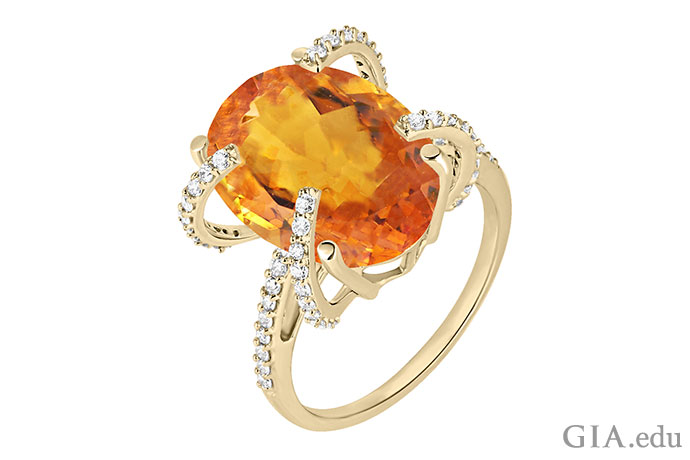
Like an ember, citrine glows in this ring. Courtesy: Arya Esha
Citrine can be safely cleaned with warm, soapy water. While it is usually okay to clean citrine in an ultrasonic machine, steam cleaning is risky since citrine should not be subjected to heat.
As noted above, most of the citrine on the market is the result of heat treatment, which causes some amethyst to change color from an undesirable pale violet to an attractive yellow. In some cases, a darker starting material is used, as the amethyst’s original hue can determine the richness of the resulting citrine’s yellow color.

Spring Bouquet, a pendant made for Rio Tinto’s “Diamonds with a Story” marketing campaign, glows with a 15 ct citrine encircled by 0.30 carats of diamonds. Courtesy: Matthew Campbell Laurenza
Love topaz? Craving citrine? You’ll find our Topaz Buying Guide and Citrine Buying Guide to be extremely helpful.

Morganite engagement rings are trending – and for good reason. Morganite is a beautiful, durable and a comparatively affordable pink gem. It has also benefited from a lot of buzz. Here’s what you need to know about morganite engagement rings.
In this blog, we’ll cover:
Why is morganite so popular?
What type of gem is morganite?
Where does morganite come from?
Morganite qualities to look for
Adding diamonds to a morganite engagement ring
Setting ideas for morganite engagement rings
Caring for and cleaning a morganite engagement ring

Morganite is a picture of romance in this ring featuring a 4.08 carat (ct) center stone encircled by diamonds that trail down the shank. The 18K rose gold setting accentuates the morganite’s color. Courtesy: 1stdibs.com
Interest in morganite engagement rings may have started in 2002, when Ben Affleck proposed to Jennifer Lopez with a 6.1 carat (ct) pink diamond. Pink picked up more momentum when Apple introduced its now iconic rose gold iPhone in 2013 and Pantone named “Marsala” — an earthy red hue that morganite compliments beautifully — the 2015 Color of the Year.
Fashion trends aside, pink has long been associated with love, romance, femininity and tenderness – so it’s not surprising that pink gems have an irresistible appeal. The color pink also flatters any skin tone.
The affordability of morganite engagement rings – especially compared to pink diamonds – puts the look within reach of brides-to-be. It is easy to see why morganite engagement rings, especially those with rose gold settings, have become so popular.

All that seems to be missing from this 20.03 ct morganite ring is the bride who will wear it. Decorating the halo and band are 1.07 carats of diamonds. Courtesy: 1stdibs.com
Morganite is a delicate pastel pink to purplish pink (“rose”), yellowish pink (“peach”) or orangey pink (“salmon”) variety of beryl, a mineral species that also includes emerald, aquamarine and beryls in other colors. Its color is caused by traces of manganese. Strong hues in morganite are rare, and gems usually have to be fairly large to achieve the finest color.
Morganite is a 7.5 to 8 on the Mohs scale of hardness. This makes a morganite engagement ring suitable for everyday wear, although it is not as durable as harder gems like diamond or ruby and sapphire.
A fun piece of lore: Morganite was named to honor American financier and gem enthusiast J. P. Morgan (1837–1913). George Kunz, then Tiffany’s colored stone specialist and a noted gem scholar, proposed the name in 1910 after examining early samples of the beautiful pink beryl from Madagascar.

A 5.94 ct morganite is the star of this ring set in 14K rose gold with 0.70 carats of round brilliant cut diamonds. Courtesy: 1stdibs.com

It takes the skilled hands of a lapidary to turn a piece of morganite rough into a gem fit for a morganite engagement ring. Photo: Robert Weldon/GIA. Gift of Dave Wilber
Most of the morganite on the market today comes from Minas Gerais, Brazil. Minas Gerais is a gemological treasure chest: emerald, aquamarine, tourmaline, alexandrite, amethyst and topaz are some of the other gems found there.
Afghanistan, Pakistan, Mozambique, Namibia and the United States are also sources of morganite, but for the most part, production is minor and inconsistent. While it is no longer a major producer today, the original Madagascar deposit still sets the standard for the best material.

It’s easy to fall in love with this charming morganite engagement ring. It features a 1.69 ct morganite and 0.08 carats of diamonds decorating the shank. Courtesy: 1stdibs.com
As you shop for a morganite engagement ring, keep in mind these tips for picking the perfect gem.
Color: The most prized morganite colors are strong pink, often the result of heat treatment. Untreated material, especially from Brazil, may be a salmon-like orangy pink. Morganite’s color is often pale, increasing in intensity with the size of the stone. Darker colors are usually more desired and thus cost more.
Morganite is almost always heat treated to improve its pink color. Heat drives off the yellow or orange tinge, leaving a purer and more attractive pink. The treatment is not detectable, and the resulting color is stable and won’t fade unless exposed to temperatures over 400°C.

Morganite is often found in large sizes and cut into a variety of shapes. This 10 ct oval morganite makes quite a fashion statement set horizontally in the trendy east-to-west style. The 18K rose gold setting includes four diamond accents in the prongs. Courtesy: 1stdibs.com
Clarity: Faceted morganite often does not have eye-visible inclusions, though they are more likely to be present in larger sizes. Stones with numerous eye-visible inclusions are usually carved or cut as cabochons. Liquid inclusions (liquid trapped in what were once voids in the gem) and fractures are two types of internal features that might be visible to the naked eye. Liquid inclusions tend to have irregular shapes. A fracture looks like a bright, shiny flat surface. It’s worth mentioning again that faceted morganite usually does not have eye-visible inclusions.
Cut: The shape of a morganite gem should have minimal effect on its beauty. Like a diamond, a morganite engagement ring can be attractive as a round brilliant, emerald cut, marquise or oval. Light-color material might be cut slightly deep to help intensify the color. Morganite is a popular material for unique fantasy cuts and carvings.
Carat weight: Although available (and affordable) in large stones, morganite is often cut in calibrated sizes to fit common jewelry mountings.

A solitaire is said to symbolize love, commitment and fidelity. This round morganite solitaire set in rose gold brings the power of pink to a traditional engagement ring style. Courtesy: 1stdibs.com
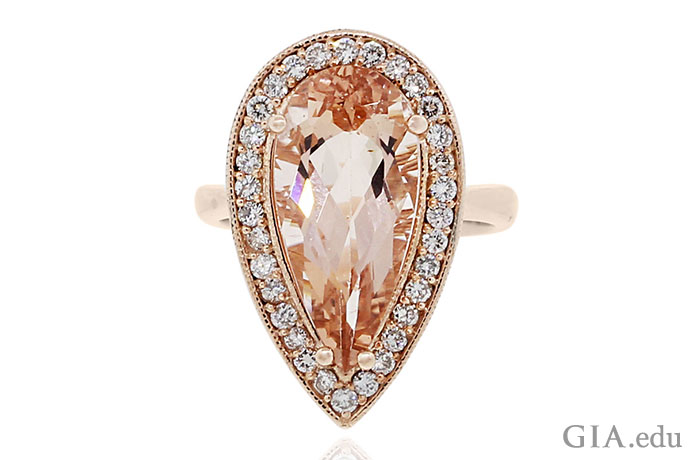
Pear shaped stones help give fingers a longer, slimmer look, and this 5.76 ct morganite ring is sure to flatter almost any hand. The delicate halo of diamonds totaling 0.58 carats adds to its feminine feel. Courtesy: TrueFacet.com
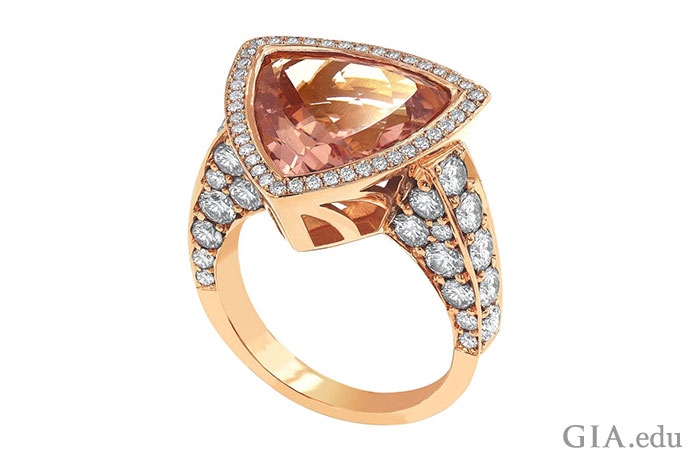
A romantic pairing: A 6.40 ct morganite with 2.45 carats of diamonds that form a halo and cascade down the shank as an enchanting counterpoint. Courtesy: 1stdibs.com
Now that you know what to look for when picking a beautiful morganite gemstone for your engagement ring, you might want to add a bit of drama to it. Morganite and diamonds form an elegant combination. The brilliance of the diamonds creates a dramatic contrast to the subtle blush of the morganite. Diamonds in a halo setting or flanking morganite as side stones are two can’t-fail choices. Here are a few things to keep in mind when selecting diamonds for your morganite engagement ring:

Placing a diamond on either side of the central gem is another way to add diamonds to a morganite engagement ring. Here, an 8.68 ct morganite is framed by two pear shaped diamonds weighing a total of 0.40 carats. Courtesy: 1stdibs.com
Morganite works well in virtually all popular engagement ring setting styles. It’s stately enough to hold its own as a solitaire. It looks glorious with a halo (a ring of smaller diamonds placed around the center stone). And it is artfully framed and protected in a bezel setting (a jewelry setting style in which a thin metal strip is pushed or hammered around a gem to hold it in place).
Since morganite is a 7.5 to 8 on the Mohs scale of hardness, it is more vulnerable to chipping and breakage than a harder gem like a diamond. Because of this, you’ll want to put it in a setting that affords more protection. A bezel setting is an excellent choice, as the metal surrounding the morganite protects the gem from damage. Four- and six-prong settings are also common, but they offer less protection and aren’t an ideal choice for physically active individuals. All options considered, a bezel setting is the safest choice.
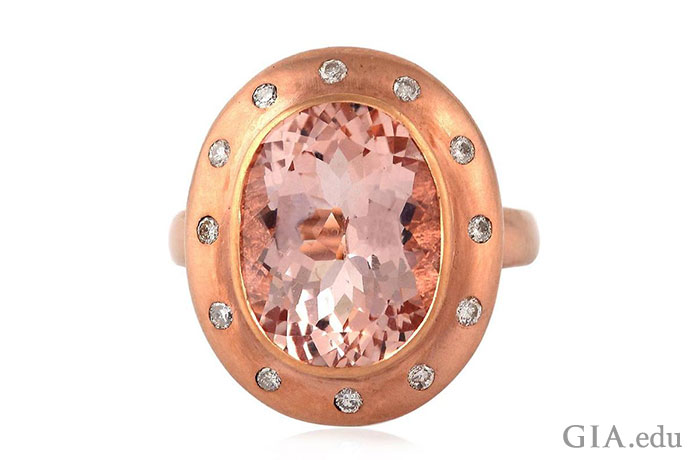
An antique frame cradling a magical mirror is a poetic description for this 6.19 ct morganite surrounded by 18K rose gold and 0.22 carats of diamonds. The rose gold setting not only protects the gemstone, but is also reflected in it, adding even more depth to the morganite’s pink hue. Courtesy: 1stdibs.com
If you’re looking for an engagement ring setting to complement morganite, consider the metal color and the overall look you’re trying to achieve. For a soft color palette, a rose gold band and prongs will enhance the gem’s pink hues, while yellow gold will bring out any yellow in the stone. Or you can opt to go bolder, by using white metal prongs or band (or both) to contrast with the morganite.

Consider the metal when choosing a setting for your morganite ring. You can use yellow gold to your advantage to bring out the yellow hues in some morganite, as in this morganite and diamond ring. Courtesy: Denise James
Warm, soapy water is always a safe cleaning method for a morganite engagement ring. Cleaning by ultrasonic and steam cleaners is also usually safe, unless the stone has liquid inclusions or fractures. Rarely, morganite is fracture filled – a glass-like substance is used to fill a fracture to make it less visible and to improve the stone’s apparent clarity. These stones should only be cleaned with warm, soapy water.
A morganite engagement ring can be damaged by some acids, including those found in certain cleaning products. Morganite is safe to wear during most everyday activities. However, like all other gemstones, morganite can be damaged, so we recommend that you remove your ring before gardening, cleaning, playing sports or participating in other strenuous activities.
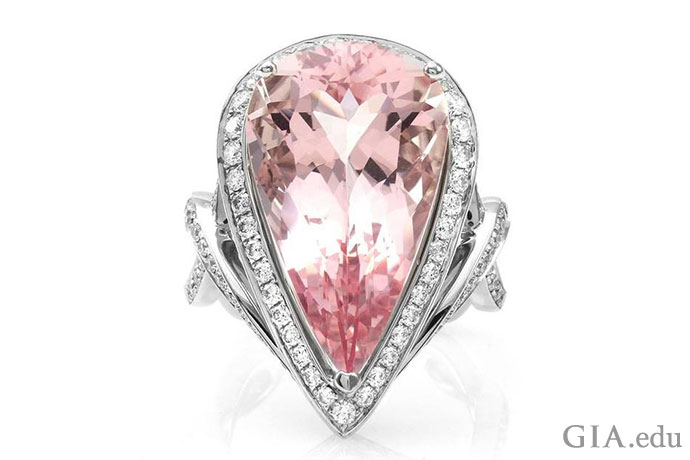
This 12.18 ct pear shaped morganite is framed by a halo of 1.06 carats of pavé diamonds. The white metal setting creates a strong contrast with the gem’s pink hue, making the morganite the star of the show. Courtesy: 1stdibs.com
Morganite in an engagement ring is sweet, romantic and trendy. It is also a charming choice – an eye-pleasing look that evokes the splendor of love.

Ready for romance? Loretta Castoro’s “Love Doves” ring has a 2 ct round morganite accented with diamonds in the shank. Courtesy: Loretta Castoro Signature Collection
Now that you’re well into your search for a center stone, learn how to select flattering engagement ring styles.

The September birthstone is sapphire – a gem that’s been cherished for thousands of years. Sapphire is one of the most popular colored stones because of its beautiful blues. It also comes in a rainbow of other colors. Here’s how to pick a stunning one.
In this post, we cover:
Gemological Properties of Sapphire
Sapphire History & Lore
Where Sapphire Comes From
Qualities to Look for in Sapphire
Sapphire Care & Cleaning
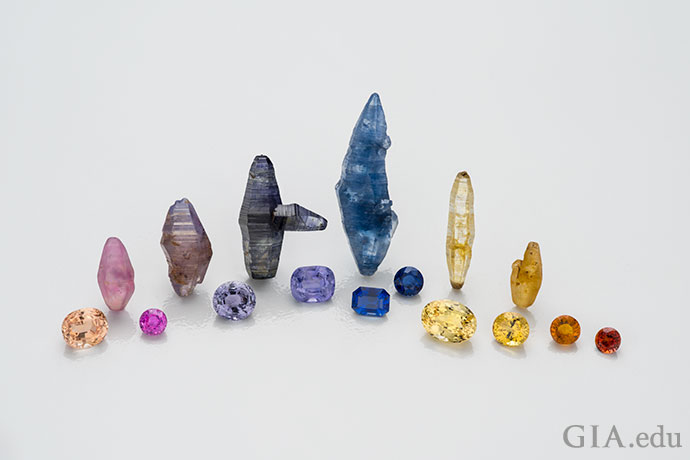
The colors of sapphire enchant. Faceted stones (from left to right): 6.36 carat (ct) pinkish orange “padparadscha,” 1.63 ct pink, 4.76 ct violet, 5.43 ct violet-purple, 3.03 ct blue, 2.12 ct blue, 8.06 ct yellow, 3.46 ct yellow, 2.00 ct orange and 1.01 ct deep orange. Photo: Robert Weldon/GIA. Courtesy: Dr. Edward J. Gübelin Collection and Bill Larson, Pala International
The September birthstone, sapphire, comes in a range of colors in addition to the familiar blue. Called “fancy sapphires,” these are violet, green, yellow, orange, pink, purple, black, brown and intermediate hues. Sapphire can be colorless, too. That’s because the gem belongs to the mineral species corundum, which is composed of aluminum and oxygen. In its purest state, corundum is colorless. However, colorless corundum is rare. Most corundum contains trace amounts of additional elements including iron, titanium, magnesium, vanadium, and chromium that replace aluminum in the corundum structure. The coloration of blue and fancy sapphires involves interactions between these impurity elements—sometimes in combination with imperfections in the gem’s crystal structure—that absorb light and impart color into this otherwise colorless mineral.
Blue in sapphire requires interaction between impurities of iron and titanium, whereas chromium is key to the pink in pink sapphires and the red color of ruby, which also belongs to the corundum mineral species. (Red corundum is the only color not called sapphire – it is called ruby.)
Any color of corundum can show a phenomenon called asterism, or the star effect. This phenomenon usually appears as a six-ray star pattern across a cabochon-cut stone’s curved surface when the gem is examined in direct sunlight or with a single intense light. Asterism is caused by the presence of numerous tiny, needle-like inclusions of rutile or hematite oriented in specific directions.

The star, or asterism, in this 5.43 ct blue sapphire is heavenly. Photo: Robert Weldon/GIA. Courtesy: Fu Gemstone Import, Seattle, WA.
Another interesting variety is color-change sapphire. These fascinating stones appear to be a different color under different lighting conditions, most often going from violetish blue in daylight or fluorescent lighting to deep reddish purple in incandescent light. Their presence adds a special dimension to the options available for the amazing September birthstone.
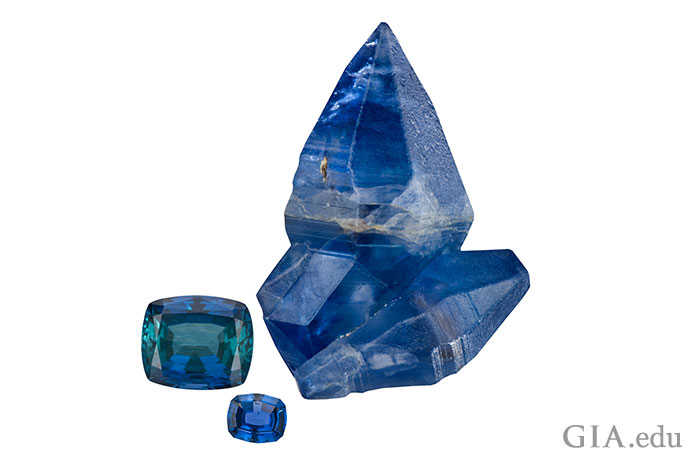
Pictured here are a cluster of sapphire crystals from Myanmar, a faceted blue-green sapphire from Kenya and a faceted blue sapphire from Montana. Photo: Robert Weldon/GIA. Courtesy: (Rough) Bill Larson, Pala International; (Left) Columbia Gem House; (Bottom) Dr. Edward J. Gübelin collection.
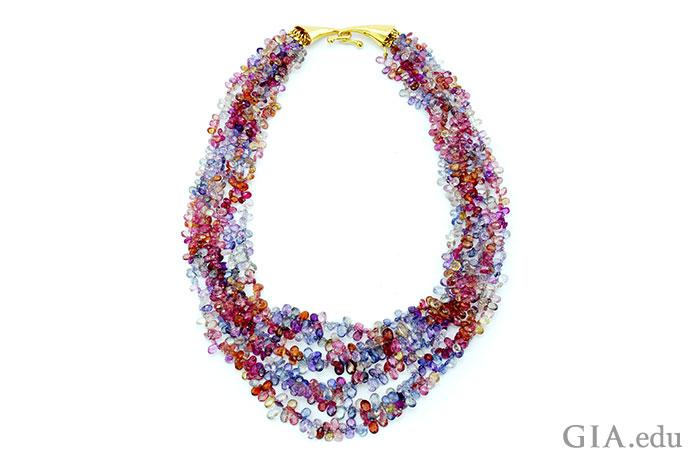
Some of the many colors of sapphire are on display in “Dawn” – a one-of-a-kind necklace that features 450 carats of sapphire beads. Courtesy: Denise James
The September birthstone has traditionally symbolized sincerity, truth, faithfulness and nobility. For countless centuries, sapphire has adorned royalty and the robes of the clergy. The elite of ancient Greece and Rome believed that blue sapphires protected their owners from harm and envy. The clergy of the Middle Ages wore sapphires because they symbolized Heaven.
The September birthstone was also reputed to have healing powers. Medieval Europeans believed that sapphire cured plague boils and diseases of the eye. It also was thought to be an antidote to poison.

A dragonfly brooch studded with a 38.82 carats of pink, green, blue and yellow fancy sapphires and 5.74 carats total weight of diamonds might make you believe in the magical powers of the gem. Photo: Robert Weldon/GIA. Courtesy: Pioneer Gems
Famous sapphires include the Rockefeller Sapphire, a 62.02 ct rectangular step cut stone that was unearthed in Myanmar (Burma). Acquired in 1934 by financier and philanthropist John D. Rockefeller, Jr. (1874–1960) from an Indian maharaja, the gem was recut and remounted over the years. The sapphire was first set as a brooch and later as a ring featuring two triangular brilliant cut diamond side stones.
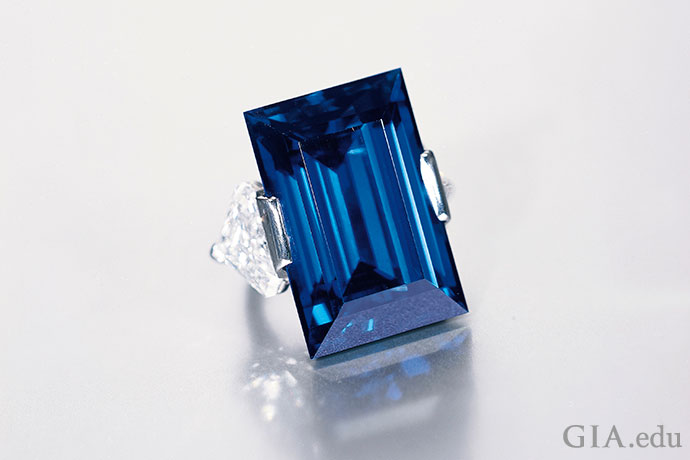
The Rockefeller Sapphire is a 62.02 ct rectangular step-cut sapphire weighing 62.02 ct. Here it is flanked by cut-cornered triangular cut diamonds, mounted in a platinum ring signed Tiffany & Co. Courtesy: Christie’s Images Ltd., 2015
The Starry Night Sapphire is another famous gem. Also originating from Myanmar, the Starry Night Sapphire is a 111.96 ct cabochon-cut gem whose magnificent six-rayed star is a fine example of asterism.
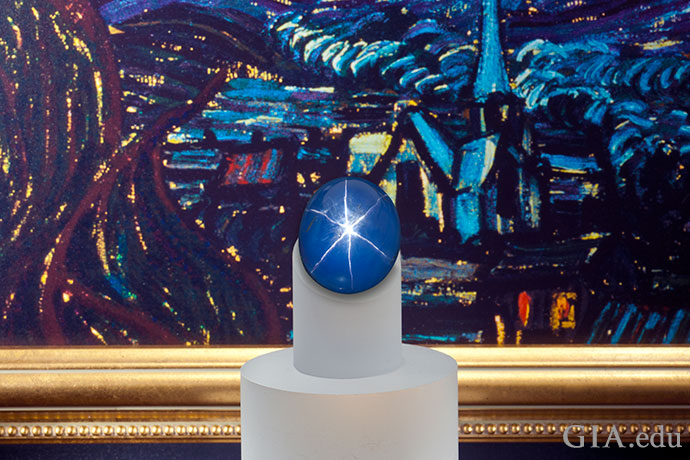
The Starry Night Sapphire comes from Myanmar, one of the most important sources of the gem. The gemological phenomenon asterism is responsible for creating the six-rayed star. Photo: Robert Weldon/GIA. Courtesy: Benjamin Zucker
In addition to being the September birthstone, sapphire is also the gem commemorating the 5th and 45th wedding anniversaries.
Kashmir, Myanmar and Sri Lanka are three historically important sources for sapphire. Significant quantities of the September birthstone have also been found in Australia, Thailand, Cambodia, Madagascar and the United States (Montana), among other countries in Asia and Africa.
Sapphires were discovered in Kashmir around 1881, when a landslide high in the Himalayas exposed a large pocket of velvety “cornflower” blue crystals. As the spectacular sapphires began to appear farther south, the Maharaja of Kashmir—and his army—took control of the new locality. From 1882 to 1887, thousands of large, beautiful crystals were recovered. In this short season of six years rests Kashmir sapphire’s reputation as one of the world’s most coveted gems. Production has been sporadic since then, but auction houses occasionally sell fine pieces of Kashmir sapphire.

A magical pool … a drop of the sky … a slice of eternity. This 3.08 ct cushion cut Kashmir sapphire conjures such visions. Photo: Robert Weldon/GIA. Courtesy: Edward Boehm, RareSource

The Himalaya Mountains are the source of Kashmir’s beautiful blue sapphires. Photo: Robert C. Kammerling/GIA
The Mogok area of Myanmar is another locale famed for producing the September birthstone. Jungle-clad hills hemmed by mountains make a dramatic landscape. Sapphire typically occurs alongside ruby deposits, but in much lower quantities than its red counterpart. ”Burmese” sapphire, as it is still called by many, can possess a rich, intense blue hue, which has made it particularly prized. Myanmar is also a noted source of jadeite jade, spinel, zircon, amethyst, peridot and other fine gem materials.

A scenic view near Mogok rivals the beauty of the sapphires hidden underground. Photo: James E. Shigley/GIA
For more than 2,000 years, Sri Lanka has been a source of fine sapphire. The blue stones mined from the alluvial gravels of this “jewel box of the Indian Ocean” can display remarkable brilliance and saturation. In addition, the island’s milky white “geuda” sapphires can be heat treated to a rich blue color.
Sri Lanka is one of the few sources for padparadscha (from the words for “lotus color” in Sinhalese) sapphires. Poetic descriptions for this light to medium pinkish orange to orange-pink sapphire include “salmon,” “sunset” and ”ripe guava.” Padparadschas are quite coveted and have a very high per-carat value.
This gem-rich island is also home to ruby, spinel, garnet, tourmaline, topaz and many more gems.
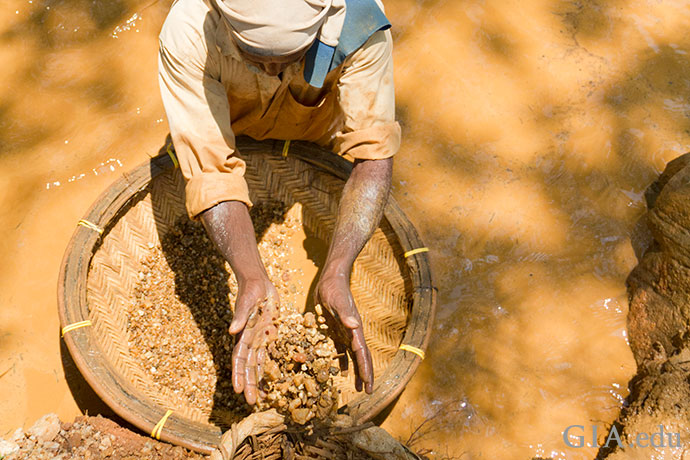
Using the same rudimentary washing techniques as generations before them in Sri Lanka, miners search for sapphire among the gravels in a local stream. Courtesy: Afsaneh Tazari
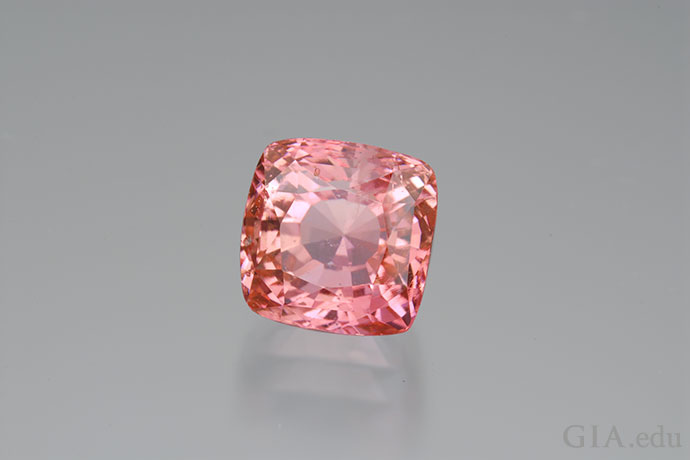
The spellbinding beauty of this 6.66 ct gem from Sri Lanka shows why padparadscha sapphires are so prized. Photo: Robert Weldon/GIA, Dr. Edward J. Gübelin Collection
Thailand is a source of sapphire and a major cutting and treatment center. In dense jungle crossed by dirt roads, miners dig for sapphire in Chanthaburi Province. Sapphires from Myanmar and Cambodia often end up in Chanthaburi for cutting and treatment, and are also sent to Bangkok, an important gem hub.

In the distance, a mining pit dots the tropical terrain of Chanthaburi, Thailand. Photo: Vincent Pardieu/GIA
Here are some tips for picking a stunning sapphire.
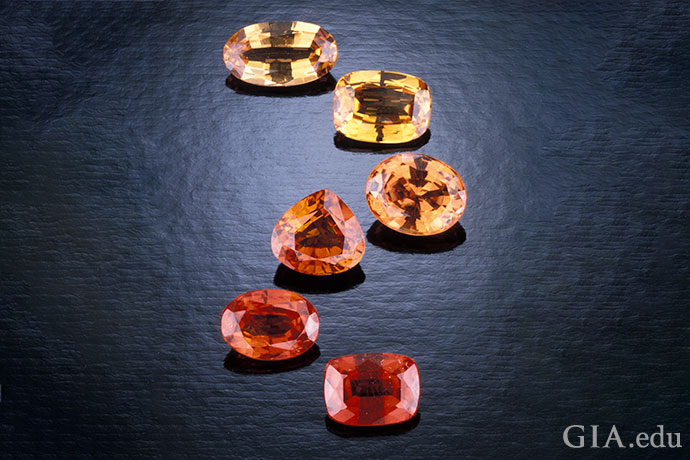
For those who prefer warm-colored gems, the September birthstone does not disappoint. These fancy sapphires range from yellow to highly saturated reddish orange. Photo: GIA & Tino Hammid. Courtesy: Varujan Arslanyan

The cushion cut is particularly popular for sapphires, like this 4.47 ct blue stone. Photo: Robert Weldon/GIA. Courtesy: Bear Essentials
Asterism in a sapphire will only be revealed if the stone is cut as a cabochon. A finished stone’s attractiveness depends on the star’s orientation and the cabochon’s symmetry, proportions and finish.
Look for a cabochon with a symmetrical outline and a star that’s centered when the gem rests on its base. The dome of the cabochon should be fairly high—about two-thirds of the stone’s width—to focus the star sharply. If it’s too high, the phenomenon loses its graceful motion when the stone is tilted. Excessive height also makes the stone difficult to mount.

Sapphires are the stars in these earrings. They were especially popular during the Art Deco era of the 1920s and ‘30s, a look that you can get in an engagement ring. Courtesy: Genevive
The September birthstone is relatively hard, ranking 9 on the Mohs scale. It has excellent toughness and no cleavage, which is a tendency to break when struck. This makes it a great choice for rings and other mountings subject to daily wear.
Corundum is stable under normal wearing conditions, which means it’s resistant to the effects of heat, light and common chemicals. Boric acid powder will etch the surface of even untreated stones. Fracture-filled, cavity-filled and dyed stones can be damaged by even mild acids like lemon juice.
Warm, soapy water is always a safe choice for cleaning the September birthstone. Ultrasonic and steam cleaners are usually safe for untreated, heat-treated and lattice-diffusion-treated stones. Fracture-filled, cavity-filled or dyed material should only be cleaned with a damp cloth.
Now that you know all about sapphire, you’re probably in the mood to buy a beautiful one. Our Sapphire Buying Guide can help you make a great choice.

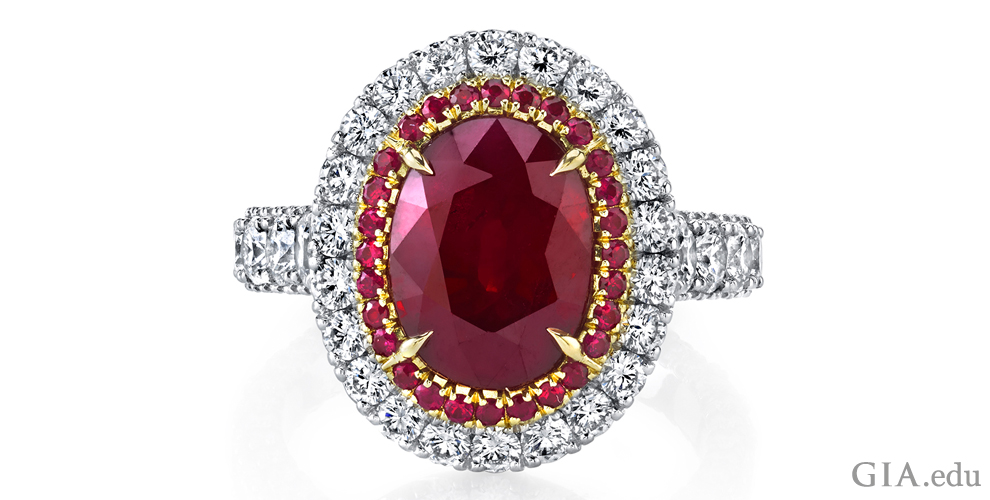
Ruby is the July birthstone – and it’s one of the most coveted of gems. Called the “king of gems” in ancient India, today it can command the highest per-carat price of any colored stone. Here’s what you need to know about this beautiful gem.
In this post, we cover:
Gemological Properties of Ruby
Ruby History & Lore
Where Ruby Comes From
Qualities to Look for in Rubies
Ruby Treatments, Care & Cleaning
Ruby, the July birthstone, is a variety of the mineral corundum that contains trace amounts of the element chromium, which causes its color. The more chromium present, the stronger the color red. Chromium can also cause red fluorescence, which adds to the intensity of the color. Fluorescence is visible light temporarily emitted by some gem materials when they are exposed to high-energy sources such as ultraviolet light (as in sunlight), X-rays or lasers.
Some rubies form in marble, when heat and pressure act on minerals in limestone. These rubies tend to be highly prized, as they have a higher concentration of chromium and little iron, which is an ideal recipe for a bright red color. They also tend to be highly fluorescent.
Other rubies are found in basalt, which forms when molten lava cools and solidifies. Basalt-hosted rubies typically have significantly more iron than marble-hosted rubies and thus are darker. A higher iron content can also mask the fluorescence, eliminating that extra glow of red color.
Still other rubies form in an amphibole-bearing gneiss (a coarse-grained metamorphic rock). These rubies tend to have good color, though they have more iron than the marble-hosted stones and less than those from basalt.
Gemologists love the July birthstone because synthetic ruby was used to create the first laser in 1960. They also consider chromium to be the “rock star” of trace elements.
Consumers love ruby for its intense red color and because it’s a 9 on the Mohs scale of hardness, just below diamond. As such, it is a very durable stone that holds up well to daily wear in rings and other jewelry.

A look at these earrings featuring 8.16 carats of ruby, 1.78 carats of marquise diamonds, and 1.69 carats of round diamonds shows why we are enchanted by the gem. Courtesy: Omi Privé
A prized gem like ruby naturally comes with many attributes. Because it resembles the color of blood, ancients believed it could stop hemorrhaging. The July birthstone was also thought to cure inflammatory diseases and soothe anger. Burmese warriors believed it made them invincible in battle. Medieval Europeans maintained that rubies bestowed health, wisdom, wealth and success in love.
In addition to being the July birthstone, ruby is traditionally given for the 15th and 40th wedding anniversaries.
The Harry Winston Ruby Slippers are a famous example of the July birthstone in a spectacular setting. To commemorate the 50th anniversary of the movie “The Wizard of Oz,” the House of Harry Winston fashioned a pair of red slippers featuring 4,600 rubies weighing an estimated 1,350 carats. When they were created in 1989, they were valued at $3 million.

Harry Winston’s famed ruby slippers were exhibited at GIA in December 1997. Some 4,600 rubies weighing an estimated 1,350 carats glitter in the slippers; another 50 carats of diamonds accent the unique creation. Courtesy: Harry Winston
Our search for the July birthstone starts in Myanmar (formerly known as Burma). For more than five centuries, the Mogok area in Myanmar has produced some of the finest rubies – vibrant red beauties softened by light-scattering inclusions and a glowing red fluorescence. The region is a place of weathered marble and ancient Buddhist temples.

Golden spires of a monastery near Mogok are flashes of color along the mountainside. Photo: Robert C. Kammerling/GIA
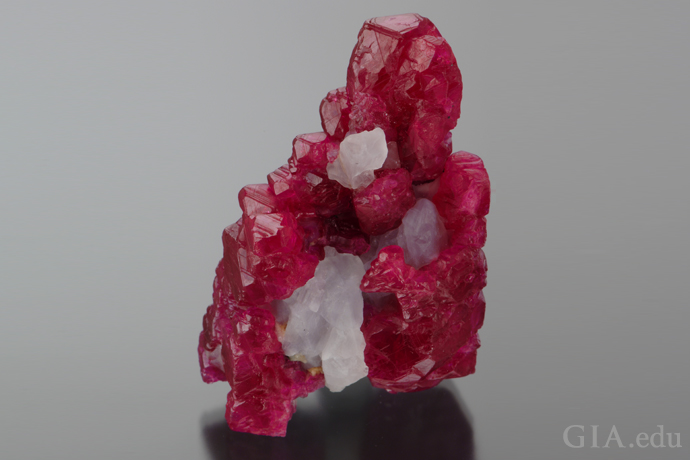
These ruby crystals intertwined with their matrix rival the beauty of finished gems from Mogok. Photo: Robert Weldon/GIA. Courtesy: Bill and Jeanne Larson
Vietnam is another important source for marble-hosted rubies. The Luc Yen region, where rainforest-clad mountains rise over broad paddy fields, produces rubies of red to purplish red color. Today, artisanal miners work the soil in hopes of finding a gem that will change their fortunes.

A small village sits at the base of the mountains in the ruby-bearing Luc Yen region. Photo: Vincent Pardieu/GIA
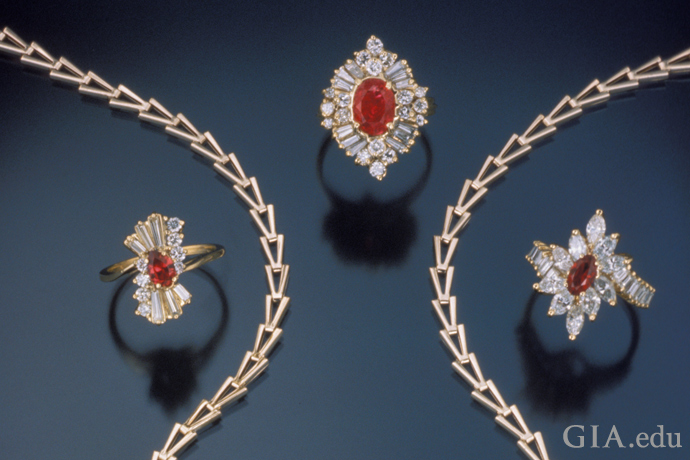
Rubies from Luc Yen and other locales in Vietnam star in these four rings and necklace. Photo: Shane McClure/GIA

This fine 4.04 carat (ct) ruby came from Mozambique, the pre-eminent source of commercial and fine rubies. Photo: Robert Weldon/GIA. Courtesy: Evan Caplan, GemFields
Mozambique is an important new, amphibole-related source for the July birthstone. This African nation is home to the prolific mines at Montepuez. Rubies found there have been compared to the famed gems of Mogok.
For many years in the late 1900s, the basalt-related ruby deposits along the border between Thailand and Cambodia were the major source of rubies in the marketplace. Other important producers include Sri Lanka, Tanzania and Madagascar.

Rubies from Madagascar are a bright, slightly orangy red. Photo: Robert Weldon/GIA. Courtesy: Allerton Cushman & Co., Sun Valley, Idaho

This 5.00 ct oval ruby is all the more radiant set in 18K rose gold and encircled by 2.53 carats of round diamonds in the halo and band. Courtesy: Omi Privé
Using warm soapy water is a safe option to clean ruby, the July birthstone. Ultrasonic and steam cleaners are usually safe for untreated, heat-treated and lattice diffusion–treated stones. Fracture-filled, cavity-filled or dyed stones should only be cleaned with a damp cloth.
Rubies are often heat treated to remove purplish coloration, leaving a purer red. The process can also remove “silk” (minute needle-like inclusions) that can cause a gem to appear lighter in tone and be more opaque. The trade typically accepts heat treatment to enhance color, as the treatment is stable to normal conditions of wear and care.
Lattice diffusion is a technique whereby heat and chemicals are used to diffuse a specific element into a gem to change its color. This treatment, too, is typically stable to normal wear and care.
Fracture filling is when a substance is introduced into surface-reaching fissures to make them less visible and thus improve the gem’s appearance. Common fillers include glass and glass-like substances, polymers and resins, and oils.
A high-lead-content glass is often used to fill fractures in rubies and thus improve their apparent clarity. There are many of these glass-filled rubies in the market, and in some cases the glass literally holds together a highly fractured gem. The glass can be damaged through contact with a variety of chemicals. Even relatively mild substances like concentrated lemon juice can etch the filler.
Dyeing with colored oils and filling small surface fissures with epoxies are other treatments. However, they are not permanent. These treatments need special care.
Always ask if your ruby has been treated before you buy. The Federal Trade Commission requires disclosure of treatments that affect a gemstone’s perceived value. A GIA Identification Report is important in identifying if a stone is natural or synthetic and whether it has been treated in any fashion.

Reminiscent of the geometric shapes used in Art Deco–era jewelry, this diamond and ruby bracelet shimmers with 20.56 carats of cabochon-cut rubies from Tanzania. Photo: Kevin Schumacher/GIA
Whether or not you have a July birthstone, owning a beautiful ruby is a rare and precious thing. And if you love red gems in general, check out our Red Gemstone Buying Guide – Part 1 and Red Gemstone Buying Guide – Part 2 for some striking alternatives to ruby.