Please ensure Javascript is enabled for purposes of website accessibility.
Search
Search
Search

GIA 4Cs Diamond Blog

GIA 4Cs Diamond Blog

Engagement Ring Styles to Flatter Her Hand and Finger

There are so many flattering engagement ring styles to choose from. How can you be sure that what looks great in the display case will also look great on her finger? Just follow these simple tips.

In this blog, we cover:
Flattering Engagement Ring Styles for Shorter Fingers
Engagement Ring Styles for Larger Fingers
Engagement Ring Styles for Petite Fingers
Engagement Ring Styles for Long, Slender Fingers
Engagement Ring Styles for Any Type of Finger


Flattering Engagement Ring Styles for Shorter Fingers

Some brides seek a look that makes their shorter fingers appear longer. Others prefer a ring that harmonizes with them. By virtue of their shape, marquise, oval, rectangular and pear shaped diamonds are good engagement ring styles for a longer look. These elongated diamond shapes have a “north-south axis” that can accentuate the length of the finger.

Or your bride-to-be might like a round brilliant or princess cut center stone with small side stones, set in a narrow band. Such a ring would flatter her finger without drawing undue attention to its length.

Regardless of the diamond chosen, a simple design is usually a better option for short fingers. An engagement ring with a complicated design likely requires a larger canvas and can overwhelm the finger.

Pear-shaped diamond engagement ring.

Undeniably elegant, this 1.40 carat (ct) pear shape diamond can make her finger appear longer. Two tapered baguettes provide contrast to the center stone. The final creation is simple and stylish. Courtesy: EraGem.com


Flattering Engagement Ring Styles for Larger Fingers

Women with larger fingers enjoy a variety of options. They have the canvas to wear a larger stone, perhaps a large sapphire, ruby or tourmaline with diamond side stones. Choose a wide stone over a narrow one, to deemphasize the width of the finger. Cluster-set diamond engagement ring styles could also make a bold statement. Look into elaborate settings, with geometric designs or intricately carved gold. She can handle them with style!

A medium to wide band looks best on a larger finger, but make sure it is comfortable and does not look tight on the finger. Just as a dress that is too tight can make the wearer look heavier, so a ring that is too tight can accentuate the width of the finger.

Some shanks (the part of a ring that fits around the finger) might be constricting on fingers that are larger, and make ordinary movements uncomfortable. One option to get the wider band effect is to choose a setting that combines several thinner bands. This makes for a distinctive engagement ring style without drawing undue attention to the size of the finger.

A prong setting, especially one that raises the diamond off the band, is another good option for larger fingers. This engagement ring style can create the illusion of depth, which makes the finger appear narrower.

1.25 ct round brilliant cut diamond engagement ring with prong setting.

This ring featuring a 1.25 ct round brilliant cut diamond would look good on a larger finger. The prong setting raises the diamond above the finger, making it look more slender. Courtesy: Avigdor Jewelry


Flattering Engagement Ring Styles for Petite Fingers

Petite fingers often appear dainty and refined. So they are flattered by similar engagement ring styles. Small rings tend to look better on petite fingers. A big ring or gem is likely to overwhelm the hand and make the finger appear even smaller.

Some diamond cuts that work well on petite fingers are round brilliant, princess cut and oval. They are all good choices for engagement ring styles for smaller hands. Or consider a heart shape for a diamond that suits both the occasion and the delicacy of the finger.

Engagement ring styles with a simple design look best on petite fingers. A more complicated design is likely to be too distracting. Putting such a ring on a petite finger might make the hand look smaller.

Round brilliant cut diamond engagement ring with platinum braided double shank.

A simple design. A thin, braided double shank. A round brilliant cut diamond. This engagement ring has all the ingredients to dazzle on a petite finger. Courtesy: Platinum Guild International, USA


Flattering Engagement Ring Styles for Long, Slender Fingers

Long, slender fingers have the most options for engagement ring styles because they can handle a variety of gems and settings. Still, as with all the finger types discussed thus far, proportion is important.

Larger diamonds and colored gems are good engagement ring styles for long fingers, which have the necessary surface area to display bigger stones. Likewise, long fingers can elongate stones like a marquise or emerald cut. A wide band can also provide a nice complement to the length of the finger.

2.01 ct emerald cut diamond engagement ring with tapered baguette accent stones

If a larger, elongated diamond flatters a slender finger, then this 2.01 ct emerald cut diamond would be a stunning choice. Another 0.25 carats of tapered baguettes accent the center stone. Courtesy: 1stdibs.com

A 3 ct ruby ring flanked by two tapered baguette diamonds.

A ruby demands to be noticed, and is a lovely engagement ring style for someone with a long, slender finger. This 3 ct oval ruby has an enchantingly rich color and is flanked by two tapered baguettes. Courtesy: EraGem.com

Long, slender fingers are also ideal candidates for stackable rings, bands that can be added to the original wedding and engagement rings to celebrate an anniversary or other special occasion. The longer the finger, the more bands you can add. It’s also a great way to update the look of the original jewel through the years.

Collection of stackable rings featuring melee diamonds.

An engagement ring, a wedding band, an anniversary band and one more to mark a special occasion – this collection of stackable rings would look elegant on a long, slender finger. The generous use of melee diamonds adds sparkle to these rings. Courtesy: Sandra Biachi


Flattering Engagement Ring Styles for Any Type of Finger

Some engagement ring styles are suitable for almost any length and shape of finger. Round brilliant and princess cut diamonds are classic choices for engagement ring center stones. They flatter no matter what the finger shape is. For a distinctive look, combine them with side stones that add to the sparkle of the ring.

1.28 ct round brilliant cut diamond engagement ring with tapered baguettes.

This 1.28 ct round brilliant cut diamond is a flattering choice for almost any finger. The tapered baguettes draw attention to the lovely center stone. Courtesy: TrueFacet.com

A three-stone engagement ring is another trending engagement ring style. The design is balanced, contemporary and works well – no matter what the size of the hand or finger is.

If it won’t spoil the surprise, have your loved one try on various diamonds and settings to see how they look. See for yourself what engagement ring styles works best on that very special finger.

Keep in mind, too, that the ring will be worn with a wedding band, which will affect the overall look.

Three-stone diamond engagement ring totaling 15.00 carats.

For yesterday, today and tomorrow – that is the symbolism of a three-stone diamond engagement ring. This stunner has a total weight of 15.00 carats. Courtesy: Rahaminov

Now that you know some engagement ring styles to adorn any shaped finger, here are some ways to make your diamond look bigger.
June Birthstone: What You Need to Know About Pearls

Coveted for millennia, the June birthstone still reigns supreme as the queen of modern fashion. Elegant, stylish and organic, pearls come in a rainbow of colors and a range of shapes. Our pearl primer will help you choose beautiful ones.

In this post, we cover:
What Is a Pearl?
Akoya, Tahitian, South Sea and Freshwater Cultured Pearls
Pearl History and Lore
Where Pearls Come From
Pearl Qualities to Look For
Pearl Care and Cleaning

"Black Star" faceted Tahitian pearl

Faceted pearls are not your traditional cultured pearls. These avant-garde beauties can have 200+ facets on their surface. Photo: Robert Weldon/GIA. Courtesy: Victor Tuzlukov


June Birthstone: What Is a Pearl?

A pearl is an organic gem that grows inside saltwater and freshwater mollusks. These soft-bodied animals possess one (univalve) or two (bivalve) shells. Mollusks are invertebrates, meaning they lack a spine or vertebrae.

Gemologists divide the June birthstone into two categories:

  • Natural Pearls: Pearls form without human intervention. When an irritant enters a mollusk, the mollusk secretes a mixture of calcium carbonate and conchiolin (called nacre). Like a protective shell, the nacre covers the irritant. Although used for adornment for thousands of years, today natural pearls are extremely rare and make up only a small fraction of total pearl sales.
Edwardian natural pearl necklace with alternating light and dark pearls

Natural pearls are the focal point in this necklace from the Edwardian era. Photo: Robert Weldon/GIA

  • Cultured Pearls: These are a product of human intervention. Technicians implant a piece of mantle tissue alone (common for freshwater cultured pearls) or with a mother-of-pearl shell bead (all saltwater) into a host mollusk. The mollusk covers the irritant with nacre, just like a natural pearl. Cultured pearls are raised in pearl farms – saltwater or freshwater operations where the mollusks are cleaned, protected from predators and eventually harvested. Cultured pearls account for the vast majority of pearl sales.


Cultured Pearls: Akoya, Tahitian, South Sea and Freshwater

Scientists estimate there are more than 100,000 different species of mollusks in the world’s waters. However, only a few dozen of these species produce the June birthstone and only about half of them are used to produce cultured pearls. Cultured pearls are classified by the species of mollusks that produce them.

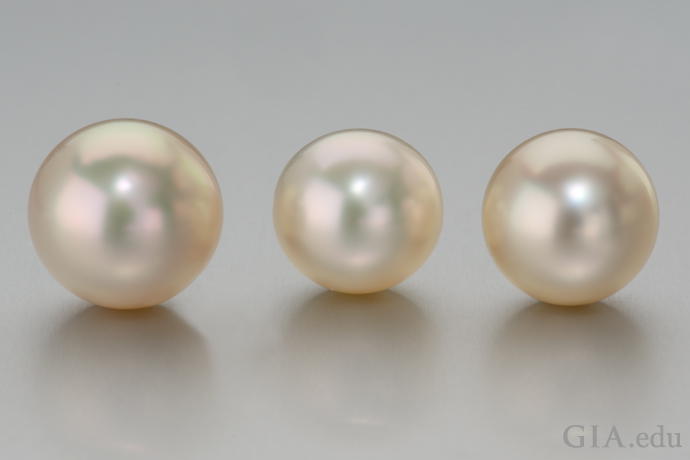
Three akoya cultured pearls

Akoya cultured pearls have an undeniable elegance. Photo: Robert Weldon/GIA

Akoya Cultured Pearls: The saltwater Pinctada fucata oyster produces white and cream-colored cultured pearls, generally between 2 and 11 mm in diameter, with the average being 6 to 8 mm. Akoya cultured pearls are often perfectly round and have a high luster (the light reflected from or near the pearl’s surface). Most akoya cultured pearls are commercially produced in Japan and China.

A necklace showing the many colors of Tahitian cultured pearls

The many different colors of Tahitian cultured pearls are on display in this exceptional necklace, which features 27 cultured pearls that range from 13 to 19 mm. Photo: Robert Weldon/GIA. Courtesy: A Private Collector and Mona Lee Nesseth, Custom Estate Jewels

Tahitian Cultured Pearls: Famous for their exotic, almost luminescent colors, these are the product of the saltwater Pinctada margaritifera oyster, which is native to the islands of French Polynesia. The mollusk produces pearls in bodycolors sometimes described in the trade with names like aubergine (dark grayish purple), pistachio (yellowish green to greenish yellow), or peacock (dark green-gray to blue-gray, with pink to purple overtones). Tahitian cultured pearls generally range from 9 to 14 mm in diameter, most commonly 9 to 11 mm.

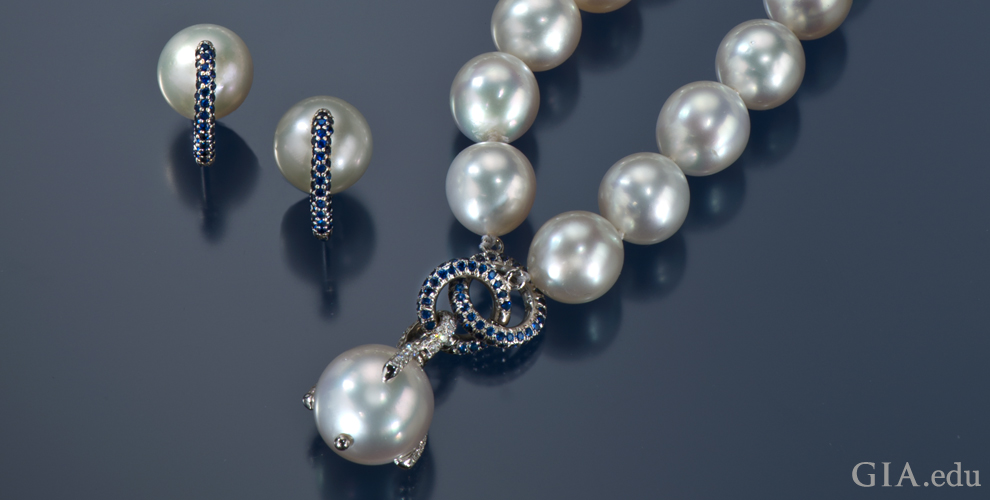
Semi-round South Sea cultured pearl necklace with blue sapphire accents

This necklace of semi-round South Sea cultured pearls with blue sapphire accents makes a breathtaking statement. Photo: Robert Weldon/GIA. Courtesy: Atelier Marisa

South Sea Cultured Pearls: The Pinctada maxima oyster is the largest of all saltwater cultured pearl oysters, and it can produce pearls from 8 to 20 mm in diameter; the average is 13 mm. There are two types of Pinctada maxima oysters: silver-lipped and gold-lipped. The silver-lipped oyster produces pearls that are mostly white to silver, sometimes with pink, blue or green overtones. The gold-lipped oyster produces mostly yellow to orangy yellow pearls, called “gold” or “golden” in the trade.

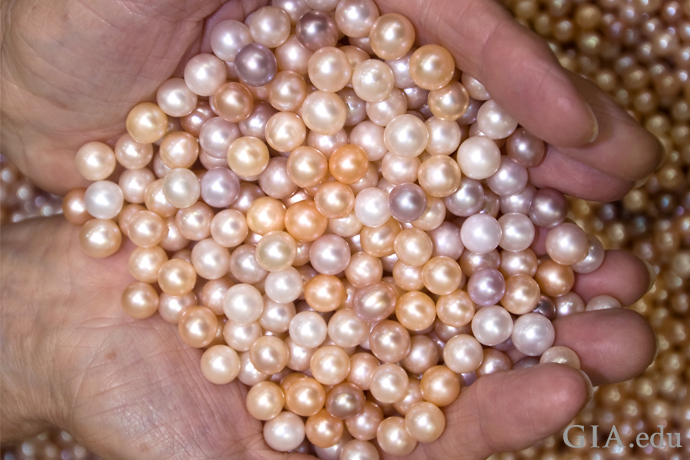
A handful of freshwater cultured pearls in many colors

Pearls come in many colors, like these freshwater cultured pearls from China. Photo: Robert Weldon/GIA

Freshwater Cultured Pearls: From the mussel Hyriopsis cumingii or a hybrid, these pearls are produced primarily in the lakes, ponds and rivers of China. They come in many shapes, sizes (up to about 20 mm) and natural colors, including white, orange, lavender and purple. They are also dyed in a wide array of colors.

Gemologists love the June birthstone because of its luster – the reflection of light off its surface, and from concentric layers of nacre, like light bouncing off a convex mirror. Pearl’s texture also fascinates: Natural and cultured pearls have a slightly rough feeling when rubbed against your teeth, while imitation pearls are smooth. However, gemologists use X-rays to examine a pearl’s inner structure, which allows them to conclusively separate natural from cultured pearls.


June Birthstone: Pearl History and Lore

The origin of pearls fascinated our forebearers. Ancients from the Middle East believed that pearls were teardrops fallen from heaven. The Chinese fancied that the June birthstone came from the brain of a dragon. Christopher Columbus and his contemporaries thought that mollusks formed pearls from dew drops.

Pearls have long been associated with purity, humility and innocence. So it may be said that the June birthstone meaning is “sweet simplicity.” As such, pearls were traditionally given as a wedding gift.

The June birthstone was also thought to have beneficial properties. In the ancient Sanskrit text, the Atharvaveda, pearls were said to bestow long life and prosperity. In Asia, pearls were believed to help alleviate indigestion and hemorrhages. Arab physicians in the 1820s maintained that pearl powder improved eyesight, quieted nervous tremors and eased depression.

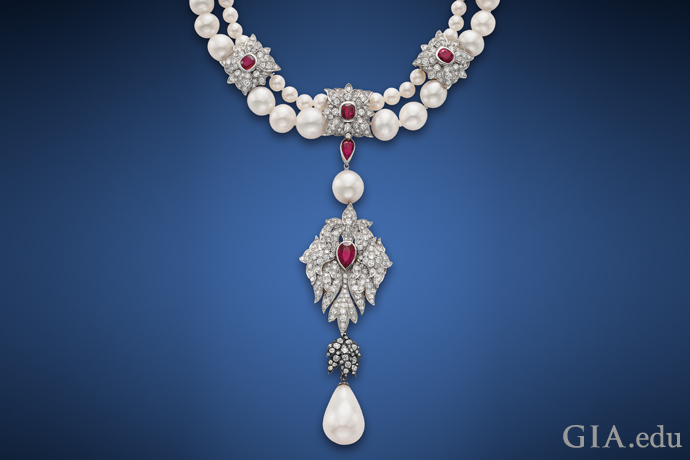
One of the most famous natural pearls is the 50.56 carat (ct) La Peregrina. About the size of a pigeon’s egg, the pearl was discovered in the 1500s in the Gulf of Panama. It became a prized possession of European royalty. Richard Burton eventually gifted it to Elizabeth Taylor in 1969; Christie’s New York auctioned it in 2011 for $11.8 million.

A two-strand necklace with 50.56 ct natural pearl pendant, accented with 56 saltwater natural pearls, four cultured pearls, rubies and diamonds

Literally a royal gem, Elizabeth Taylor’s 50.56 ct La Peregrina pearl was owned by eight Spanish kings, from Philip II (1582-1598) to Carlos IV (1778-1808). Cartier set the pearl as part of the pendant in this two-strand necklace that has 56 saltwater natural pearls, four cultured pearls, rubies and diamonds. Courtesy: Christie’s


June Birthstone: Where Pearls Come From

You’ll have to set sail for pristine waters if you want to find the June birthstone. Pearl-bearing mollusks fail to thrive in polluted waters, so pearl farms are usually located far from civilization – and often in breathtaking settings.

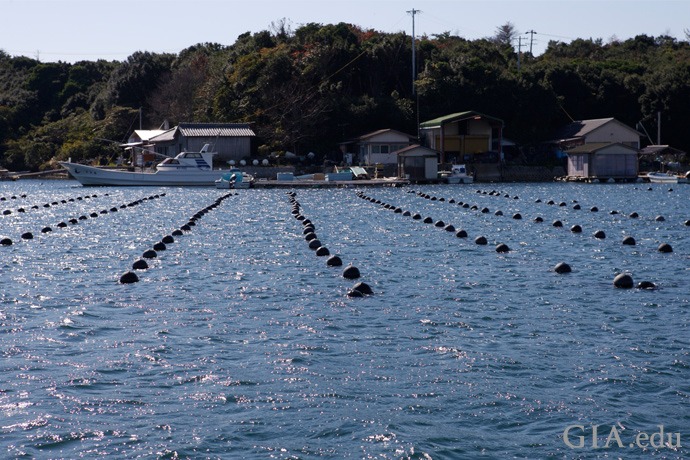
Saltwater pearls are grown in many areas around the world. Akoya cultured pearl farms are primarily found in Japan and China, especially along the southern coasts of Guangdong and Guangxi provinces. South Sea cultured pearls are farmed from the northern coast of Australia through Indonesia to the southern coast of Southeast Asia, with large operations in the Philippines as well. The Gambier Islands and the Tuamotu Archipelago, both part of French Polynesia, are two locales where the rich black Tahitian pearls are cultured.

An akoya cultured pearl farm in Ago Bay, Japan

Ago Bay, Japan is one of the most important sites for akoya cultured pearl farms. Photo: Valerie Power/GIA

Freshwater cultured pearls are primarily grown in China, within a 400 mile (644 km) radius of Shanghai.

A cultured pearl farm in French Polynesia

The breeding waters of a cultured pearl farm in French Polynesia look like a piece of paradise. Photo: Amanda Luke/GIA

Natural pearls have been found in the Arabian Gulf (Persian Gulf) for at least 5,000 years, while divers have been recovering the June birthstone from the Red Sea since 300 BCE. The Strait of Mannar has been providing pearls since 2000 BCE. Starting in the 16th century, during Spanish colonial rule, large quantities of pearls were recovered from the waters off Mexico, Central America and what is now Venezuela. Only small quantities of pearls are found in any of these areas today.


June Birthstone: Pearl Qualities to Look For

As you’re shopping for pearls and comparing quality and prices, keep in mind the seven factors gemologists use to evaluate and describe the quality of the June birthstone. Known as the GIA 7 Pearl Value FactorsTM, they are:

  1. Size: Pearl measurements are stated in millimeters, rounded to the nearest 0.5 mm. All things being equal, the larger the pearl, the greater its value.
  2. Shape: GIA categorizes pearls as one of seven shapes:
    • Round
    • Near-round (almost round, with minor variations)
    • Oval
    • Button (symmetrical, circular and flattened)
    • Drop (symmetrical, rounded or pear shaped)
    • Semi-baroque (not quite symmetrical; an off-round)
    • Baroque (has no apparent symmetry and is noticeably irregular)
  3. Color: Pearl color has three components:
    • Bodycolor – The dominant, overall color of the pearl
    • Overtone – A translucent color that appears to layer over a large area of the pearl’s surface
    • Orient – More than one translucent color over the bodycolor, or surface iridescence
  4. Luster: The intensity and sharpness of the light reflected from a pearl’s surface. There are five categories of luster: excellent, very good, good, fair and poor.
  5. Surface: The nature and number of blemishes or irregularities on the pearl. As products of nature, few pearls are completely blemish free. Pearl surface is described as clean, lightly spotted, moderately spotted, or heavily spotted.
  6. Nacre Quality: The thickness and regularity of the nacre. For nacre quality to be acceptable on a bead-nucleated cultured pearl, no evidence of the bead should be visible and there should be no chalkiness.
  7. Matching: This factor applies when evaluating a strand of pearls or a jewelry item with two or more pearls. Excellent matching requires a uniform appearance across all the pearls, with the drill hole on center.

You should also know that cultured pearls routinely undergo treatment to improve their appearance. Some may be color enhanced by heating, dyeing, irradiation and coating. Other treatments include:

  • Bleaching – To whiten them and create a uniform appearance
  • Tinting – The use of a red dye to turn akoya cultured pearls pink (also called pinking)
  • Buffing – Tumbling pearls in a canister (or similar device) to remove surface imperfections
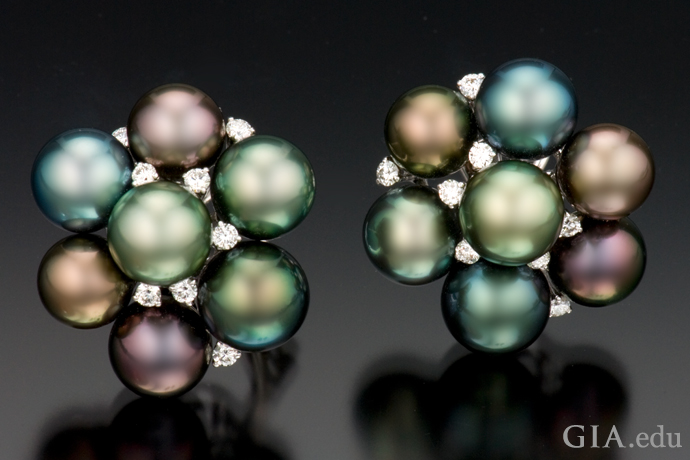
Diamond and Tahitian cultured pearl cluster earrings

Take special care when cleaning pearl jewelry like these diamond and Tahitian cultured pearl earrings. Photo: Robert Weldon/GIA. Courtesy: Mastoloni, New York


June Birthstone: Pearl Care and Cleaning

Pearls are 2.5 to 3.0 on the Mohs Scale of hardness, so they are a comparatively soft gem and require special care. Store them separately from other gemstones and metal jewelry to prevent scratching. Never store pearls in a plastic bag — plastic can emit a chemical that will damage their surface. Always apply perfume, hair products and cosmetics before putting on your pearl jewelry. The best way to clean your June birthstone: Use a soft, damp cloth, ideally after each time they are worn.

Read more tips on how to care for pearl jewelry to keep your watery treasures beautiful.

June is a month for celebrations, be it weddings, anniversaries, graduations or birthdays. And what better way to celebrate than with the June birthstone. From a classic strand of akoya cultured pearls to a single faceted Tahitian cultured pearl, there’s a look for every taste and budget.

Pearls are trending. Five Easy Pieces shows how to wear them with style.

May Birthstone: What You Need to Know About Emerald

With spring in full bloom and summer just around the corner, emerald is the perfect choice for the May birthstone. Kings and queens have prized the sought-after green gem for centuries. Here’s how you can pick a breathtaking one.

In this post, we cover:
Gemological Qualities of Emerald
Emerald History & Lore
Where Emerald Comes From
Emerald Qualities to Look For
Emerald Care & Cleaning


May Birthstone: Gemological Qualities of Emerald

Emerald’s green has been the standard by which other green gemstones have been measured for thousands of years. It is the rich green to bluish green variety of beryl, a mineral species that also includes aquamarine and varieties in other colors.

Trace elements that cause emerald’s color include chromium, vanadium and iron. As a general rule, the higher the chromium or vanadium content, the more intense the green color. The more iron present, the greater the degree of blue. When iron content is relatively high, emerald is a bluer green. When iron content is relatively low, the May birthstone is a purer green.

The difference between an emerald and a less-expensive green beryl is a matter of debate among gem experts. Some in the trade describe the May birthstone as any green beryl colored by chromium. However, gemologists, gemological laboratories and most colored stone dealers, think it is incorrect to call a green beryl an emerald when its color is “too light.” There are differences of opinion even in this group about the definition of “too light.” GIA settles the debate by using lab-graded comparison stones to determine if the green color is sufficiently dark and saturated to be called emerald.

Gemologists love the May birthstone for its inclusions. Emeralds from Colombia can have fascinating characteristic inclusions – called three-phase inclusions – that consist of tiny crystals of rock salt, a liquid and a bubble of gas.

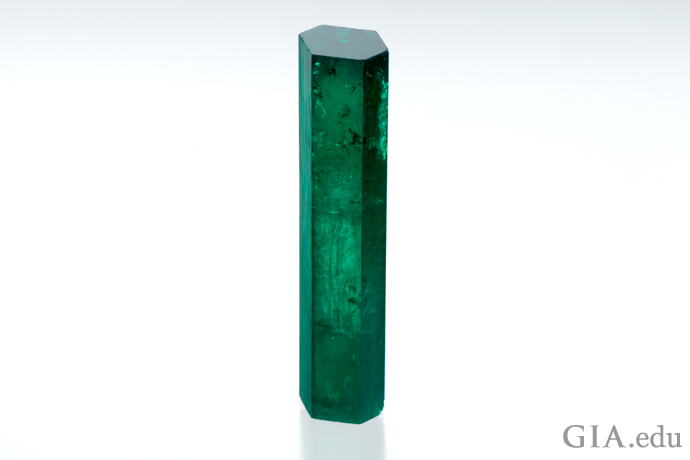
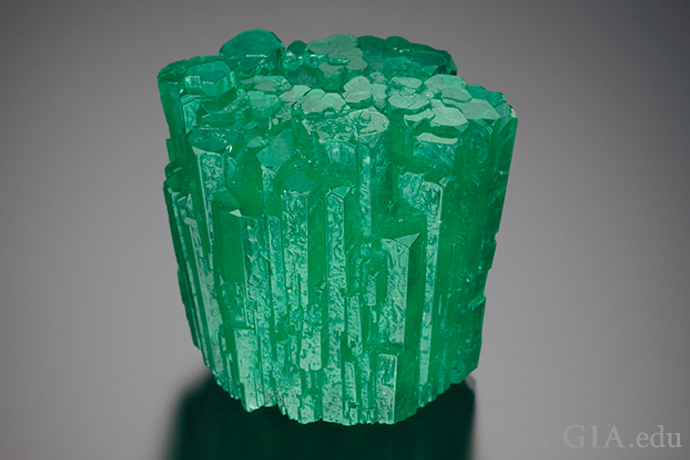
The best emerald crystals are also gorgeous flat-topped green hexagonal columns that can rival the beauty of faceted stones.

A 47 carat rough emerald crystal

Weighing in at 47 carats, this rough emerald crystal from the Muzo mine in Colombia is so beautiful that it may put to rest all debates about color. Photo: Robert Weldon/GIA. Courtesy: Jon Sigerman


May Birthstone: Emerald History & Lore

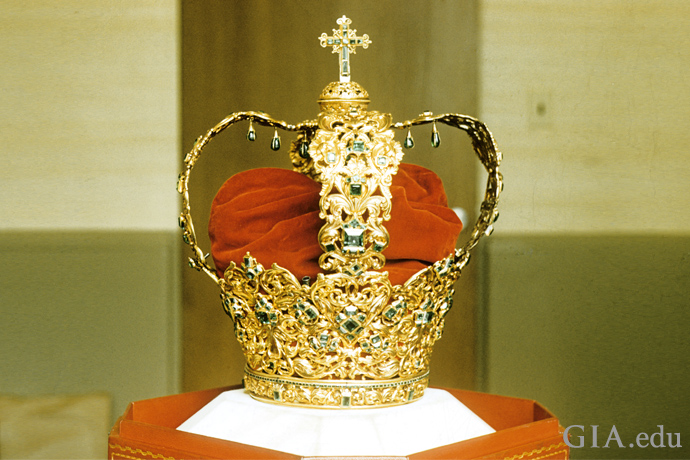
From Egyptian pharaohs to Inca emperors, emerald has enchanted royalty. Cleopatra was known to have a passion for emerald, and used it in her royal adornments. The legendary Crown of the Andes, fashioned in colonial South America, is one example of how the Spanish revered the May birthstone. According to lore, its largest stone—now called the Atahualpa emerald—was taken from the last Inca emperor, Atahualpa, by conquistador Francisco Pizarro. The modern recovery of the Spanish galleon Nuestra Señora de Atocha shows the length generations of treasure hunters would go to recover its sunken loot.

The word “emerald” comes from smaragdos, ancient Greek for a green gem. Roman author Pliny the Elder, who died in the 79 CE eruption of Mt. Vesuvius, wrote in his encyclopedic Natural History that “nothing greens greener.” He also stated that the May birthstone had therapeutic properties that helped gem cutters: “(they) have no better method of restoring their eyes than by looking at the emerald, its soft, green color comforting and removing their weariness and lassitude.” Science now proves this belief: The color green relieves stress and eye strain.

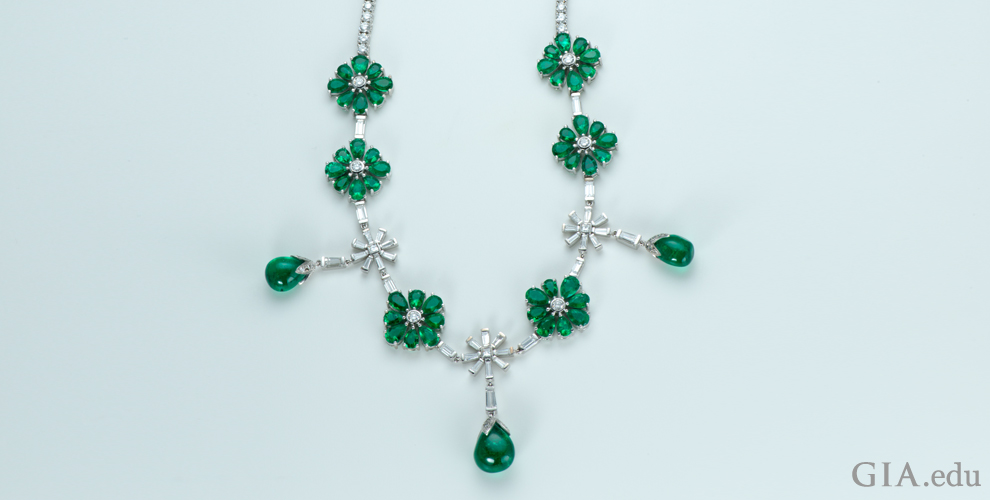
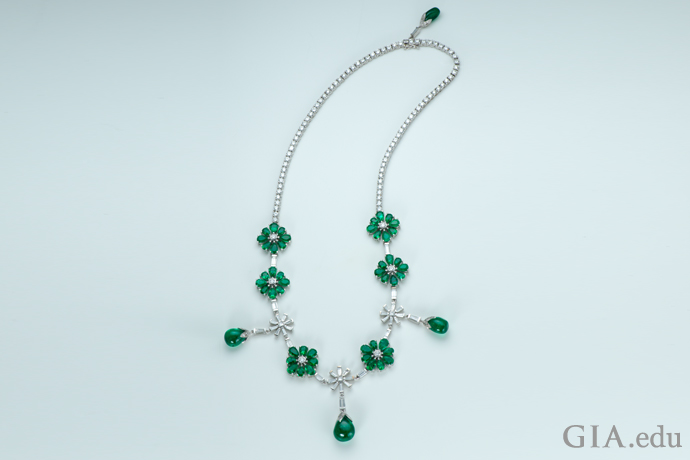
An emerald and diamond necklace totaling 41.97 carats

An emerald necklace sure to soothe the eye, this beauty has 52 emeralds, with a total weight of 32.86 carats, and 160 diamonds, with a total weight of 9.11 carats. Photo: Robert Weldon/GIA. Courtesy: Ismael Daoud

Emerald was also thought to have magical powers. By placing it under the tongue, one could see into the future. Some believed the May birthstone offered protection against evil spells, cholera and malaria. Others thought it made one an eloquent speaker and exposed lovers who made false promises.

Emerald is traditionally given for the 20th and 35th wedding anniversaries.

The Crown of the Andes is set with a 24 ct emerald center and 442 additional emeralds

The Crown of the Andes, now at the Metropolitan Museum of Art in New York City, boasts an impressive 24 ct emerald center stone and 442 additional emeralds set in the golden headpiece. Photo: Dr. E. J. Gübelin/GIA


May Birthstone: Where Emerald Comes From

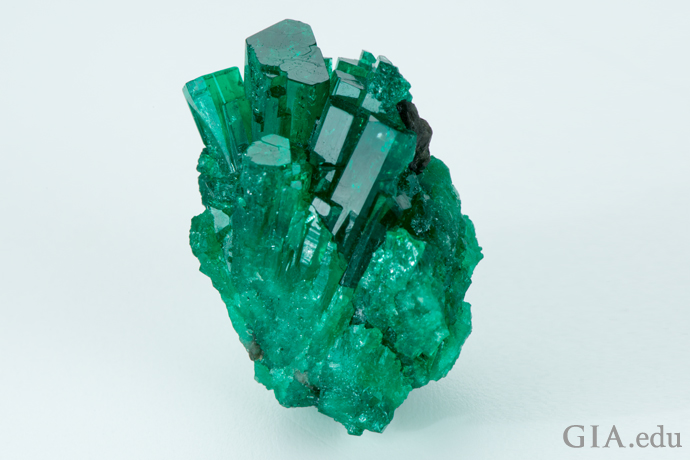
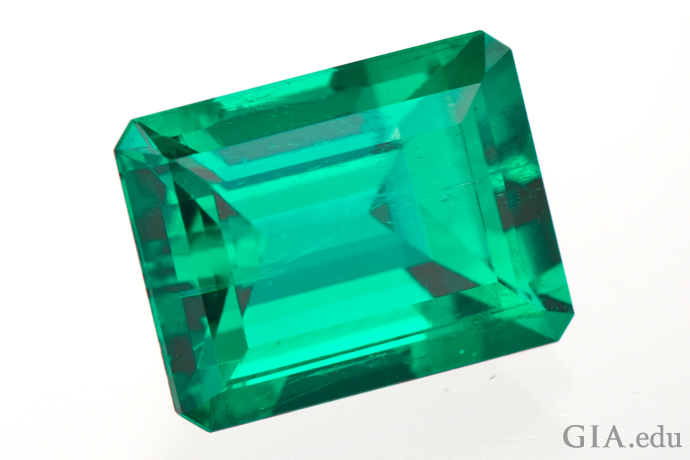
Colombia has been the source of the finest emeralds for more than 500 years, and they have been the standard by which all others are measured. Three mining sites in Colombia are particularly noteworthy: Muzo, Chivor and Coscuez. Emeralds of slightly different hues are found at each of these sites. Each locality produces a range of colors, but generally speaking, darker tones of pure green emeralds come from Muzo. Emeralds that are lighter in tone and slightly bluish green are associated with Chivor. Slightly yellowish green emeralds are unearthed in Coscuez.

A 38 carat emerald crystal cluster

This 38 carat cluster of emerald crystals originated from Colombia’s Muzo Mine. Photo: Robert Weldon/GIA. Courtesy: Ismael Daoud

A 4.50 ct polished emerald

Chivor, Colombia is the source of this 4.50 ct emerald. Photo: Robert Weldon/GIA


An 88.4 gram emerald crystal cluster

This 88.4 gram emerald crystal cluster is from Coscuez, Colombia. Photo: Robert Weldon/GIA. Courtesy: Gene Meieran

Emeralds are also found in the state of Minas Gerais, Brazil. One of the most productive sites for the May birthstone is the sophisticated Belmont Mine. Capoeirana is another important locality, a rugged region worked largely by independent miners and small-scale operations.

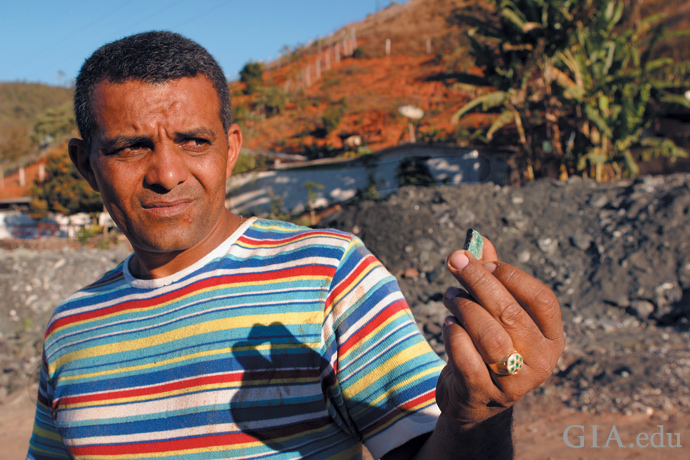
An independent miner holds a rough emerald

An independent miner at the Capoeirana mining area holds a rough emerald. Photo: Eric Welch/GIA

The May birthstone can also be found in Africa. Zambia is a major source, and mines in the Ndola Rural Restricted Area are known for producing emeralds that are bluish green and darker in tone. Pakistan and Afghanistan are important producers as well.

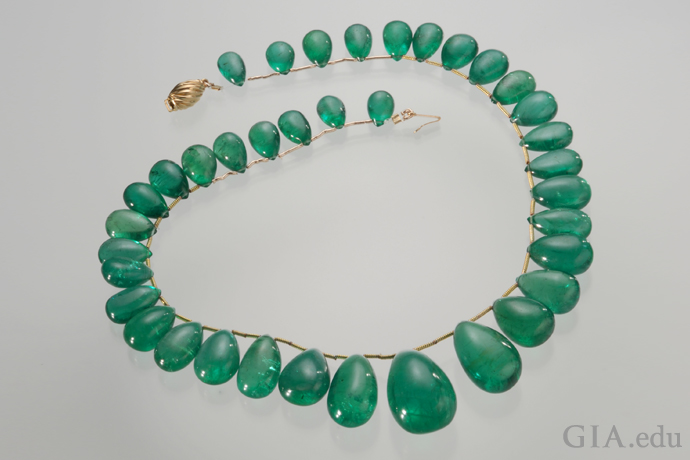
A 240 carat emerald drop necklace

The 240 carats of emeralds in this drop necklace come from Zambia. Photo: Robert Weldon/GIA. Courtesy: Sanjay Chordia, BEACAB GEMS INC.


May Birthstone: Emerald Qualities to Look For

Color: The most important quality factor in the May birthstone is color. Emeralds that are bluish green to green, with strong to vivid saturation and medium to medium-dark tone, are the most coveted. Emeralds that are highly transparent are especially valuable.

Clarity: Emeralds typically contain inclusions that are visible to the unaided eye. Because of this, jewelry professionals and some consumers understand and accept the presence of inclusions in emeralds. Eye-clean emeralds are especially valuable because they’re so rare.

Emerald inclusions are often described as looking mossy or garden-like. They’re sometimes called jardin, which is French for “garden.”

In colored stones, transparency and clarity are closely linked. This is especially true for emeralds. Jewelry professionals generally accept some eye-visible inclusions in higher-quality emeralds. But when the quantity or nature of the inclusions has a negative effect on transparency and clarity, they also dramatically reduce value.

Cut: Emerald crystals are difficult to cut. Almost all rough emeralds have significant fractures (sometimes called fissures) and a gem cutter must work to minimize the effect of those fractures on the appearance of the finished stone.

These inherent fissures make emeralds more brittle than other gems. Consequently, they are vulnerable to damage during cutting, polishing and setting–or even from careless daily wear.
The famous rectangular “emerald cut,” with its beveled corners and two, three or four concentric rows of facets, maximizes the shape and weight of the original emerald crystal. It also helps protect against damage because the vulnerable corners are faceted and provide a comparatively safe place for prongs.

Carat Weight: Fashioned emeralds come in a wide range of sizes. There are emeralds in museums and private collections that weigh hundreds of carats. At the other extreme are tiny emeralds that weigh fractions of a carat.

A 3.69 ct emerald ring with six diamond side stones

Take extra caution when caring and cleaning for emerald jewelry like this 3.69 ct emerald ring flanked with six diamond side stones. Photo: Robert Weldon/GIA. Courtesy: Ismael Daoud


May Birthstone: Emerald Care & Cleaning

Emerald is a 7.5 to 8 on the Mohs scale of hardness, so it is more susceptible to scratching than a diamond, which ranks 10 on the scale. The May birthstone is often treated to improve its color and clarity. Common treatment methods include:

  1. Dyeing: Paler porous or fractured emeralds are dyed green to enhance their color.
  2. Fracture Filling: Oils, waxes and artificial resins are sometimes used to fill surface-reaching fractures in emeralds. The goal is to reduce the visibility of the fractures and improve the apparent clarity. The volume of filler material present can range from insignificant to major; these substances have varying degrees of stability.

Emerald requires some special care; avoid exposure to heat, changes in air pressure (such as in an airline cabin) and harsh chemicals. Never put an emerald in an ultrasonic cleaner. Filled emeralds can also be damaged by exposure to hot water used for washing dishes.

The May birthstone is perfectly suited to the celebration of life blooming everywhere. Now you can treat yourself – or a loved one – to an emerald that captures the exuberance of the season. Learn more about how to pick a beautiful emerald with our Emerald Buying Guide.

March Birthstone: What You Need to Know About Aquamarine

Winter is on the way out; aquamarine is on the way in. The placid hues of the March birthstone are a tranquil antidote to the season’s bluster. Read on to learn more about this gorgeous gem and how to pick a beautiful one.

In this post, we’ll cover:
Gemological Information on Aquamarine
Aquamarine History & Lore
Where Aquamarine Comes From
Qualities to Look for in an Aquamarine
Aquamarine Care & Cleaning


March Birthstone: Gemological Information on Aquamarine

Aquamarine is the green-blue to blue variety of the mineral beryl. (Emerald is the green to bluish green variety of the same mineral.) Most of the aquamarine in the marketplace is a light pastel slightly greenish blue. Traces of iron in beryl’s crystal structure cause aquamarine’s color. Like many beryls, aquamarine may form as large crystals suitable for exceptionally large fashioned gems and carvings.

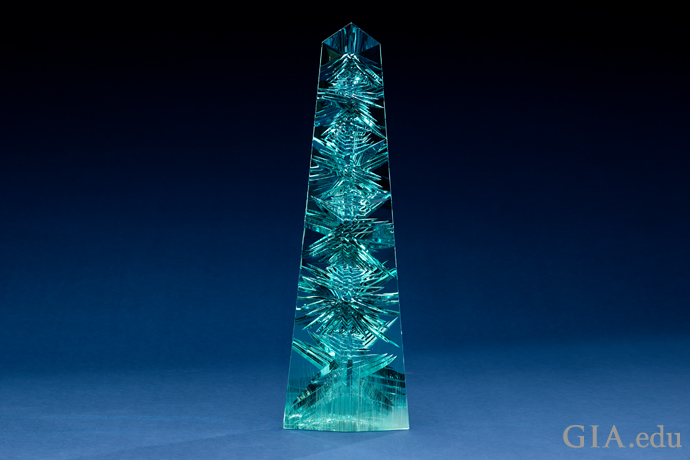
10,000+ carat Dom Pedro Aquamarine has been described as “the one gem that can rival the Hope Diamond.”

A celebrated attraction at the Smithsonian Institution, the 10,000+ carat Dom Pedro Aquamarine has been described as “the one gem that can rival the Hope Diamond.” Courtesy: Donald E. Hurlbert, Smithsonian Institution


March Birthstone: Aquamarine History & Lore

Aquamarine’s name comes from the Latin for seawater, and ancient mariners claimed the gem would calm waves and keep sailors safe at sea. March’s birthstone was also thought to bring happiness to marriages. Beryl was believed to give the wearer protection against foes in battle and litigation. It was also thought to make the wearer unconquerable and amiable, and to quicken the intellect.

Aquamarine is not only the birthstone for March, the gem is also given as a present on the 19th wedding anniversary. As for famous ones, in 1936 the government of Brazil gave First Lady Eleanor Roosevelt a dark blue rectangular step cut aquamarine that weighed 1,298 carats (ct). It was the larger of two stones faceted from a piece of aquamarine rough that itself weighed an impressive 2.9 pounds (1.3 kilograms). It is now housed at the Franklin D. Roosevelt Presidential Library and Museum in Hyde Park, New York. A celebrated attraction at the Smithsonian Institution is the 10,363 ct Dom Pedro Aquamarine – believed to be the largest faceted aquamarine in the world. The 14 inch (36 centimeter) high obelisk was fashioned by acclaimed German lapidary Berndt Munsteiner using the fantasy cut technique.

The government of Brazil gave this 1,298 ct rectangular step cut aquamarine to Eleanor Roosevelt

The government of Brazil gave this 1,298 ct rectangular step cut aquamarine to Eleanor Roosevelt when she and President Roosevelt visited Rio de Janeiro in 1936. Courtesy: The Franklin D. Roosevelt Presidential Library and Museum, Hyde Park, New York.


March Birthstone: Where Aquamarine Comes From

The Brazilian state of Minas Gerais has been an important source of aquamarine for the past two centuries. Travel there and you’ll find a changing panorama of landscapes: rocky hills, rivers and scrub brush dominate the central and eastern regions; savannahs, forests and streams checker the west; and lush green hills roll southward. Aquamarines are found in primary (hard rock) and secondary (weathered) pegmatite deposits in the eastern portion of the state, near the gem center of Teófilo Otoni.

Disguised as “love doves,” 14K white gold prongs hold a 32 ct cushion cut aquamarine from Brazil.

Disguised as “love doves,” 14K white gold prongs hold a 32 ct cushion cut aquamarine from Brazil. Courtesy: Loretta Castoro Signature Collection

Aquamarine is also found high in the Karakorum foothills of Pakistan. To reach the deposits, miners must climb steep paths to elevations of 9,800 to 13,000+ feet (3,000 to more than 4,000 meters) and work the sides of forbidding cliffs. Below this inhospitable rocky world lie fertile valleys, rushing rivers and small towns. Aquamarine from this area has been described as “water clear.”

Pakistan’s gem-rich Shigar Valley lies between foothills of the majestic Karakoram range.

A sliver of an opening (on the far left) is the entrance to an aquamarine mine. Pakistan’s gem-rich Shigar Valley lies between foothills of the majestic Karakoram range. Photo: Vincent Pardieu/GIA

Aquamarine is also mined in Kenya, Madagascar, Nigeria, Zambia and Mozambique, as well as elsewhere in Africa. U.S. sources include the Mount Antero area of Colorado (it’s the state gem) and California’s Riverside and San Bernardino counties. In addition, aquamarine has been found in China, Myanmar, Russia and Ukraine, among other countries.


March Birthstone: Qualities to Look for in an Aquamarine

Aquamarine is pastel blue, greenish blue or green-blue. The preferred color is a moderate slightly greenish blue to dark blue. Fine stones are an even blue with no bands of color (called “zoning”). Most faceted aquamarines are free of eye-visible inclusions. Aquamarine is readily available in large sizes – with many fine gems 25 ct or greater. Aquamarine can be cut into almost any shape, and is often fashioned as emerald cuts, pear shapes, or round or oval brilliants. It also lends itself well to fantasy cuts.

10.06 ct pear shaped aquamarine is surrounded by 72 round diamonds (0.35 carats) that are set in platinum.

A delightfully icy look: a 10.06 ct pear shaped aquamarine is surrounded by 72 round diamonds (0.35 carats) that are set in platinum. Courtesy: Omi Privé


March Birthstone: Aquamarine Care & Cleaning

With a hardness of 7.5 on the Mohs scale, aquamarine is durable enough for everyday wear. Caring for the gem is easy. Use warm water, mild dish soap and a toothbrush to scrub behind the stone where dirt can collect. Ultrasonic cleaners and steam cleaning are usually safe options as long as there are no feathers or liquid inclusions in the gem.

Nearly all the blue aquamarine in jewelry is produced by heat treatment of bluish green, green, greenish yellow and even brownish yellow beryl. The process removes the yellow color component and leaves a purer blue hue. The treatment is undetectable and appears to be permanent.

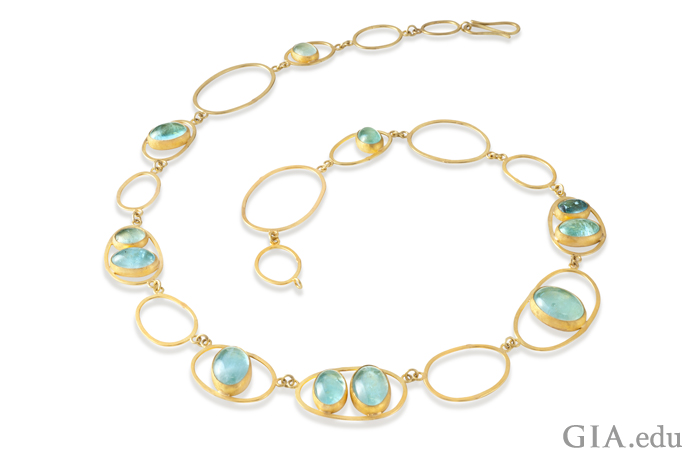
The aquamarine cabochons in this necklace look like drops of water from the Caribbean.

The aquamarine cabochons in this necklace look like drops of water from the Caribbean. Courtesy: Petra Class

The March birthstone aquamarine has it all: It’s beautiful, eye clean, rich in lore and exceptionably wearable. Now you know how to pick one that will become a cherished addition to your jewelry wardrobe.

Born in March? Pisces and Aries are your zodiac signs. Jewelry designers have fashioned some creative pieces, and we’ve found ones for you to enjoy.

February Birthstone: What You Need to Know about Amethyst

Amethyst, the February birthstone, has adorned the nobility for centuries. Now it’s in reach of most consumers. Here’s how to pick a stunning amethyst for the king or queen of your heart – or treat yourself to a royal present.

In this post, we’ll cover:
Gemological Characteristics of Amethyst
Amethyst History & Lore
Where Amethyst Comes From
Amethyst Qualities to Look For
Amethyst Care & Cleaning

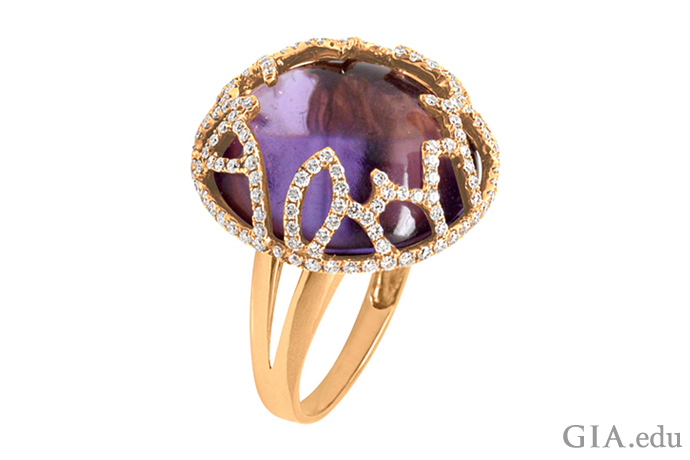
If this ring with an amethyst center stone seems a bit otherworldly, it’s because it comes from the Galaxy collection by Arya Esha.

If this ring with an amethyst center stone seems a bit otherworldly, it’s because it comes from the Galaxy collection by Arya Esha. Courtesy: Arya Esha


February Birthstone: Gemological Characteristics of Amethyst

Amethyst is the purple variety of the quartz mineral species. Its color ranges from a strongly saturated violetish purple to reddish purple in fine quality gems; to weak grayish violet in commercial quality stones. Natural irradiation acting on trace amounts of iron in its crystal structure causes amethyst’s characteristic color. Amethyst also commonly shows color zoning, which often occurs as angular bands of darker to lighter purple. The saturated purple color is typically limited to the tips of amethyst crystals, while the rest of the crystal fades to colorlessness. Cutting an amethyst crystal often produces a few high-quality, deep purple stones and many more low-quality, light-colored stones.

Gemologists and consumers alike love amethyst because it is a beautiful gem that is also affordable. Even fine amethyst can have a modest price tag. Here’s another reason: Amethyst rough comes in fascinating packages. In gem localities like Brazil, amethyst sometimes forms in hollow, crystal-lined geodes so big you can stand in them.

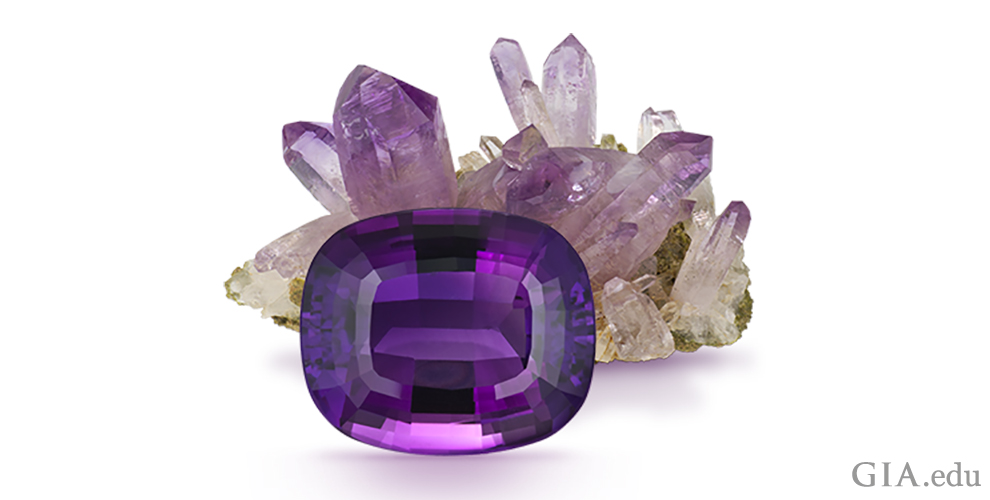
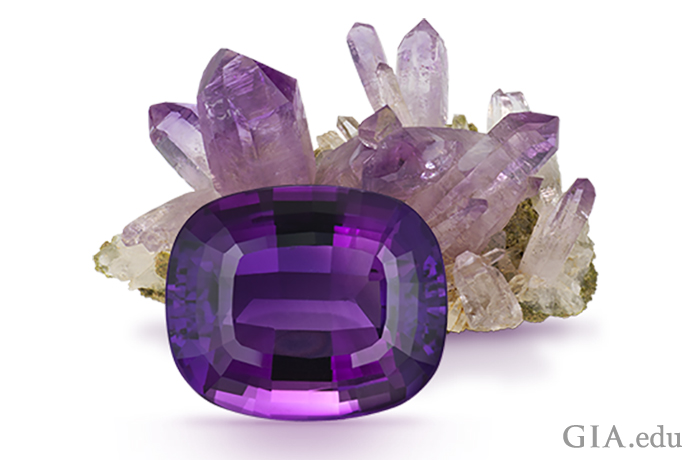
A 22.62 carat (ct) cushion cut amethyst is the dramatic foreground to the amethyst rough behind it.

A 22.62 carat (ct) cushion cut amethyst is the dramatic foreground to the amethyst rough behind it. Photo: Robert Weldon/GIA


February Birthstone: Amethyst History & Lore

The name amethyst derives from the Greek amethystos, which means “a remedy against drunkenness,” a benefit long ascribed to the purple gem. It’s no coincidence that methy is the word for wine, typically of a color very similar to that of this gem. Amethyst was also believed to keep the wearer clear headed and quick witted in battle and business affairs. Renaissance Europeans thought it calmed lovers overrun by passion.

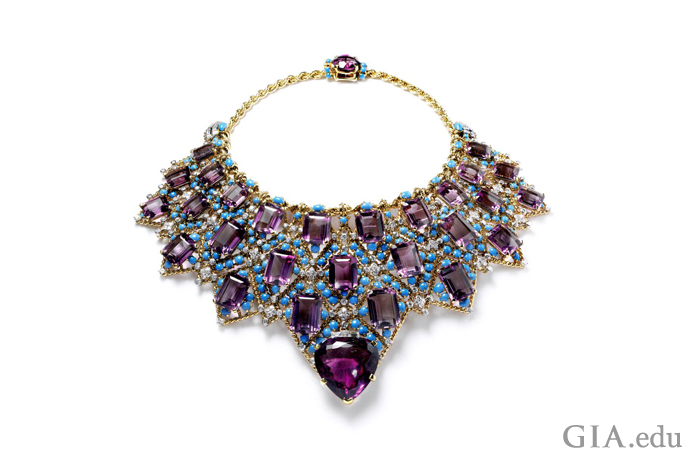
Amethyst is the gem traditionally given for the sixth wedding anniversary. Wear it in celebration of your wedding nuptials or as your February birthstone and you’ll be in royal company: Catherine the Great (Empress Catherine II of Russia; 1729–1796) had a penchant for the gem, and decked herself in necklaces, earrings and other amethyst-adorned ornaments. The famous jewelry connoisseur Wallis, Duchess of Windsor (1896–1986) made a memorable statement when she wore a lavish Cartier-designed amethyst bib necklace to a gala in Versailles in 1953.

The Duchess of Windsor’s bib-style necklace boasts 27 step-cut amethysts, one oval faceted amethyst, and a large heart-shaped amethyst in the front, as well as turquoise cabochons and brilliant cut diamonds, all suspended from a rope-like gold chain.

A colorful medley of purple and blue, the Duchess of Windsor’s bib-style necklace boasts 27 step-cut amethysts, one oval faceted amethyst, and a large heart-shaped amethyst in the front, as well as turquoise cabochons and brilliant cut diamonds, all suspended from a rope-like gold chain. Courtesy: N. Welsh, Cartier Collection © Cartier


February Birthstone: Where Amethyst Comes From

Amethyst was as expensive as ruby and emerald until the 19th century, when large deposits were found in Brazil. The country is still an important source for amethyst, and its southernmost state, Rio Grande do Sul, is a particularly productive area. Along with its rich amethyst deposits, the region is also home to vast grassy plains, thick forests, waterfalls, panthers and jaguars.

The Anahí mine in Bolivia is another famous source for amethyst. Hidden in the Pantanál wetlands, the Anahí mine is shrouded in fascinating lore. It was discovered by a Spanish conquistador in the 1600s, given to him as dowry when he married Anahí (a princess from the Ayoreo tribe), forgotten for three centuries, and rediscovered in the 1960s.

A treasure trove of amethyst crystals lines the walls of the Anahí mine.

A treasure trove of amethyst crystals lines the walls of the Anahí mine. Photo: Robert Weldon/GIA.

The February birthstone is also found in Zambia. The country is a major producer, and the Kariba amethyst mine is an important source. Amethyst mined here tends to be of superb quality with richly saturated colors.

On the left is amethyst from Zambia. On the right is amethyst from Brazil.

On the left is amethyst from Zambia. On the right is amethyst from Brazil. Photo: Robert Weldon/GIA. Courtesy: Pala International


February Birthstone: Amethyst Qualities to Look For

To pick a stunning gem, consider these tips:

  • Color: The finest amethyst is a strong purple or reddish purple, with no visible color zoning. Any brownish or bronze-colored tints lower the value dramatically. Amethysts that are a little less saturated in color are usually more affordable than those with more color saturation. A light lilac amethyst is usually much less expensive than an intense purple.
  • Clarity: Almost all faceted amethyst is eye clean; that is, no inclusions can be seen with the naked eye. Material with eye-visible inclusions is usually cut into beads or cabochons.
  • Cut: It is not unusual to see faceted amethysts of 10 or 20 carats and even larger. Because the gem is so plentiful, matched sets of faceted amethyst are relatively easy to obtain for bracelets and necklaces. The gem can also be found in a variety of fancy cuts and nonstandard sizes.
A Striking fantasy cut amethyst pendant.

A series of grooves and concave facets breathe movement and life into this striking fantasy cut amethyst pendant. Courtesy: Sonja Kreis Unique Jewellery and Gems


February Birthstone: Amethyst Care & Cleaning

Amethyst is a 7 on the Mohs scale of hardness. This means that it is appropriate for daily use in rings and other jewelry, but over time may show wear and require repolishing. Because amethyst is more susceptible to damage than harder gems such as rubies, sapphires and diamonds, do not store your amethyst jewelry next to these, as they can scratch it.

Heat treatment is the most common technique for improving the color and marketability of natural amethyst. Heat treatment can’t make pale amethyst darker, but it can lighten the color of very dark amethyst and make it more attractive. It can also remove unwanted brownish inclusions in some amethysts. Some amethyst turns yellow–to citrine–with heat treatment.

Heat treating amethyst results in a durable and permanent change in color. However, submitting it to intense heat may render it slightly more brittle than usual, and care must be taken not to damage pointed faceted corners and edges. Note, too, that excessive heat can remove the color entirely, and some amethyst fades with prolonged exposure to strong light. Though the color is stable with normal use, this is not a gem to wear to the beach every day.

Amethyst jewelry can be cleaned with an ultrasonic cleaner or a steamer, but use caution to avoid thermal shock. A soft brush with mild soap is the safest option.

As you shop, you’ll also encounter lab-created amethyst. Having the same chemical properties as its natural counterpart, synthetic amethyst has been manufactured since the 1970s. As manufacturing processes became increasingly sophisticated, it became more difficult for gemological labs to distinguish natural from synthetic amethyst. GIA can tell the difference, but many in the jewelry industry do not request testing because of the expense and time required to determine the origin of what is a comparatively inexpensive gem. Still, merchants are required to tell you if a gem is natural or synthetic.

These gems from the Montezuma mine in Minas Gerais, Brazil show the varied coloration of quartz: untreated amethyst (left), heated green quartz (center) and heated and irradiated violet quartz (right).

These gems from the Montezuma mine in Minas Gerais, Brazil show the varied coloration of quartz: untreated amethyst (left), heated green quartz (center) and heated and irradiated violet quartz (right). Photo: Robert Weldon/GIA. Gift of Henrique Fernandes and Gabriel Freitas, Pinkstone International, Governador Valadares, Brazil.

Amethyst has enchanted kings and queens for many centuries. Now you know how to buy a royal gift for your love with a February birthday. And for some quick tips, take along our Amethyst Buying Guide the next time you go shopping.

January Birthstone: What You Need to Know About Garnet

Lucky you if yours is the January birthstone. A favorite gem of the Victorian era, garnet comes in a palette of beautiful colors. Read on to gain a deeper appreciation for the gem and the knowledge to shop more wisely.

In this post, we’ll cover:
Types of Garnets
Garnet History & Lore
Where Garnets Come From
Qualities to Look for in a Garnet
Garnet Care & Cleaning


January Birthstone: Types of Garnets

Garnet is a group of minerals that have the same crystal structure but slight differences in chemical composition. Five members of this group are commercially important as gems:

  • Pyrope (purple to orangy red)
  • Almandine (purple to orangy red)
  • Spessartine (oranges and yellows)
  • Grossularite (colorless to yellow, to reddish orange and orangy red, to vibrant green)
  • Andradite (yellow and yellowish green)

There are also mixtures of these five species, creating even more colors. Variations in trace elements such as iron, manganese, chromium and vanadium produce the kaleidoscopic color range of garnets.

An array of the many colors of garnet, featuring yellow, orange , deep pink, reddish orange, green, and bluish green.

These are some of the many colors of garnet (top row, from left to right): 16.94 carat (ct) yellow garnet, 19.89 ct orange spessartine, 44.28 ct deep pink rhodolite, 16.99 ct reddish orange garnet, and 7.26 ct green tsavorite. Bottom row, left to right: 8.20 ct greenish yellow garnet, 12.36 ct golden yellow garnet, 9.22 ct pink garnet, 14.53 ct light green grossular, and 4.32 ct bluish green garnet. Photo: Robert Weldon/GIA

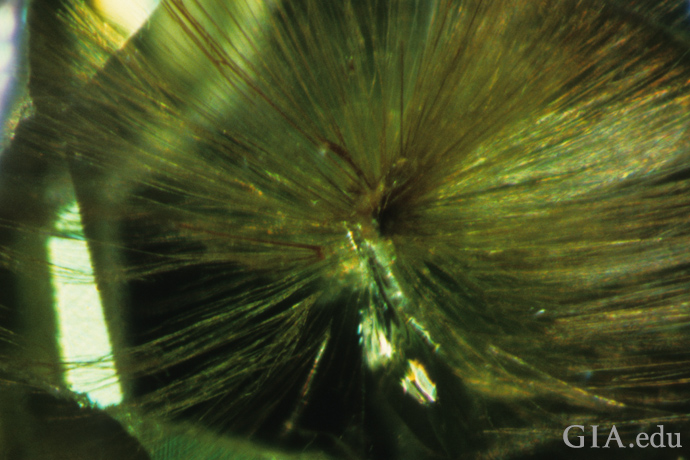
Gemologists love garnets for many reasons. For some, it’s the challenge of categorizing new garnet varieties. Others are fascinated by the characteristics of specific varieties. For example, demantoid garnets, the green variety of andradite, may display dramatic horsetail inclusions, which are one of the few internal clarity characteristics that can increase a gem’s value. Gemologists also love demantoid’s dispersion, which is so high that a well-cut gem displays an amazing amount of fire.

Image of horsetail inclusions in a green demantoid.

It’s obvious how horsetail inclusions got their name. Think of them as Mother Nature’s signature in this green demantoid. Photo: John I. Koivula/GIA

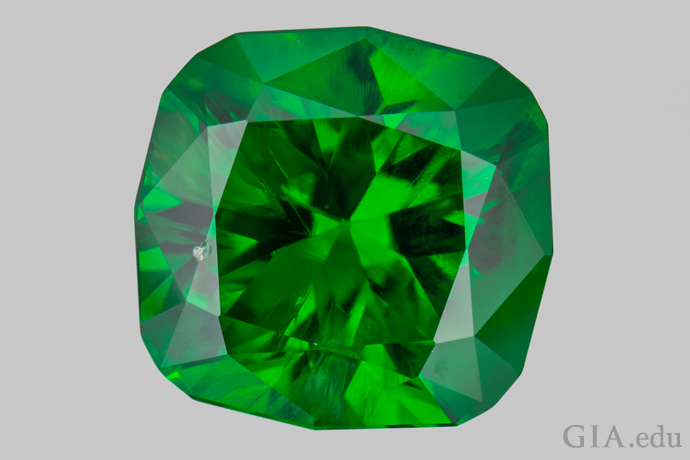
7.00 ct demantoid from Russia

This 7.00 ct demantoid from Russia shows why some garnets are so coveted. Photo: Robert Weldon/GIA. Courtesy: Pala International


January Birthstone: Garnet History & Lore

Red garnets have a rich history. Necklaces studded with them adorned the pharaohs of ancient Egypt. Signet rings in ancient Rome featured garnet intaglios that were used to stamp the wax that secured important documents. The clergy and nobility of the Middle Ages had a preference for them.

The Smithsonian’s antique pyrope hair comb is one of the most famous pieces of garnet jewelry (pyrope is from the Greek pyrōpos, which means “fiery-eyed”). A large rose-cut garnet sits at the crest, much like a queen serenely surveying her court. The pyrope garnets that decorate this tiara-like jewel came from the historic mines in Bohemia (now part of the Czech Republic), and these rich red beauties were extremely popular during the Victorian era (1837-1901), when this piece was fashioned.

Antique pyrope hair comb with a crescendo of red garnet.

A crescendo of red, this antique pyrope hair comb would have made a breathtaking statement when worn. Courtesy: Chip Clark, Smithsonian Institution.

Curious about garnet’s reputed health benefits? Red gems like garnet were thought to be remedies for inflammatory diseases, and to soothe the angry heart. Garnet also was thought to cure diseases of the liver.

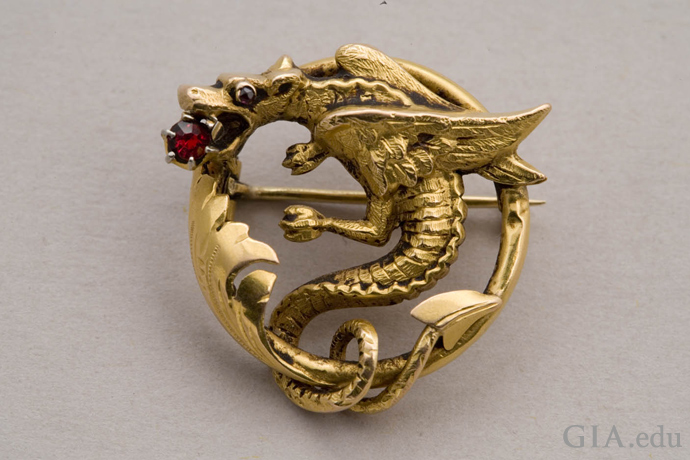
18K gold Art Nouveau era pin depicts a dragon or gryphon with a red garnet in its mouth.
This fanciful 18K gold pin depicts a dragon or gryphon with a red garnet in its mouth. It was made during the Art Nouveau era (1890-1914). Photo: Eric Welch/GIA. Courtesy: Jana Miyahira-Smith.


January Birthstone: Where Garnets Come From

Russia and Bohemia were important sources of garnet in the 19th century, when they were prized by the Russian royal family and used by the great jeweler Peter Carl Fabergé (1846 – 1920). Tanzania and Namibia are important present-day sources for garnet. The gem is also found in Myanmar, Brazil, Kenya, Iran, Afghanistan, Pakistan, India and Sri Lanka, among other countries.

The rolling hills of Green Dragon mine in Namibia.

Namibia’s rolling hills are the scenic backdrop to the Green Dragon mine – an important modern source for demantoid garnet. Courtesy: Green Dragon Mine


January Birthstone: Qualities to Look for in a Garnet

Here are some helpful tips on selecting a beautiful garnet:

  • Clarity: Garnet clarity depends on its type. The red garnets almandine, pyrope and rhodolite (a pyrope-almandine) typically do not have eye-visible inclusions. Some of the orange garnets, like spessartine and hessonite (a variety of grossularite), often have eye-visible inclusions. You can use this information to rule out particular gems. For example, you might not want to purchase red garnets that have eye-visible inclusions.
  • Cut: Many garnets are cut into standard shapes and sizes for easy setting into jewelry. This is especially true of many red garnets. Expensive garnets like fine-quality tsavorite (a variety of grossularite) are cut into shapes and cutting styles that allow more of the weight to be retained from the rough.
  • Demantoid is often cut to allow the best possible display of its fire. Garnets are also popular for designer cuts and carvings. Red garnets are classic materials for cutting into cabochons and beads. They are commonly found to have high clarity and to be very transparent.
  • Carat Weight: Garnets can be found in all sizes and weights. Some garnets, like demantoid and tsavorite, are more commonly found as small crystals, so their value goes up significantly with size. Other garnets, like almandine, occur as larger crystals, so there’s no dramatic rise in value as size increases.

Most garnets are more affordable than diamonds, rubies, sapphires and emeralds. This means you should be able to get a larger gem for the same price.

A 6.22 ct spessartine necklace is encircled with 0.40 ct of round diamonds set in platinum and 18K rose gold.

A 6.22 ct spessartine flaunts its beauty in this necklace. Encircling the fiery orange garnet are some 0.40 ct of round diamonds set in platinum and 18K rose gold. Courtesy: Omi Privé


January Birthstone: Garnet Care & Cleaning

The different types of garnet range between 6.5 and 7.5 on the Mohs scale of hardness. This means that garnets are more susceptible to damage than rubies, sapphires and diamonds. So while not all garnets are good candidates far daily wear in a ring, they are ideal for earrings, brooches and pendants.

Give thought to where you store garnet jewelry in your jewelry case. If you let it rub against harder gems–again, think diamonds, rubies and sapphires–it can be scratched.

Garnets might rarely be treated by fracture filling, which is a method of concealing surface-reaching breaks in the gem by filling them with a glass-like substance. Their comparative affordability may be a reason why garnets are infrequently treated. Regardless, warm soapy water is always safe for cleaning garnets. Ultrasonic cleaners are usually safe, except for stones that have fractures or have been fracture-filled. Steam cleaning is not recommended.

A 5.55 ct oval tsavorite garnet ring, with two fancy yellow diamonds weighing a total of 0.71 ct, and 136 round diamonds weighing 1.02 ct total weight, set in platinum.

This award-winning ring by Omi Privé may just take your breath away. It features a 5.55 ct oval tsavorite garnet, two fancy yellow diamonds weighing a total of 0.71 ct, and 136 round diamonds weighing 1.02 ct total weight, set in platinum. Courtesy: Omi Privé

Whether you’re shopping for the January birthstone, or a gem to celebrate your 2nd wedding anniversary, be sure to download our Garnet Buying Guide. It has the essential tips you need to find the perfect garnet. Take it with you, and shop with confidence.

December Birthstones: Where Do Turquoise, Tanzanite and Zircon Come From?

If you were born in December you have a lot to celebrate, including three December birthstones: turquoise, tanzanite and zircon. With a spectrum of colors to choose from, learning about where the sources of these gems will only add to their appeal. (more…)

Edwardian Engagement Rings: How to Get the Look

Once worn by the English aristocracy, Edwardian jewelry is a look that’s popular with today’s brides-to-be. Antique Edwardian engagement rings might be out of reach, but you can still create a beautiful engagement ring rich in period motifs. (more…)

Moonstone: A Gem to Celebrate the Moon

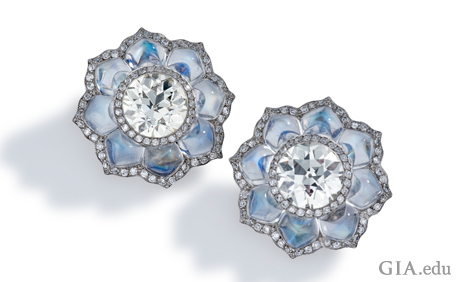
According to Hindu mythology, moonstone is made of moonbeams! And it’s easy to see why so many cultures also associate the gem with moonlight. Read on to learn all about this remarkable gem, including what gives moonstone its other-worldly glow. (more…)

A Look at First Lady Nancy Reagan’s Jewelry Collection

Explore Christie’s auction of “The Private Collection of President and Mrs. Ronald Reagan” to learn more about the jewelry and style of Nancy Reagan, one of America’s most well-known first ladies. (more…)

October Birthstone: Where Does Opal Come From?

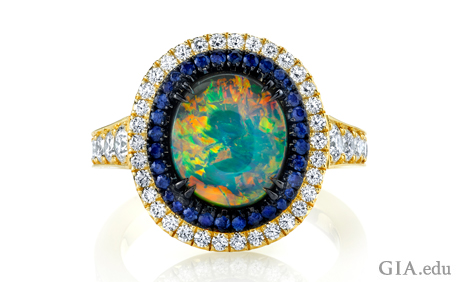
Opal’s kaleidoscopic hues have delighted us for centuries. Loved for its spellbinding play-of-color, this October birthstone seems to be a bit magical and mysterious. Get ready to find out where it comes from – and how it forms. (more…)

September Birthstone: Where Do Sapphires Come From?

Sapphire is a popular gemstone – and comes in a rainbow of colors. It’s also been long prized, from Ancient Greek rulers to the clergy of the Middle Ages. But where does the September birthstone come from? (more…)