Please ensure Javascript is enabled for purposes of website accessibility.
Search
Search
Search

GIA 4Cs Diamond Blog

GIA 4Cs Diamond Blog

About GIA
GIA wrote the book on diamond grading. Color, Clarity, Cut, Carat Weight. Today, the 4Cs scientifically ensure public trust in our industry.
The Origin of Wedding Rings: Ancient Tradition or Marketing Invention?

The origin of wedding rings is a fascinating one. The tradition of exchanging rings dates back 3,000 years, while the first diamond wedding ring was recorded in the will of a widow who passed in 1417. Why are rings, especially diamond rings, the ultimate symbol of romance? (more…)

How to Buy a Three Stone Engagement Ring

The three stone engagement ring is a classic style, and now that the Duchess of Sussex, Meghan Markle, is wearing one, it’s a popular choice. What does it symbolize? Which diamond shapes work best? Follow these tips to pick a beautiful one.

In this blog, we cover:

What’s the meaning of a three stone engagement ring?
What has more sparkle: a diamond solitaire or a three stone engagement ring?
Which diamond shapes work best for a three stone engagement ring?
Diamonds are popular side stones in a three stone engagement ring
Colored stones can be side stones in a three stone engagement ring
What mountings work best for a three stone engagement ring?

What’s the meaning of a three stone engagement ring?

A three stone engagement ring typically has one center diamond bordered on each side by another gem of the same size or smaller. The three stone engagement ring style dates back at least to the 17th century, and it is rich in meaning. To some, the three stones represent a love that encompasses “yesterday, today and tomorrow.” To others, they symbolize “friendship, love and fidelity” or “mother, father and child.” Others believe the three stone engagement ring represents the Holy Trinity. In some designs, the center stone is a colored gem, but here we will focus on three stone engagement rings with a diamond at the center.

An 18K gold three stone engagement ring is set with old mine cut diamonds.

A treasure from the Victorian era (1837-1901), this three stone engagement ring is set with old mine cut diamonds in 18K gold. Courtesy: DoyleDoyle.com

What has more sparkle: a diamond solitaire or a three stone engagement ring?

Cut, one of the 4Cs of diamond quality (the other three are Color, Clarity and Carat Weight), is an important factor in how much a diamond sparkles – diamond experts call that ‘scintillation.’ The GIA cut grade takes into account the diamond’s proportions, culet size and girdle thickness, as well as the symmetry of its facet arrangement and the quality of the polish on those facets. Facets are like tiny mirrors. Their size and placement will influence how light behaves as it passes through the diamond and back to your eye.

A diamond solitaire six-prong engagement ring.

A diamond solitaire in a six-prong setting is a classic engagement ring. Courtesy: JK & Co. Jewelers

GIA only grades the cut of round brilliant diamonds; other diamond shapes do not receive cut grades. A round brilliant’s potential cut grade ranges from Excellent to Poor. You can take a deep dive into understanding diamond cut by reading GIA Diamond Cut Grade: Six Things You Need to Know. A GIA Diamond Grading Report can tell you a round brilliant’s cut grade, giving you objective information you need to make a comparison. Learn more about comparing loose diamonds by reading our blog.

Assuming in both cases the diamonds are of equal size and quality, a three-stone diamond engagement ring will have more sparkle than a diamond solitaire. But what if you’re comparing diamonds with different cut grades? Or you’re comparing diamonds that are not round brilliants? Or for the same price as the three stones you can get a solitaire that is significantly larger? If sparkle is what you’re looking for when comparing diamonds of different shapes, cut grades or sizes, view the solitaire and the three stone rings under different lighting environments – and not just under the bright lights of the store.

A three stone engagement ring featuring oval diamonds.

A trio of oval diamonds creates a mesmerizing piece. The center diamond weighs 1.70 carat (ct) and the two side stones total 0.78 carats. Courtesy: EraGem.com

What diamond shapes work best for a three stone engagement ring?

Since the round brilliant is the most popular diamond shape, it’s no surprise that you’ll see many three stone engagement rings set with round brilliants. Other popular diamond shapes for three stone engagement rings are the oval and the square or rectangular princess cut and cushion cut. An engagement ring with one large and two smaller emerald cuts has a sleek, sophisticated look. The symmetry of this shape brings a grace and rhythm to the ring.

You can also mix and match shapes. For example, a trilliant cut diamond on either side of a marquise, oval or princess cut diamond would frame the center stone nicely.

Set in platinum, yellow gold and rose gold, this 3.03 ct fancy yellow cushion cut diamond engagement ring is bookended by 0.54 carats of half-moon cut diamonds.

Mixing diamonds of different shapes and colors can create an unforgettable piece. This ring has a 3.03 ct fancy yellow cushion cut diamond bookended by 0.54 carats of half-moon cut diamonds. Platinum, yellow gold and rose gold are artfully used to create more visual richness. Courtesy: Novel Collection


Diamonds are popular side stones in a three stone engagement ring

Many three stone engagement rings feature a prominent center diamond flanked by two smaller side stones. To create a harmonious look, jewelry designers and manufacturers often pick side stones that have color grades identical or close to the grade of the center diamond. GIA organizes diamond color into five groups:

  • Colorless (D–F): The rarest, and therefore the most valuable
  • Near colorless (G–J): Color is often unnoticeable except by trained graders
  • Faint (K–M): Color is still difficult to see by the untrained eye
  • Very Light (N–R): Subtle color can be seen in larger stones by an untrained eye
  • Light (S–Z): Color can be seen in stones of different sizes. The diamonds appear slightly yellow or brown but do not have sufficient color to be considered “fancy” colored diamonds.

You can use this information when searching for side stones to complete your three stone engagement ring. Diamond Color: Seven Things You Need to Know gets to the heart of diamond color.

Clarity grades should also be similar but need not be identical, as most inclusions are not visible with the unaided eye unless the diamond has a grade of Included (I1, I2 or I3). Learn more in Seven Things You Need to Know About Diamond Clarity and VVS versus VS Diamond: What’s the Difference in Diamond Clarity?

Colored stones can be side stones in a three stone engagement ring

Want to add a pop of color to your three stone engagement ring? Then consider adding rubies or sapphires as side stones. Both gems are cherished for their beauty. They are also a 9 on the Mohs scale of hardness, making them durable, long-lasting choices for an engagement ring (only a diamond is harder). You can use colored gems as the center stone of your ring. Here are tips for picking a stunning ruby or sapphire. You also have other choices for colored gemstones, and we share them in our Buying Guide: Colored Gemstone Engagement Rings.

A three stone engagement ring featuring one 1.39 ct center diamond framed by two rubies.

A 1.39 ct round brilliant cut diamond is framed by two round rubies weighing 1.41 ct and 1.37 ct. Courtesy: 1stdibs.com

A three stone engagement ring featuring a diamond center stone and two sapphire side stones.

Two sapphires are a tranquil evening sky against which the center diamond glitters like a bright star. Courtesy: Omi Privé


What mountings work best for a three stone engagement ring?

Deciding how to set the stones in a three stone engagement ring is a matter of personal preference and your beloved’s lifestyle. The most common choices are prong and bezel settings.

A prong is a narrow metal support, usually in groups of four to six, used to hold a gemstone securely in place. A bezel is a thin metal strip that is pushed or hammered around the edges of a gem to hold it in place. Prongs will show off the diamond better, as the least amount of metal will be on the stone. Less metal means more diamond to see and admire. The trade-off is that diamonds in a prong setting can be more vulnerable to damage than those in a bezel setting. Because a bezel setting protects the stone, it is an excellent choice for individuals who are physically active and love the outdoors.

Three stone diamond engagement ring.

In this engagement ring, prongs hold the three diamonds in place. Courtesy: 1stdibs.com

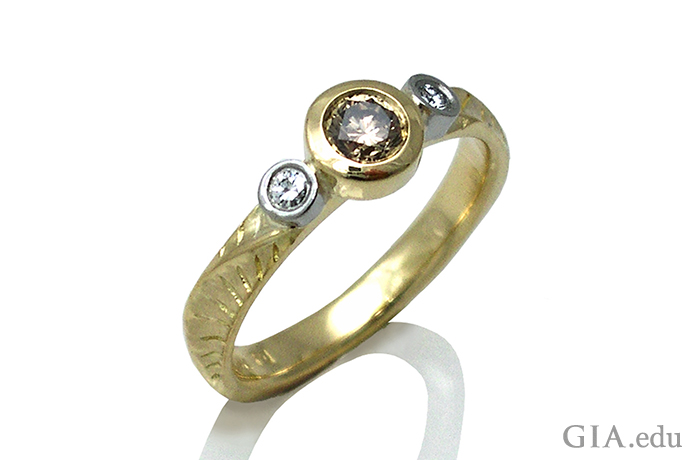
Three stone bezel set engagement ring featuring a 0.25 ct brown diamond and 0.07 carats of colorless side diamonds.

Play ball! Or go hiking, rock climbing or whatever your favorite sport. The center 0.25 ct brown diamond and 0.07 carats of colorless side diamonds are secure in their bezel settings. Courtesy: K. Mita Design

The three stone engagement ring has charmed for centuries – and is now especially chic. Pick a beautiful one, and you’ll have an engagement ring that is timeless.

The three stone engagement ring is hot, and so are these seven other irresistible Engagement Ring Styles.

The Marriage Proposal: Seven Tips to Help Get You There

“Will you marry me?” It’s the ultimate question. You want the marriage proposal to be perfect and the answer to be “yes!” There’s a lot that goes into popping the question. But have no fear. Follow these common tips for how to propose in a few simple steps. (more…)

Cruise Ship Shopping: Tips for Buying Gems and Jewelry

A cruise ship vacation offers a sea of buying options for diamond or colored gemstone jewelry. To get the best value for your memento, it pays to do some homework and know the risks of buying jewelry while on a cruise. (more…)

How to Build Your Own Engagement Ring: The Magic of Semi Mount Rings

Many jewelers offer a way to create your own engagement ring featuring the use of semi mount rings. These partially set mountings let you create an engagement ring that is uniquely yours, often more quickly and for less money than a custom engagement ring. (more…)

Buying Guide for White, Yellow and Rose Gold Engagement Rings

Gold engagement rings are forever favorites. But how do you pick the right color gold for your ring style and center diamond? Here’s a quick breakdown on gold alloys and what to consider when making this important engagement ring decision. (more…)

Buying Guide: Colored Gemstone Engagement Rings

Colored gemstone engagement rings are hot. They’re showing up on royalty and celebrities alike. They’re beautiful. They’re unusual. And they can be a great value. Here’s what you need to know when you go shopping.

In this blog, we cover:
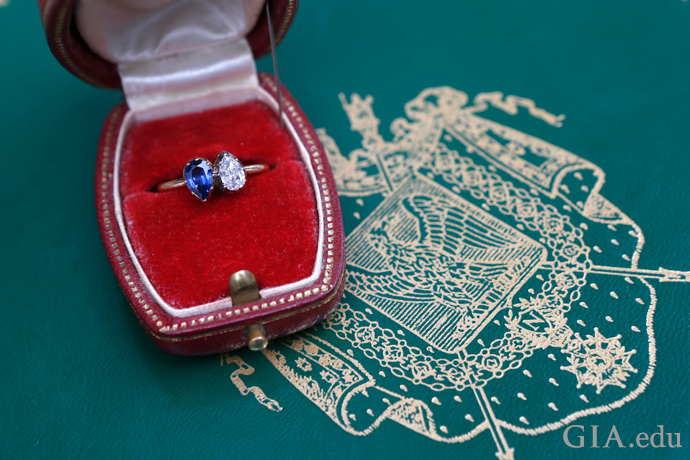
The Empress Josephine toi and moi engagement ring featuring a 1 carat pear shaped sapphire and diamond mounted in 18K gold.

The Empress Josephine toi et moi (“you and me”) engagement ring features a 1 carat (ct) pear shaped sapphire and diamond mounted in 18K gold. Photo: PATRICK KOVARIK. Courtesy: AFP/Getty Images

Why the trend in colored gemstone engagement rings

Colorful gemstone engagement rings are decorating the fingers of royals and other style makers, reviving a not-so-new trend for adding pops of color – and personality – to traditional colorless diamond engagement rings.

Some stylistas are achieving the color-me look with pink, yellow or blue diamonds, while others turn to the world of colored gemstones to find their splash of color.

More than 200 years ago, in 1796, Napoleon Bonaparte gave his future empress, Joséphine, a sapphire and diamond toi et moi (“you and me”) ring for their engagement.

Today, Kate Middleton, the Duchess of Cambridge, wears what is probably the most famous colored gemstone engagement ring. A beautiful creation that once belonged to Princess Diana, it boasts a 12 ct sapphire encircled by diamonds.
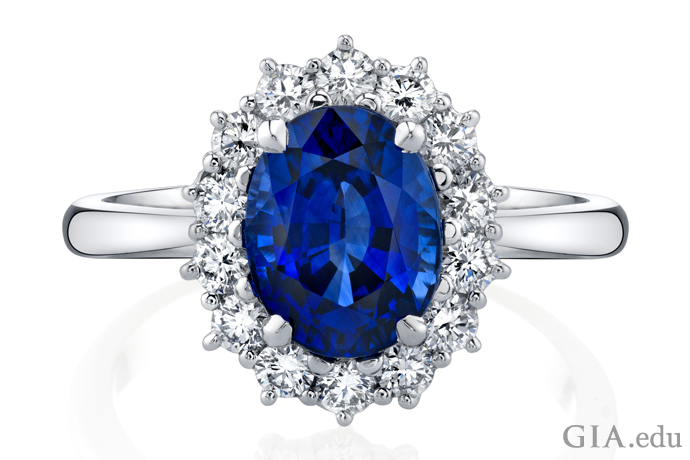
A 2.73 ct oval sapphire engagement ring accented by 0.56 carats of diamonds.

If you like Kate Middleton’s engagement ring, then you’re sure to love this beauty. A 2.73 ct oval sapphire glows the brighter for being accented by 0.56 carats of diamonds. Courtesy: Omi Privé

Kate’s recently engaged cousin by marriage, Princess Eugenie, daughter of Prince Andrew and Sarah Ferguson, opted for a slightly orangy pink padparadscha sapphire, surrounded by round brilliant cut diamonds. The style somewhat resembles the engagement ring her mother (the Duchess of York) received – a ruby with a halo of diamonds.
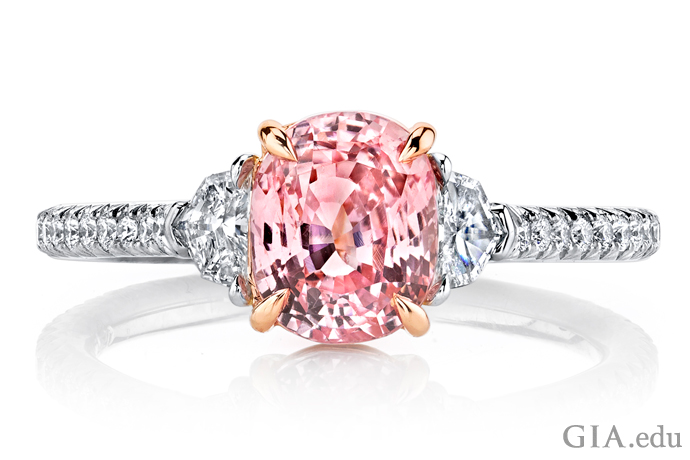
A 2.02 ct padparadscha sapphire and diamond ring.

Like Princess Eugenie’s engagement ring, this 2.02 ct padparadscha sapphire and diamond ring is both beautiful and unusual. Courtesy: Omi Privé

In the celebrity world, actress Jenny McCarthy wears a 10 ct yellow sapphire engagement ring framed by diamonds. Ashlee Simpson’s vintage-style ring features a marquise diamond surrounded by calibré cut rubies. Elizabeth Hurley sports a 9 ct blue sapphire framed by two trilliant cut diamonds in a classic design.

For these trendsetters – and many other brides – incorporating colored gemstones into an engagement ring offers myriad options to display their individual style and personality. It’s a look that’s both timeless and contemporary.

What’s great about colored gemstone engagement rings

There’s a lot to love about colored gemstone engagement rings. First, there’s the obvious: color. Explore the world of colored gems and you’ll find a rainbow, from the deep reds of ruby and blues of sapphire, to the grassy greens of tsavorite garnet and kaleidoscopic colors of spinel. There’s a gem for every hue imaginable.

Second, with colored gemstones you can add more depth of meaning to the engagement ring. For example, you could include your birthstone and your partner’s birthstone, alone or with diamonds. Colored gemstones also come with historic symbolism, and you could pick one that inspires you. Take sapphire – it has traditionally been associated with sincerity, truth and faithfulness.

You can also use colored gemstones to send secret messages. The Victorians turned this into an art form with acrostic jewelry – using the first letter of each gemstone to spell a word. For example, a diamond, emerald, amethyst and ruby set together would spell the word “dear.” Acrostic jewelry can also be designed to spell birthdays, private messages or a secret shared between you and your beloved.
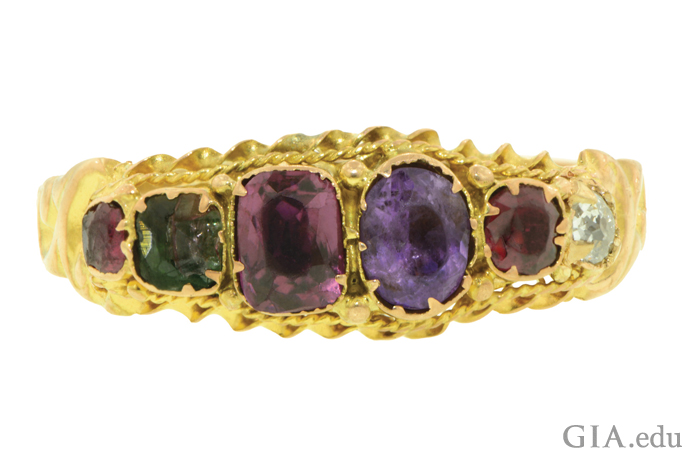
A Victorian era acrostic ring featuring ruby, emerald, garnet, amethyst, ruby and diamond.

This acrostic ring was made in England during the Victorian era (1837–1901). The gems spell “regard” from left to right: ruby, emerald, garnet, amethyst, ruby and diamond. Courtesy: Doyle & Doyle

Finally, there’s affordability. Colored gemstones are a great way to add size to an engagement ring. This is especially true if you look beyond rubies and sapphires toward gems that are less well known but equally as beautiful – and usually significantly less expensive. Examples include the pink beryl morganite, the many colors of spinel and tourmaline, or intense green, red or orange garnets.
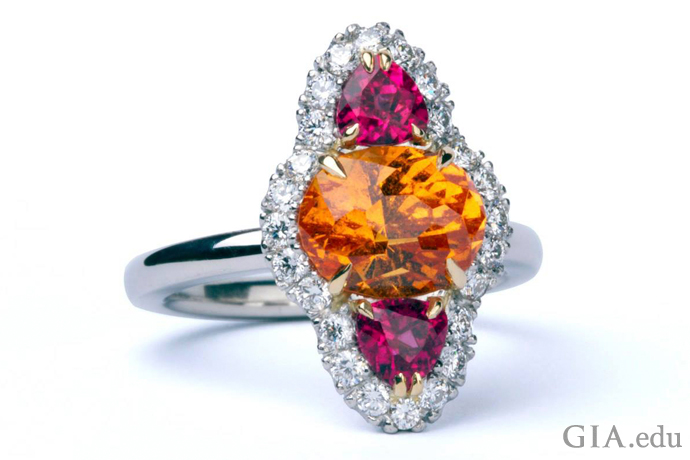
A gemstone engagement ring featuring a spessartine garnet center stone cut by John Dyer, pink tourmaline side stones and diamond melee.

If your bride-to-be’s favorite colors are orange and pink, this ring featuring a spessartine garnet center stone cut by John Dyer, pink tourmaline side stones and diamond melee is sure to please. Courtesy: John Dyer & Co.

A 7.07 carat Art Deco style morganite cocktail set in18K white gold with a double-halo of diamonds.

The color of morganite can be very similar to that of a pink diamond, but this 7.07 ct morganite is a striking – and more affordable – option. Courtesy: 1stdibs.com

Morganite engagement rings are recent favorites with brides-to-be – and for good reason. Pink has traditionally been the color of romance, and morganite ranges from pastel pink to purplish, yellowish or orangy pink. Similar hues are seen in pink diamonds, but you can have a large, attractive morganite for a small fraction of their cost.

Blue zircon, with its high dispersion, is often mistaken for blue diamonds. Yet while the cost of even a 1 ct blue diamond would be prohibitive for most buyers, a 3 or 4 ct blue zircon engagement ring is obtainable for far less than an average month’s salary.
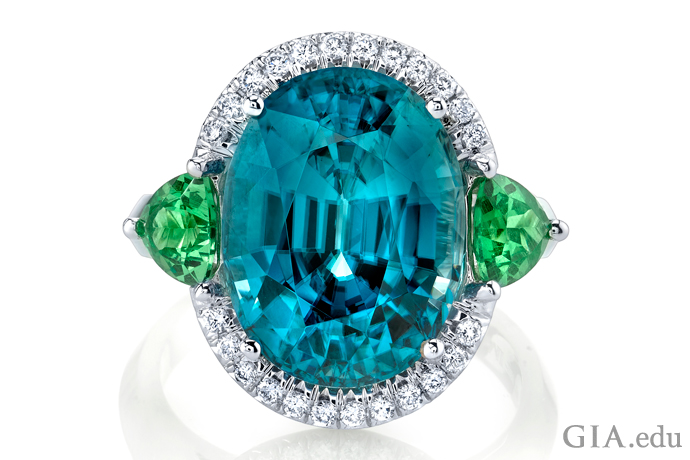
A 6.74 ct cushion cut zircon ring accented with trilliant cut tsavorite garnet side stones and round brilliant cut diamonds set in 18K white gold.

Find beauty in blue with this 6.74 ct cushion cut zircon ring accented with trilliant cut tsavorite garnet side stones and round brilliant cut diamonds set in 18K white gold. Courtesy: Omi Privé

Spinel and tourmaline are two other gems that offer a wide range of color options and great value. They occur in colors that are very similar to those of fine ruby or sapphire, but a top-quality 5 ct red tourmaline (rubellite) could be purchased for less than a third of the cost of a comparable 2 ct ruby – delivering more bling for your buck.

One of the most exciting, if less well known, colored gemstones seen in engagement rings is the green garnet known as tsavorite. More durable and often brighter than emerald, whose color it mimics, a fine tsavorite garnet is usually less expensive than its counterpart.

A 2.86 ct tsavorite ring with diamond accents, set in platinum.

An alternative and more durable option than emerald, this 2.86 ct tsavorite ring with diamond accents stands out from the crowd. Photo: Emily Lane/GIA. Courtesy: Sara and Bret Keller

With so many different colored gemstones available, your challenge will be finding one that sets your heart aflame – and making sure the gem is tough enough for daily wear.

Durability and colored gemstone engagement rings

Durability is a major consideration when searching for an engagement ring gemstone. The gem you choose must withstand the bumps and bangs of daily wear, plus the effects of heat, light, household chemicals and low or high humidity. Different gemstones have different properties and, as a result, different tolerances to these stressors.
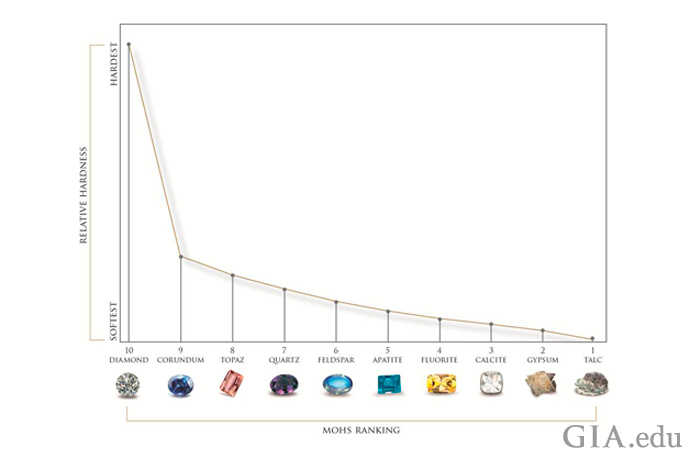
The Mohs scale ranks gem and mineral hardness in a range from 1 (least hard – talc) to 10 (hardest of all – diamond).

Introduced in the early 19th century, the Mohs scale ranks gem and mineral hardness in a range from 1 (least hard – talc) to 10 (hardest of all – diamond). Illustration: GIA

One aspect of gemstone durability is hardness. The Mohs scale ranks gem and mineral hardness on a scale of 1 (least hard – talc) to 10 (hardest of all – diamond). Ruby and sapphire rank 9, meaning they are able to resist scratching and abrasions. This makes them great choices for engagement rings that will see a lifetime of active wear. Although less hard, spinel (8), morganite (7.5–8), zircon (7.5), and tsavorite garnet and tourmaline (both 7–7.5) are considered durable enough for everyday wear provided care is exercised (no rock climbing!).
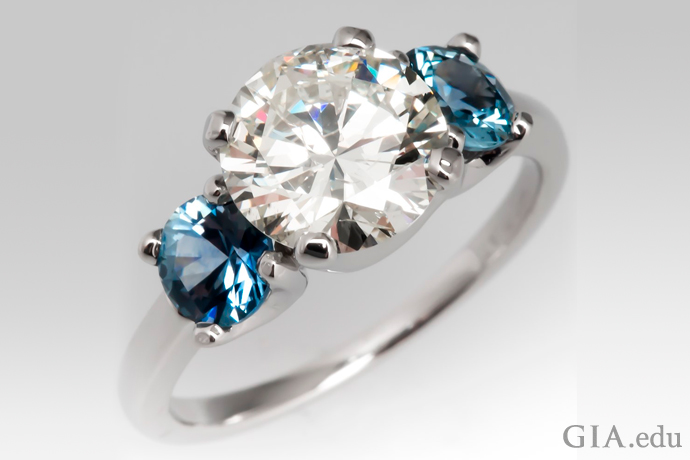
Two Montana sapphires weighing a total of 1.19 carats bookend a 2.05 ct round brilliant diamond.

Two Montana sapphires weighing a total of 1.19 carats bookend a 2.05 ct round brilliant diamond. Courtesy: EraGem.com

Toughness and stability are two additional factors that determine a gemstone’s durability.

Toughness indicates how well a gemstone resists breaking, chipping or cracking. The way the atoms of a gem bond together and the strength of these bonds determine gemstone toughness. Examples of not-so-tough gems are opal and tanzanite which, if set in rings, are best reserved for special occasions – not everyday wear.

Stability refers to how well a gemstone can withstand exposure to chemicals, light and changes in temperature or humidity. Extreme temperature changes can damage some gems like opal and tanzanite. Opals can crack or craze in low humidity or with exposure to heat. Citrine, amethyst and topaz may fade or change color from prolonged exposure to sunlight. Light and/or heat can also negatively affect most organic gems – such as pearls, coral and amber – as will exposure to household chemicals.

A 9.30 carat tanzanite center stone is surrounded by 1.18 carats of diamonds in this ring.

Tanzanite is a beautiful gem that calls for special occasions. At 6 to 7 on the Mohs scale with fair-to-poor toughness, it’s not ideal for an engagement ring that will see a lifetime of daily wear. Courtesy: Omi Privé

It’s important to note that many colored gemstones are routinely treated to improve their color and/or clarity. Designed to bring out the inherent beauty of a gem, many of these treatments are widely accepted in the gem trade. However, you should be aware that some treatments can also affect stability. As a result, your gem may require special care.

For example, treatments such as coating and fracture filling can be removed by heat and strong chemicals. Although emerald ranks 7.5–8 on the Mohs scale, it is not a tough gem and is often treated with oil and/or resin to improve clarity. This treatment also disguises fractures in the stone that can cause it to break if banged against a hard surface. If you have your heart set on a green gemstone engagement ring you plan to wear every day, you might want to consider a more durable tsavorite garnet instead, reserving emeralds for earrings or pendants. Garnets are rarely treated and have good toughness.
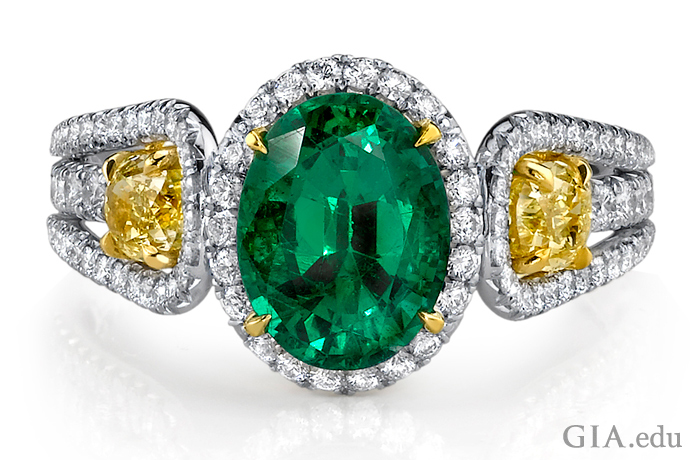
A halo of diamonds creates contrast with the emerald and helps protect this popular but fragile stone. Two yellow diamonds add more color and drama to the ring.

A halo of diamonds creates contrast with the emerald and helps protect this popular but fragile stone. Two yellow diamonds add more color and drama to the ring. Courtesy: Omi Privé.

Other qualities to look for in colored gemstone engagement rings

Color is king

Like colorless diamonds, the quality of a colored gemstone is determined by a combination of the 4Cs: color, clarity, cut and carat weight. For colored gems, however, color is by far the most important factor. In some cases, such as whether a gem is called pink sapphire or ruby, or green beryl or emerald, the distinction may be made based on color alone. Clarity is important, but for most colored gems there is no universal grading system or set of standards to evaluate clarity. And cut may vary greatly from stone to stone. The goal is typically to maximize size and color – or, as in the case of fantasy cuts, to create a work of art.
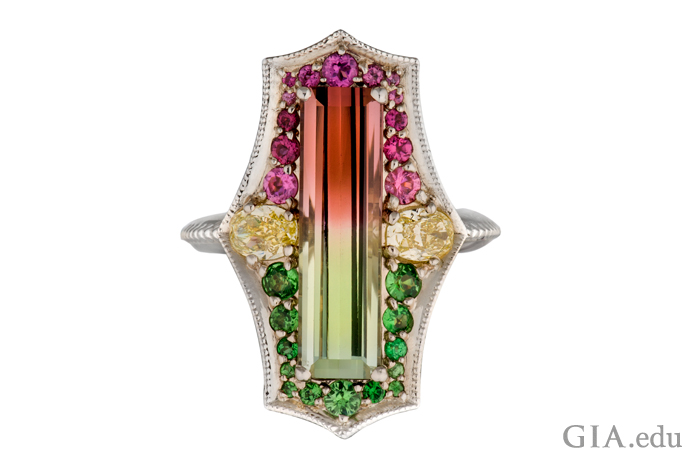
A 9.05 ct bi-colored tourmaline ring set in 14K white gold features yellow diamonds, tsavorites and rubellites.

A piece of art to stand the test of time, this 9.05 ct bi-colored tourmaline ring set in 14K white gold features yellow diamonds, tsavorites and rubellites. Photo: Orasa Weldon/GIA. Gift of Derek Katzenbach. In Memory of Nicholas Scott Golden, University of Maine geology student.

There are, however, some important considerations to look for when assessing the quality of a colored gemstone in addition to the durability factors discussed above. Many gems show more than one color. This can be an asset in a bi-colored tourmaline – for the bride-to-be who wants a truly unique colored stone engagement ring.

In other gems, such as blue sapphire, colorless zones seen on close inspection may detract from the overall appearance of the gem. And while high clarity is desirable in most colored gems, as it is in diamonds, a few identifying inclusions in an inconspicuous area (such as the culet) may ensure that the colored gem is natural (not synthetic) and untreated.

Optical phenomena
Colored gemstones also offer the possibility of certain phenomena, such as chatoyancy (the cat’s-eye effect) and asterism (a star), that are not seen in diamonds. These phenomena are caused by the reflection of light off dense inclusions of minerals in gems cut as cabochons. Such phenomenal stones provide exciting design options for a colored gemstone engagement ring.

A 7.57 ct cat’s-eye chrysoberyl ring surrounded by a halo of round brilliant cut diamonds.

This 7.57 ct cat’s-eye chrysoberyl seems to symbolize two lives united as one. Add a sparkling halo of round brilliant cut diamonds for strength and you have the perfect sentiment for an engagement ring. Photo: Robert Weldon/GIA. Courtesy: Richard Krementz Gemstones

Where the gem comes from
For some gems, such as ruby and sapphire, country of origin may also play a significant role in determining value. For example, a ruby from Myanmar (“Burmese” ruby) can cost significantly more than a comparable ruby from another locality, such as Mozambique. Similarly, there is a premium for sapphires from Kashmir, due to both their distinctive “cornflower blue” color and their rarity: There has not been major production from this region for more than a century.

Who owned it before
Another important factor in determining price is historical provenance. An antique or vintage colored gemstone engagement ring may come with its own story, and that story may have value. In one of the most striking examples, when the Empress Josephine sapphire and diamond engagement ring mentioned above was offered at auction in 2013, the auction house estimated its value at $20,000 based largely on the gems alone. Ultimately, the winning bidder paid more than $1 million – a huge premium for the ring’s storied association with Napoleon Bonaparte and his first bride.
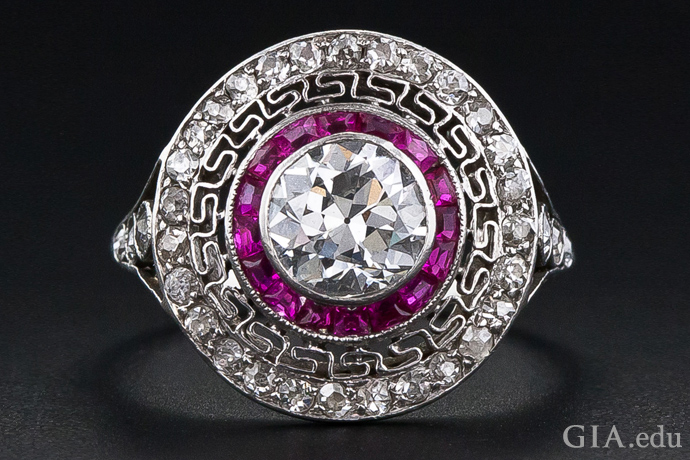
A ring of Burmese rubies encircles an Old European cut diamond in this Art Deco–era ring.

A ring of Burmese rubies encircles an Old European cut diamond in this Art Deco–era ring. A Greek key motif made of platinum circles the rubies, while another ring of diamonds completes the design. Courtesy: LangAntiques.com

Quality and rarity drive value
Like diamonds, colored gems of high quality are rare, so buyers typically pay a premium for top-quality colored stones. Once you’ve decided on a gemstone for your engagement ring, it pays to comparison shop to understand its quality factors and how they affect value. You should also learn as much as you can about your gemstone of choice. GIA’s Gem Encyclopedia is a good place to start. It provides in-depth information for 29 of the most popular gems on the market. You’ll also find detailed buying guides for each gem describing the specific qualities to look for, the gem’s durability, common treatments and more.

Caring for colored gemstone engagement rings

After you’ve purchased your colored gemstone engagement ring, you’ll want to keep it like new. The right way to clean it will vary depending on the gem material you’ve chosen and whether or not it’s been treated. Usually, gentle cleaning solutions specially formulated for delicate gems – or just warm, soapy water and a soft cloth – are all you need. If you’re uncertain about the durability of your gem, avoid using ultrasonic cleaners and off-the-shelf cleaning solutions.
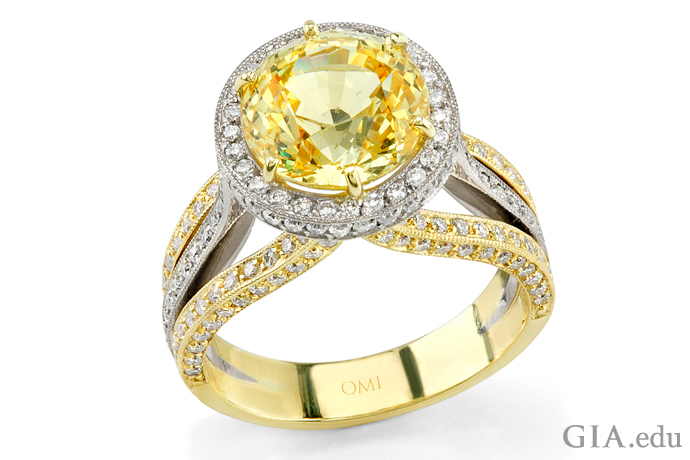
A 5.11 ct yellow sapphire engagement ring, surrounded by 128 round diamonds weighing 0.75 carats.

Washing with warm, soapy water is the safest way to clean this 5.11 ct yellow sapphire engagement ring, which is surrounded by 128 round diamonds weighing 0.75 carats. Courtesy: Omi Privé

Setting styles for colored gemstone engagement rings

Engagement ring settings must secure the gems they hold as well as show them to their best advantage. Bezels, halos and other protective settings can play an important role in preventing the chipping or cracking of colored gemstones. But who said practical can’t also be beautiful? Settings serve as an essential design element, defining an engagement ring’s style and overall look. Settings let you introduce contrasts in color or harmonize them to get just the right amount of color pop in your ring. Consider these examples:

  • A three-stone engagement ring. A three-stone engagement ring is rich in symbolism: The gems represent yesterday, today and tomorrow. Wear it and you’ll proclaim that your love is eternal. The style has also withstood the test of time – three-stone diamond engagement rings date to at least the 17th century. Adding color with rubies, emeralds, sapphires and onyx to a white canvas of diamonds and platinum was popular in the Art Deco era.
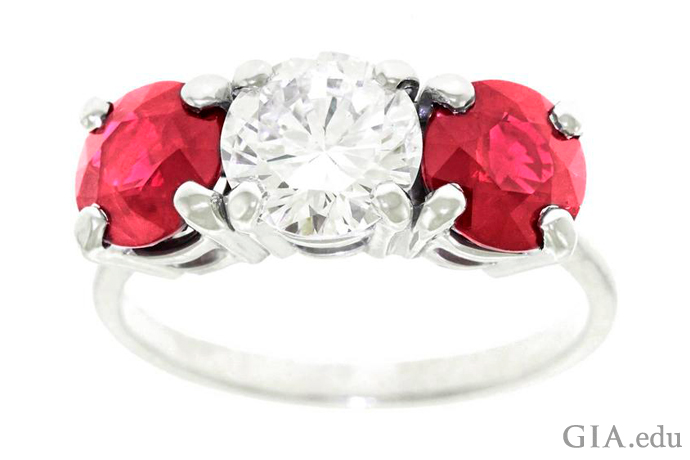
Three-stone gemstone engagement ring featuring two rubies and a round brilliant diamond.

Create a fiery look in an engagement ring by using this three-stone ring for inspiration. The two rubies (1.41 ct and 1.37 ct) bracketing the 1.39 ct round brilliant diamond are sure to catch the eye. Courtesy: 1stdibs.com

  • A halo setting. This setting features a circle of gems surrounding the center stone. Diamond engagement rings with halo settings have been particularly popular these past several years because they’re beautiful, add sparkle and make the center stone look larger. The halo setting is also a favorite for colored gemstone engagement rings. You’ll often see the center stone providing a bold splash of color, while a circle of diamonds or colored stones adds sparkle and contrast – as well as protection for the gem they surround.
A gemstone engagement ring featuring a 2.57 ct spinel encircled by 0.20 carats of round diamonds.

Need more proof that colored gemstones can bring excitement to an engagement ring? This stunning creation features a 2.57 ct spinel encircled by 0.20 carats of round diamonds. Courtesy: Omi Privé

  • A bypass ring. Want an engagement ring that looks a bit different and has color? Consider the bypass ring – a style where the band overlaps, instead of completing the circle. Bypass rings were popular in the Victorian era. The sentiment behind these toi et moi rings has an undeniably romantic cachet.
A Victorian-era diamond and sapphire bypass ring.

The diamond and sapphire in this Victorian-era bypass ring make for a delicate pairing. Courtesy: Treasurly by Dima

Jewelry designers are putting a contemporary stamp on three-stone, halo and bypass rings with colored gemstones. Their modern updates are a beautiful melding of past and present – pieces that pop with color and life. Look around and you’ll find a number of creative interpretations.
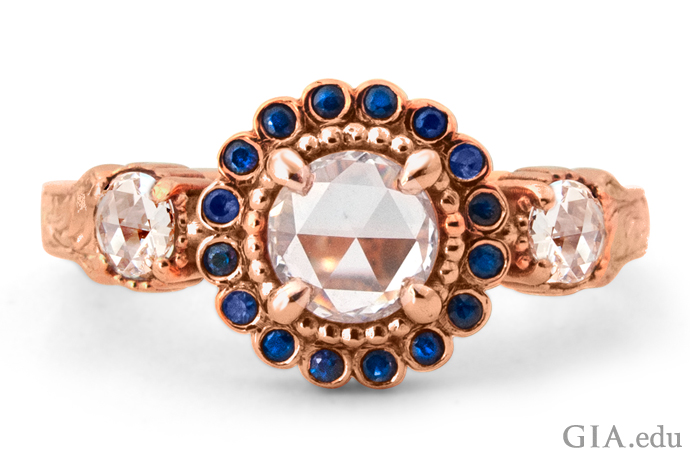
Blue sapphires surround a rose cut diamond in this modern ring with a design borrowed from the Victorian era.

Something old. Something new. Something borrowed. Something blue. Blue sapphires surround a rose cut diamond in this modern ring with a design borrowed from the Victorian era. Courtesy: Shelly Purdy Studio
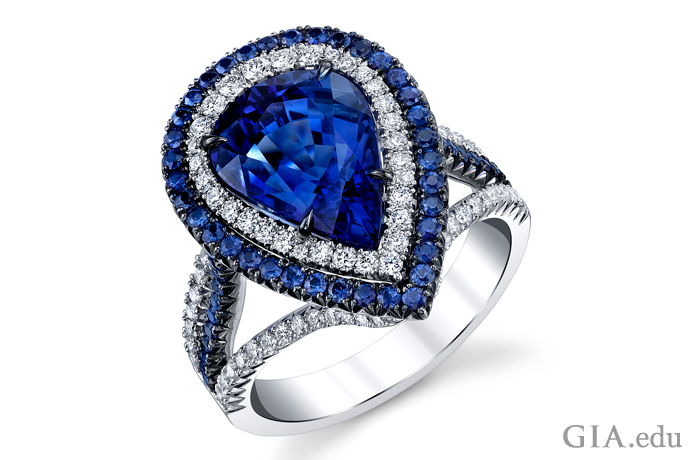
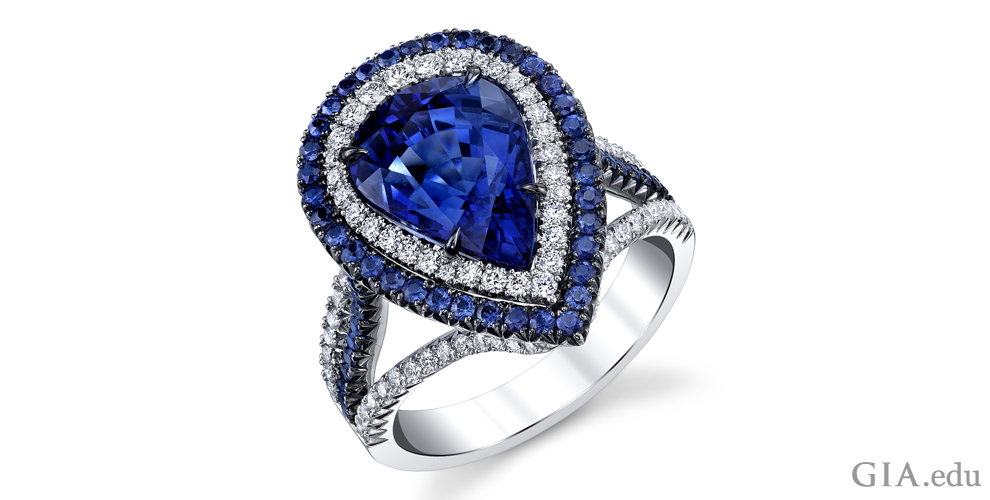
A pear shaped sapphire is surrounded by colorless diamonds and a second halo of sapphires.

A pear shaped sapphire is surrounded by colorless diamonds and a second halo of sapphires. Diamonds and sapphires spill down the shank of the ring. The bold contrasting colors create a visual richness sure to please. Courtesy: Omi Privé

How to buy colored gemstone engagement rings

Now that you know about colored gemstone engagement rings, you’re ready to start shopping. But where? The GIA Retailer Look Up lets you easily find local retailers who have GIA-trained staff to help you through your gemstone selection process.
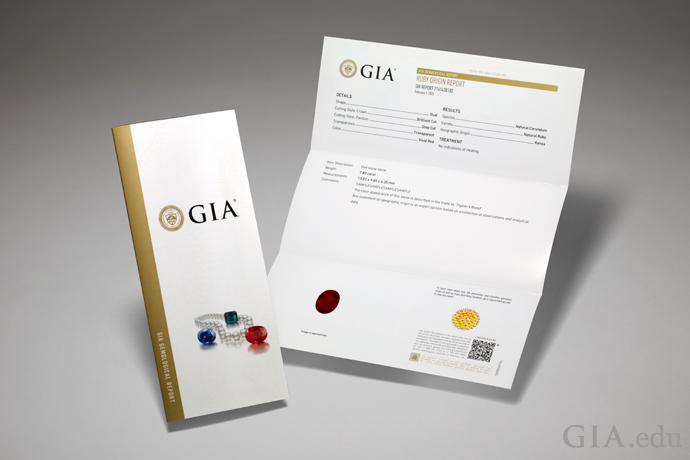
GIA Colored Stone Report

Before you decide on a colored gemstone engagement ring, ask for a GIA Colored Stone Identification Report.

To make sure you get the best value, ask for an unbiased GIA Colored Stone Identification Report. The report will validate the gem’s identity and include detailed descriptions of its size, color and measurements, along with a color photograph. The report will also indicate whether the gem has been treated and, if it has, identify the type of treatment – important to knowing how to care for your gem. Depending on the gemstone, you may also be able to get information on its geographic origin.

Need more inspiration for colorful engagement rings? Read our article on how to buy antique and vintage engagement rings for some exciting examples.
How to Shop for Antique and Vintage Engagement Rings

Antique and vintage engagement rings are in fashion – and for good reason. They have an undeniable charm and style. They are a beautiful piece of the past. They’re lasting symbols of love. Here’s how to pick one that you’ll cherish.

In this blog, we cover:
Establishing a budget for antique and vintage engagement rings
Understanding the difference between antique and vintage engagement rings
Important jewelry periods for antique and vintage engagement rings
Diamond cuts typical of antique and vintage engagement rings
Challenges with buying antique and vintage engagement rings
Where to find antique and vintage engagement rings

Establishing a budget for antique and vintage engagement rings

Prices for antique and vintage engagement rings run the gamut from less than $1,000 to more than $100,000. Put another way, there are beautiful rings for every budget. Deciding what to spend is a personal decision that balances practicality and love. You know what’s best for your circumstances.

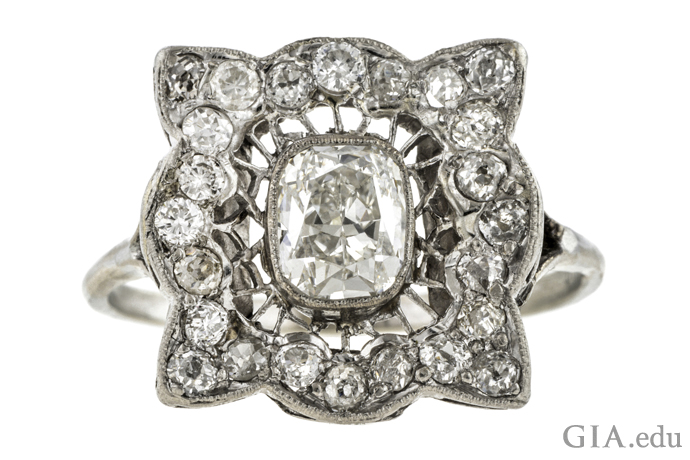
A 1.12 carat cushion cut diamond engagement ring with 0.48 carats of melee.

If you’re looking for an antique engagement ring, aristocratic elegance is a hallmark of the Edwardian era. In this intricate creation, a 1.12 carat (ct) cushion cut diamond nestles within approximately 0.48 carats of diamond melee. Courtesy: Doyle & Doyle

Understanding the difference between antique and vintage engagement rings

Before we dive into the details of shopping for antique and vintage engagement rings, here are a few terms you need to know:

  • Antique: Jewelry made more than 100 years ago
  • Vintage: Jewelry that is not contemporary, but not old enough to be antique
  • Estate: Preowned jewelry – can be antique, vintage or contemporary

Understanding the difference between antique and vintage engagement rings will be helpful for your search. If you’re interested in an engagement ring from a specific period, like the Victorian era, you’ll want to use the proper terminology to help the retailer find the appropriate pieces. It also shows that you’re an educated customer.

Victorian style heart shaped moonstone engagement ring surrounded with a halo if diamonds.

With its heart shaped moonstone cradled in a halo of diamonds, this Victorian era engagement ring sparkles with romance. Courtesy: 1stdibs.com

Important jewelry periods for antique and vintage engagement rings

Throughout history, certain periods or cultural movements have had a signature jewelry style. Your delightful challenge will be finding antique and vintage engagement rings and choosing one that best captures the spirit of your love. Here are brief descriptions of rings made during some of the more important jewelry periods.

  • Victorian (1837–1901): During the long reign of Queen Victoria, engagement rings featured a number of romantic design motifs, including acrostics (using the first letter of gemstones to spell a word), serpents, flowers, hearts and more. With the discovery of diamonds in South Africa during the latter half of her reign, diamonds became more common. The Victorian era spanned many decades, so you’re likely to find antique engagement rings from this era that charm your heart and eye.

Learn more about Victorian style engagement rings.

Gold snake motif engagement ring featuring two coiled serpents set with ruby, diamond and emerald.

An engagement ring with a snake motif might seem unusual to modern eyes. To Victorians, the serpent symbolized love, eternity and wisdom. Two coiled serpents are set with ruby, diamond and emerald. Courtesy: 1stdibs.com

  • Art Nouveau (1890s–early 1910s): Antique engagement rings of this period can be identified by the use of sinuous whiplash lines, enamel and unusual colored gems. Jewelry designers were strongly inspired by nature. They made fantastical pieces often depicting peacocks, swans, swallows, bats, dragonflies and butterflies, as well as the feminine form. Asymmetry (a lack of proportion between two parts of an object) and the economy of line (the elimination of non-essential elements) are other signature design features of this period.

Learn more about Art Nouveau engagement rings.

Art Nouveau antique engagement ring with diamonds and dramatic swirling lines.

Dramatic swirling lines, a signature of Art Nouveau jewelry, infuse this ring with a sense of movement while diamonds add sparkle. Courtesy: 1stdibs.com

  • Edwardian (1890s–1915): Triumphal laurel wreaths, scrolls, feathers, tassels, ribbons tied in bowknots, garlands of flowers, platinum and diamonds gave Edwardian era engagement rings a regal look, in keeping with the fashion established by Victoria’s heir, King Edward VII. The marquise cut diamond was also in fashion; the elegant shape was supposedly named for the Marquise de Pompadour, a mistress of France’s King Louis XV, because its outline resembled the shape of her mouth.

Learn more about Edwardian engagement rings.

A 1.63 carat elongated oval diamond engagement ring surrounded by milgrain and delicate open work.

This 1.63 ct elongated oval diamond is surrounded by milgrain and delicate open work that are characteristic of the Edwardian era. Courtesy: LangAntiques.com

  • Art Deco (1920s–1930s): For engagement rings of this period, look for geometric patterns and abstract designs brought to life with diamonds and gems of contrasting colors. Triangles, squares, rectangles and other geometric patterns were used to evoke the streamlined, modern spirit of the time. If you love a simple, yet bold style, then Art Deco vintage engagement rings would suit your taste.
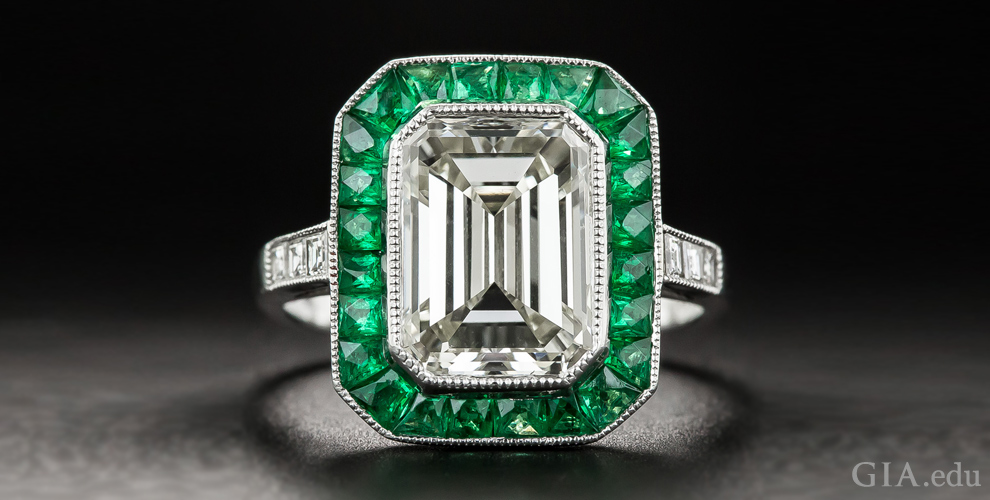
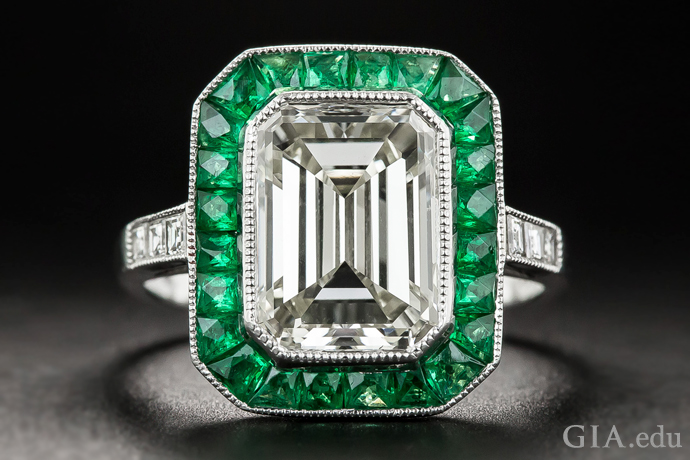
A 3.00 carat emerald cut vintage diamond engagement ring boarded by emeralds.

A 3.00 ct emerald cut diamond bordered by emeralds captures the geometric patterns and contrasting colors that are classic Art Deco. Courtesy: LangAntiques.com

Learn more about Art Deco engagement rings.

  • Retro (mid-1930s to the 1950s): Retro era engagement rings featured the geometric shapes of the Art Deco era but softened them with curves. Gold, especially rose gold, was the metal of choice. Expect to see these vintage engagement rings set with rubies, sapphires, emeralds, topaz, citrine, green beryl and aquamarine. Diamonds tended to be small, so jewelers used techniques like the illusion setting to make them appear larger. Designs were inspired by mechanical objects such as bicycle chains and padlocks.

Learn more about Retro-style engagement rings.

Retro engagement ring with rubies and diamonds.

Wearable sculpture is a perfect way to describe this Retro era engagement ring. The diamonds shine brighter for being juxtaposed against rubies. Courtesy: Lang Antiques.com

Diamond cuts typical of antique and vintage engagement rings

If you’re looking for antique engagement rings, you’re likely to come across the terms old mine cut and old European cut diamonds.

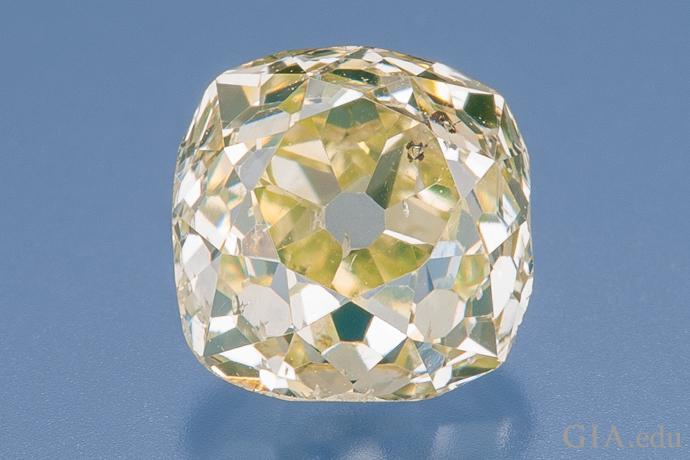
An old mine cut diamond is a squarish or cushion shaped brilliant with many proportion variations that was often used in jewelry during the Georgian (1714–1837) and early to mid-Victorian periods. Although it has 58 facets like most modern round brilliant cut diamonds, it typically has a smaller table, larger culet and higher crown. It also has short lower half facets and a girdle that is very thin in places, which contribute to its distinctive look.

A 0.68 carat old mine cut diamond.

No two old mine cut diamonds are identical. This one weighs 0.68 ct. Photo: Orasa Weldon/GIA

The old European cut emerged as advances in diamond cutting technology in the late 1800s made it possible to fashion round girdles, like the modern round brilliant, though it has a higher crown, very small table and greater total depth. It is typically found in jewelry from the late Victorian era, the Edwardian era and the Art Deco period.

A 0.99 ct old European cut diamond.

This 0.99 ct old European cut diamond has a stately elegance. Photo: Orasa Weldon/ GIA

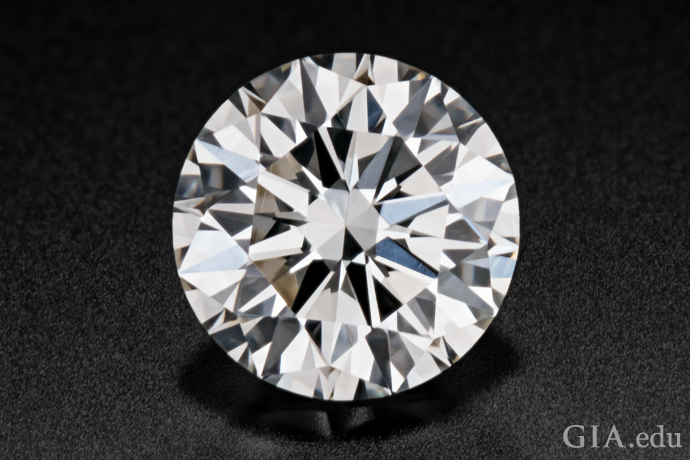
A 0.73 carat round brilliant cut diamond.

The round brilliant cut diamond, here at 0.73 carats, has been the standard for engagement rings since the mid-20th century. Photo: Kevin Schumacher/GIA

Challenges with buying antique and vintage engagement rings

Antique and vintage engagement rings can be a unique choice for your bride-to-be, but there are some challenges you should be aware of before you make a purchase.

  1. Synthetic Gems and Simulants:
    When shopping for antique and vintage engagement rings, it’s not uncommon to find some set with synthetic gems or simulants. Synthetic rubies have been around since the late 1800s, and both synthetic rubies and sapphires were very popular in the early to mid-1900s as they made jewelry more affordable. During the Art Deco era in particular, small calibré cut synthetic rubies and sapphires often served to accent diamonds in engagement rings and other jewelry. By the middle of the 20th century, synthetic emerald was also available, and by the 1970s we had synthetic alexandrite, opal, turquoise, citrine and amethyst, among others.
    Simulants, like garnet-and-glass doublets in different colors (not just red, but also blue, green and even colorless) and other imitations, were commonly used in place of natural gemstones. Synthetics and simulants were often mixed with natural gems or diamonds. Over the years, fine gems in some pieces of antique or vintage jewelry have been removed and replaced with less-expensive imitations. The bottom line: Don’t assume that just because a ring is older, the stones are natural.
  2. Thinning Prongs and Shanks:
    With time, prongs on antique and vintage engagement rings can weaken from years of wear. When prongs are thin or worn, they can’t hold the stone as securely, making it vulnerable to loss. Retipping a prong usually requires removal and resetting of the stone, which always comes with some level of risk. Similarly, the back of the shank may be too thin on some rings, so it may need to be replaced with a new quarter shank or half shank.
  3. Resizing Issues:
    Antique and vintage engagement rings can be very difficult to resize, especially to go significantly larger or smaller. Consult with your jeweler on how to determine ring size before you buy.
  4. Return Policy:
    What happens if the engagement ring you bought doesn’t meet your expectations (or those of your bride-to-be) when you get it home? Our suggestion: Make sure the retailer has a generous and fair return policy. You should insist on having at least seven days to return an item.
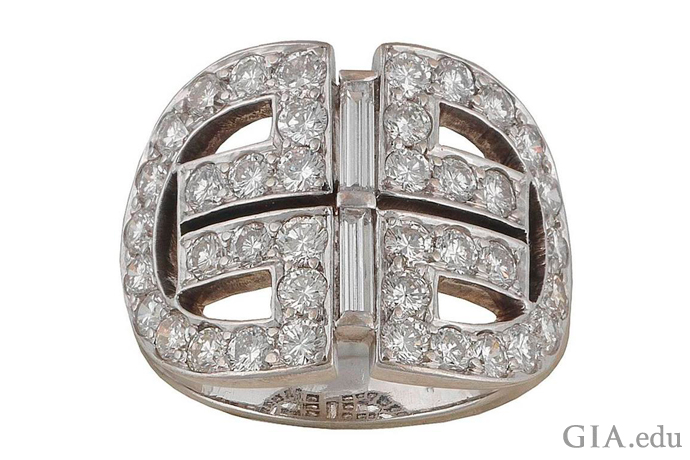
Retro era engagement ring with two baguette diamonds weighing 0.60 carats and about 2.00 carats of melee.

A distinctive geometric pattern with both strong angles and curves incorporates two baguette diamonds weighing approximately 0.60 carats and about 2.00 carats of melee in this Retro era ring. Courtesy: 1stdibs.com

Where to find antique and vintage engagement rings

A number of websites specialize in antique and vintage engagement rings. To determine if an online retailer is trustworthy, look to see how long they have been in business and if they are in good standing with the Better Business Bureau. Be sure to speak with retailers directly both to get answers to your questions and see if they are knowledgeable professionals. It is wise to purchase items with diamonds that come with GIA Grading Reports. Our blog on the Five Non-Negotiable Rules for Buying Jewelry Online has more essential information that may be helpful during your search.

Auction catalogs and websites that sell estate jewelry are two other sources. In addition, you can search the GIA Retailer Lookup for retailers who carry GIA-graded diamonds. Some of them also sell antique and vintage engagement rings, so it may be a good place to start.

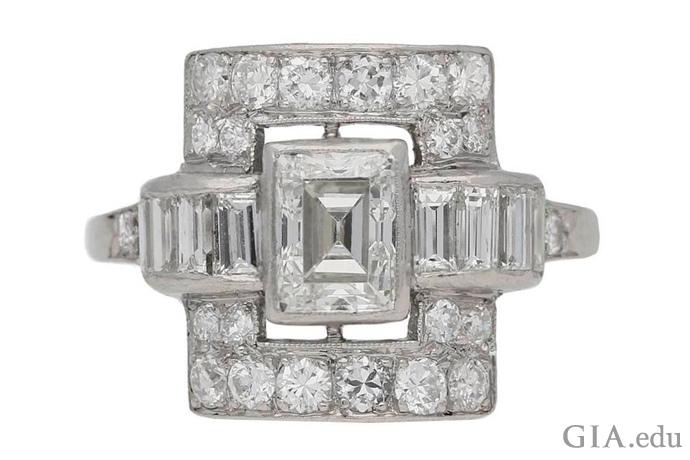
A 0.85 ct octagonal emerald cut diamond Art Deco engagement ring accompanied by eight rectangular baguette cut diamonds and a group of round old European cut diamonds.

Contrasting geometric shapes create a sum greater than its parts in this Art Deco ring. A 0.85 ct octagonal emerald cut diamond is the center stone, accompanied by eight rectangular baguette cut diamonds and a group of round old European cut diamonds. Courtesy: 1stdibs.com

Once you find your perfect antique or vintage engagement ring, consider getting an unbiased appraisal from an experienced jeweler or independent jewelry appraiser. The appraisal should provide you with a full description of the piece, including its condition, as well as validate its historical period and estimate its value.

Searching for antique and vintage engagement rings can be like going through a treasure chest filled with lots of precious surprises. If you’re having a tough time finding one that’s right for you, consider creating a custom engagement ring with these antique and vintage styles in mind.

How to Determine Ring Size: Tips and Ring Size Chart

Getting the ring size right is a must for any engagement ring. After all, you’ve invested a lot in selecting the perfect ring and planning the proposal, so naturally you’ll want the ring to fit right out of the box.

In this blog, we’ll dispel some common myths floating around on the Internet and provide some reliable tips on how to determine her ring size, including an international ring size chart, so you can get it right. (more…)

Five Ways to Pair Wedding Bands and Engagement Rings

A lot of love and care went into choosing and giving your engagement ring, so now it’s time to give wedding bands your undivided attention. The choices seem endless, but we’ve gathered some popular looks to help narrow things down for you. (more…)