Anatomy of a Marquise Diamond
A marquise-cut diamond is a fancy shape, a term used for any diamond shape other than round brilliants with fifty-seven or fifty-eight facets. To choose a beautiful stone for your marquise diamond ring, it helps to understand the anatomy of this cut.
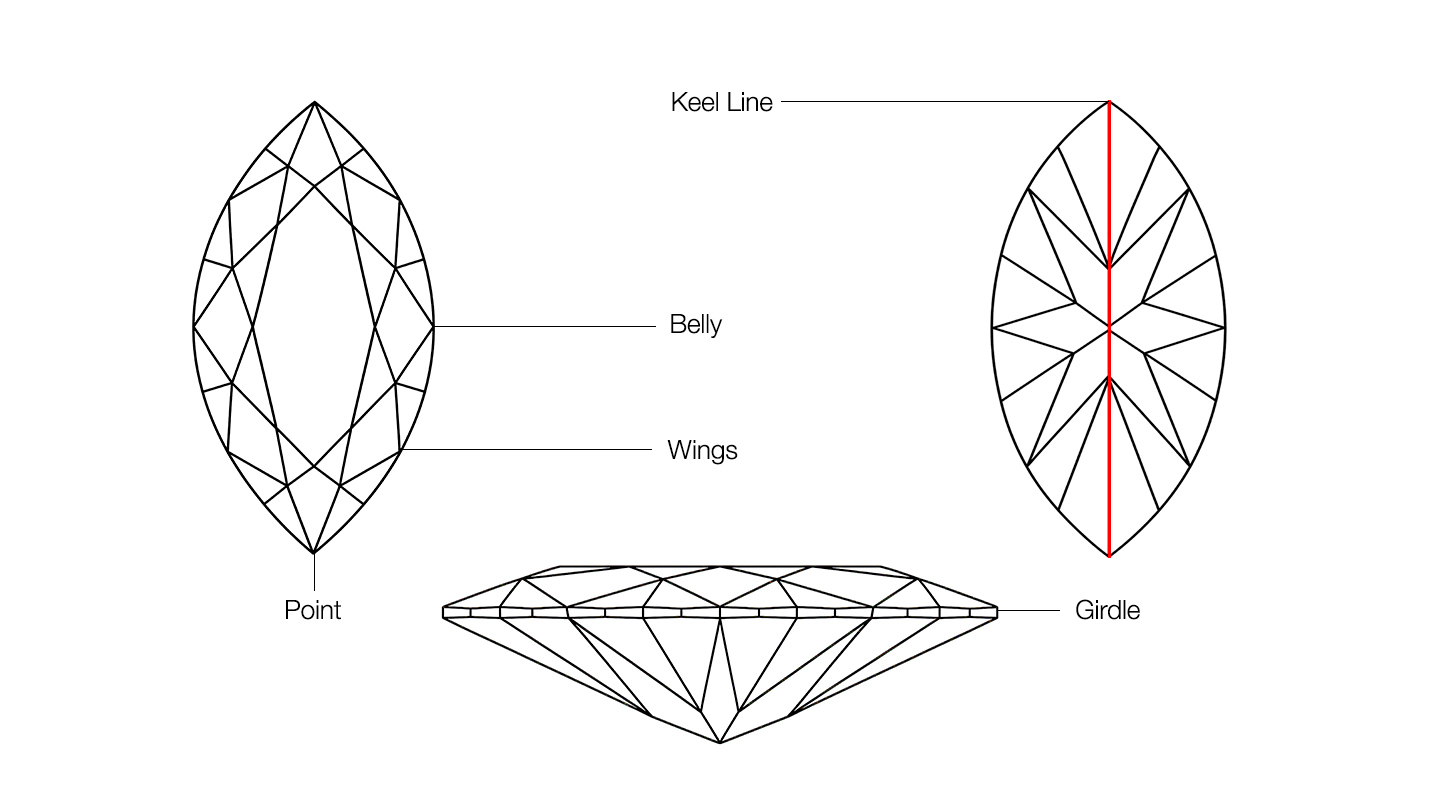
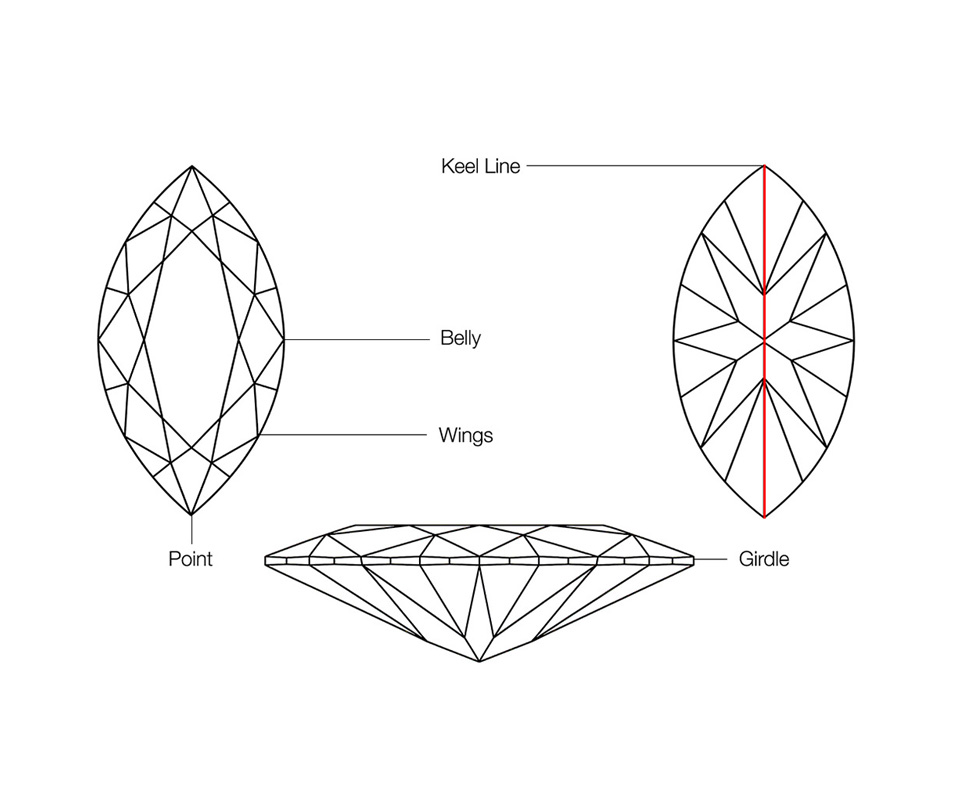
- Belly: The central area where the sides curve outward the most. This is an important reference point because it is where the diamond’s width is measured.
- Point: The location at each end where the two curved sides meet.
- Wing: The curved section that extends from the belly toward each point.
- Girdle: The edge of the diamond where the crown (top) meets the pavilion (bottom facets), forming the diamond’s outline.
- Keel Line: The bottom ridge of a fancy-cut diamond where the pavilion facets meet. It runs along the length of the stone and may include or pass through the culet facet at the center.
Understanding these parts of a marquise shaped diamond helps you evaluate its proportions, symmetry and overall appearance.
What to Look for in a Marquise Diamond
Several factors affect the overall beauty and durability of a marquise-cut diamond. Consider the following when selecting your perfect marquise.
Girdle Thickness
The girdle is sometimes described as a belt that encircles the diamond, separating the crown (top) from the pavilion (bottom). It forms the outer edge of the diamond and is also the area typically secured by the setting. When it is sufficiently thick, it can help protect the diamond from damage.
In a brilliant style diamond, the girdle appears slightly scalloped, with alternating “valley” and “hill” positions created where the upper and lower half facets meet.
An overly thick girdle can add unnecessary carat weight (and cost) without improving the diamond’s face-up size, while a very thin girdle may increase the risk of damage, such as chipping.
Girdle thickness is assessed the same way in both round and fancy shapes, but certain fancy cuts require special consideration. In marquise diamonds, the pointed ends are the most vulnerable areas, so it is acceptable—and often beneficial—for the girdle to be slightly thicker at the points.
French Tips
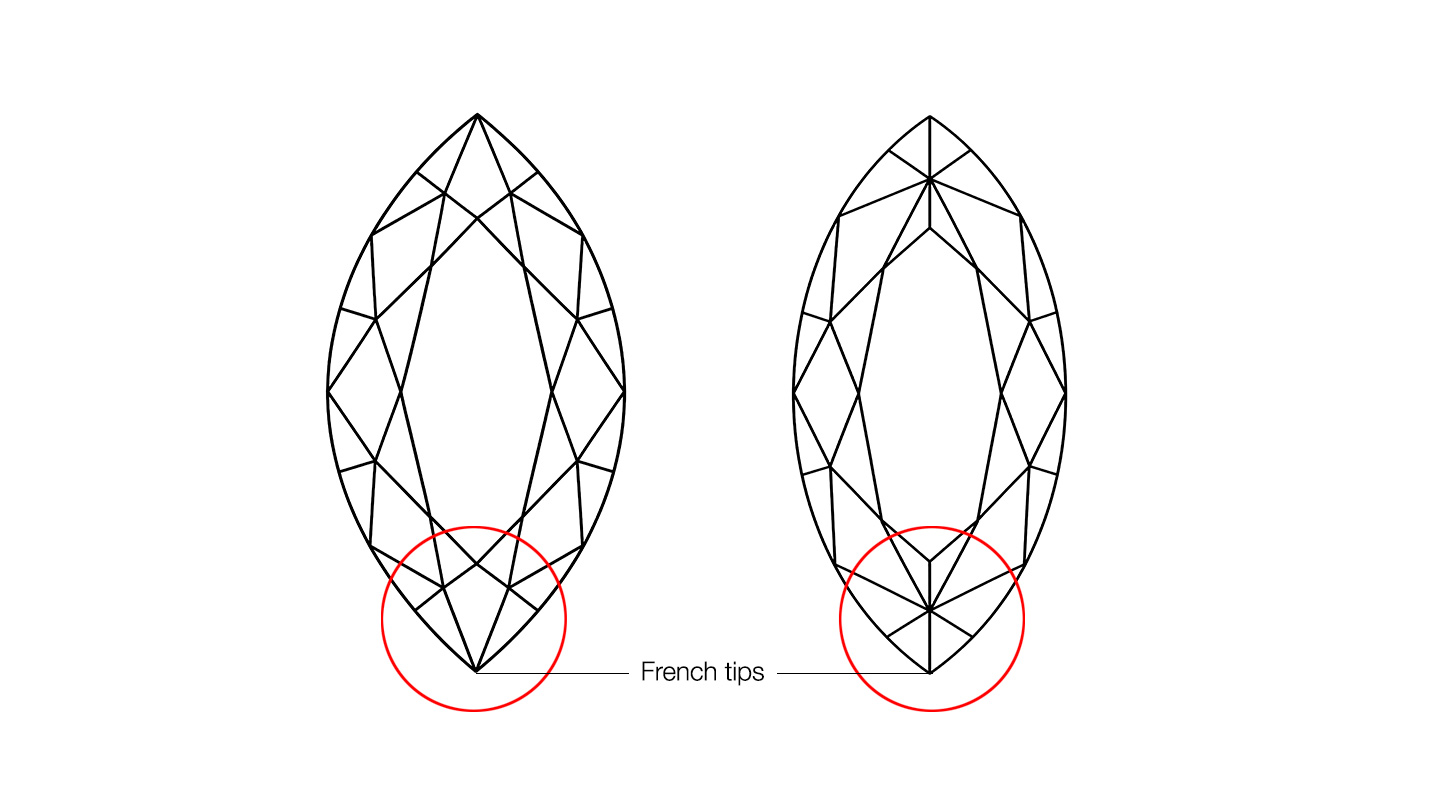
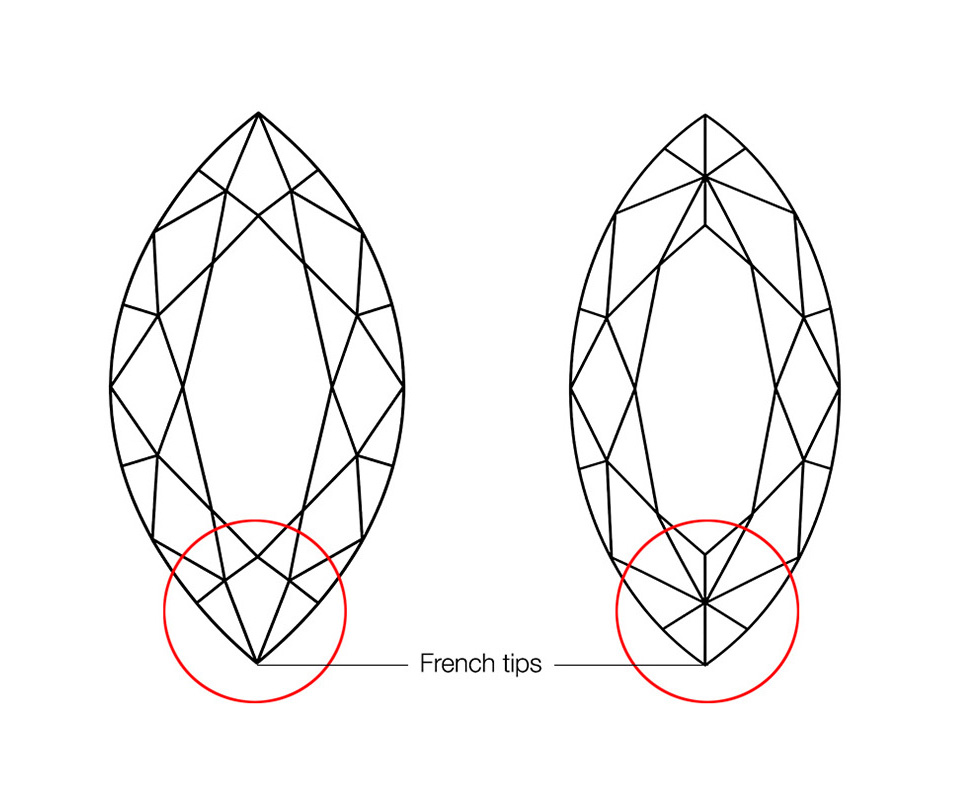
Because a marquise diamond has pointed ends, those tips can be more vulnerable to chipping or breakage. To help protect them, some cutters use French tips, a faceting style that replaces the large bezel facet at each point with smaller star and upper girdle facets. This arrangement strengthens the tip area and helps distribute pressure more evenly, improving the diamond’s durability.
Length-to-Width Ratio:
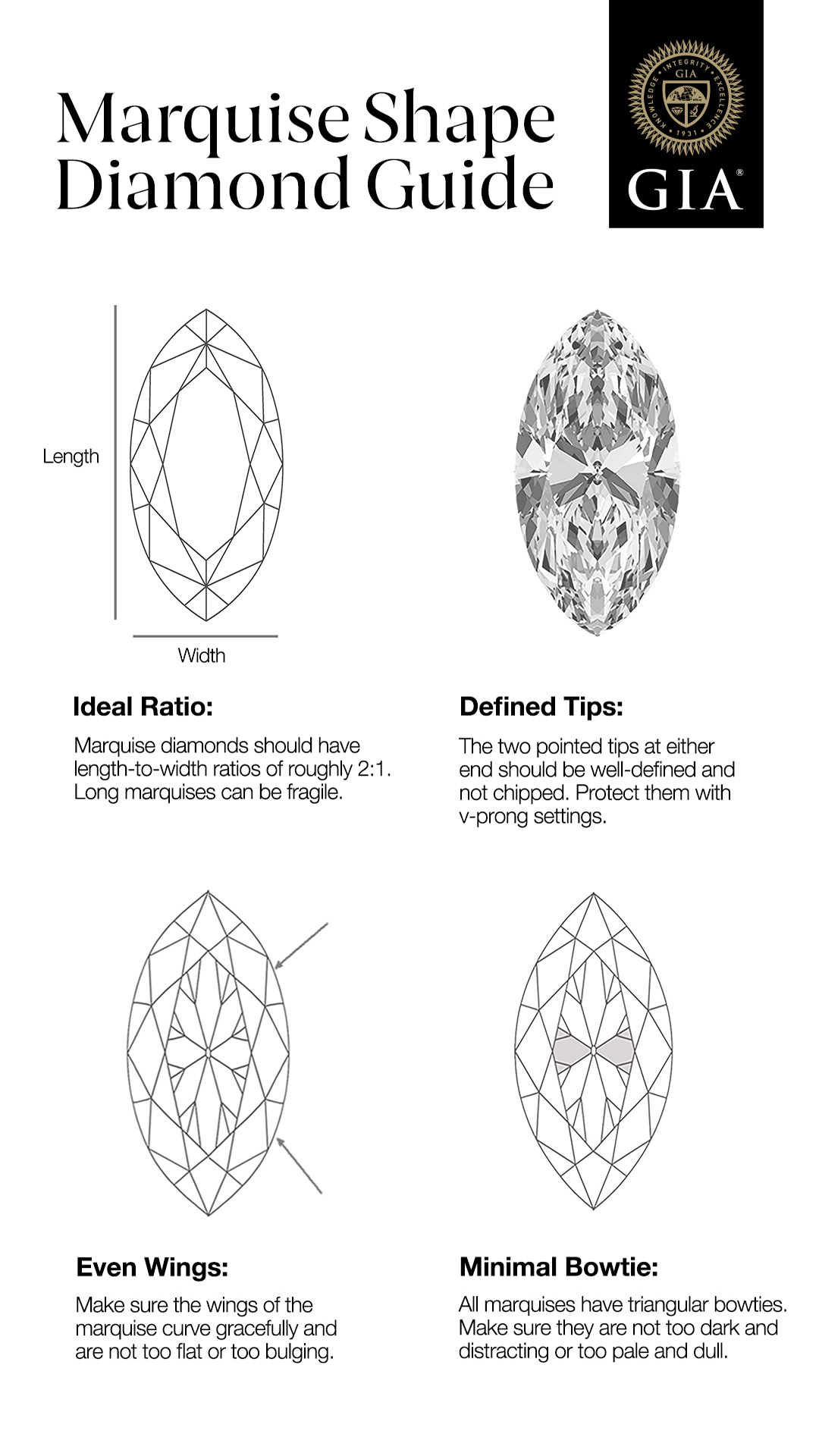
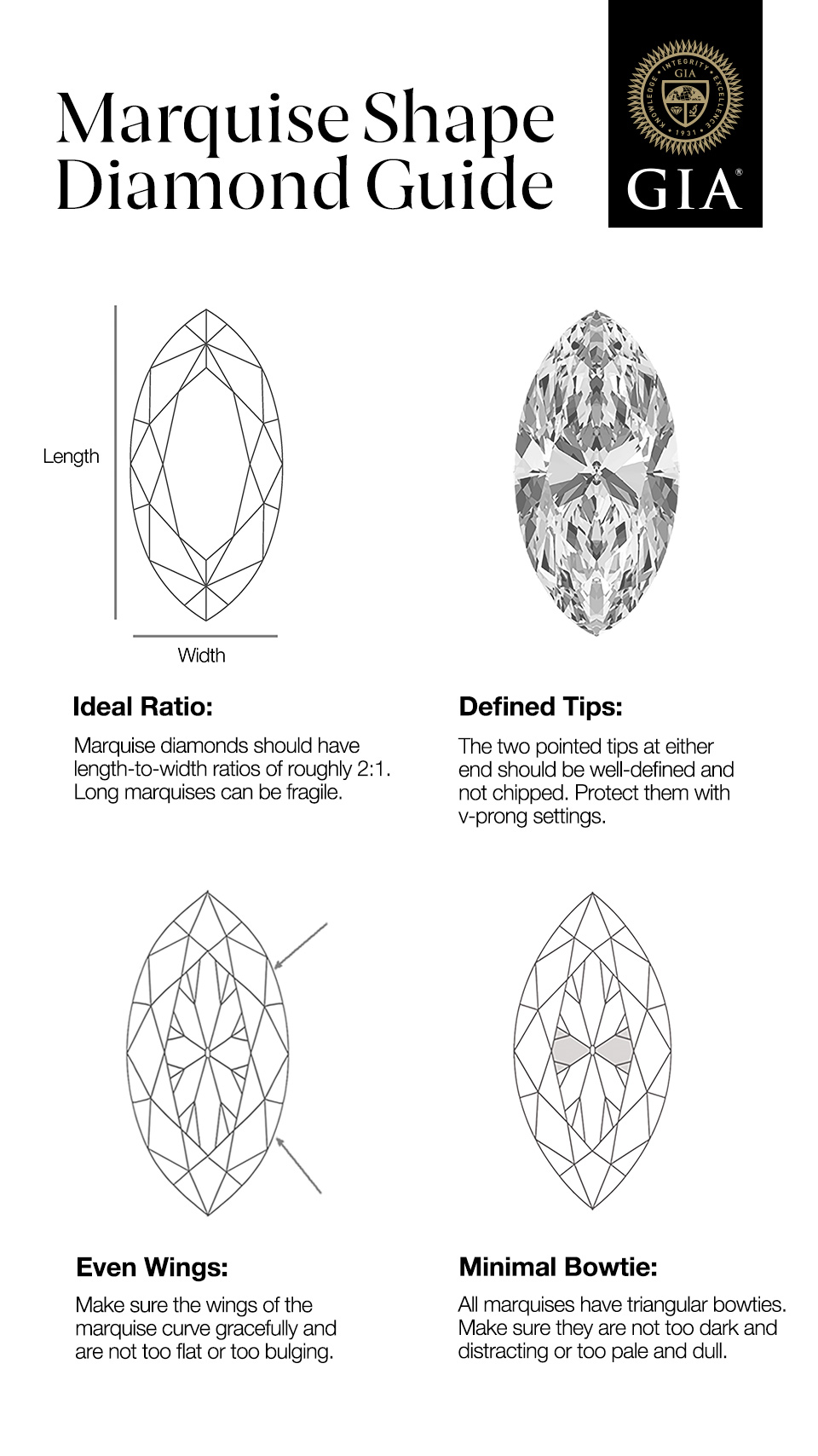
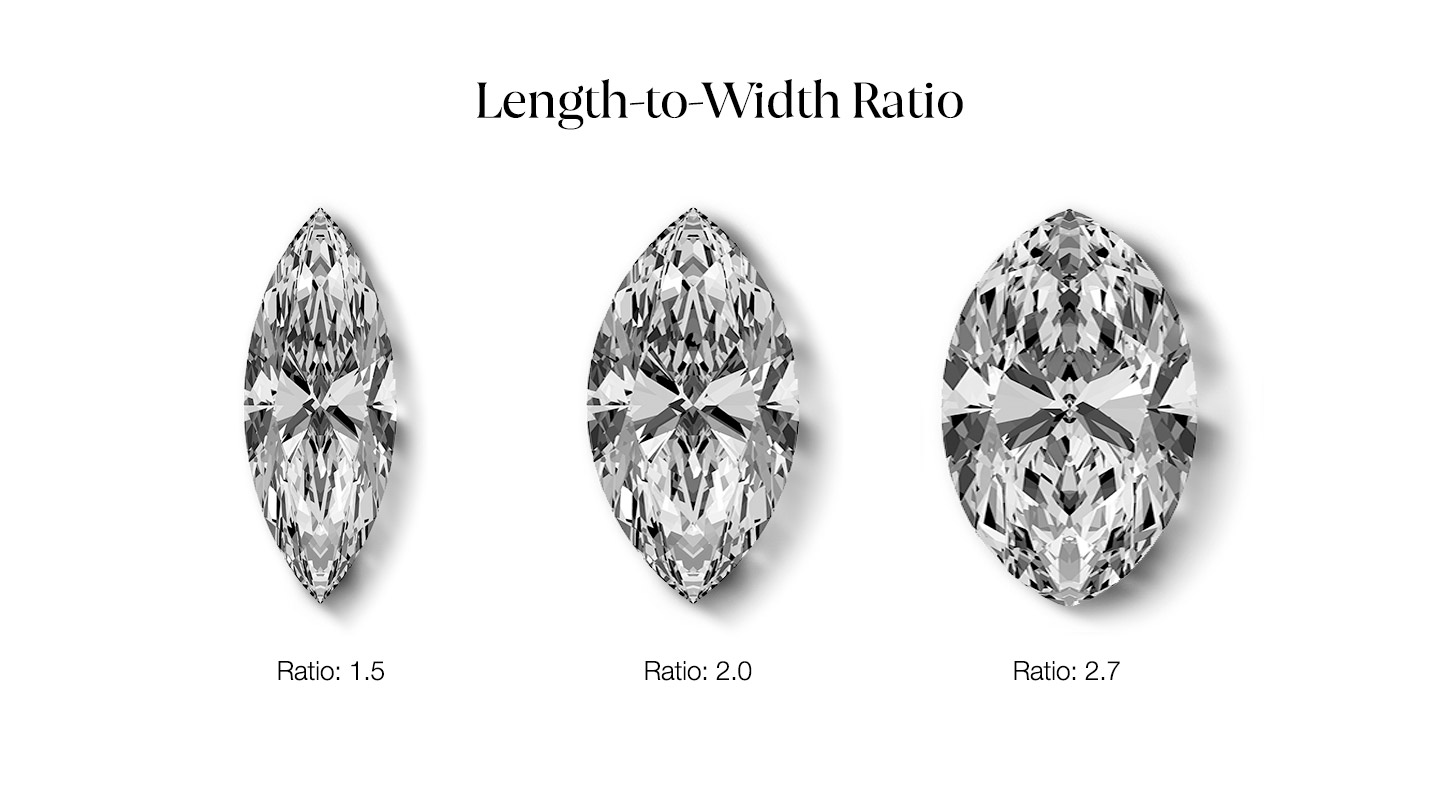
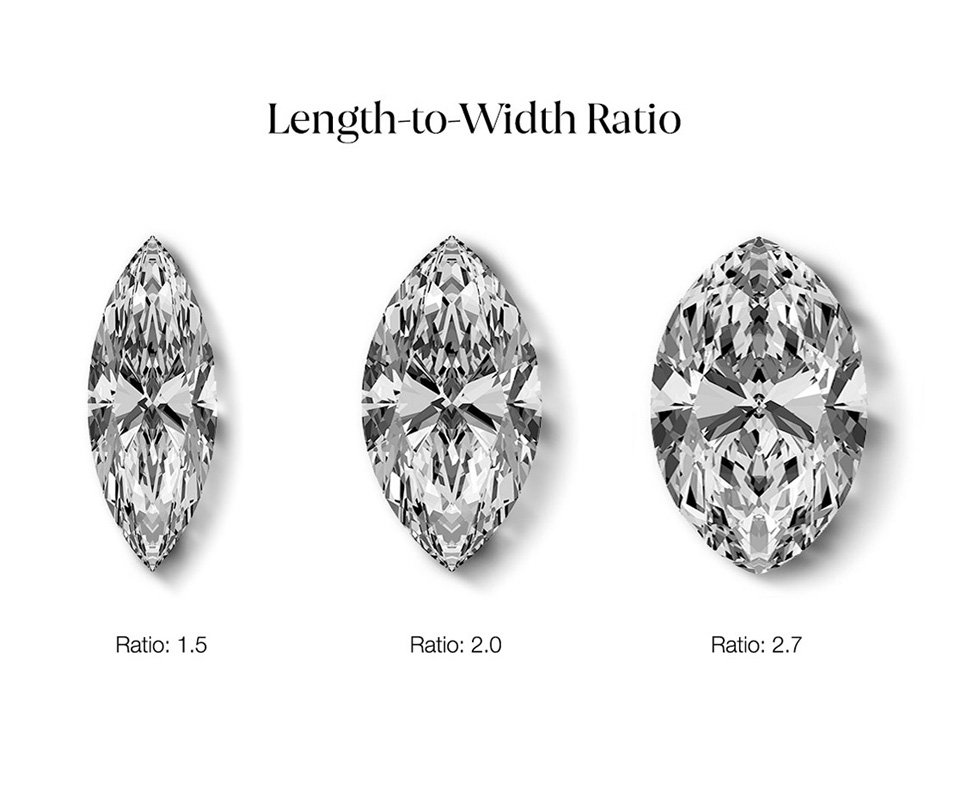
A diamond’s length-to-width ratio compares its length (from point to point) with its width (across the belly). A classic marquise proportion is about twice as long as it is wide, or a 2:1 length-to-width ratio.
Is there an ideal length-to-width ratio for marquise diamonds?
Marquise diamonds submitted to the GIA laboratory most commonly fall within a length-to-width ratio of 1.6:1 to 2.2:1. Diamonds with longer ratios can be more difficult to cut while preserving an attractive face-up brightness and pattern, whereas very short marquise diamonds may appear somewhat “stubby.”
Ultimately, however, the ideal length-to-width ratio comes down to personal preference. Some buyers are drawn to longer marquise diamonds, while others prefer a shorter, fuller shape.
Symmetry
Symmetry plays an important role in how balanced and attractive a marquise diamond appears. Because the shape has pointed ends and curved sides, even small differences can affect how the diamond looks face-up.
GIA evaluates symmetry through careful visual observation. GIA Diamond Grading Reports include a symmetry grade on a five-point scale ranging from Excellent to Poor.
Here are some tips to keep in mind when evaluating the symmetry of a marquise diamond.
- Compare the wings: Look at the curves that run from the belly to each point. The wings on both sides should have the same shape and amount of curve.
- Compare the two halves of the diamond: Imagine a vertical line running through the center of the diamond from point to point. The left and right halves should appear balanced in outline and equal in length—one side should not look longer or shorter than the other.
- Examine the facet pattern: Draw an imaginary line down the length of the diamond. The facets on the right and left halves should be the same shape and size and at the same relative locations along the wings.
Then draw an imaginary horizontal line across the diamond and see if the facets on the bottom and top halves are also symmetrical. The more symmetrical the facets are, the more pleasing the overall appearance of the diamond. - Look for irregularities: Check for any missing or extra facets.
A GIA-trained retail associate can help you evaluate your marquise diamond based on these criteria, pointing out subtle differences in symmetry and explaining how they may affect the diamond’s overall appearance and appeal.
Shape Appeal:
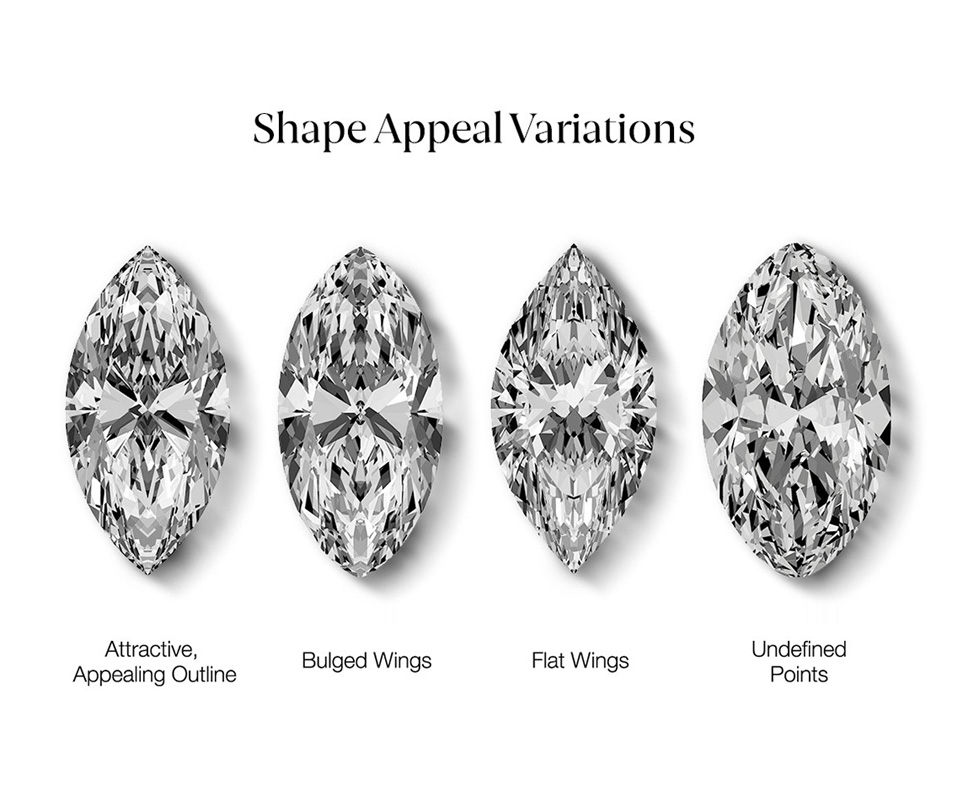
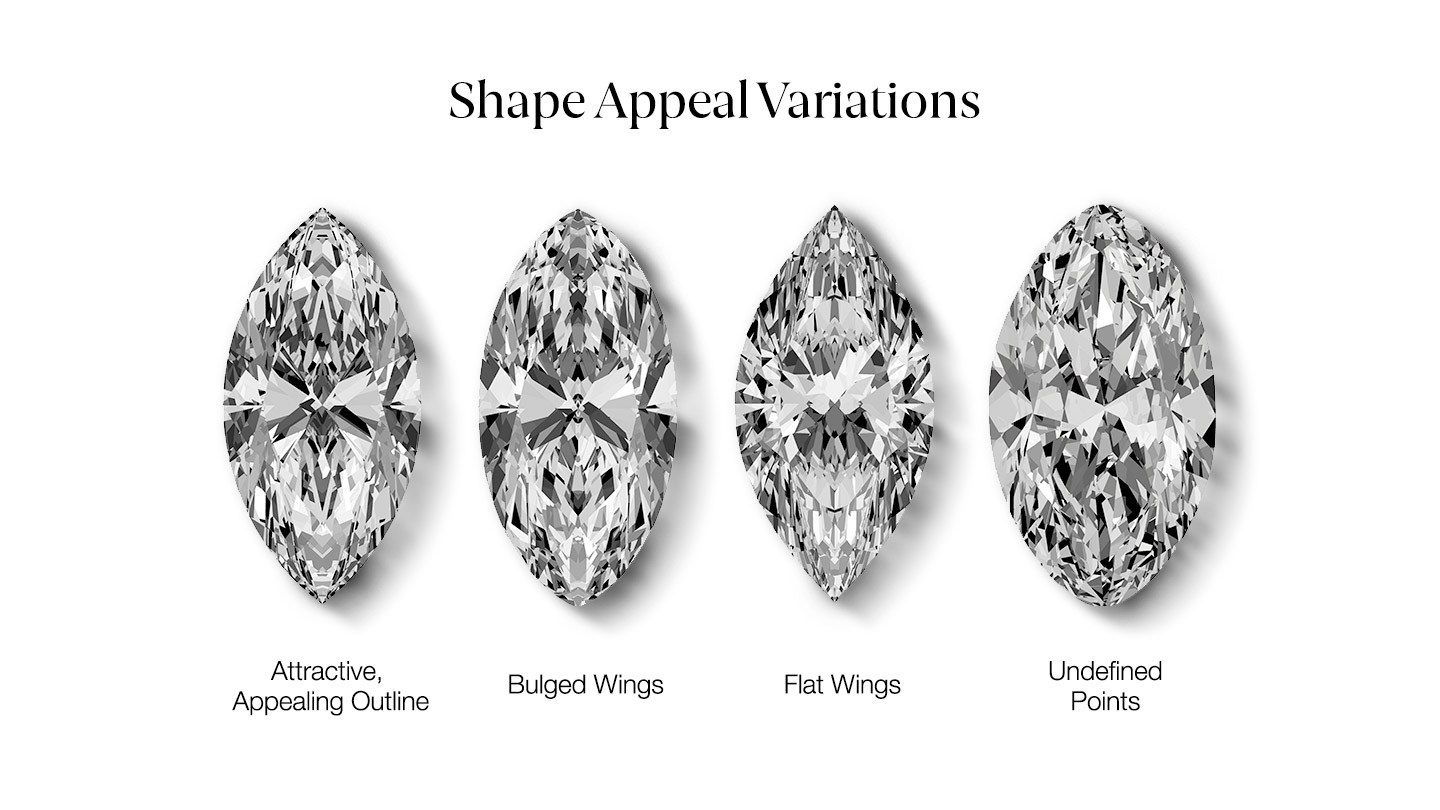
In addition to symmetry, shape appeal—or how graceful and well-proportioned the diamond appears—is also important. While symmetry measures how precisely the diamond’s parts align, shape appeal evaluates the overall outline and balance of the stone.
Here are some common shape issues to look out for in marquise diamonds:
- Flat wings: The wings have less curve than usual, giving the diamond a narrower, flatter, appearance.
- Bulged wings: The wings appear overly rounded or “plump,” making the shape appear bulging and ungraceful.
- Uneven wings: One or more wings curve differently than the others, creating an unbalanced outline.
- Undefined points: One or both tips appear slightly rounded, rather than crisp and well-defined.
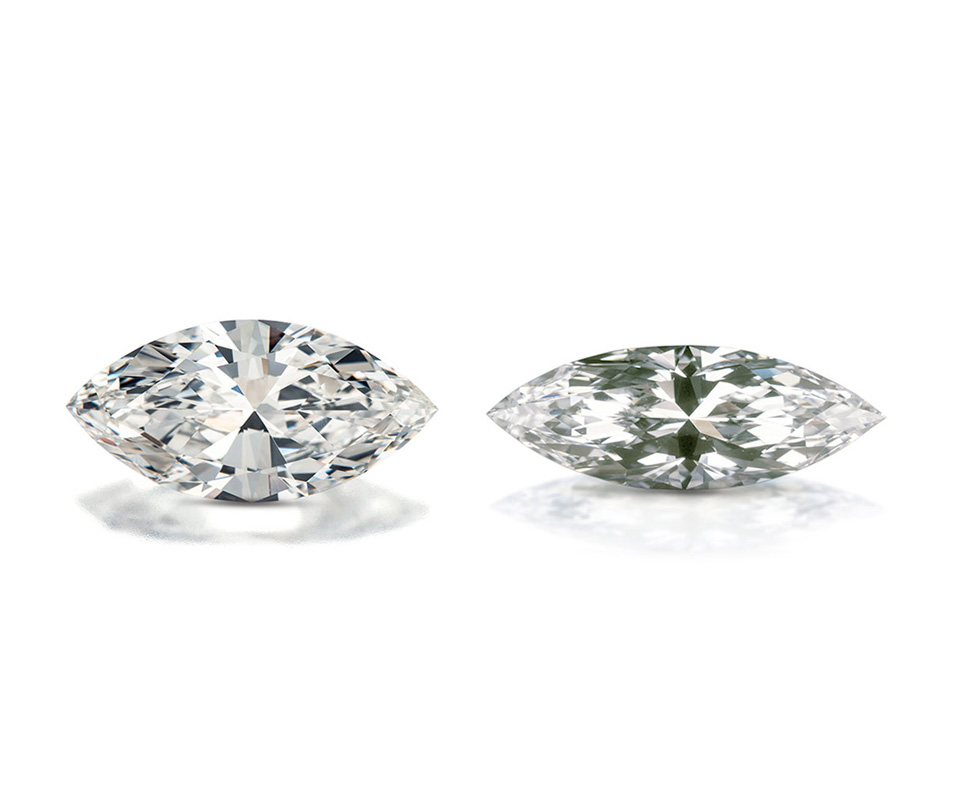
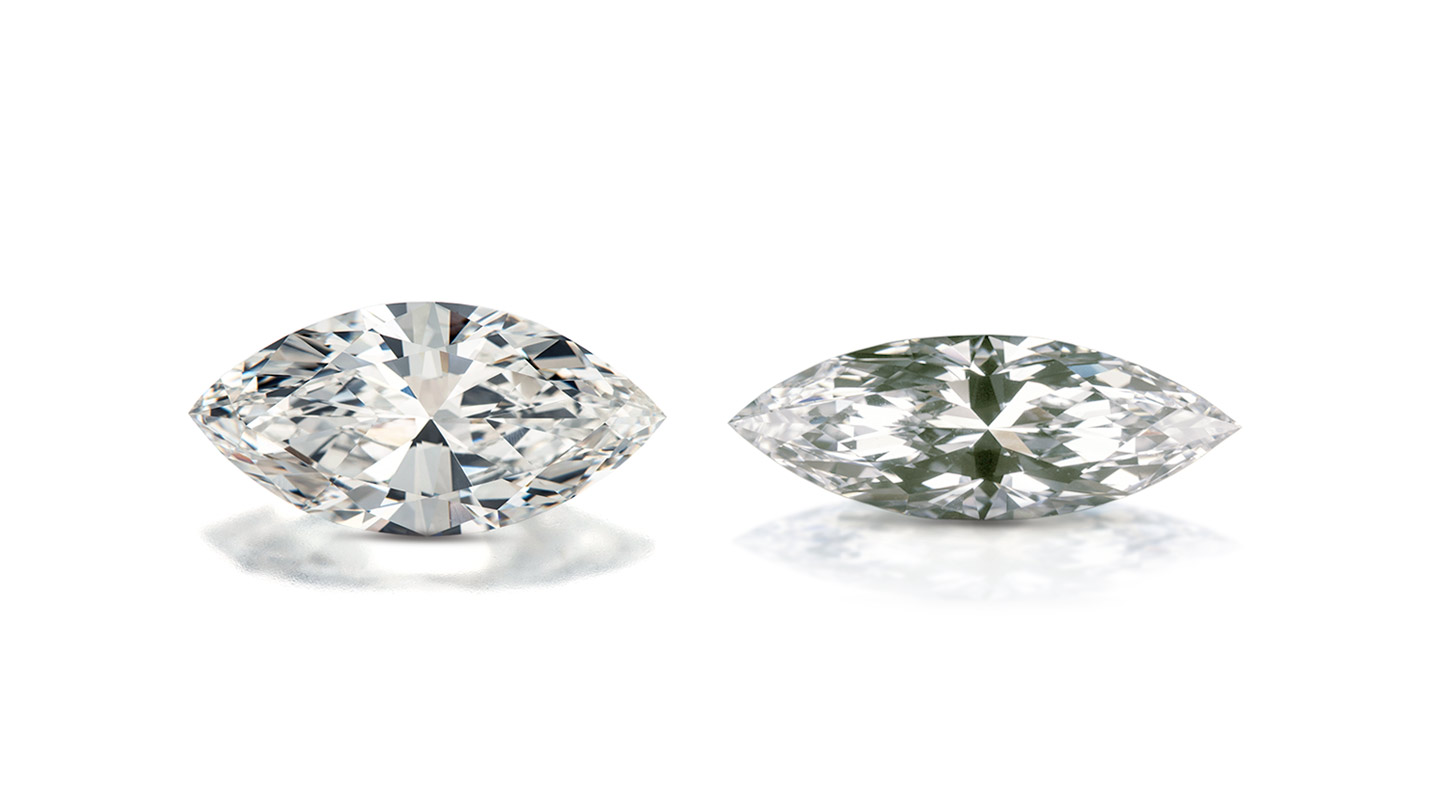
A Marquise Diamond and Its Bow-Tie
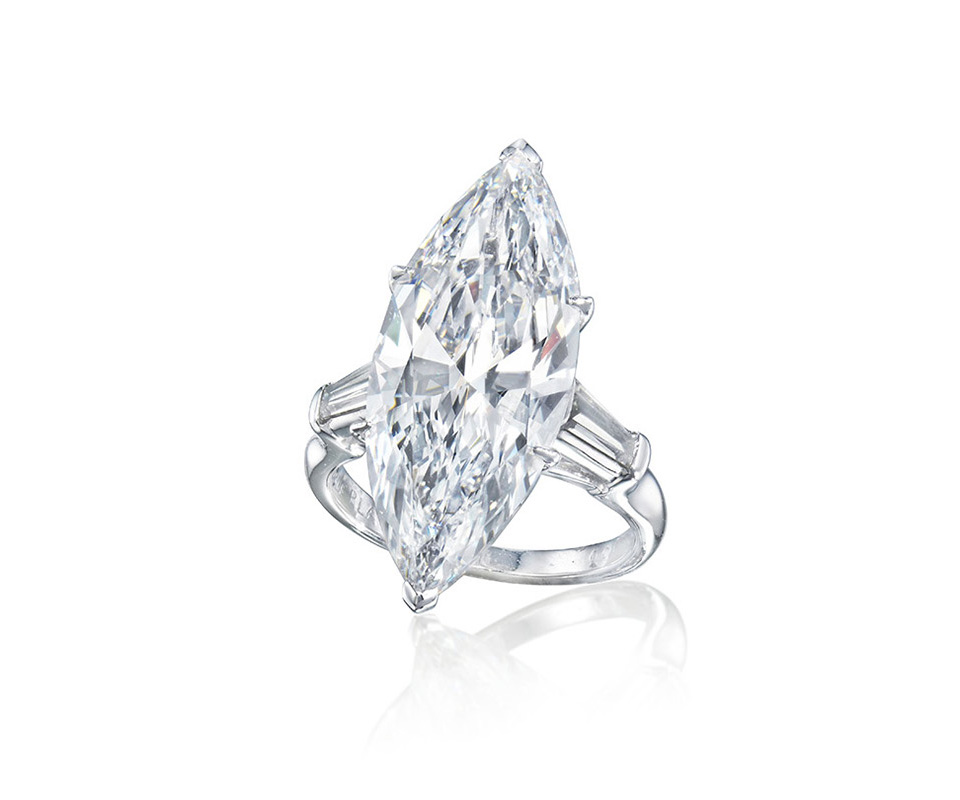
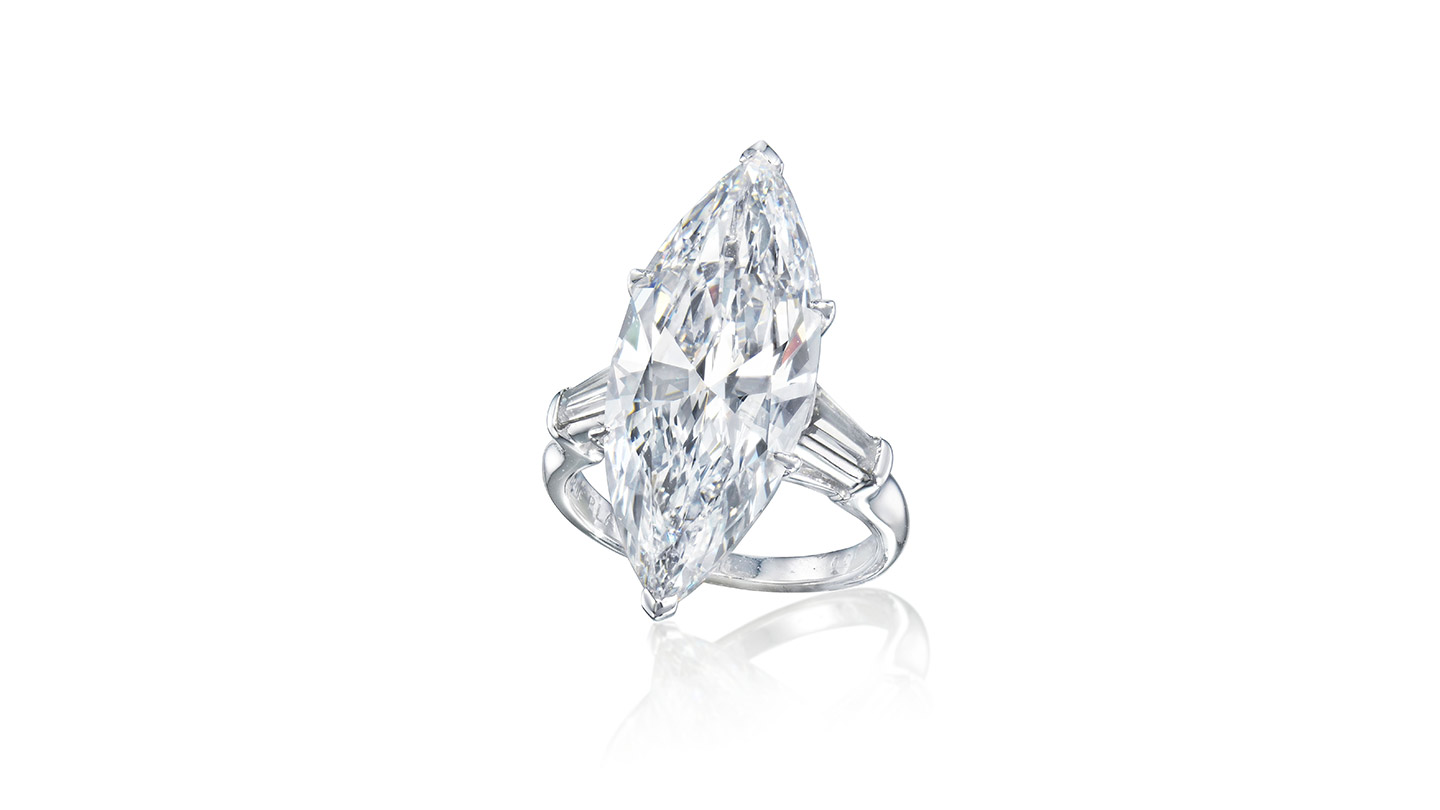
Many settings use V-prongs to protect a marquise diamond’s tips. These prongs form a small V-shape that wraps around each point of the diamond, helping shield it from impact while holding the stone securely in place.
Because they follow the natural shape of the diamond’s points, V-prongs create a sleek, dramatic look while providing essential protection. They are especially useful for larger marquise diamonds, where the pointed tips may be more exposed.
Prong Settings
A six-prong setting provides additional stability by securing the diamond at more points. Typically, two V-prongs protect the tips, while four additional prongs support the sides of the stone.
This design distributes pressure more evenly and helps keep the diamond firmly in place, making it a durable choice for everyday wear. By framing the diamond at multiple points, six-prong settings can also create a balanced and unobtrusive appearance, letting the stone shine.
Partial or Full Bezel Settings
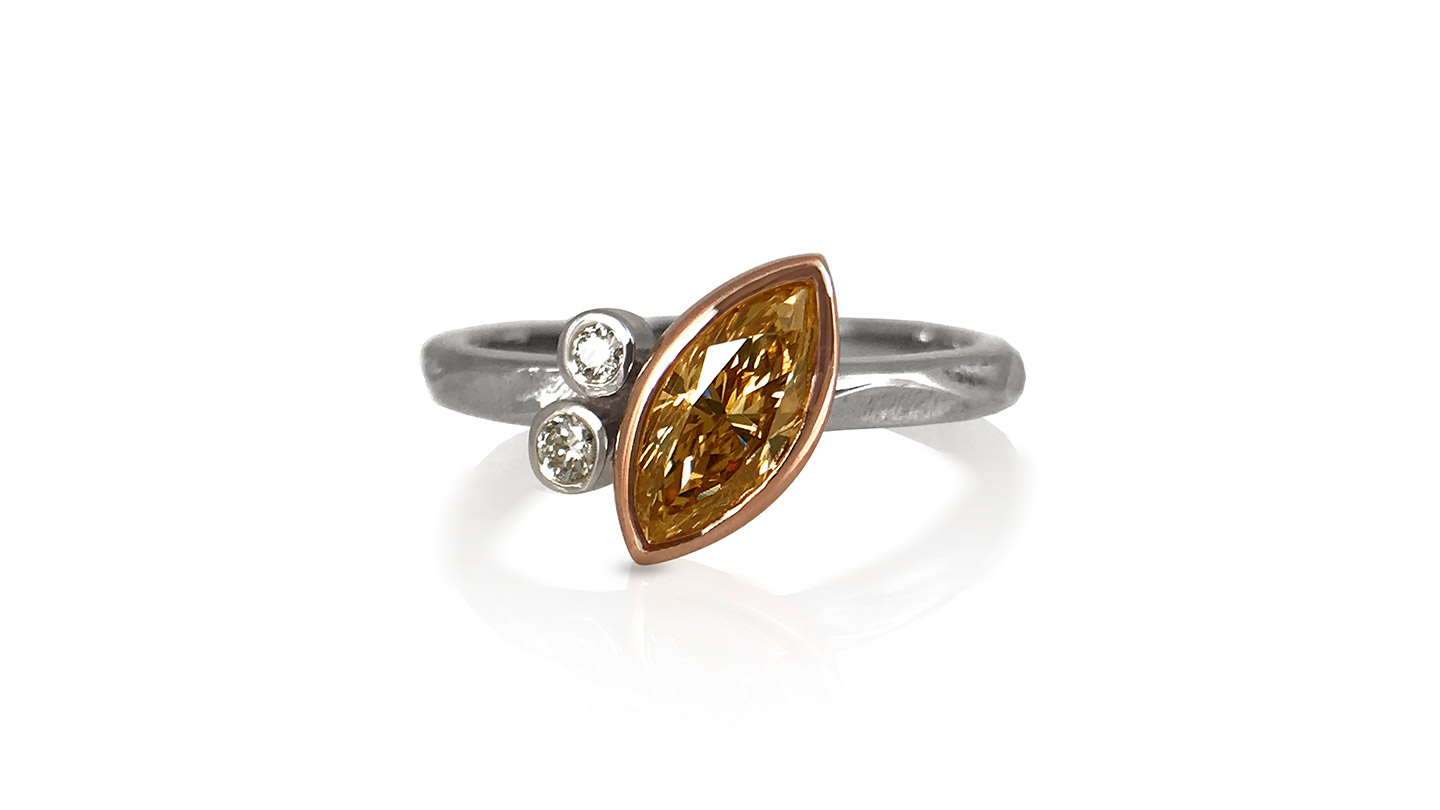
For even greater protection, some marquise diamonds are set in partial or full bezel settings. A bezel uses a thin rim of metal that wraps around part or all of the diamond’s edge. A partial bezel covers only portions of the girdle while leaving more of the stone visible, while a full bezel surrounds the entire perimeter of the diamond. Both styles can help protect vulnerable areas of the stone and offer a sleek, modern look that emphasizes the shape of the stone.
Bezel settings are also great for those who like the dramatic look of the marquise but work with their hands or have an active lifestyle. Bezel settings are much less likely to snag than prong or halo settings.
Halo Settings
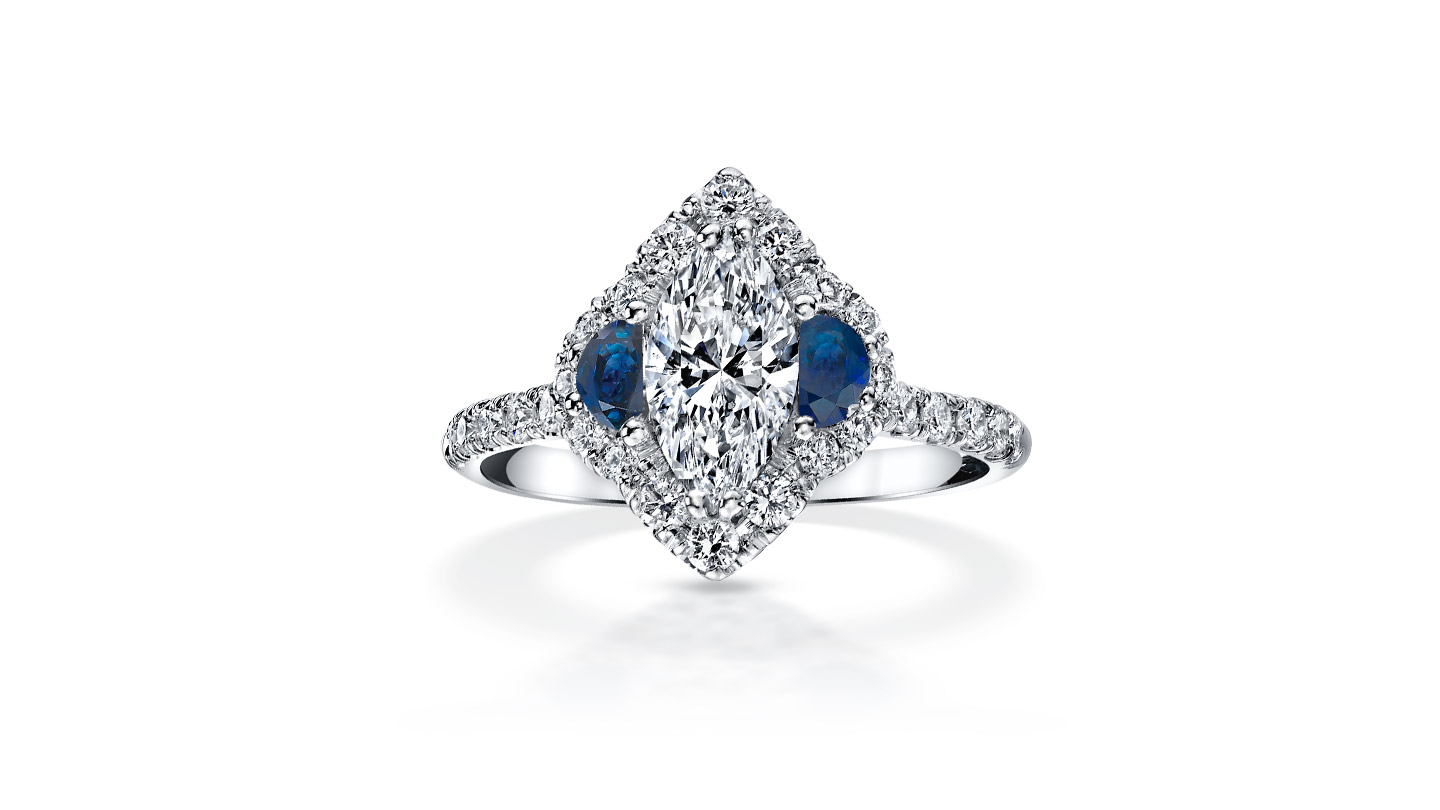
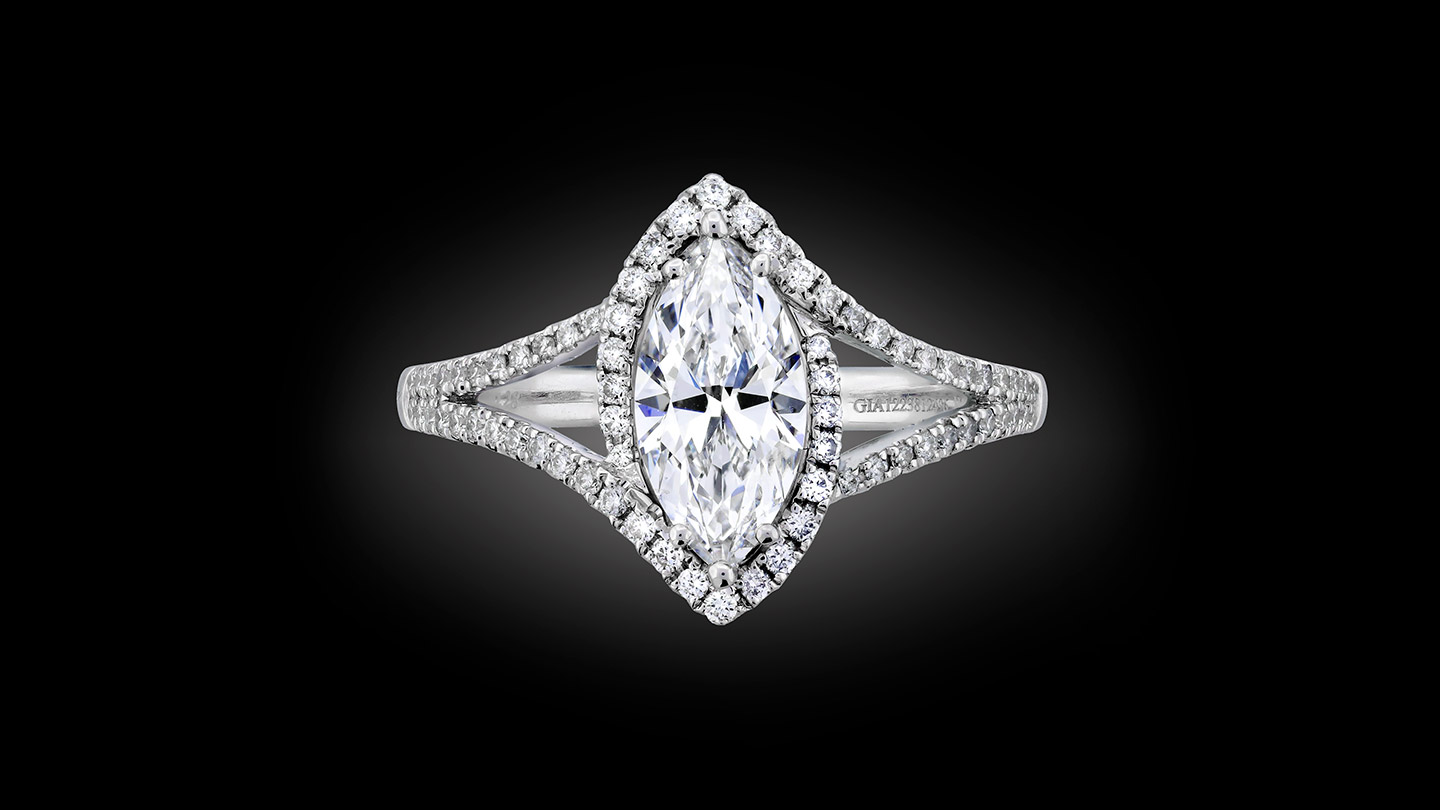
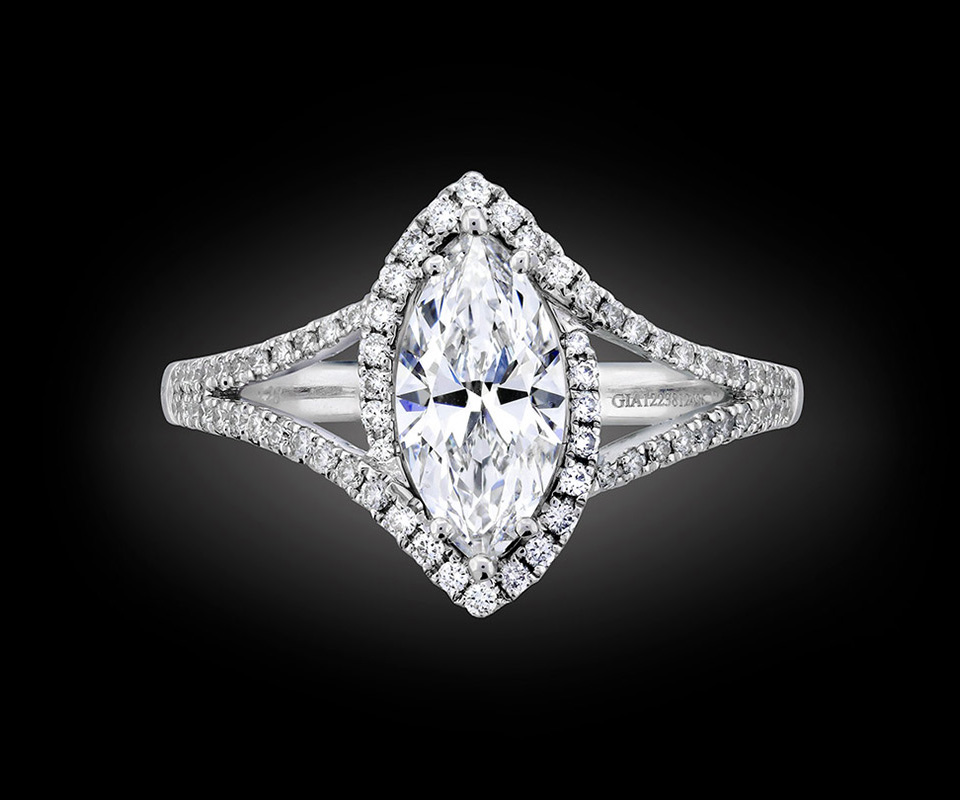
A halo setting surrounds the center marquise diamond with a circle of smaller diamonds. Halos are often chosen for their decorative appeal because they add sparkle and visual presence to the ring, often making the diamond appear larger.
They can also provide some added protection by creating a buffer around the center stone. Because halo designs include many small side stones, they may require more regular care and cleaning to keep the setting looking its best.
Split-Shank Settings
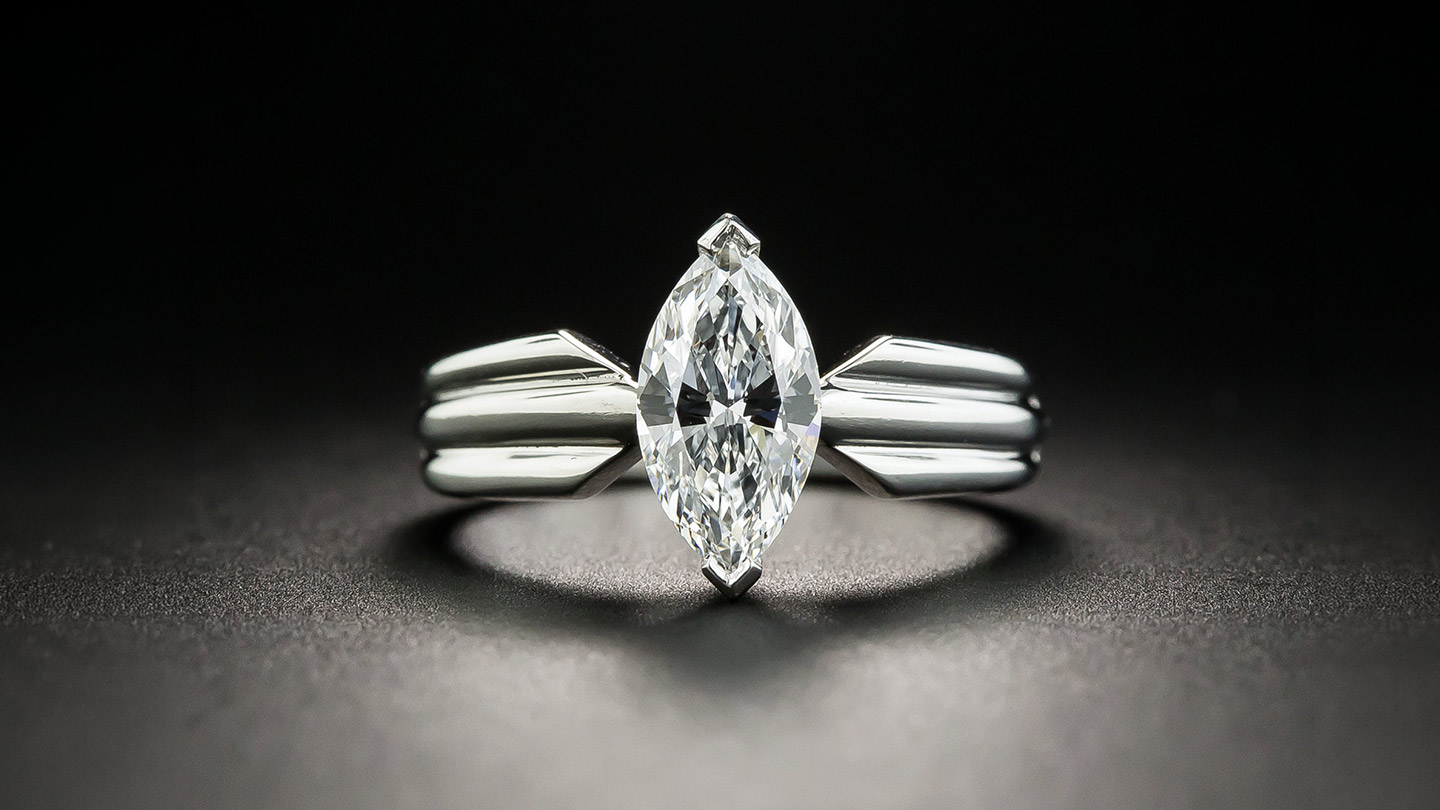
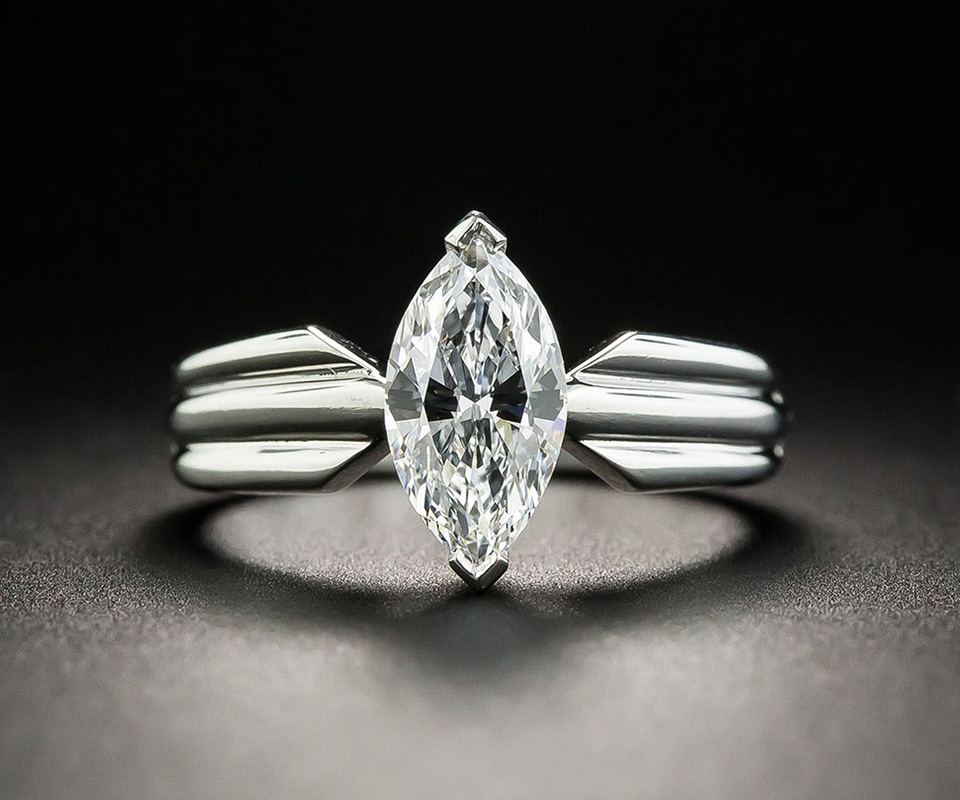
A split-shank setting features a band that divides into two strands as it approaches the center stone, creating an open, airy frame around the diamond. This design draws attention to the vertical length of the marquise while adding visual interest to the ring.
Split shanks can be paired with prong or bezel settings. When combined with prongs, the style highlights the diamond’s elongated shape while keeping the stone prominently visible. When paired with a bezel, the split band adds structure while the surrounding metal offers additional protection for the marquise’s delicate tips.
Because the band widens as it approaches the stone, sometimes ending at the diamond’s tips, split-shank settings can also help balance and support larger marquise diamonds, making the ring feel both secure and visually striking.
History of the Marquise Diamond
The marquise diamond shape is believed to have originated in France in the 18th century. According to legend, King Louis XV commissioned the cut in the 1740s and named it for his mistress, the Marquise de Pompadour, because its elongated outline was said to resemble the shape of her lips.
The marquise diamond is also known as a navette, an Old French word meaning “little ship.” Its pointed ends and curved sides resemble the hull of a small boat. The shape enjoyed popularity during the Edwardian era in the early 20th century, when elegant, elongated diamond cuts were favored in jewelry design. Sailing was also a popular pastime among Britain’s King Edward VII and his wealthy contemporaries, further reinforcing the appeal of ship-like forms in decorative arts and jewelry.
The marquise shaped diamond experienced renewed popularity in the 1970s and remained a favored choice in engagement rings through the 1980s and 1990s, prized for its elongated silhouette and large face-up appearance. By the late 20th century and early 2000s, however, square and rectangular shapes—particularly the princess-cut—grew increasingly popular among engagement ring buyers.
Today, marquise diamond rings are once again attracting attention among buyers seeking distinctive shapes with vintage character and dramatic presence.
Famous Marquise Diamonds
Marquise diamonds have appeared in some of the most famous engagement rings in history. When Jacqueline Kennedy Onassis married Aristotle Onassis in 1968, he proposed with a 40-carat marquise diamond known as the Lesotho III, purchased from Harry Winston. The extraordinary stone was one of the diamonds cut from the famous 601-carat Lesotho rough and became one of the most talked-about celebrity engagement rings of its time.
Another well-known example is the ring worn by Catherine Zeta-Jones, given to her by Michael Douglas. The vintage ring features an approximately 10-carat marquise diamond set east west surrounded by a halo of pavé diamonds.
Another notable marquise ring belongs to Portia de Rossi, who received a distinctive engagement ring from Ellen DeGeneres. Designed by Neil Lane, the ring features a marquise diamond set east west surrounded by swirls of pink pavé diamonds.
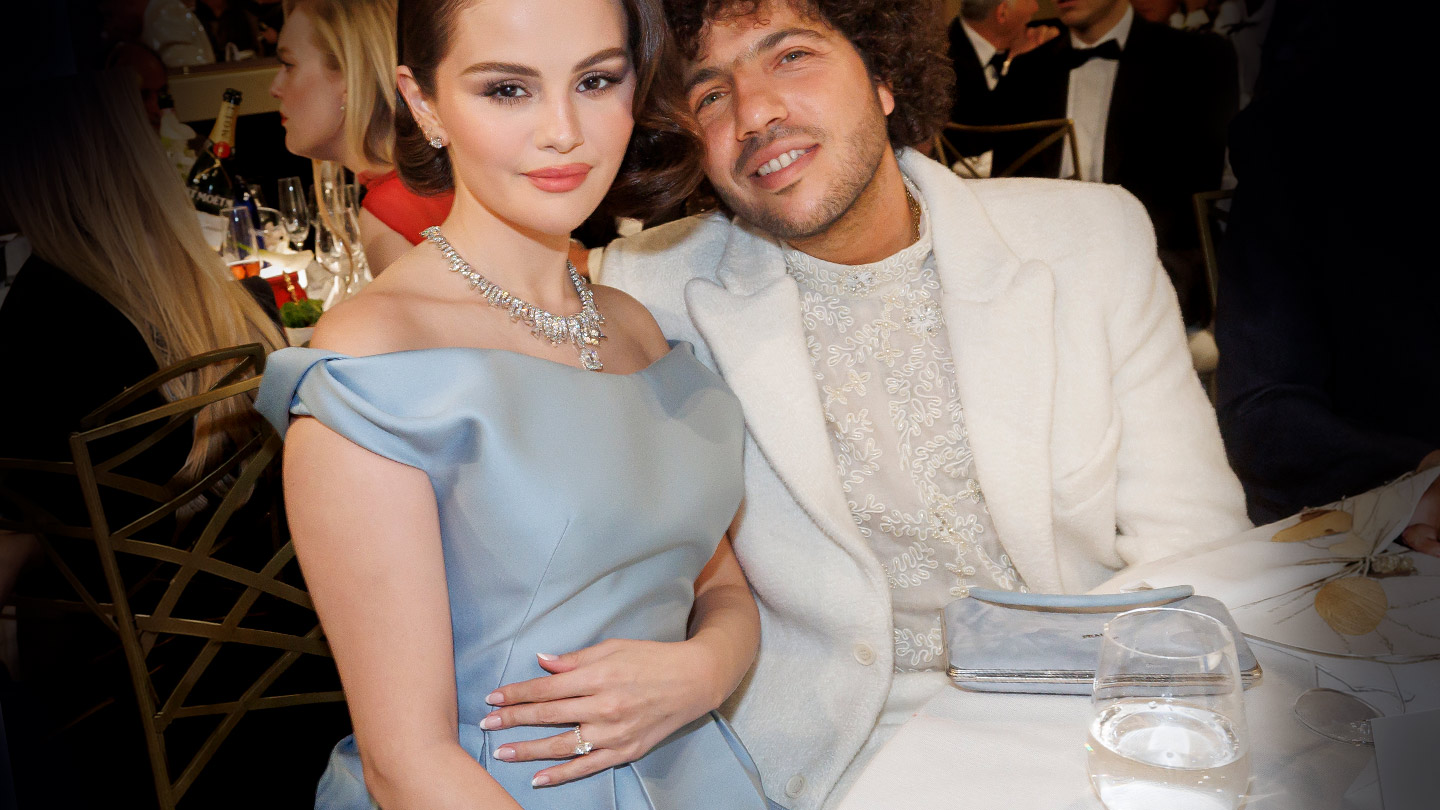
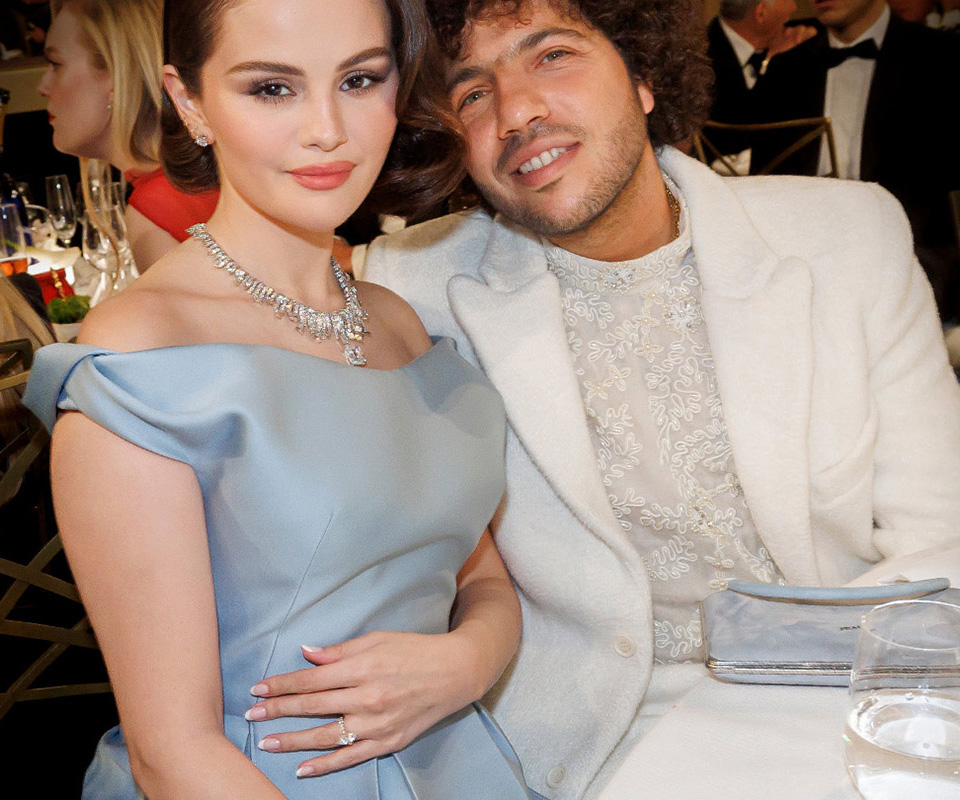
More recently, Selena Gomez has helped renew interest in the shape with her marquise diamond engagement ring. Her ring features a marquise-cut center diamond set vertically on a yellow gold band with pavé-set diamonds, combining the bold silhouette of the marquise with a delicate, modern setting. The slim pavé band enhances sparkle while allowing the elongated center stone to remain the focal point.
Together, these rings illustrate the versatility and popularity of the marquise diamond.
Explore Other Fancy Shapes for your Engagement Rings
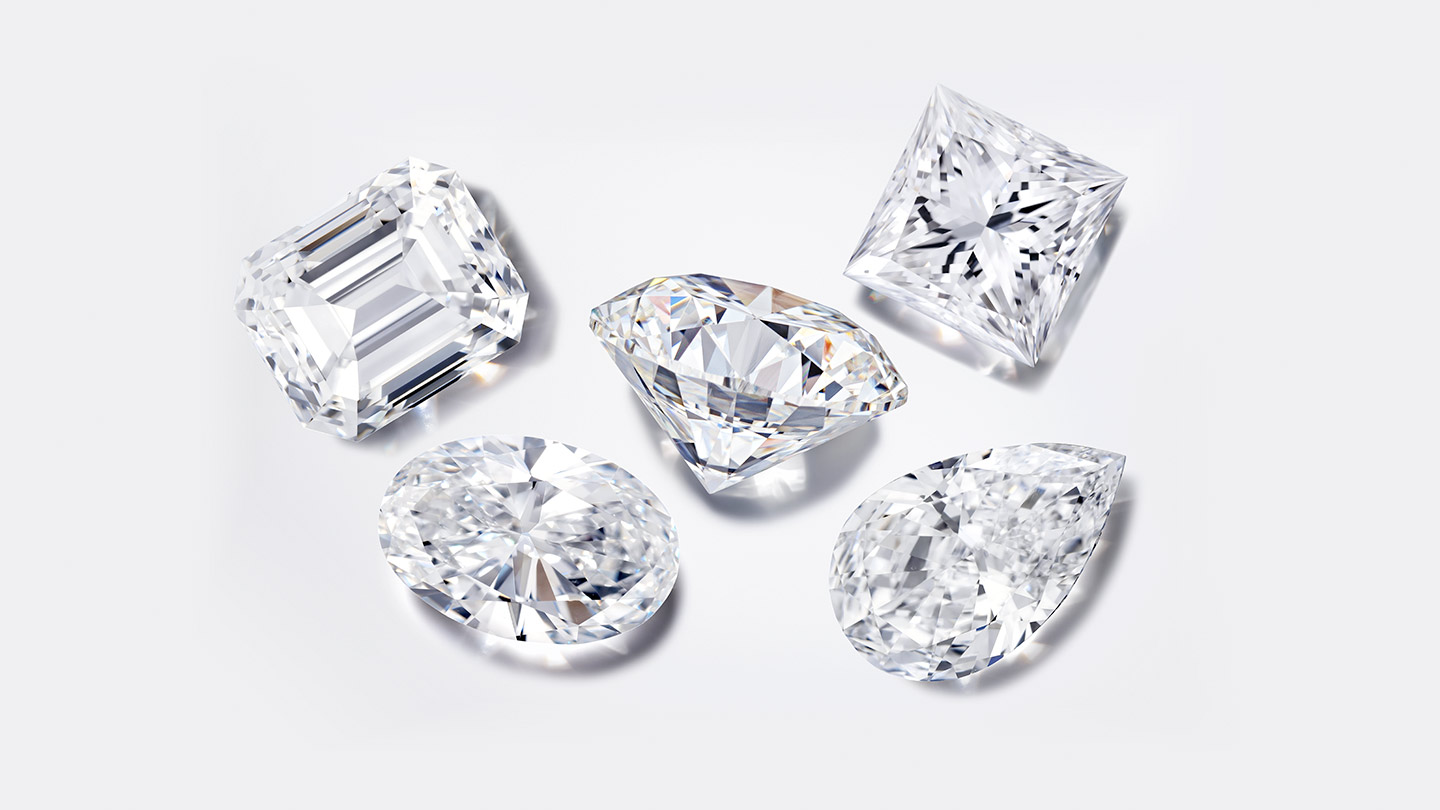
Diamonds come in many shapes, but any shape other than round is considered a fancy shape. Fancy shaped diamonds are popular for engagement rings because they offer distinctive silhouettes, unique faceting patterns and, in some cases, a larger face-up appearance compared with round diamonds of similar carat weight.
From elongated shapes that create a finger-lengthening effect to vintage-inspired cuts with soft corners, fancy diamond shapes give couples more ways to express their personal style.
Below are several popular fancy diamond shapes to consider when choosing an engagement ring. You can also learn more about these and other cuts in our Guide to Diamond Shapes for Engagement Rings.
Oval-Cut Diamonds
Oval-cut diamonds combine the brilliance of a round diamond with an elongated shape. Their brilliant style faceting produces strong sparkle, while their length-to-width ratio can make the diamond appear larger and create a slimming effect on the finger. Some oval diamonds can display a bow-tie effect in the center, similar to a marquise diamond.
Pear-Shaped Diamonds
The pear-shaped diamond—sometimes called a teardrop—combines a rounded end with a pointed tip. This shape appears elegant and dramatic and is often worn with the point facing outward along the finger. Pear shaped diamonds can appear larger than round diamonds of the same carat weight due to their elongated shape. Like a marquise, the pointed tip of a pear-shaped diamond should be protected with a prong or bezel setting.
Emerald-Cut Diamonds
Emerald-cut diamonds are known for their step-cut facets, which create broad flashes of light rather than intense sparkle. Their rectangular outline and open table emphasize clarity and symmetry. Emerald-cut diamonds produce an elegant hall-of-mirrors effect, but their large facets can make inclusions and color more visible compared to other diamond shapes.
Cushion-Cut Diamonds
Cushion-cut diamonds feature softly rounded corners in a square or rectangular outline. This shape has been popular for centuries and is often associated with antique and vintage-inspired jewelry. Cushion cuts produce beautiful fire and brilliance in a romantic, classic shape, but may appear slightly smaller face-up than other elongated shapes.
Radiant-Cut Diamonds
The radiant cut combines the rectangular outline of an emerald cut with brilliant-style faceting similar to a round diamond. This design produces strong sparkle while maintaining a clean geometric shape. The unique faceting pattern of the radiant cut helps disguise inclusions and creates a “crushed ice” appearance as opposed to the broad flashes of light seen in step-cut diamonds, like emerald cuts. Radiant cuts are available in both square and rectangular shapes.
Princess-Cut Diamonds
The princess cut is one of the most popular fancy shapes used in engagement rings, and is among one of the newest diamond shapes, first developed in 1979. Its square shape and brilliant faceting create strong sparkle with a modern geometric look. Its sharp corners should be set in protective prongs.
Heart-Shaped Diamonds
The heart-shaped diamond is one of the most romantic fancy cuts. With its distinctive outline and symmetrical lobes, this shape symbolizes love and makes a bold statement in engagement rings. Heart-shaped diamonds typically need to be at least 0.50 carats for their shape to be clearly visible.
The Importance of Choosing a Marquise Diamond with a GIA Report
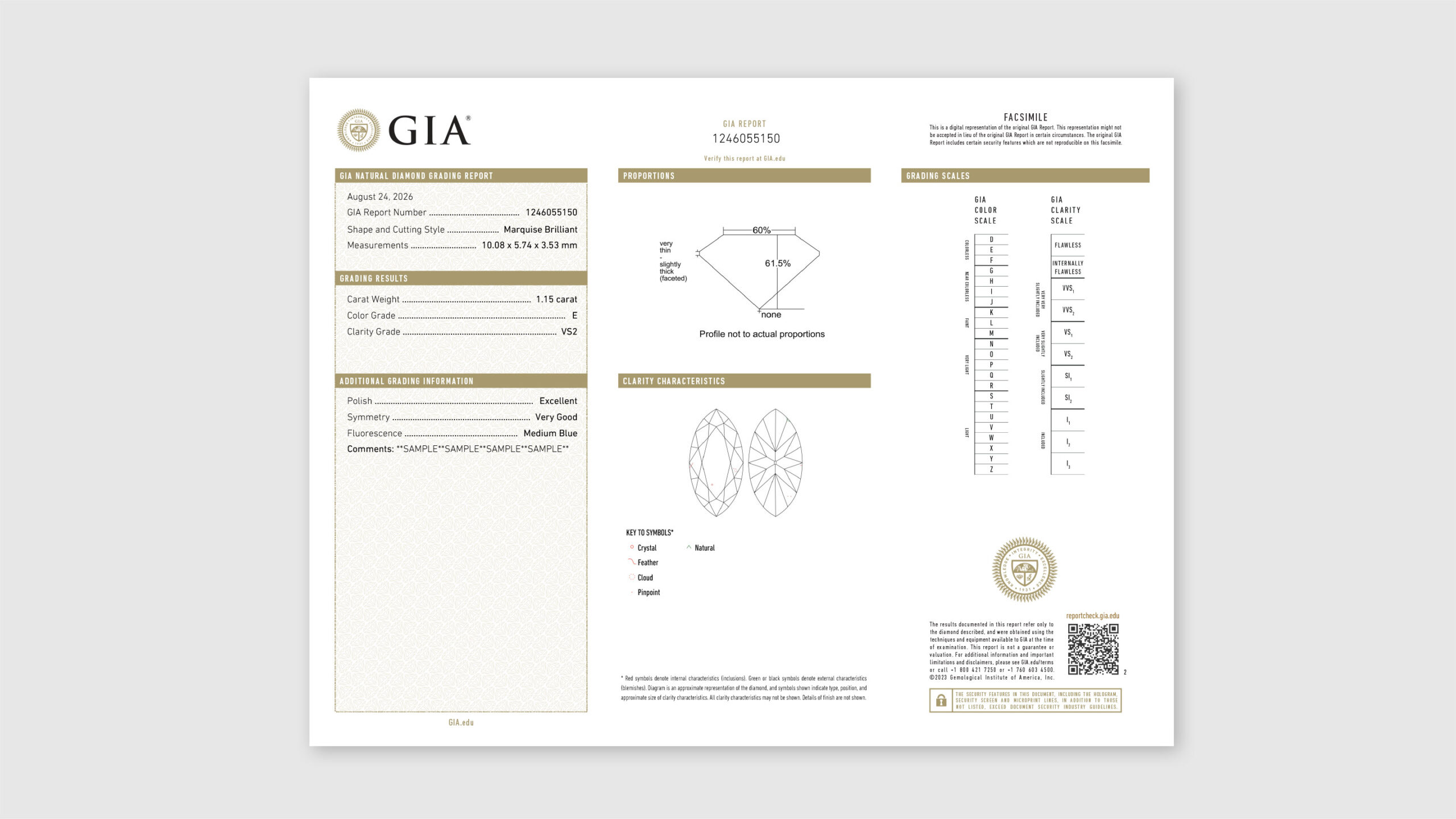
When purchasing a marquise diamond, it’s important to choose one that comes with a GIA report, which provides an independent, unbiased assessment of a diamond’s identity and quality.
A GIA Diamond Grading Report evaluates a diamond using the 4Cs—color, clarity, cut and carat weight—along with other identifying characteristics. The report also includes fluorescence, and a plotted diagram of clarity characteristics. The report may also include a graphic representation of proportions, which can help buyers understand the diamond’s length-to-width ratio and overall shape.
Each report also includes a unique report number that can often be laser inscribed on the diamond’s girdle. This number allows the diamond to be matched to its grading report and verified through GIA’s online Report Check services.
GIA offers several types of diamond reports. The GIA Diamond Grading Report is the most comprehensive. For smaller diamonds, GIA offers the GIA Diamond Dossier, which includes key grading information but typically does not include a plotted clarity diagram.
A GIA report allows you to shop with confidence, so you can find a marquise diamond with the quality, brilliance and character you’ll treasure for years to come.